
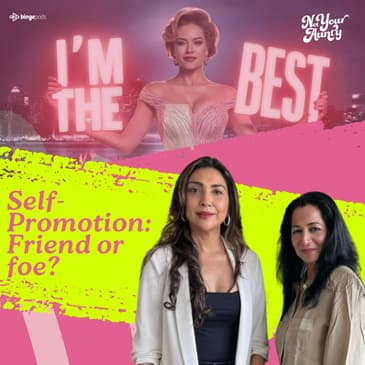

In this episode, Kiran and Shunali discuss the often-blurred line between self-promotion and over-promotion. From personal anecdotes they share the pressures of promoting one's work in a world saturated with social media. The conversation explores the impact of self-promotion on authenticity, gender differences in self-promotion, and the social and psychological aspects tied to this practice. Tune in to hear their thoughts on finding a balance and the importance of genuine engagement versus the pitfalls of relentless self-promotion.
00:00 Introduction and Setting the Stage
00:48 Personal Experiences with Self-Promotion
01:32 The Fine Line of Self-Promotion
03:24 Generational and Gender Perspectives
06:00 The Impact of Over-Promotion
09:49 Networking and Double Standards
14:54 The Corporate World and Self-Promotion
21:08 Gratitude and Acknowledgments
21:29 The Irony of Paid Leadership Offers
21:53 The Coffee Table Book Phenomenon
23:46 The Psychology Behind Self-Promotion
25:18 Social Media and the Need for Validation
28:16 The Exhaustion of Moderating Events
30:42 The Vulgarity of Relentless Self-Promotion
35:38 The Etiquette of Promoting Others
36:27 The Formula for Balanced Self-Promotion
38:40 The Vicious Cycle of Self-Promotion
38:58 Conclusion and Final Thoughts
[00:00:08] Hello everybody. We all have that friend who tooths his own horn a bit much. We all know people who can't stop self-promoting on social media to the point of giving us physical nausea.
[00:00:22] Kiran and I recently got into a conversation about people we know who do this and we got into a sort of a debate between us about how much self-promotion is too much self-promotion and where does one draw the fine line between creating awareness, sharing information and authenticity.
[00:00:46] So Kiran, it's a very fine line as you said and I've been guilty of it, you know that in the past when I started out and I had my first book, first second, third book out.
[00:00:59] I was the one tooting my horn all the time to the point that it embarrassed me because I was told that is what you're supposed to do. You're supposed to talk about your work and if you don't know, one else is going to do it for you.
[00:01:11] And I did not know that line. I did not see that line. I think I was nauseating everyone around me and I had some kind friends like you who told me, Kiran calm down, turn it down a bit.
[00:01:24] There was someone not so kind who told me like what is wrong with you and why are you disgusting everyone. But it's taken me a while and I do realize, Shunali that we all in this world have to toot our horn a certain bit.
[00:01:38] It is necessary well you can't live in a little cave and expect people to know of you and your work. You have to put it out there but that fine line that is the difficult point. I think not many people can straddle that fine line.
[00:01:53] See the, I get your point. I hear you. And a part of me when I talk to youngsters around us today and when I see our contemporaries and our colleagues doing it, don't give that smile.
[00:02:05] Telling knowing smile. See the thing is that it seems that we do live in an era where I know apparently if you don't highlight your accomplishments and admire yourself on Instagram and your work.
[00:02:17] And I'm not talking about admiring your looks, your appearance, physical appearance. I'm talking about your achievements. I got this award. I got nominated for this.
[00:02:26] So and so said this about my film or my book sharing a tweet and praise of your work, sharing reviews which of course is part of the course. Everyone needs to do that. And I'm not just talking about books. I'm talking about anything. Any creative work.
[00:02:42] But the constantly sharing appreciation about your work. If you don't do that, there's an argument to be made. I concede that you will get lost in the clutter of the other people online who have not much to talk about in terms of their achievement and you will get beaten down by people who are
[00:03:01] screaming horse from rooftops with neon signs. Absolutely, you will get beaten down by people who are screaming horse. The other side is what I've realized is yes, you are going to promote yourself and you are going to promote your work but what happens when you do it too much.
[00:03:18] And that is what has served both of us. No, I think that is also there. But the other thing is, I think we come from a generation and an upbringing where you said let your work speak for you.
[00:03:31] And I think modesty and humility was a quality that was the quality, was a trait that we were encouraged to have. You didn't sit around girlfriends and say, oh, I got a 98 or 100 in math, how much did you get?
[00:03:45] I mean, I never got to say that because I never got those marks. But I'm just saying that, you know. It was just unseemly to talk about your achievements but I think, Shunali, this is a very gendered thing.
[00:03:55] I mean, you see men from our generation who have absolutely no qualms about tooting their own horns and tooting it over and over again and very loudly.
[00:04:03] And these are men, I'm sorry to say some are lovely people but with not half the achievements that some of the women have, the women will not be talking about their achievements while the men will be going on and on ad nauseam and about it.
[00:04:18] Remember we've discussed it before that when we sit with our male writer friends, then most of the conversations revolve around their work and their book. Absolutely. Absolutely.
[00:04:27] And in Litfest also when you go unless you've written something really extraordinarily path breaking, you know, something which is sort of going to change the course of the cultural conversations around you, which is not us at least.
[00:04:41] So I'm just saying that it is true that humility is something that women have been encouraged to, or trade that they've been encouraged to imbibe and have.
[00:04:50] I'm glad you mentioned this that when we have conversations with male writers, it's them who's talking unless you've written something path breaking.
[00:04:57] I was at a Litfest last year when there was a woman writer who had won a very major prize. I'm not going to name her. She's a lovely person. And she was sitting in the authors lounge and chatting and there was a male writer there talking to her.
[00:05:10] And the male writer was only talking about his work. This woman has won an international award. Really? And please listen to her, give her the space. She is not speaking about her work. I mean at that point she was like my work has spoken for herself.
[00:05:27] I don't need to speak about it. But maybe he was trying to get her acquainted with his work. I don't know what the thing was, but I was listening in and thinking you cannot brag about your work to her. Please stop.
[00:05:40] No, but there's also one is in consideration lack of interest in somebody else's work. And the other is a sort of dismissiveness that if she got recognition, it might have been a pure chance. If you meet a booker shortlist male versus female, you will see the difference immediately.
[00:05:58] Absolutely. Having said that, there's so much self-promotion going on and I think we as a people who are consuming the self-promotion are really falling for it to a point.
[00:06:11] Unless somebody talks about their work or stands on the rooftop and screams and says that listen this is what I'm doing. We don't think people are worthy of our attention. That's not true. I don't think so. I can speak for myself. I get put off by people.
[00:06:25] Skir and Seed, you do something. You have a book out. You're a designer. You have come out with a collection. Naturally you will say this went into creating it. We'll share snippets when we are doing book promotion tours, when there are interviews that we've given to other publications.
[00:06:42] Of course we'll share that. That is sharing information and to that end it is justified. You're sharing information about your product with the market out there.
[00:06:51] But what I'm saying is that if you only constantly talk about met Mr. So-and-so or some celebrity and even he said, oh my God, such a fan, this kind of stuff is what I'm talking about.
[00:07:02] The extreme stuff. Okay. The extreme nonstop. Maybe there's some formula to it that we need to ace. Maybe that's your gut instinct. When you feel, am I not doing enough? Maybe I need to really go into turbo mode and over promote myself.
[00:07:17] Pull back because your gut is telling you, no, do it at your own pace, share that information but stop somewhere. The gut tells you all the time. But what happens is a pressure to promote is too much because you see everyone else doing it.
[00:07:31] And I speak from a person who's published, from the point of view of someone who's published books. If you don't talk about your book and you don't promote it, there are 300, 400 titles coming out every month. Where does your book land?
[00:07:46] And its discoverability at the end of the day is not just about one reader telling another. It's also about promoting it and getting the word of mouth out. Initially. Initially. But not constantly. I agree with you on that point.
[00:07:58] The first two, three months when your book is out, of course you do that. We all do that. You have to do that. But if you're doing it one and two years later, okay?
[00:08:05] Then there's a bit too much. And this is what I'm saying that when I see anybody over promote their product, I begin to doubt the authenticity of the product and the quality of the product.
[00:08:17] Because I begin to think that clearly if you have so much to say about what you have done, nobody else is speaking enough about it. I'm really being 100% authentic with you here and I'm telling you this. And it doesn't have to be only about.
[00:08:30] And the other is of course a lot of people who self promote, look hustling, meeting juries, having lunches and dinners with them, social climbing to make the right contacts,
[00:08:45] whether they are glamorous actors or smart politicians wanting to selfie with them and to post it on your social media, making them hold your book and do it. It's also a part of nauseating self promotion. After you've pointed becomes a blind spot to the viewers.
[00:09:06] Not blind spot. Nauseating spot. That's what I'm saying. Blind spot. You don't notice it. You don't realize because it's just another promotional thing like you just pass over their feed, like your eyes glaze over.
[00:09:15] At least that happens for me. I finished being nauseated by it. I realized that you need to do it. But after point of time, I'm not even looking or registering at what they're posting.
[00:09:25] It doesn't matter to me and I think that's where the danger happens when you post it. You do your promotions. It's very essential. You have to do it. If you don't do it, your book will, why am I sticking to books?
[00:09:35] Your work will get lost. But if you're constantly shoving it down somebody's throat, they're not going to register after the point. And that's wasted effort. That's all that effort.
[00:09:48] There's great joy in watching people network at literature festivals and book launches with celebrities around because you'll always have that writer friend of acquaintance rather who is going to thread their way through the crowd
[00:10:04] and sit up to somebody important and say, oh my God, such a fan. Can we have a picture please? Yes, my book. And within seconds. That will go up. That is online because now the hustle is also to get more followers which is in every profession.
[00:10:17] You know the strangest thing that happened to me at the Bangalore Litfest? There was this young writer. I was not familiar with her work. She was wandering around with her book in her hand going up to everybody.
[00:10:32] Me included from Shashi Tharoot to Little Old Me saying, oh please such a fan and this is my book.
[00:10:39] Can I have a picture? She makes a pose, clicks a picture and takes the book back for the next person, for everybody, for the next person to click a picture with. Yeah well this is what I'm talking about.
[00:10:54] So we were, I won't mention which literature festival but there was one very new young writer also or maybe two books old and she was basically talking about people being star stuck by Dr. Shashi Tharoot. Okay.
[00:11:12] And she said, I just don't get it. I mean people never leave him alone. Everybody wants to selfie with him. What's with that?
[00:11:18] At the end of the day he's only just a politician quote unquote and then we were at this dinner venue and she's asking somebody can you please introduce me to him which is fine. And next thing you know she is taking a selfie with him. Lovely.
[00:11:34] And I was like you know I think that something needs to be said for having double standards. Right. But and it's not just in literary circles. I know somebody all she ever did from the beginning of when so she went Twitter and Instagram.
[00:11:53] We all joined it around the time that she would go from party to party taking pictures with celebrities and posting those pictures. And I'm sure she had a million followers today. Wonderful. Because unfortunately we live in a culture which prefers spectacle over substance.
[00:12:12] Which is what I was saying when you post and you post in your hype there is a section of people. It may not be you and I should only but there is a section of people which will look up at these people and say okay they are important.
[00:12:22] Yeah. There has to be. She's saying she's important. She must be. She must be important. If she's posing with these people she must be. So many people are saying all good things about his work he must be good. Yeah.
[00:12:32] They will not use their own discretion and that's I think the audience that this spanders to. Yeah but so if you take it beyond even creative work. I know we've already spoken about Ori but since we spoke about him he's become even bigger.
[00:12:45] And there is no escaping social media without reading about him or looking at his photos. But he is a true representation of the culture we live in. Absolutely. Celebrity and spectacle over substance that's exactly what it is. And the question still is what does Ori do?
[00:13:02] So this morning somebody I know had posted several pictures with him and she was gushing at him in the pictures that oh my god he's like a ray of sunlight. He is the smartest cookie in the jar. He is a smart cookie I'll give him that.
[00:13:17] Yeah I agree. And it seems he just had some party where he had some 20 duplicates body doubles and then now he wears some jacket with his own face on it. And I mean he's the not good looking Kardashian in that sense right to put it bluntly.
[00:13:34] So I said to her I don't get it babe because she hasn't taken so many selfies with him and her so as a husband I guess they were invited to the party. So I said I don't get it. Why are you all promoting this gentleman?
[00:13:51] She said because he's so smart. That's the point. No that's not reason enough. He's on Einstein. I'm just saying that I'll walk up to Einstein and take a selfie but I'm saying Ori is actually smart because he has seen through this generation.
[00:14:04] He's seen through the weakness and he's capitalizing on it. So I generally I have I grant him give him more credit today than I did a few months ago for sure. He's smart.
[00:14:14] Because he is the one having the last laugh and these fools who are taking photographs with them he's probably laughing at them also. But he's got them where he wants them right? He's got all of us where he wants us. No not us. Don't count us in.
[00:14:26] We can't not talk about him because on our podcast we discuss popular culture. Okay so we can't this is not a podcast about Razaz and Suzaz work.
[00:14:34] Okay so we have to we can't escape from speaking about him because he is a sign of the times we live in.
[00:14:40] And it's a very depressing sign of the times we live in because if somebody who has absolutely nothing to show in terms of creating something adding value to the world, leaving something behind for posterity gets this amount of fame and notoriety.
[00:14:53] We are bang on in the Kardashian culture of course but in the corporate world you know, I've been realizing I have a lot of quite a few friends who are in the corporate space and very senior positions.
[00:15:04] They grapple with this a lot because it is a double edged sword such promotion. How much do you promote yourself if you promote yourself too much you risk angering your superiors. Of course.
[00:15:16] If you don't promote yourself enough people do not know what you're capable of and you get passed over for promotions, raises perks. So that very delicate line of that they have to balance in American corporate culture self promotion is the only way to get ahead it seems.
[00:15:32] But it's very different in the eastern countries in Japan because in our country the game humility is still a virtue. And countries like Japan and Korea the whole is more important than the individual. Of course.
[00:15:44] So you know if you're promoting yourself over the team you're bound to become the black sheep. It is true. And very often they do find yes there is research to state that men even if they don't have the abilities
[00:16:00] to promote themselves much more than women who have all the requirements for the job or the who are doing well at their work because we are meant to make ourselves invisible. We're meant to make ourselves smaller. Yeah. To accommodate their size.
[00:16:12] I mean not literally maybe literally as well. Man spreading is everywhere. Exactly. There's a meme about a man explaining man spreading to a woman. And I would like to see one about a man explaining man explaining to a woman. There is a meme for that.
[00:16:29] There's a meme left for anything. Yeah I love the meme culture. I'm such a fan. But coming back to you know speaking of creative people who write us today. I find it really challenging because all creative jobs are inward looking jobs right.
[00:16:48] And which is why introverts thrive in these jobs. But talking literature festivals marketing yourself across Twitter Instagram and LinkedIn and finding things to say about yourself in different ways across platforms is not something that an introvert or an ambi word is very equipped to do.
[00:17:11] It's not a skill set that creative people possess. And yet if they don't sharpen these skills or develop these skills they may not be able to sell their work.
[00:17:24] So sometimes you know I used to not have a LinkedIn profile and as I've just mentioned before over the last four or five years I've completely stopped tweeting. I was doing happy pictures on Instagram because I like looking pictures and you know sharing them.
[00:17:41] And then it was pointed out to me by my sister who works at Mastercard and she looks at innovation and marketing for a certain region based out of Singapore and she said that you know you don't even have a LinkedIn profile and nobody will take you seriously professionally if you don't have that.
[00:18:01] And so now that I have a LinkedIn profile someone pointed out to me that you know you had such a good Twitter following and presence and now you don't tweet.
[00:18:07] So my question then is that if all I'm doing is skipping from Instagram to Twitter to LinkedIn when am I doing any real work. Absolutely and those who are doing this really well when are they doing any real work.
[00:18:17] So are they doing any real work is the question or is it all performative. That's exactly the whole point of it. So most of it is performative.
[00:18:26] If you see my first thought I'm sorry I mean I've been on that side where I used to tweet the whole day and I was posting stuff quite regularly. I'm not on Twitter often anymore in Insta I'm there maybe I put up a post or two and some.
[00:18:41] Oh and this Facebook and all this I forgot about the old people's medium. Facebook have completely left out but I'm saying that people do it across the four platforms. But they're very focused on building their presence their online personality or whatever.
[00:18:56] This is what I'm saying when are you doing creative work. And this is how you set aside in the day just to do this like you do for gym and meditation and yoga.
[00:19:04] Bloody hell but when I see somebody tweeting the whole day or putting up Insta posts back to back or stories continuously. I'm guilty of it when I'm on holiday not otherwise. I start to doubt the person's ability to work. That's really because all your energy is going there.
[00:19:24] As you said when are they doing work and what work are they doing. What is the quality of the work that is coming out that you need to keep shouting about it so often. Yeah.
[00:19:33] So I was you know there's a list of writers who are all very accomplished by the way and who are really not very easily accessible through social media or otherwise. So Haruki Murakami tops the list then there is Corbac Makati.
[00:19:52] And of course Ellen Aferrante people don't even know who she really is. They don't know what she looks like. Now this is what I'm saying so if someone argues with me and says no no no in today's day and age you have to market and promote yourself.
[00:20:04] There's no other way to survive. Then I would say that real genius will still survive. Real genius will survive definitely on the flip we also have before he had the attacks Salman Rushdie was quite active on Twitter. We have Neil Gaiman who's very active.
[00:20:22] We had JK Rowling who unfortunately got herself into all kinds of controversies. But hold on a second but they already proved themselves. That's what I'm saying. I'm saying their greatest work has already been created and they have a body of work.
[00:20:34] Now they are sitting and engaging with the world around them which they must and they are nobody is nobody can get away with saying that politics is not my cup of tea because actually if as thinkers you are going to be a leader.
[00:20:48] If you are going to stay clear of making any political comment then you have forfeited your right to influence and improve the world. So that's what these people have been doing and point to be noted for all. They haven't been saying I got shortlisted for this award.
[00:21:02] Thank you jury at Penn for acknowledging my contribution to literature. I got this award. Thank you so much women's organization. I am because you are you are the wind beneath my wings and I can go on and on.
[00:21:15] Thank you so much some random college in Timbuktu for calling me and you know asking me to address your next batch of graduates. It has been such an honor. My God and you and I both know.
[00:21:29] I mean I'm sorry this is such a rant but we have these messages in our inbox offering us to be leaders of whatever leaders of whatever thought leaders giving us awards for X amount plus taxes plus GST.
[00:21:43] And then you see the same thing being tutored on people's social media. How can you put that up at the straight face? We all know this is what my God. Yes. And there was a very big major media group that was doing this.
[00:21:57] We're coming out with a coffee table book and then I personally know people who went in post it and posted and why are you doing this? Honored to be on the cover of this magazine at XYZ.
[00:22:09] The only magazine I've ever graced the cover of was mother and baby. When my kids were small and somebody walked up to us and said we'd love to feature you. So I said okay why not it'll be a nice keepsake.
[00:22:20] And the other magazine that's chasing me for a cover is some dog and paws magazine for free. These are the only covers I've been offered for free. I have been on stories then. I have been on Femina but only my name because they're not my mugshot. Mugshot. No.
[00:22:38] But both were not paid for. That's what I'm saying. I don't even have the money to pay for it. Dogs and paws wants me on the cover. Dogs are all over. But both are for free. Okay. Thanks to my dogs that too. Like no merit.
[00:22:50] One is children no merit to me and no credit to me and dogs. But I'm saying everybody else is doing coffee table books and we're doing a list of 40 under 40 50 over 40 or whatever the hell they're doing.
[00:23:00] When these are out there everyone is getting these emails and we're talking about these emails publicly and these DMs. You still go pay for that award. Fine.
[00:23:09] One day does that only an idiot thing that they have been shortlisted with you know by the company to reach out to them. I don't think you don't really introspect and think am I really worthy of this award.
[00:23:20] Why would somebody give me an award out of the blue. What have I done to the hunger for fame. The hunger for recognition.
[00:23:27] And the deep rooted insecurity which seeks validation from the world even at the expense of paying for it is what makes people go so far with self promotion paid or otherwise. That's what it is that is what is at the core of this.
[00:23:45] Anybody who self promotes and I actually dug up some comments by psychologists because I thought I'm sure that psychologists have something to say about this. And I'm going to quote them. Okay.
[00:23:58] Here goes so psychologists say that there is a very strong relationship between excessive self promotion and narcissism. Okay. There's also a strong relationship between people who have fragile self esteem. No self worth about their achievements and excessive self promotion.
[00:24:20] So we are going now beyond the need to let your product be known. I'm not saying that nobody should you know talk about what they have done. I'm saying people who do it to the point of lunacy.
[00:24:31] So Dr. Susan David who is a Harvard psychologist and author of a book called Emotional Agility says relentless self promotion is a way to feed your ego and constantly seek admiration of others.
[00:24:45] I mean it's no news breaking news and Dr. Keith Campbell says that he's written a book called the narcissism epidemic which I think we must read.
[00:24:54] Excessive self promotion can be a sign of underlying inferiority complex when people feel an inherent lacking of self worth or abilities they may over compensate by constantly drawing attention to their accomplishments.
[00:25:12] Is this also a product of the social media age because we are so wired now for these dopamine hits for these likes for these comments that we feel compelled to keep posting about achievements.
[00:25:24] I think that there have been times when one has wondered that am I not talking enough about what I do because when you see everybody else is doing that then it normalizes that and then there is it's a natural human insecurity will I get that.
[00:25:42] Overload. Okay. But I really understood I think that is the benefit of growing older that whenever I've gone against what my gut is telling me you know what I'm uncomfortable with and your body speaks to you whether you are making a gossip you know making a mincemeat over somebody over lunch by gossiping about them behind their back.
[00:26:03] You know you start to feel a knot in your stomach tightness in your chest and uneasy feeling that's your body telling you don't do this and similarly whenever I've not listened to my inherent like my inner feelings about not really overdoing it.
[00:26:17] I have regretted it later and so I'm just more attuned to that now and that's I'm like let others do what they have to do.
[00:26:26] I think it's a big part as you mentioned of getting old if I just had a book out last month. Yeah, I've done nothing for it. Yeah.
[00:26:34] In others post about it I will retweet. Yeah, I will share but I mean it will be foolish not to do that. I mean because I mean they've taken time out to read it and say something about it it would be very ungracious of me not to acknowledge it at least.
[00:26:47] Also you have to sell your product so this is what I'm saying now you can't go to the other extreme.
[00:26:52] I was also the person, Sonali who would keep posting three or four times a day about my book. So I've been on that side and all against my instinct my natural instinct is very to be behind the scenes and not you know talk about myself but I kept doing it because I thought it was necessary
[00:27:10] but now I've come to the realization it isn't. Yeah but that's called growing older. That's called growing older and it's also called laziness.
[00:27:19] You're satisfied with your achievements you don't need validation so one is that and also Kiran you know when your new book is out you're looking for engagement speaking engagements to promote your book at your festivals and things like that.
[00:27:34] But the other thing these days is people are desperate for a platform to speak from because then they can talk about it on social media and I can't even tell you how much this business has proliferated.
[00:27:49] There are people representing talent you've never heard of as speakers really yeah and they'll always find some college or the other and these people are willing to pay for their f either willing to do everything because
[00:28:01] they just need a little stage to be propped up from. So that is again this whole universe of self promotion has so many verticals in it.
[00:28:12] So this I want a platform to speak from or nowadays I've started saying no to moderating a lot of things and I've been approached by people to say you know one well known actor will you do you know moderate a conversation with him
[00:28:28] very very highly well regarded actor who's won many awards and I said no and the person who approached me I really respect her a lot.
[00:28:40] I like her so I said you know for see it takes too much out of me to do my research and prepare to you know I'd rather be doing something else with my time and I'm done there was a time I used to willingly go to moderate conversations with real
[00:28:56] real achievers because there was this joy in interviewing them interacting with them and there was also the thrill that look I'm doing it right.
[00:29:04] And then the other day this very big women's organization approached me very very large and they wanted me to interview one of India's top host most bestselling authors.
[00:29:17] I don't read that genre of books his genre of books but he is hugely successful and she thought I'm so surprised that you're turning this down because you're so good at moderating.
[00:29:28] And I said the same thing I said look I don't have it in me I don't want to be in front of a camera or large audience any longer. It takes too much out of me to do it.
[00:29:39] I said the only time I agree to moderating something is if I'm already going to a literature festival to talk about my work then additionally I will do it or I will do it.
[00:29:49] If I stand to gain something intellectually or about the craft from a writer so naturally if I had to interview J.K. Rowling I will bend over backwards to do it but I'm not going to leap at an opportunity and interview everybody because I just want a few minutes of fame to rub off on me reflected
[00:30:06] in my glory. So I'm just saying that this has also come with time. Yes I think I've turned on a lot of moderations myself and the only people I can't say no to is when a friend asks me.
[00:30:19] No that is the only time when I can't I don't say no now I have said no left right and center to everyone because as you said I'm done with it. It's too tiring.
[00:30:31] It takes out too much preparation and all that but coming to think of it I think sometimes I envy people who can relentlessly self promote. Why do you envy them? Because it does take a certain amount of courage to keep putting yourself out there. Courage is vulgarity.
[00:30:47] You know that people are going to mock you make fun of you. They don't know it. You think so.
[00:30:52] I think that desire to get those few minutes of fame and validation far supersedes their knowledge or the awareness of how they're going to be laughed at behind their backs. But some of them are really intelligent people. I'm sure they would understand that if they're doing this.
[00:31:11] Are they we need to talk offline about this? Who are the highly intelligent people? You know who are doing this recklessly. We will share names later. But you wonder you say that you know they're going to be mocked for this.
[00:31:25] You know that at least you would have some inkling that you're irritating people by constantly putting this up about yourself. I'm so great. I'm so wonderful. I'm so lovely. Look at how many people love me. Actors is different. Their visibility is required.
[00:31:39] But I don't know any actors who self promote like this. They just post their pictures and the video shooting and doing stuff. The only time the actors come out of their cave on social media is when they have a movie release. Which is what authors should do.
[00:31:50] Which is what authors should do and very often it's a different ballgame altogether for actors and cricketers in India. They are in a different league and different orbit. Whatever they do will be forgiven. It's not so far the rest of us.
[00:32:05] We will be laughed at and we will be mocked. You need to promote. I keep saying there has to be promotion. You have to be the biggest advocate of your creative work. But there's a fine line. You can't constantly keep coming.
[00:32:19] What about people who are promoting their children's work and glorifying their children and living off their children's success at school? One another trophy, one this one that of course we all like to share.
[00:32:36] The worst happens when the board results out and everybody is posting their percentages for what their children have scored. That is no reflection on you mama. That's exactly what I'm saying. No reflection on you. So proud, so proud, so proud that.
[00:32:53] Listen even that if your child gets into a good university or a good college. So super proud. That's okay. All human beings look even people who this people who share on social media and say if you want to wish your daughter happy birthday.
[00:33:08] Why don't you do it privately? Why are you posting online? But then people even for the dear departed are writing comments online. Miss you dad wish you were here.
[00:33:19] So I think it has just become a way of expressing your innermost emotions about certain things in your life and your certain relationships. And it's all right. I mean there's no judgment there but I'm saying that.
[00:33:32] But I'm going to judge one thing when you talk about dear departed people the moments the celebrity dies. Is it compulsory? Is it the rule that you have to dig out that one picture you have with the celebrity and post it? Oh my God.
[00:33:44] Yes, that is part of self promotion also. It's not about the celebrities. Oh my God. I'm sure people have an album of celebrities who have reached a certain age. That's why they're clicking selfies with the celebrities they're waiting for them to try.
[00:33:56] So they can post the pictures online. I still cherish that encounter five second encounter I had with you. Rocky years ago. Whatever. You did it with remember by name. No way you didn't.
[00:34:09] I mean where I actually basically ambushed you into taking a picture with me and oh my God now Kate Middleton by the way. Poor thing. Kate Middleton has been diagnosed with cancer and I've been noticing people because she had come to India, right? Our posting pictures.
[00:34:28] There was a big party that they attended and people are posting pictures saying dear Kate feel better soon. Like even. Is Kate Middleton reading our messages? Like how deranged are you? You know like if any celebrity dies what am I going to do?
[00:34:44] How am I going to control their death? I don't have any pictures. You need an album you can start working now. After start taking selfies. Yeah. See look again. Sometimes the good thing about social media is your intent becomes very apparent to the reader viewer.
[00:35:04] So supposing some great artist dies and a few weeks later you say remembering so and so because you've had a relationship with that artist. Okay. Or you've had an interaction that has left a lasting impression on you. Either artist can be an actor or an actor. Any performer.
[00:35:23] That's different again right? But the minute somebody dies and you go on searching through albums. Or pictures. Maybe they have a special celebrity album like whoever pops it. Like arranged by road.
[00:35:37] Another thing I find really strange is people who will promote you in the expectation that you would promote them. Well that's okay. That's quick. Quick promo. Once, twice, enough. Yeah. Over and over and over again until you know you forget that heart dode ka emoticon also be like.
[00:35:56] I don't know any such person. There are some people. And sometimes you're happy to give people a shout out because you have that reach on Twitter. Be there so short when my next book comes out. You will be expected to promote it. That is a given with friends.
[00:36:10] That's a given and that will be taken for granted. Only for the first one month. Not after that. Just let people know the book is out and then you are done.
[00:36:17] But you won't expect me for every one day of the week for the next year to keep saying the same thing. There's a wonderful writer please buy a book. And there's another interesting thing I read. That there's a formula to self-promotion. Okay. Let's hear it.
[00:36:34] Five tweets of five three will be knowledge based genuine content creation. Two will be sharing some, you know, talking about somebody else's work, not the good in you saw in somebody else. If you watch something interesting or one will be about yourself. Okay. That's not a bad one.
[00:36:59] That's I think a formula that everybody should think about. For example, now if there is no book, no article to talk about what will be that one tweet about myself that you propose I should write. I'm at a hurry. That doesn't ever happen.
[00:37:13] So what is that one tweet? No, I'm asking I'm genuinely asking you when there's no work to talk about when there's a big lull between one work and your next. What is the one thing you can share a picture of your coffee mug.
[00:37:27] You can share a picture of a podcast. I'm seeing then there's no work. Not just before anybody. What is the one tweet? I mean, I'm not sure I want to know so much about people who are doing nothing with their lives on Twitter.
[00:37:39] Instagram is a different cup of tea. So I don't know. I don't think you can promote it if there's nothing to promote. Don't promote it's not. You don't have to put out something constantly promoting yourself. Just be yourself and just talk about something that affected you.
[00:37:52] Why does it always have to be talking about your work? It doesn't need to. Yeah, I've completely I mean, I feel sad that I have nothing to say on Twitter. Any longer. But nobody's reading anything on Twitter, so you're not missing anything.
[00:38:05] Anyway, there's one quote which I thought was very interesting. It is by Marianne Williamson. And she says, our deepest fear is not that we are inadequate. Our deepest fear is that we are powerful beyond measure. It is our light, not our darkness that frightens us.
[00:38:22] We ask ourselves who am I to be so brilliant, gorgeous, talented and fabulous? Actually, who are you not to be? This is the part of our self promotion. As we let our own light shine, we unconsciously give other people permission to do the same.
[00:38:39] So people who are self promoting are giving other people permission to do the same. And that's leading to a vicious cycle of everybody self promoting. So are you saying that they're shining their light and it's fine? I'm saying that they're shining their light.
[00:38:52] They're shining their light too much. Like we have too many lighthouses out there. Blinding. Correct. So on that great note, let's call it a day because this is a never ending conversation. And looking forward to seeing you guys again next week.