
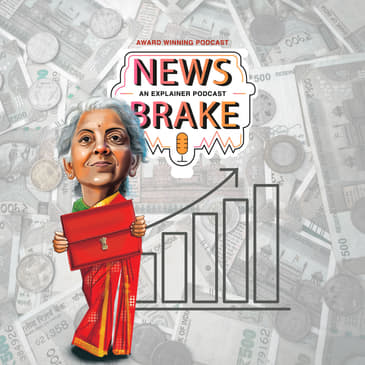

Union Finance Minister Nirmala Sitharaman presented the first budget of the third Modi government on July 23. Ayyappan R and Kannan V join Haritha Benjamin to discuss how the budget affects the common man and corporates.
See omnystudio.com/listener for privacy information.
[00:00:02] Finance Minister Nirmala Sita Raman presented the Union Budget today and as expected she has focused on boosting employment, MSMEs and agricultural sector in her seventh straight budget. But are these measures enough to help the struggling youth, middle class, farmers and women in India?
[00:00:21] Hi, you're listening to Onmanorama's explainer podcast, News Break, a weekly show that breaks down news in a clutter free manner. This is Haritha Benjamin and today we are here to discuss the Union Budget. My senior colleagues, Ayipin and Kannan are joining us today to dissect
[00:00:44] the budget further. So Ayipin, considering that this is Modi 3.0's first budget, what is your overview? Haritha, what I thought was that she, Nirmala Sita Raman stuck to that fiscal consolidation path that she had sort of unveiled right from 2022-23 and it was also evident during the
[00:01:05] interim budget. So what was 5.1% fiscal deficit, what was 5.1% in the interim budget has been brought down further to 4.9%. And perhaps after the elections there has been an acknowledgement that unemployment is worrisome. Huge innovative moves to boost employment has been presented
[00:01:25] in this budget. Employment on its own spurs demand and on top of that, Nirmala Sita Raman has also increased standard deduction which hopefully would further incentivize consumption. But what could be of slight concern if the stock markets are anything to go by is the
[00:01:43] increase in capital gains tax. The middle class who now increasingly depend on mutual funds to fatten their savings could be affected. And then there was a special emphasis on manufacturing, especially the thrust given to MSMEs and electronics industry. Basically
[00:01:58] I think the attempt was to generate jobs, transform India into a manufacturing hub and put more money in the hands of the middle class. Okay, and Kannan, what about you? Yeah, broadly agree with Ayyipan saying that it is growth oriented or a job incentivizing
[00:02:15] budget. What I also want to focus on the specific two or three points that she touched upon, giving Bihar a bit more outlay of 25,000 crore and paying Amravati or developing Amravati to Andhra Pradesh. These are two states which actually propped the NDA government
[00:02:42] and held NDA government gain the majority. And one of the major factors that BJP government lost, the majority was their rural unemployment, unemployment as such and rural disenchantment with the BJP rule. So I view this the rural, sudden the push for rural employment and
[00:03:03] rural development to that sector of gaining the majority or rather she even started the speech by thanking the people. Probably this was the first time that she thanked the people for voting the government back into the power. But I don't believe that she did
[00:03:22] that in the second term when she presented her budget. That when this was also on the expected lines, there was no much change in the education budget outlay, not much change or there was an increase in defense spending but that was also on the expected
[00:03:43] lines. So probably this was much, yes she has not gone away from the growth trajectory that she was proposing but it is nothing, not something that pushes into a different path altogether. It was on the expected line. And as I was saying before we had
[00:04:03] a poll on our side and 45% as we are recording, 45% of them said it was a poor budget. So it probably is between poor and on the expected line, not anything good or great.
[00:04:16] So yes I think that's pretty much what everyone's talking about. It is a budget on the expected lines and a slight nudge to the middle class and the youth who decided to penalize the BJP government for the unemployment and the issues which they have been facing. So
[00:04:34] I am now moving on, we have a lot of taxation related announcements which have come into being. Now the standard reduction for the new tax regime has actually been increased from 50,000 to Rs 75,000. So how do you think this is going to help the middle
[00:04:54] class or the rural population? Haridha, I am sure this is going to benefit the salaried middle class definitely. But I think this was a gamble that Nirmala Siddharaman took. I mean she had brought down the fiscal
[00:05:11] deficit from 5.1 to 4.9 and I think she is banking on this increase in standard reduction through this by giving more money in the hands of the people and she is thinking that this might spur consumption, give her more taxes and also deepen her tax space and
[00:05:30] that is one way, that is perhaps the most crucial way in which she is trying to bring down the fiscal deficit because she is hoping that income tax is going to fetch her nearly
[00:05:41] 20% of her revenue. And GST again is going to give her the other nearly 18-19%. This was not the case before. I think this was the first time that income tax is going to give her. Direct taxes are going to give her more money than even corporate taxes and
[00:06:00] GST also I think is going to give her more than corporate taxes. So by giving more money she is trying to reap in more money. Now Kanan, Ayyappan had earlier mentioned about the corporate sector and the capital
[00:06:14] gains taxation in particular. So could you please outline them and tell us how it stands to benefit the common man? This may not be benefiting a common man because as we see in the BSE and BSE
[00:06:29] Sensex and NSE Nifty, the imposition of or rather the increase of long-term capital gain tax from gains tax from current 10% to 12.5% and also increasing the short term capital gains tax from current 15% to 20% may actually take away whatever we
[00:06:51] owe the 17,500 rupees that a salaried person might be earning from his or her salary in way of income tax. Now if you are investing that money in an SIP, if you are investing directly into the stock market or through SIP for a short
[00:07:09] term gain tax you are going to pay higher money when you are withdrawing that, when you're selling all the stake and withdrawing that money. You'll be charged more. This almost kind of a double tax section because double tax session
[00:07:24] because you are already taxed and the saved amount is what you are investing. So you are already taxed in terms of income tax on your salary then you are doubly taxed on that. Early it was there. I'm not saying
[00:07:38] that it was not there but suddenly a push has been given so that the gain here may be offset by the other gain. Probably that's why we saw a completely volatile market in the morning when they were expecting
[00:07:53] something, they were actually expecting one of the comments that I read was that NSE chief saying that they were expecting sure these security transaction tax that has come into effect which personally I believe which is very good
[00:08:10] which is stopping the retail investors from FNO market. FNO market is absolutely different of these not like the stock markets and you may completely lose every saving if you don't know how to invest in that kind of a
[00:08:25] market so that's all good. They were expecting that kind of a move but they were not expecting this higher jump in gain stacks short term or long term capital gain stacks so whatever we get the benefit it is taken off.
[00:08:40] That's why I said it's a very very balance I'm not saying it's a balance budget but yeah all her gains are taken from all her or the payment that the government gives through income tax deduction in terms of standard
[00:08:57] deductions and the revised slaps is taken in a different way. This may also my problem I'm worried is that it may also push those people who invest in SIP into traditional investments like fixed deposits or recurring deposits
[00:09:16] that again is a gain but then you need also your retail money to come into the more riskier investments for the growth of the market which may not happen now. So now while we are talking about the stock markets it's been pretty volatile
[00:09:32] it's been going up and down the entire day so do you think businesses are happy with the announcements which are made today now we know about the angel tax which has been abolished so do you think all these major
[00:09:45] announcements have are in fact a positive for the Indian corporate sector? As for angel tax this is something that Chedumar also tweeted that we have said the same thing in our manifesto and he also said that she had taken it from this
[00:10:02] particular page. Yes and angel tax is specifically very welcoming move. Angel tax actually is the income tax that the government imposes on funding raised by unlisted companies or startups if the valuation exceeds the company's fair
[00:10:21] market value. This actually used to as a used to be a hindrance for people to invest in startups given that the startup is one way that specifically Kerala is looking to increase our entrepreneurship this is a wonderful
[00:10:40] benefit for or a beneficial move for specifically for Kerala and for the startup sector. That is one positive move here. Now Ayyappan you mentioned about the fiscal deficit earlier so are you positive that you know we are on a
[00:10:58] path of better fiscal management or there are you know some opinions that you know fiscal deficit we shouldn't be restricting ourselves to a lower fiscal deficit because that could constrain the economy so do you think
[00:11:10] that is true or you know reining in and you know keeping it together is what we need right now. I think at least on paper there is a balance because you know even when she's following this glide path there has been an increase in
[00:11:24] capital expenditure last time it was 4.97 lakh crore this time I mean in the interim budget and this time she's pushed it about upwards of 15 lakh crore so capital expenditure is there even while she's following this this
[00:11:39] glide path this downward slope of fiscal deficit and I think she was she is pocketing the gains of this post COVID exuberance because GST collections are up your direct taxes are up it is more than what has been budgeted last
[00:11:56] time 2023-20 she has received more than what she has budgeted and on top of that there was RBI's unprecedented dividend which which amounted to some 1.2 lakh crore so all of that all of that gave her a lot more to play with and
[00:12:12] that could be the reason why she tried to put some money into the hands of the people through to that what is standard deduction to by increasing standard deduction what Kanan was speaking the SIP the problem with SIP people would
[00:12:27] want to sort of making it less attractive I don't think that would be problematic for her at the moment what she wants is money spent in the market if she gets if she if she gets some if you get some 17,500 on an average freed
[00:12:41] in the hands of the people that could be immediate purchasing power which can be put into the market and she can gain GST money through which she can follow this her revenue increases a fiscal deficit sort of comes down now
[00:12:55] the government has also laid a lot of emphasis on employment at this time and this is something which I think all financial experts and economists have been harping about saying that the employment needs to be improved and
[00:13:08] there should be a labor demand and supply match right so like looking at today's announcements there are a few announcements which say that one month wage would be provided to all persons who are newly entering the workforce then there is something about creating jobs in the manufacturing segment
[00:13:26] and incentivizing employers to employ more people so now my concern here is why is it that it is focused on the formal sector because a majority of our you know people are employed in the informal sector right so what do you
[00:13:43] think do you think that these employment linked schemes which is to the tune of rupees two lakh crore would benefit the informal sector as well I think I think this this massive employment incentive scheme I think
[00:13:59] that should be linked to the kind of boost that she's trying to give MSMEs because you know the MSMEs to they register their employees with the EPFO so it's basically I mean we are going to give you a lot of push we are
[00:14:13] going to increase the mudra loan from 10 lakh to 20 lakh we're going to give you a credit guarantee we're going to give you stress credit guarantee for stress so new kinds of protective measures are being given
[00:14:28] to MSMEs and on the other hand they're being told you bring in more people you employ more people we will support you so that's that's what has been done I mean I think MSMEs it's important to sort of give a big
[00:14:43] boost to MSMEs because they are the they they constitute about 45 percent of India's total exports and 38% of manufacturing output and they are the second largest employer after agriculture so so evidently it's labor intensive so expanding manufacturing is also important to
[00:15:02] increase India share in the global exports now it is 2.4% if it has to be taken to 5% then MSMEs will have to be empowered and and India has been trying to transform itself into a manufacturing hub and it has been working
[00:15:20] wonders in the electronic manufacturing sector the value of electronics produced rose from 37 billion dollars and in eight years it has now come to nearly 120 billion dollars so and currently India's production of electronics accounts for 3% of the global total and and and and half of India's electronics
[00:15:45] production is made up of phone mobile phone mobile phone manufacturing and it is second largest in the world after China so in this budget more incentives have been given to sort of give a boost to the electronics and MSME
[00:15:59] electronic basically the electronic sector because there has been this basic custom stacks have been have been completely removed for all for basic minerals like lithium copper and cobalt that are used for high tech industries the oxygen free copper which is one of the components of the
[00:16:15] manufacturing of resistors that has been completely taken out so there has been this huge boost given to further expanding on the success that electronics industries have achieved and along with that is the along with it is the
[00:16:29] MSME the boost given to the MSMEs on the employment front and on the MSME friend I think they're also correcting the part that they took during the demonetization the demonetization actually was a was a killing blow for
[00:16:46] MSMEs MSMEs and even the say small time manufacturing establishments they were completely on cash based economy and the cash based companies or the small firms completely were decimated because of the demonetization now they
[00:17:04] are giving a boost to MSMEs and they are giving boost to mudra loans is also one way of saying that they may not say sorry they're too egoistic team to say sorry but this one way of saying that you are bigger generator of jobs than
[00:17:23] than the government sector the other factor was that couple of days back there was a report which said that even India is growing but it's a kind of a jobless growth because more people want government jobs they apply
[00:17:36] applications for the government jobs have increased many fold government will not be able to provide job that those many jobs in in coming years even with automation they are not going to generate that many jobs so even if
[00:17:50] you have 100 people retiring and say in 15 years 100 jobs may not generate in 15 years maybe three four the other jobs might be automated going forward so you will have to find other sectors to generate jobs that could also be a
[00:18:09] reason why she is also pushing it in a different way rather than saying that we're not we may not take these many people in right absolutely so now moving on what does Kerala stand to benefit from the Union budget although
[00:18:24] the state's name was not explicitly mentioned in the budget and only Andhra and Bihar had major takeaways from the budget for obvious reasons but could you I open could you you know briefly tell us on what the state could stand to
[00:18:39] benefit generally has its pet peeves I mean it wants more central shares more central grounds it wants a borrowing limit to be increased and it doesn't want the retrospective inclusion of kiff pee and KSS peel in the borrowing limit
[00:18:54] and it has also asked 5000 crore for for for William none of these have been addressed there is no mention of any of these in the budget but then Kerala can can stands to benefit from the other schemes the employment schemes
[00:19:10] the what do you call the customs duty changes I mean all of that will impact Kerala to but in the general sense the policy level changes have not been affected through this budget and I don't think anyone expected such decisions to
[00:19:27] come through the budget either but then there is this 1.5 lakh crore infrastructure investment through state governments that is that is one scheme that she has announced interest-free loans that is something that Kerala can avail of
[00:19:43] but then she also said what you call a substantial chunk of this 50 year interest free loans will be used for generation next reforms and that is especially related to land reforms but I think most of these like digital surveys are
[00:19:59] unique thunder pair I mean these are things that either Kerala has achieved or Kerala isn't the process of achieving so I don't think Kerala doesn't stand to benefit much because we are way ahead of times and especially after what we had achieved through the sustainable development goals
[00:20:15] we have continuously come first I think we need a special package to sort of sustain our unique growth and that is not here. Okay I think with that we can conclude today's episode of Newsbreak thank you
[00:20:29] so much Ayyipan and Kannan for joining me on Newsbreak this is a wrap and this is on Manor Amar's Newsbreak an explainer podcast which is produced by Haritha Benjamin with technical production by Ida Bruce Studios it comes out
[00:20:43] every week and is available on all podcast platforms do follow on Manor Amar.com for the latest updates