
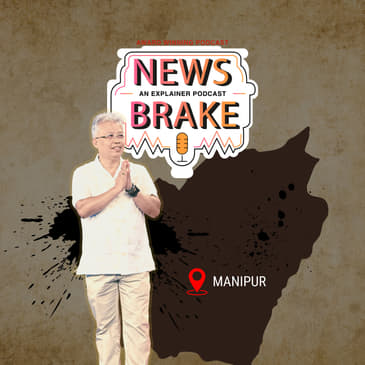

Congress MP from Inner Manipur constituency Angomcha Bimol Akoijam speaks on the 'Elusive Solution in Manipur' at Manorama News Conclave 2024.
See omnystudio.com/listener for privacy information.
[00:00:04] Hi, you're listening to Onmanorama's Explainer podcast, News Break, a weekly show that breaks down news in a clutter-free manner. This is Harita Benjamin.
[00:00:14] It's been over a year since riots broke out between the Maitis and the Kukizo tribal community in the northeastern state of Manipur. The state unfortunately still struggles to return to normalcy.
[00:00:28] Manipur Chief Minister and BJP leader Bireyn Singh has predicted that the state would take another 5-6 months to restore peace.
[00:00:38] Meanwhile, the opposition party, the Congress continues to ask an important question.
[00:00:44] Why does the Prime Minister Narendra Modi continue to turn a blind eye to the state?
[00:00:50] Why has he not visited the state yet?
[00:00:53] Congress MP from Inner Manipur Constituency, Agamcha Bimol Akoijam, who visited Kerala this week for the Manorama News Conclave, speaks on the elusive solution in Manipur today.
[00:01:06] Bimol Akoijam is a renowned academic and film maker. He's also an associate professor at the Jawaharlal Nehru University School of Social Sciences.
[00:01:17] Let's tune in to listen to his speech at the Manorama News Conclave 2024.
[00:01:22] It's always a pleasure to be in Kerala. You know, I keep on saying that there is an eternal connection between Kerala and my home state Manipur.
[00:01:32] If you're not aware, the sobriquet, the nickname of my state is called Little Paradise.
[00:01:40] So quite obviously, Little Paradise have to have some relationship with God on country, I suppose.
[00:01:47] That's why we have commonality in football, in theatre, in films. Both these states are pretty well known across the country.
[00:01:56] And I think this crisis has, I believe, brought us together more closer.
[00:02:01] This is, I think, my fourth visit to this state in my life.
[00:02:05] Recently, I was there in Kochi for an international film festival, where incidentally, one of my films was premiered.
[00:02:14] I was also into filmmaking before I joined. I'm into too many things in my life, I suppose.
[00:02:21] And it so happened that after winning the Lok Sabha election, as part of the New Year's history rule,
[00:02:27] I still continue to be a teacher in JNU, which is in my bone marrow. It's my primary identity.
[00:02:35] What I shall do briefly is just to lay out some issues for the rest of the country and for my audience to understand what is the issue that we face.
[00:02:46] It's a long history, and I'm aware that many of the people in this country is not aware of what happened in the Northeast.
[00:02:53] That's also primarily because of the exclusion that I mentioned in my first speech in Parliament,
[00:02:59] which has been part of my writing, academic writing or otherwise.
[00:03:05] Northeast is being included in India through a process of exclusion.
[00:03:10] And I have written this borrowing from an Italian thinker.
[00:03:14] It is inclusion by exclusion.
[00:03:18] That's the process through which Manipur or the Northeast become part of India.
[00:03:23] It is excluded from Indian history.
[00:03:26] In just the way as the European would have excluded Africa and Asia and the rest of the world,
[00:03:34] as in Hegelian sense, people without history.
[00:03:38] And they were anthropological subjects.
[00:03:41] It was only after Bertrand of Plassey, for instance, that India finds its place in the history of the world within,
[00:03:49] quote, dominated by the European lens as a part of history.
[00:03:54] In a very similar sense, you will see that I know as an academic for the last 31 years of my life,
[00:04:01] that you will find Northeast as a subject matter of anthropology, not as a part of history.
[00:04:06] So it is excluded from NCRT textbook and so on.
[00:04:11] That's peculiarly what the post-colonial scholar says there is a continuity between the colonial and the post-colonial in South Asia.
[00:04:17] And a classic example is what the Northeast is to India.
[00:04:22] It is on the same principles that I asked a very prominent journalist as he was interviewing me,
[00:04:29] and I said, just answer me first.
[00:04:31] I said, had this crisis been in places like the so-called mainstream, UP, Bihar or Bengal or anywhere,
[00:04:42] do you think that it would have been allowed to go on like this?
[00:04:45] He shook his head.
[00:04:47] And I said, therein lies the answer.
[00:04:50] You must ask why it was allowed or it has been allowed for so long in that part of the world.
[00:04:57] So, in this sense, like many issues in this country, what happened in the Northeast and Manipur,
[00:05:05] in particular in the present crisis, is a legacy issue.
[00:05:09] It has a lot to do with the practices and ideas injected by the colonial forces.
[00:05:15] Just as we know how senseless was introduced in this part of the world, and classifications of people,
[00:05:25] and how identities get reified based on those colonial practices.
[00:05:30] We are all familiar with that.
[00:05:32] What happened in Manipur is, unfortunately, there was a false topographical,
[00:05:38] and categories were injected by the colonial British.
[00:05:43] We should know that right from Kashmir to Uttarakhand, to Nepal, and Sikkim, Arunachal Pradesh, to Nagaland, to Manipur,
[00:05:51] to Mijauram, and all the way to Arakan Ranges, and even down the Manikobar Island,
[00:05:58] was created through a collision of the Indian plate and the Eurasia plate,
[00:06:04] sometimes like 50 million years ago.
[00:06:07] So that's the elevation we call it, Himalayan regions.
[00:06:11] So Manipur is part of the Himalayan ranges.
[00:06:15] What the British did was that there is a large central valley in the middle of the state,
[00:06:24] which is roughly around the largest community to which I belong, the Maitai, reside majorly.
[00:06:30] And around 90, 92% of the total area is in the up highland, which is where various tribes are settled.
[00:06:42] And this dynamics had a particular way or form of life where they interacted,
[00:06:49] they relate with each other in many ways, like most South Asian communities.
[00:06:55] It was through a particular classificatory scheme.
[00:06:58] They were seen as if they are discrete, opaque boundary identities.
[00:07:04] That's how the colonial practices have done in South Asia.
[00:07:07] The same thing happened in Manipur.
[00:07:10] What they described was that those people in the central valley, they call it civilized and civilization,
[00:07:16] and those people in the surrounding hills as Sevezes and naked tribes.
[00:07:21] They forget that in their forms of life, as well-known scholars like Sudhir Thukavira and others will remind us,
[00:07:28] they have a relationship in this country.
[00:07:30] It's a fuzzy community.
[00:07:32] We all have relationship.
[00:07:33] They marry each other.
[00:07:35] They go to war sometime together.
[00:07:37] They will fight with each other at times.
[00:07:39] But it was created as if these are two different sets of people.
[00:07:43] One called civilized.
[00:07:44] It's a typical European way of looking at the Mediterranean region as a civilized people,
[00:07:49] and the Nordic people as the Sevezes, barbarians, and so on.
[00:07:54] That kind of classification was injected by the Britishers, particularly around 19th century.
[00:08:01] And they further consolidate once they took over Manipur.
[00:08:05] In the 20th century, they introduced laws, and they started treating these two sets of people as two different sets of people,
[00:08:15] to different legal regimes.
[00:08:17] So they have created two sets of subjects.
[00:08:21] And that particular identity was internalized.
[00:08:24] And on that basis, they began to look at each other in the similar fashions.
[00:08:29] That as if they are different, they are unrelated, as if they cannot have a common goal.
[00:08:35] That's the kind of a thing, if you take a little larger perspective,
[00:08:38] that's the same thing that many scholars will tell you about the Hindus and Muslims.
[00:08:43] Let's remember that communalism, as many scholars will remind you,
[00:08:47] was a product of the colonial practices and processes.
[00:08:51] In a very similar sense, what happened in Manipur is a legacy issue in the same sense.
[00:08:57] It is a kind of a schism which was manufactured by the British.
[00:09:01] They complemented this division of the population in terms of a topographical false mapping.
[00:09:07] You think about it, how many of you will think that Nainital and Heratun are two different places.
[00:09:12] They are part of the Sevalik region of the Himalayan ranges.
[00:09:17] Dheradun is briefly around 640 meters above sea level,
[00:09:21] and Nainital is around 2,000.
[00:09:24] They are part of the Himalayan ranges.
[00:09:27] Mark my word again, 640 meters.
[00:09:30] Dheradun is a hill station.
[00:09:33] Nainital is a hill station with 2,000 meters.
[00:09:36] Imphal is 800 meters above sea level, higher than Dheradun,
[00:09:41] and it is treated as if it is like a plain.
[00:09:45] In Chirachampur, the hub of the conflict where these tribal groups reside,
[00:09:50] is barely 900 meters, a difference of 100 meters.
[00:09:54] But in the topographical mapping, they think that it is the same relationship
[00:09:59] like Allahabad would have with Nainital,
[00:10:01] or Gawati, which is 50 meters above sea level,
[00:10:05] with Kohima, the Den Naga hills, which is around 1,500 meters.
[00:10:10] They have falsely mapped out what is essentially a part of a mountainous region as a hill and a plain.
[00:10:18] So it complemented that one, and this trouble has continued.
[00:10:22] That's why they said hills should be separated, valleys should be separated,
[00:10:27] forgetting that this is topographically and ecologically a compact state.
[00:10:31] Intimally tight geographical formation with interrelated communities.
[00:10:37] To think of it, what you called Kuki tribes.
[00:10:40] Their language, according to linguistic classification,
[00:10:43] is part of the Kuki-Chin linguistic family,
[00:10:46] of which my language, Manipuri, the first Indo-Mongoloid language to be recognized in the 8th schedule of the Constitution,
[00:10:54] is also part of the Kuki-Chin groups.
[00:10:56] So it is a schism which was manufactured.
[00:11:00] So that is a kind of a colonial legacy.
[00:11:02] What happened is in the post-colonial period, what they have done is that Indian state,
[00:11:07] its practices, instead of reversing these colonial categories,
[00:11:13] reinforces the two sets of communities.
[00:11:15] One was classified as scheduled tribe and the other as non-scheduled tribes.
[00:11:19] That my community is a non-scheduled tribe, general category.
[00:11:23] The other is a tribe.
[00:11:25] Then Christianity is spread among these SD groups,
[00:11:31] majorly in the mid-20th century.
[00:11:34] And traditionally those people in the Central Valley.
[00:11:38] There are a lot of valleys in Manipur, don't get confused,
[00:11:41] but I'm talking about the Central Valley in the middle.
[00:11:44] They are part of what we call Manipuri Vaisnabayat.
[00:11:47] We are quite like the Japanese in some sense
[00:11:50] because you follow your actual ritual and thought processes.
[00:11:54] Your institutions are a mixture of just like the Japanese
[00:11:57] between the traditional Shinto religion and Buddhism.
[00:12:01] Meite's religious practices are majorly part of the larger,
[00:12:06] what you can call it, Vaisnabayat tradition
[00:12:08] and the pre-Vaisnabayat religious belief.
[00:12:11] We practice both of them.
[00:12:13] I'm wearing one of them.
[00:12:14] This is our demi-king god,
[00:12:17] which is the protector of the police, the state.
[00:12:22] What I'm saying is that not only that,
[00:12:25] colonial practice continued in the post-colonial period,
[00:12:30] classifying one as SD and another as non-SD.
[00:12:34] And then again they introduced laws in 1960s
[00:12:38] and they classified the upland as hills
[00:12:40] and the Central Valley as plain.
[00:12:44] Interestingly, in Nagaland, which is also part of the mountainous
[00:12:47] and there is a place called Dimapur,
[00:12:49] which is their commercial hub,
[00:12:52] which is part of the extension of the Indo-Gangetic plain
[00:12:56] called Brahmaputra Valley,
[00:12:58] which is considered to be part of a hill state.
[00:13:02] And in fall, the capital city is supposed to be a plain,
[00:13:05] as if it is like Lucknow, Elavar and Gowati.
[00:13:09] Interestingly, in 1965, in National Development Councils,
[00:13:12] there was a move, the decision was taken in 1964
[00:13:16] to take care of the hill regions development
[00:13:19] and National Development Council in 1964.
[00:13:21] The decision was taken.
[00:13:23] The report was submitted in 1965.
[00:13:26] And there they have this, all India,
[00:13:28] they classify, you know, two groups of states with hill areas.
[00:13:32] One they call it hill state.
[00:13:34] Another they call it state with hill areas.
[00:13:38] Kerala is considered to be a state with hill areas.
[00:13:42] So does Assam, Madhya Pradesh and so on.
[00:13:46] Manipur was classified along with Nagaland and Kashmir
[00:13:50] and all of them as part of the hill state.
[00:13:53] But within it, both legally and institutionally
[00:13:56] and conceptually, you think that there is a plain
[00:13:59] and there is a hill and two different kinds of people.
[00:14:02] It is this worldview and practices and institutions
[00:14:06] that is implicated in the present crisis.
[00:14:10] It was aggravated by what can be called
[00:14:14] practices of the coastal colonial Indian state practices.
[00:14:18] It's primarily, I'll mention only one because I don't have time,
[00:14:21] counter-incidency.
[00:14:23] Manipur was a kingdom.
[00:14:25] We know that in Indian history,
[00:14:27] following the negotiation in the London on Roundtable
[00:14:32] and the Simon Commission report,
[00:14:35] an administrative reform was carried out
[00:14:37] and the government of India in 1935 was passed.
[00:14:41] We assume it to be a federal state,
[00:14:43] combining what used to be called Indian state
[00:14:46] or princely state on one side
[00:14:48] and the British India, which is directly ruled by the British.
[00:14:51] They came together, but it did not work out.
[00:14:55] The 1937 election was held by excluding this princely state.
[00:15:01] But Sardar Patel and VP Menon tried to integrate
[00:15:03] these princely states under the same act in 1935,
[00:15:07] an instrument of accession was carried out.
[00:15:10] Manipur was one of those states.
[00:15:12] Out of the 600 states, they have listed less than 100 states
[00:15:16] as a gun salute state.
[00:15:17] Manipur was an 11 gun salute state.
[00:15:22] Kashmir and Hyderabad were 21 gun salute state.
[00:15:25] Kochin and Trevankar was also one of those gun salute states.
[00:15:29] So Manipur came, but unlike other princely states,
[00:15:32] Manipur had a constitution of its own.
[00:15:34] The king was reduced to a constitutional monarch.
[00:15:37] The government of India bulldozed those constitutions
[00:15:40] and the assemblies, that's the dissatisfaction led to the armed movement in Manipur.
[00:15:45] As a part of countering death,
[00:15:48] Indian state did was to prop up these small, small tribal armed groups
[00:15:52] to fight against these armed groups.
[00:15:54] So it is a part of that violence that continues.
[00:15:59] And the present crisis is part of the same problem.
[00:16:03] Many of the so-called Sioux groups of these cookies have never fought with the Indian state.
[00:16:10] They have never fired a single bullet, so to speak, against Indian armed forces.
[00:16:15] Yet these armed groups, the government of India, maintain the relationship
[00:16:19] and suspension operations.
[00:16:21] You must understand why some people demand the scrapping of the Sioux.
[00:16:25] It is these practices that they was burst into flame for two reasons.
[00:16:32] I think I'll just cut short with this.
[00:16:34] Because of these tradition of separate and practices, various kinds of ideas,
[00:16:40] there's a movement for Zalingam, which is supposed to be an independent country,
[00:16:45] comprising of what they call Kukichin groups in Bangladesh and Myanmar,
[00:16:52] which is a Chin state, neighboring Missouri.
[00:16:55] So it encompasses a large group of these areas.
[00:16:58] And there is an ethno-nationalist mobilization.
[00:17:02] And part of the population in Manipur Southern part is implicated in that movement.
[00:17:09] So many of them imagine Kukichin state within India as some sort of a halfway home
[00:17:14] to maintain their own autonomy within this structure.
[00:17:18] So they will side with this side, Indian state one time, another side, this side.
[00:17:23] So that gets complicated.
[00:17:25] And Indian state continued.
[00:17:26] This move, many observers believe this crisis is also related to controlling
[00:17:31] and neutralizing political armed groups who have been fighting against the Indian state.
[00:17:37] This particular crisis, they said this is part of that.
[00:17:41] To mobilize forces, to create alternative civil society forces.
[00:17:45] In fact, it has been done now.
[00:17:47] We have armed groups who have never heard of before.
[00:17:52] There are groups which are much more active today.
[00:17:54] And that neutralizes and balances some of the traditional forces.
[00:17:58] So this is part of the crisis that we have.
[00:18:03] Two more issues.
[00:18:04] The Golden Triangle, notorious for its drug and poppy, has UN reports suggested that it has shifted its
[00:18:11] gear towards the eastern side of Laos, Thailand and Myanmar.
[00:18:16] Myanmar became the hub of that one.
[00:18:19] It has spilled over in Manipur.
[00:18:21] That is why bordering Myanmar, you have massive forests and hill areas.
[00:18:25] In the United States, you have poppy cultivations.
[00:18:28] So there are an international drug dimensions to the crisis.
[00:18:33] And we are pretty sure that local people are also involved.
[00:18:36] But I suspect that those people will be minor player of this game.
[00:18:41] But when I say minor, remember that when you're dealing with opiums like this,
[00:18:46] even a minor would mean thousands of crores of rupees.
[00:18:51] And according to some observers, when I had a conversation with them, the economy of drug in Manipur
[00:18:58] runs in 60,000 crores, much bigger than that of the state's own budget.
[00:19:04] Lastly, but not the less, there is also competitive democratic politics.
[00:19:10] You try to prop up yourself as leader of the Maite community, one as leader of the Kuki community,
[00:19:17] and busy people play the game.
[00:19:20] What they did was that they asked these two groups in 2017, 2022.
[00:19:27] It's all in public domain.
[00:19:28] You Google it and you'll see.
[00:19:30] These two groups, these armed Kuki groups, supported them in elections.
[00:19:36] In promise they were supposedly said that they will fulfill their political demand
[00:19:41] of a separate administration or something of that kind.
[00:19:44] Which has openly came out because one of these groups, in an avidavid submitted to the court,
[00:19:50] written very clearly that I met so and so of the BJP, and they promised us all of these things.
[00:19:56] On the other hand, they prop up some people from my community as a defender and the savior of the Maite.
[00:20:03] And it is this polarization played by BJP government has aggravated the situation.
[00:20:10] And I suspect that the government of India's silence, which I call it its complicity in the whole crisis.
[00:20:17] Please remember, in post-colonial Indian history, you have never heard of 60,000 people
[00:20:25] linguisting in wretched condition in camps.
[00:20:28] I have seen them.
[00:20:29] It's horrifying.
[00:20:30] I happen to have some experience of doing partition studies of the 1947,
[00:20:35] particularly while I was working in a research institute called CSDS,
[00:20:39] under the principal investigator was Professor Ashish Nandi.
[00:20:44] The case studies that I have read and I have seen, interviews that we have conducted,
[00:20:50] in life forms today I see in my own home state.
[00:20:54] Those pain and anger is what you have seen me in parliament,
[00:20:57] and that had forced me to join what you call it the dirty domain called politics.
[00:21:03] I came in and people have spoken out.
[00:21:07] I won without the traditional style of elections, we are investing money.
[00:21:13] And Manipur elections, normally the margin is always around 20,000 to 30,000 maximum.
[00:21:18] I won the elections by one like almost 10,000.
[00:21:22] And that is people speaking out for nobody like me from a university who comes there.
[00:21:30] And I think that is the issues.
[00:21:34] The road ahead is that I would suggest two things.
[00:21:38] Indian government and all of us must take a firm stand against any demand of a political structure
[00:21:46] based on communal exclusivist sectarian ideologies.
[00:21:50] That's the fundamental.
[00:21:52] You can have demand for administrative reforms or structures
[00:21:57] based on what the state reorganizing commission had said.
[00:22:01] To empower the people for participation in the governing and their life
[00:22:06] and also for the effective and efficient delivery of goods and services.
[00:22:12] There must be an administrative rational rather than an exclusive communal identity project.
[00:22:19] Indian government, whichever party holds it, and for the rest of us.
[00:22:23] If you don't do that, this country will not survive.
[00:22:27] It will open a Pandora's box.
[00:22:29] That's why State Reorganization Commission way back in 1956 have said it very clearly.
[00:22:35] It cannot be done on these communal identities,
[00:22:37] but it should be founded on administrative rational for effective and efficient delivery of goods and services.
[00:22:43] And what should I say expecting?
[00:22:47] Still, I expect the government of India to assert its own authority, its reed.
[00:22:54] As whoever would suggest that you must claim the monopoly of the legitimate use of physical force.
[00:23:00] And that's what state is all about.
[00:23:03] When the state surrenders, you have warlords roaming around with guns.
[00:23:07] Afghanistan is a clear picture of that.
[00:23:10] We know what is the idea of a failed state when the state does not assert its authority.
[00:23:15] But I've told you this government is complicit in its silence.
[00:23:21] Allowing this violence to go on for so long clearly tells you that something is there in the mind of this government.
[00:23:28] And we must be careful about and alert to this move of the government.
[00:23:33] But still, I will ask the Prime Minister, as my leader Rahulji says, please visit.
[00:23:38] Call all your MA.
[00:23:39] Remember that all the leaders of this community's leader and that community leader's popping up as a savior of respective communities are all from BJP's.
[00:23:49] The one who is asking for defending Manipur is also in the cabinet.
[00:23:53] The one who is demanding for separation also in their cabinet.
[00:23:57] And the game plan, 200 plus people have lost life.
[00:24:02] Lawlessness, economies destroyed.
[00:24:04] Investment has flown away from the state.
[00:24:06] Shops are being closed down.
[00:24:08] Petrol pumps have been closed down.
[00:24:10] And 60,000 people are still suffering in wretched condition.
[00:24:15] We all need voice from your end as well to pressure the government of India to behave.
[00:24:21] Thank you.
[00:24:22] That brings us to the end of today's episode.
[00:24:25] This is On Manorama's Newsbreak, an explainer podcast produced by Harita Benjamin.
[00:24:30] It airs every week and is available on all podcast platforms.
[00:24:35] Do follow on manorama.com for more updates.