
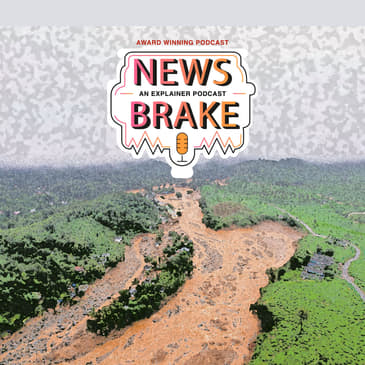

Jayakumar C, the executive director of Kerala-based NGO Thanal, joins News Brake to discuss the factors that led to the landslides that killed hundreds in Kerala's Wayanad and the way forward.
See omnystudio.com/listener for privacy information.
[00:00:01] Kavalapara, Uthumala, Pettimudi, Mundakai, Churalmala Over the years, these serene landscapes of Kerala have turned into scenes of devastation, where landslides strike with terrifying force. Hundreds died in Kerala's Weynart district this week as Natures' playbook took an unexpected turn in the God's own country.
[00:00:24] But is it Natures Wrath alone or is man also responsible? Hi, you're listening to Onmanorama's explainer podcast, News Break, a weekly show that breaks down news in a clutter-free manner.
[00:00:43] This is Harita Benjamin and today we are here to discuss the recent landslide that killed hundreds in Kerala's Weynart. Jai Kumar C, the Executive Director of the NGO Tunnel joins us today to discuss the issue. Welcome to the show, Jai Kumar.
[00:00:58] Thank you. Happy that we can communicate to the people about the details of what is happening. So happy to join you. Sir, let's start with the landslides which occurred in Mundakai and Churalmala. The rescue operations are still on there.
[00:01:13] So what I would like to ask is, was the zone always vulnerable to landslides? And if so, why is the area so densely populated? Traditionally, if you look at mountains, western gods are much more older, stronger mountains.
[00:01:29] That is what the geologists tell us and that is what we learn in colleges. But on the same time, there are kind of vulnerabilities. If you look at Kerala in Lakiti, for example, where adjacent to what all these landslides happened,
[00:01:45] the rain goes as high as 7000 millimetres a year. Whereas in Trivandrum where we talk, the annual rain is as low as 1500 or something like that. So I mean, in Kerala if you look at the whole state with a beautiful geography and different geological formations,
[00:02:07] it also has a lot of vulnerability which is not fully understood by us in one sense. Also there is a bit of, if you look at the old plantations or the earlier move by our people in those times who try to cash on the land.
[00:02:24] They set up plantations and if you look at it, there is always the follow of conduces. There is a lot of scientific planning, if you want to say so, managing the land and keeping conduces intact,
[00:02:36] keeping sharp slopes, maintaining its integrity without interventions, without major load on the landscape or on the land. So there are a whole bunch of things which was there in the past. I am not saying or glorifying the past, what I am saying is,
[00:02:52] those kinds of pressures were probably the number of people who were less at that time as you said. But I was also quite surprised to see the number of houses in this area which is in a sense a very remote part of Vainad.
[00:03:08] If you look at development or per capita income in Kerala, Vainad is the worst performing income of income. Or if you look at the people who need jobs or all the essentials in economics, they are in a backward district.
[00:03:25] Even in the whole country, Vainad is the only aspirational district in the Government of India plan in India. So you know the geopolitical location of Vainad in that sense. Correct. But again, this is not something new.
[00:03:41] We know that whatever we boast about Kerala's past or natural heritage of Kerala, with a lot of pressure, with a lot of expansion, a lot of change in priorities, I will stress the change in priorities. Like earlier if we had a plantation as a priority for income,
[00:03:59] I think plantations are not performing as expected or the plantation economy is coming down. So there is all kinds of other pressures for use of land including construction of buildings using for ecotourism.
[00:04:14] So if you ask me, I will say that both the cost of Kerala and the western guards are highly vulnerable. Right. So now you've already spoken about how the landscape has been performing. But then if you're looking at the data which we have in Mundakai,
[00:04:33] the Mundakai region actually received a 572 millimeters of rain in the 48 hours which was prior to the landslide. So this is an alarming rate of rainfall. Right. And what kind of warning systems were in place, you know when high rainfall, rainfall takes place in such a scenario.
[00:04:51] And we've, you know why I'm asking this because we've heard a lot of blame being tossed around after the landslide occurred. Some say that the district administration and the state government dropped the ball. Is there any truth in this?
[00:05:04] And do you think the type of warning systems could be improved? What's your take? I will not blame the district administration. I will not blame the state government or neither the central government in that sense. I will blame the policies of the government. That is a different thing.
[00:05:20] Like if you look at the Disaster Management Act, the agency who should communicate to you about whether warnings is the IMD. Right. And so you did IMD-1? No. I don't think anybody can have a prediction because if you look at a very scientific warning,
[00:05:41] I will take you two, three months or at least two months behind. You look at the cloudburst in Kerala. The first recorded cloudburst is in Kalamashiri in Nairnaburam. Right. Right. Was there a warning? No. There was actually IMD radars are there.
[00:05:58] I am at the University of Science and Technology with Dr. Abilash who is monitoring weather and especially rain all over there. And Dr. Abilash cannot warn, but because basically the system is that the IMD has to give the warning.
[00:06:11] And IMD's eyes, what you call the radars and measuring devices are not that spread in Kerala or in, I mean we are still a lot more to go. So I don't think, I mean again if you look at the 575 millimeters of rain in the last 48 hours,
[00:06:28] there will be a bit keenness to know at which hours those rain was there. And unfortunately the community monitoring done by local community and the NGOs there, they can't do that because it needs a much more investment requiring sophisticated equipments and we don't have that.
[00:06:46] I will say that we are not in a position to warn about such issues because we don't have the system to warn. We don't have enough radars, we are not collecting data, we are not documenting our early basis of rain.
[00:06:59] And if you look at your first question was about the change in weather pattern or how you, I mean very broadly what we call the change in climate. Right. I think we are experiencing what every day, what we hear in media about climate change.
[00:07:16] In Kerala we are experiencing whether it is cloudburst in Kalamashiri, whether this 575 millimeters of rain in Wainat which caused this, the most disastrous event which we ever experienced in Kerala. I think I won't blame the current incident but I will blame the governments for not having the systems,
[00:07:39] especially when we have these systems in place when we have this very alarming situation. And we have all the, I think I mean I will ask a different question also like how many of our local self-governments,
[00:07:51] I mean we have more than 1200 Punjayats and block Punjayats and 14 district Punjayat. How many of them can invest 4 lakh, 5 lakh kind of all-weather monitoring system and connect it to IMD, connect it to Kuchin University of Science and Technology to monitor what is happening in Kerala.
[00:08:09] And then probably we can say that we are monitoring the state and we could actually do the predictions. And in climate modeling you need a significant amount of data to make prediction and you need a very micro level monitoring to come up with micro forecast
[00:08:26] and it will be very difficult to come with micro forecast for moving people out with the current system. And I think so that is broadly the kind of a problem in terms of predicting.
[00:08:38] And I will also take one more step to say that what we are not addressing is the change, the change in the way rain is happening. And if you ask me there are several triggers for example, I think the clouds do not immediately rain.
[00:08:56] The clouds, the water molecules need a hygroscopic, I mean some material where it contents around that and form rain drop and then it falls down. So if there is a lot of aerosol particles in the atmosphere then there will be more rain.
[00:09:13] This is typically what they call seeding of rain happens when there is less aerosols in the atmosphere. You can artificially drop aerosol materials which we can create rain. So what is the aerosol particles in Kerala?
[00:09:30] And I will say that Kerala is one of the highest aerosol particles probably due to all kind of this huge madness for construction, quarrying, moving of soil, soil cutting and moving.
[00:09:45] Everything creates a lot of and also even cutting of, I mean a variety of sources which is creating aerosols which can in one sense increase the amount of rain from the clouds which are already formed there.
[00:10:00] So it is not a single factor where you have a culprit or you can accuse somebody. It is a collective issues where we are not addressing the different issues to create a system to predict and a system of warning
[00:10:14] and also linked it to the previous question you asked. This is also one question we need to really ask. Kerala is definitely one of the highest populated area but how can so many people live in their highly vulnerable slopes
[00:10:27] where by no law in the existing manuals will permit panjayats or administration to sanction or approve construction of houses, construction of commercial buildings, construction of ecotourism spaces. I can see that the need of the local people with whatever way you call it whether they are farmers, settlers, whatever.
[00:10:49] I don't want to brand them but the people, the owners of the land, the owners, the people of the state who are, who own the country actually, it is owned by the citizens of the country.
[00:10:59] So they have a right to make their houses and the government has the right to guide them to the proper locations. More than that I think this whole spree of all kinds of constructions,
[00:11:13] the number of roads to the area in a very vulnerable zone, cutting the conduits, creating damage to the conduits and all kinds of like several check-dumps on the slopes were adding to the load bearing on the slopes.
[00:11:29] There are series of bad decisions or cumulatively errors we committed which created in this major disaster where probably the trigger for that came from high intensity of 48 hours of rain which again as per the existing law, the community monitoring are not factored as a sense of warning.
[00:11:52] So I think it is time where we look at the Disaster Management Act and if there is a scientifically guided community monitoring system like what we have in Vineyard where the local rain gauges measure 575 millimeters of rain, I think I am not an expert on weather
[00:12:11] but I think what I learned is that if 48 hours more than 500 mm rain in English they say danger is not far away. And it has touched 600 and still we believe that danger is not far away,
[00:12:24] it's a stupidity or arrogance of human being if I may put it that way. I think a micro level monitoring is the need of the hour considering the climate change which is escalating every day especially in vulnerable places like this.
[00:12:41] If we don't have a system in place, we are going to face more and more disasters in the years to come. Moving on you were speaking about the land use patterns and the climate change in the district.
[00:12:52] Now you've been working in and around Vineyard for quite some time. So if you were to look at the number of years over the years how has the land use pattern changed?
[00:13:02] We know that the plantations, the tea plantations in Vineyard and those kind of set up has been there for a long time. Now has it been aggravated by the climate change because we did not have so many landslides and all that in the past compared to the present.
[00:13:20] So has it been aggravated because of the climate change and the heavy density precipitation which is happening or has there been any new type of land use patterns which is aggravating these kind of landslides? Could you just take us through the journey?
[00:13:37] I think the first thing probably the best person who can tell you is Dr. Abilash who always says when there is a 5 degree temperature change in Kochin it may not have a major impact
[00:13:50] but if there is a 1 degree climate change in Vineyard it is going to have a major impact because Vineyard is highly vulnerable, highly susceptible to various climatic triggers.
[00:14:01] Having said that I will say that your question I think the last one is a serious issue like the recent kind of changes in land use. There are in a sense if you ask the earlier plantations the plantations are highly regulated
[00:14:16] you cannot do whatever you want to do in a plantation area because it is regulated it has to be for plantations but then there is this demand that the plantations are not performing well
[00:14:26] probably then you need to see how to make it performing well or how to incentivize the plantations to maintain the natural integrity of the region because it is highly required. Instead of that what we have done is we created, we relaxed the kind of laws for example
[00:14:44] earlier plantation area can be used only for plantations. So we amended the act and said that 5 to 10% of the area can be used for non-plantation purposes and non-plantation purposes can be anything it can be setting up a commercial building
[00:14:59] or a shopping mall or an ecotourism site or anything. So that means probably that decision might be one of the major issue to be blamed in the change of land use and there is pressure for land for people to stay for example
[00:15:15] but that pressure could have been very easily solved by the local administrations and Punjab's empowered to provide or take revenue lands which are good for housing and move people out of the vulnerable area and relocate them
[00:15:33] which could have been one of the policies which we take instead of that what we did was we stretched the limits in the slopes and we created the problems. It happened in Mundaqai in Chural Mala, it happened in Putumala
[00:15:50] but I'm really really worried that we are only starting the falls or the slips it is not going to be safe for the future. Now moving on, we know that landslide is triggered by number of factors now we've already spoken about the extreme precipitation right?
[00:16:08] Now there are also factors like the steep slope, the type of soil type and long run out distances and things like that. So if you are to look at the current why not landslides
[00:16:21] how many of these factors came to play to lead to the landslide which eventually came on Tuesday? The major factor will definitely be the high intensity of the high rainfall but there are factors which triggers the fall
[00:16:41] like we opened up a lot of condors for roads for various activities which should not have been approved there and there is also crop changes like cardamom has been changed to rubber tea has been converted into a few other things including greenhouses and bigger building spaces
[00:17:01] and even check-downs and other kind of things there disaster perspective each of them escalates the things to a point of no return and probably the point of no return you got the rain to finish it
[00:17:18] so there are series of bad activities or bad acts done by various people I won't say just the government it is also individuals I think at the end of the day individual also has a responsibility you can't blame government for everything
[00:17:32] it's a cumulative errors which created the problem but rain has a role to play it but that is again the rain is caused by factors including aerosol presence in the atmosphere which is a totally anthropogenic presence
[00:17:48] Okay so now moving forward if you are to look at the public and the government what would be your suggestions to prevent such disasters in future now we know that we have to stabilize the slope
[00:18:02] so we know that we have to control the land use patterns in ecologically vulnerable areas and we know that we have to improve our monitoring of such situations so that we can issue alerts fast and quickly and help people evacuate
[00:18:20] so if you are to give an outline of the number of steps which need to be taken by the government and the public what would they be and with that we could conclude today's podcast session I think you really need to look at the priorities of the government
[00:18:37] If I am to outplay I say that we can't wish away the disasters it will come in one form or the other we can save people that is the first priority
[00:18:47] and if you really want to save people do we have enough shelters where we can move people out if there is a local monitoring or an IMDA warning that okay the rain is coming we don't have any space if you ask us we boast about many things
[00:19:06] we say that Kerala is the first in everything and Kerala is stupidly caring for its people so if you ask me in terms of disaster what you do you move all the families to those schools
[00:19:17] and shut down those schools men those schools are essential for the children to be engaged and I think our people deserve more than school benches why can't we set up convert marriage halls and hotels and have been like
[00:19:33] I was involved in disaster management in New Zealand and the government gives hotel vouchers so there are people when there is an alarm they are asked to evacuate from the places and they can go to the hotel vouchers check in in the rooms
[00:19:44] and stay there safe for 2 days or 48 hours whatever the government decides then they can return why can't we think in terms of creating government owned shelters or private owned shelters whatever the ownership do not matter but what matters is space available for people to come
[00:20:00] and I think all the revenue administration or the district administration gives order to move out the police can immediately move people out to a shelter so that our lives are saved in in Wainer that's one of the first priorities
[00:20:14] second I think can we cut down the factors which are triggering like can we stop playing with the condor can we do much more priority for life than roads
[00:20:25] I think Caroline got this myopic idea of go roads and if you if any geologist goes for a mapping in Kerala I will say that 40 to 50% of the major landslides and things are triggered by roads
[00:20:40] which is a disaster in thinking so we need to have a total relook at priorities I think the first priority is to save human lives and assure right to property and right to life to the people of the country under the constitution of article 21 of the constitution
[00:20:55] so when if you ask me the governments totally failed to provide the right to property and right to life to the people as in we say it in the article 21 so you may have 2 acres of land in Putnamale
[00:21:09] but if the warnings are coming it is not there is a vulnerability then if the police ask they can just drive to a shelter or the police can move them to a shelter
[00:21:20] we need to think about such future where we can actually help to save people that is one second can we make some amendments to some of the rules to feature the kind of inclusive things
[00:21:34] which need to be done like whether the local monitoring of whether by the people and how it can be systemized into the IMD forecasting and how the NGOs like in Vainard who did the forecasting have a place in the policy formulations or the place in disaster warnings
[00:21:51] controlled by the district administration I am not asking to privatize it but totally under the control of the disaster and finally we have it what very broadly what we call a carrying capacity is what some people call it
[00:22:04] I think we have limits to growth or limits to space I mean I am not talking in a chronically limits to growth I am talking about the physical limit of things can be done in a slope physical limit to things can be done in a river
[00:22:23] the river needs a place to flow and if you don't give the river the space to flow it flow wherever it finds a space so we need to provide the rightful space to the river to flow
[00:22:38] and we in that sense we need a lot of discussions to reprioritize our priorities for what we call development in a very broad way Alright so I think that was very nicely summarized thank you so much Mr. Jayagumar for joining us
[00:22:55] so that's a wrap of today's episode of On Manorama's Newspreek an explainer podcast which is produced by Haripa Benjiban with technical production by Ida Bruce Studios it comes out every week and is available on all podcast platforms
[00:23:09] so do follow on manorama.com for the latest updates about the Wynard landslide thank you so much for joining us Thank you Haripa