
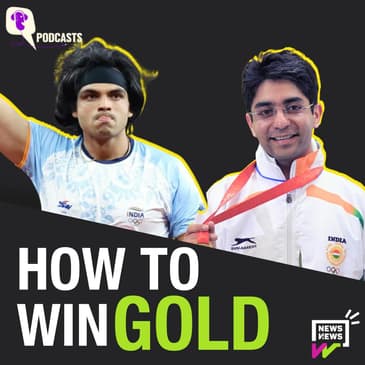

Do Olympic champions have a different mindset? In this podcast, Prateek Lidhoo asks this question to sports administrator Manisha Malhotra, who was a part of Abhinav Bindra and Neeraj Chopra's Olympic gold campaigns. She also recounts some stories behind their preparation, and what we can look forward to in the Paris and LA games.
Learn more about your ad choices. Visit megaphone.fm/adchoices
[00:00:00] You are listening to The Quint's Podcast. Hello and welcome to this podcast with The Quint and today with me I have a sports person. So already I am a little nervous, am I looking fit enough? Have I done my workouts before meeting you?
[00:00:18] But hello, welcome to The Quint. We have Manisha Malhotra, the head of sports scouting and excellence at JSW. How are you doing? Very very good, it's hot outside, nice. Okay tell me do people online confuse you with Manisha Malhotra? Yeah all the time.
[00:00:35] All the time right because I will tell you while like researching for this episode I was googling. I get phone calls too and I say oh Manisha Malhotra and I am like but I sound like, I definitely don't sound like a man
[00:00:47] and they are like no but Manisha Malhotra. So I will click down the first result because I just typed and then I entered the via and Google auto correct and Manisha Malhotra came and I opened a website
[00:01:00] and there were fashion things and I thought I was interviewing a sports person. I have never googled myself but we can see. Okay so we are going to talk to you today about the mindset of a sports champion
[00:01:18] and that's because you have had a great deal of experience with sports champions. You were part of Neeraj Chopra's campaign in Tokyo, you were part of Abhinav Bindra's campaign in Beijing. It is a different mindset I think that when you look at. Is it?
[00:01:34] There is almost, you can even almost see a different mindset between a gold medalist and every other medalist. Yeah like gold and silver maybe there is. It's a mindset because at that time the talent level is the same. Exactly.
[00:01:47] So something separates one from the other and a lot of times it's luck but a lot of times it's also your mind and to be able to kind of deliver at the right time. And that's what the key is, everybody thinks it's chance but it's not.
[00:02:03] It's training to be able to deliver on command at a certain point. So there are several athletes of very similar capabilities but yet on that day only one person wins. So how does he kind of or she round it all up to win on that day
[00:02:23] and in many cases they have not won for the whole year before. Abhinav is a wonderful example of this. I think in the year of Beijing he, okay between his world championship and Beijing which was two years
[00:02:36] he didn't win anything else. So he didn't win another gold medal but on that day so the idea was that he used every single tidbit of information to perform on that day and then used, trained every single day to be able to perform on that day.
[00:03:01] I mean not anybody else can really replicate it at that level and that's a fact. Where does your work start in an athlete's journey? So my work essentially starts, so I'm already working towards LA.
[00:03:16] My work never ends. I mean there's a lot of overlapping layers in what I do and of course every athlete is an individual in itself and so each one needs their own thing. So you know we're already looking forward to LA even in some cases Brisbane
[00:03:31] but the idea is that there are also athletes who are participating right now and I'm just saying Olympics to Olympics just because that's easier for a layman to kind of understand but that's not really what I look at in terms of markers for performance.
[00:03:47] If you can imagine like an inverted funnel, like you start off and you keep getting more and more specific in how it goes and how you kind of mark the athlete or maintain interventions in the pathway of the athlete.
[00:04:01] So they get more precise, they get more individualistic, they get more really tailored to their... It's not a question, it's not even cutting edge but it's just much more specific than when you started off in the beginning.
[00:04:14] And so there are, I mean right now in my life there are about 80 different pathways running at the same time and everybody has an end point somewhere but those are all different points.
[00:04:26] Yeah it's a very interesting job, it's a very fun job but it's a very frustrating job at the same time. I mean it's you know at the end of the day if you think about it, it doesn't matter how hard I work right?
[00:04:39] That gold medal has nothing to do with me. I mean I have absolutely no control of whether it's going to come or not. But at the same time you do also right? Yeah but it's very difficult to sit there and watch athletes perform now at the Olympics.
[00:04:55] Paris is over, like whatever I could do, whatever interventions were done, the systems are set, people are going along, qualifications are finished. As you said you're already working for LA. You're just now kind of maintaining and you're just kind of working like that.
[00:05:07] But LA now is the one where the focus is. So how deep and how far do you go to scout these people? Like is it just like camps, is it just like you know personal recommendations somebody?
[00:05:22] And what are the benchmarks at that time? Is it just cold hard stats? That okay his numbers are good, his records are good or is there something else that you... No it's all of the above but sometimes you stumble on people who reach out to you,
[00:05:36] sometimes you see them somewhere and sometimes it's stats, sometimes it's results, sometimes it's someone who's obviously your head and shoulders ever better. But what happens over time is that once you have a good group of athletes,
[00:05:49] you will be able to see at a very early stage someone who will be more successful than the other. And this has nothing to do with data. Of course the data backs your assumptions out.
[00:06:05] But you do inherently get that feeling about what it is that makes the athlete stand out. And is it a very instinctive thing or...? No, I mean in my case it's instinctive because I don't have a foreman knowledge in this. I've learnt everything I've learnt is practicality.
[00:06:24] Like I've studied finance in school so it was not a... You know I was not bred or whatever honed into this line of work. Let's say taking an example of somebody like Neeraj, what was that? No Neeraj is a bad guy, he was already very very good.
[00:06:37] He was a very good junior, he was prominent. He's actually a bad example. I think a better example would be someone like Alin Thoi. She's cadet world champion. Now this year we'll fight the junior world championships. We're expecting she should get some medal, right? And she was nobody.
[00:06:57] She was standing on the side watching us run a trial in Manipur. So she was 13, she wasn't even in the fray of things. So when we're assessing a different group of kids, she's standing in the corner just watching us with her hands like that.
[00:07:15] The coaches are going and making the kids do a battery of tests and figure that out. And she walks up to the coach and says you know I can do all of those things. So like there was... It's not always... there's no black and white rule.
[00:07:29] And I think that's what we really need to start understanding that a lot of the talent that comes in India is by chance. And that's where actually the biggest gaps and the interventions need to happen is that we need systems, we need pathways, we need funnels
[00:07:44] to put these people in the same room with them. They'll weed themselves out. That's not the problem. It's just getting them to be on that platform to be able to kind of perform. I think there's a very funny story about Aditya Ashok
[00:07:58] when she heard the sound of the golf ball. She was walking past the driving range and she heard them clinging the golf ball which attracted her to go. So there's this funny... I mean even Neeraj for that matter, right?
[00:08:08] Like it was a swivel of the javelin that kind of enamoured him in that sense. So those different examples show you that we are in a... We don't yet have our identity so to speak. Like what is it that the Indian youth wants to gain out of sport?
[00:08:28] And how do you think an Olympic success like an Abhinav Vindhara or a Neeraj affects that mindset of people gravitating towards it? See, you have to understand Abhinav came in a time when there was no social media. So that's a whole different story than a Neeraj.
[00:08:46] But what it did was galvanize that sport. Nobody knew about 10 meter air rifle before Abhinav. Who followed 10 meter air rifle? Nobody. And today if you go to 10 meter air rifle nationals, there's 5000 people competing. So that... I mean you cannot take away from that.
[00:09:04] And the sport has had periodic results much more than any other sport in India. I mean it was... Athens it had a medal, Beijing it had a medal, London it had two medals. It kind of missed out in Rio and Tokyo.
[00:09:18] But I think that Paris will be a big redemption for shooting. The same with Neeraj. I think that Neeraj has... I mean athletics is a much bigger stage than air rifle. There's no two ways about it. And in coming from a rural background, coming from a completely...
[00:09:37] Like a sport which India has no history in, to come out and win like that is huge for that sport. And it's one of the biggest platforms of the Olympic Games.
[00:09:48] I mean the three biggest sports are swimming, athletics, swimming and then probably gymnastics and those are the peripheral whatever. But athletics and swimming are the crowning jewels of the Olympic Games. They were the first sports that Olympics started with.
[00:10:03] Correct. But it's not even a historical thing. It's just the stage that's there. And to be able to win on that is something that's amazing. And it really has galvanized a lot more athletes.
[00:10:17] And if you see that now with other sports which we may not have been good at, there is that belief that hey you know we're not considered great in the strength sports. But here's Neeraj who's the scrawniest of the lot, probably the shortest of the lot, winning everything.
[00:10:33] So it's really a fun story. He's also a very good ambassador of his sport. So he speaks very well about his sport. He has a lot of passion for his sport. And the social media presence is crazy.
[00:10:49] And do you think had Neeraj not won a gold, anything would change about your work right now? If he hadn't won the gold in Tokyo, would I be preparing him differently now? Not him. In general, would your work be different today? No.
[00:11:08] No, right? Has the amount of money being spent increased? Has the resources changed post-Neeraj? No. Obviously there's a boost in morale and there's that whole euphoria of having a gold medal under your belt.
[00:11:26] But I don't think that I view it as Neeraj's contributions to my journey that way. I don't think there's a direct correlation, no. Honestly, I didn't think Neeraj was going to win a medal in Tokyo. Okay, I take that back.
[00:11:44] I did think he was going to win a medal in Tokyo. I did not think he was going to win a gold medal in Tokyo. So in one of our conversations, I kept talking to Neeraj, I'm like, let's not worry about Tokyo so much.
[00:11:54] You have a chance at a medal, that's for sure. Basically, Vettar will win the gold. And then there's four of you for silver, bronze. So that's a 50% order, that's not so bad in sport.
[00:12:09] He's like, no, I don't know why you're thinking like this. Sometimes Vettar doesn't even get a throw. And then he's telling me this. So the point is that he has the belief that I don't even have.
[00:12:22] That's literally the mindset. These kids do not think that they cannot win. And that's what's amazing is that, you know, he's like, I don't care whether I win or lose. I want to have a really good throw. And it's not such an easy quality to have.
[00:12:41] Like it's not such an easy quality to understand. And was that a constant between, let's say, Abhinav and Neeraj? The fact that I don't care what happens on that day, I just want to have a good time and do my best.
[00:12:55] You know, this is very like a generic term. Like what do you mean good time? Like you're in hell there. Okay, it's really a good time when you win and when you lose, it's really not a good time.
[00:13:04] But the point is when you're actually competing, there are very, very rare moments when you'll be like, wow, it's all going good. So it's not like essentially what you're doing at that moment is not having a good time, you're problem solving.
[00:13:17] Like so you're trying to say, okay, this is what I need to do now. How did that compare to my best standard? What do I need to correct? What do I need to throw? So there's a vast array of thoughts running through your mind.
[00:13:31] And to be able to sift through the garbage and keep the right ones and then work through, takes tons and tons and tons of training time and that's experience in competition. This is Neeraj's first Olympics.
[00:13:43] So how does one train for that? Like sports I can understand you can, you know, do the drills again and again. But how does one train for this aspect of professional sports? It's a very difficult thing to train.
[00:13:54] And it's, you know, like there's someone like an Abhinav has immense control over his mind. That's just because the nature of the sport is so meditative. So you get very, you get control of very involuntary factors which normally in other reactionary sports you don't have.
[00:14:09] So he's a bad example. But in terms of Neeraj, I think that for him, he was really happy to be at the Olympics. He had come off such a roller coaster where he probably didn't,
[00:14:20] I mean, I'm sure there were doubts that went through his mind whether he would throw again after surgery. There are those always doubts. And the fact that he was healthy again, the fact that it's his first Olympics and he just wanted to really go out there and throw.
[00:14:32] So you don't consciously train for that with an athlete like him. But years and years and years of competing trains you for that. How does Neeraj know he's had a bad throw without, he's not looking at himself, right? Without looking at a video. Forget about the distance.
[00:14:49] How does he know that the throw did not feel good? So your body is in that mode where you're assessing every step, everything is feedback, feedback, feedback, feedback. And then it's like a computer just spits out a thing at you like, yeah, that felt good.
[00:15:02] And sometimes it feels really good but didn't go really far. Like his throw just now in Doha. His throw felt fantastic. It didn't go very far. It happens. So there is a subconscious training that just comes over time. It comes over you.
[00:15:18] How you have honed your own mind for a tournament, like for your event. And how does one sort of gauge success in such a, you know, as you said, it's a personal thing, right? For some people it's different, for some people it's different.
[00:15:36] So how does an administrator keep track of this thing? Or do you try to? No, of course you try to. You need to try to, right? Like how do you know some athlete has fallen by the wayside otherwise or how?
[00:15:48] So there are different markers obviously at different levels of sport. And then there is just personal well-being and health. A very interesting example is I have a long jumper right now who's on his way to kind of qualify for PAS. To kind of qualify for Paris or whatever.
[00:16:07] And he has the Indian national record which he jumped last March. Since then he hasn't jumped even close to that same distance ever. Okay? Now it's a year later this guy, right, is faster, stronger, right? His technique is way better. But he's still not jumping that distance.
[00:16:34] So he jumped 842 last March and he's jumping, best he's jumped right now is 799. So it's a good 50 centimeters, right? So now as an administrator how do I view this? Should I view it as an improvement or should I not view it as an improvement?
[00:16:48] So that's where the challenge comes in. I do view it as an improvement. So his tangible factors are way better, at least 35% better. What the problem with that is, is that there is some inherent technique that comes along with your body.
[00:17:03] So if he's almost so fast down the runway now that he's not able to control his takeoff. That is the problem. That is technically also that is the actual problem with why he's not jumping. He's hitting the board harder than he's ever hit it.
[00:17:19] So he's not able to control the flight of himself. So he's diving instead of really reaching up, right? So you have to go into the technicality of the sport and that is something that's so small to come.
[00:17:33] It just comes and one day when it comes, it's like bicycling. You don't know how to do it but one day when you do it, you do it and then you never forget it. So there is as an administrator you need to have that appetite for patience.
[00:17:47] You know, it's very frustrating. I mean this is an Olympic year. This is when I need him to jump. I didn't need it last year. So it is, I mean half this gray hair, I can name, they have names. There is a reason why they're there.
[00:18:02] It is that's just how it is. So you essentially have to wait for an athlete's body to make a memory, form a memory. Almost in some cases yes. Then when you take the sport like a boxing or a wrestling, it's completely different
[00:18:14] because it doesn't matter what memory you have, you are reacting to that guy's memories, right? So that becomes a whole different aspect and the way you manage that sport is very very different. There's never a dull moment. No there isn't. I mean there really isn't.
[00:18:29] I cannot remember coming to the office and saying, okay you know, let me just go on Google because there's nothing really to really work about. Because it's just a never ending. Which is probably why you never Googled yourself. Yeah, I'm also not very internet savvy.
[00:18:43] But yeah, but like my point is that like I can't just stroll, even when I'm not in office for that matter, I don't, all I do is consume sport. And people ask me what do you do for enjoyment? I said I watch sport. That's enjoyment for me.
[00:18:55] And so I've been really really blessed to feel like I don't work. To work like balance. There's no balance. In the sport there's no balance. There's no balance. So there's sports and more sports and that's just how it is. I don't have interest to do anything else.
[00:19:07] And I think like I was just telling someone the other day that the only thing now I really want to do, two things. One is go to a Super Bowl. And two is watch an F1 race. And so it's always sport related.
[00:19:20] Oh and then my new obsession is Taylor Swift. Yeah, so that. The obsession only became if she's dating a football player. So yeah, until then I didn't even care about Taylor Swift. There's some connection to sport at least. Yeah, there's always a connection to sport and that's amazing.
[00:19:37] I think that I've been really really blessed in my life to be around some amazing athletes. Amazing stories and amazing journeys. And just to be a part of it. And the gold medal ones of course are the ones that get highlighted and not.
[00:19:49] But really my actual, like for me the joys have been to empower these girls and these little kids who would have never been anywhere. So I have this observation and an opinion about Indian sport. Indian non-cricket sport let's say.
[00:20:04] That there's only three ways to reach any high position. Either you have to have a rich family or you have to have a very dedicated father or a coach that kind of a figure. Or you have to be at the patronage of a company, a corporate.
[00:20:25] How much truth is there in this and where does the government come in the picture of all of this? Because none of these three ways are connected with the systems that are in place, right? It's always like a one-off story. I don't think so. I don't think any.
[00:20:42] I don't think that that's the correct assessment. I think that all these three things that you mentioned are extremely important in your career and can have a huge push. But they're not the determining factor whether you're going to make it or not.
[00:20:56] So I think that the government now does a lot more than it's ever done. And I think that they've really kind of tried to, how efficient they are as secondary.
[00:21:05] But they've really tried to make the effort to create centers, to create platforms, to create, empower the size centers to be a little better. They have better coaches around. So they've really tried to do that.
[00:21:16] Now what I think is a disconnect is that, and this is what's being bridged essentially by social media. Is that from a rural perspective, you don't have that pathway. What happens everywhere in the world is that sports is a huge part of your schooling.
[00:21:36] And what happens in India is a lot of people don't even go to school. So then that's already, you've kind of fallen off by the tracks there. I won't even say a rural area. I'll say let's say a tier one or two city.
[00:21:48] Let's say I'm going up in Delhi even, right? I decide that the sport for me is fencing. Because I've watched it on TV and I really love it. Or the sport for me now in the young youth is skateboarding or breaking or whatever.
[00:22:03] How do I go about doing that? Where's the pathway? How would I do that? You can't. That is the disconnect. So we need clubs, we need people who are sitting in federations, especially the smaller federations. Like the state federations, the district federations to start working.
[00:22:23] Because it is their baby. So do you think they have to make the first step to bridge that disconnect? Or the government has to do it. But the government, I don't know how it can come under their purview.
[00:22:33] Because the states and the way the political system is set up in India is that, you know, the central government who has the money for sport has no purview over a state government. And I don't even know the murkiness of the governments.
[00:22:43] But the owners of sports and the promotion of that sport needs to lie with the person who's administering the sport, i.e. the federations. And are there some small examples of it being done right in India? Yeah. I mean there are huge examples of it being done right.
[00:23:00] I think that if you look at sports which are not really monetized very well, like a football for example, right? India doesn't do well in football. And we don't even have a really good league. But yet there are so many offshoots of community soccer, 5 on 5.
[00:23:16] They've taken it, there's slum soccer. There's all these different little shoots that are there everywhere that happens. I mean the whole point of sport needs to move from an Olympic gold medal focus to a community focus.
[00:23:33] And I think that's when you really understand where sport can intervene in so many of the issues that you have right now. So from that lens, let's say if I'm only talking about an Abhinav Bindra or an Irad Chopra,
[00:23:50] I'm actually perpetuating that same idea right that sport is all about that glory instead of... But it's that glory is also important. So I don't want to really take away from that. I think that glory is really important to highlight a sport.
[00:24:02] I think that glory is really, really important to bring about some sort of recognition to the efforts being put in by these people. And if you don't see that and you don't see these people firsthand, then it doesn't help you.
[00:24:21] What needs to happen is that systems need to be built around them. So that's the whole point. And shooting was able to do it just because it... Especially air rifle, the infrastructure requirements are very less for air rifle.
[00:24:36] You can essentially do it in this room. All you need is 10 meters, right? And then you can buy a target and a gun and that process is quite straightforward.
[00:24:46] What we need to understand is that there are sports that are for the masses and there are sports that are not. And when you do something like in track and field, while javelin may not be for the masses, track and field is.
[00:24:59] So it needs to galvanize around the niraj and use that icon to galvanize the sport. What happens in India is that the media really... Because there are no systems, the media is the only galvanizing factor to bring that thread together. It's a fact.
[00:25:14] So I don't think that I would take away from the fact that the media is so Olympic hungry or Olympic focused. I think that's a really important part of our Indian ecosystem. But it can't be the whole thing. But it cannot be the whole thing.
[00:25:28] Because if you look at anywhere in the world, like Germany, it's not a big country. But the gold medalist comes and everybody says, hi, hello, you have one party. Like a week later, the guy is going for his job.
[00:25:40] It's not that the guy is never going to be able to walk on the street again. So that's just how it is. I just think that the lack of icons really makes these even more special. But I just think it's also a growing process.
[00:25:56] India is not a mature sports market. It's not a mature development market in terms of sports. So it will just take its own time and I hope that we can see that. And I think that there's a lot more people now speaking about broad basing systems.
[00:26:09] I mean, I know the intents are there. It's just a question of, you know, kind of putting it all together. How has you being an Olympian, how does that help your work now? I mean, it does in an emotional point of view.
[00:26:22] You understand the pressure that comes with an Olympics. You understand the aspirational dreams of an Olympics. You understand that. But the Olympics has changed so much since when I went. So I went to the Olympics and I was not planning to win any medal.
[00:26:36] I went there. I knew I was not going to win a medal. I enjoyed myself. I went to every other sport. You know, like I did it purely from what the Olympics wants it to be, like a festival of sports. A sports fan. Almost, right?
[00:26:50] We were in the Pond. You know, we just loved the whole experience. That's not how it is now. It's a business now. Like you need to go there to perform and if you don't then there's repercussions and you know, the other point of that...
[00:27:03] What are the repercussions that somebody... Okay, for example, like somebody goes to the Olympics and they do crap and they come back. They lose a lot of funding, right? Like I, for example, now one of my athletes goes to the Olympics and there's a big flop.
[00:27:14] I'm not going to support them anymore. Right? I'm going to be like, no, we'll see. So there's a lot of things that come with it and now all athletes believe that they can win a medal. So they're going in with the expectation to win a medal.
[00:27:27] Very, very few, I would even say a handful would be like the ones like me. Saying, oh we're just going to... I'm so happy I've qualified. I've achieved my lifelong dream and I'm just going to go and come back.
[00:27:37] Which is probably why you didn't think Neeraj was going to get a gold out. No, that's not why I didn't think that but yeah. I mean he was definitely not going into the Olympics to enjoy.
[00:27:45] I just thought that I was always, I mean I'm always of the thing that the Olympics is such a different kettle of fish. And if you've never been there, you don't know how your body's going to react. So that margin of error.
[00:27:58] I always said second Olympics he should win gold. Now we're at our second Olympics so let's see. So what's the prep right now for him? For Neeraj? Well Neeraj's prep right now is just competition. So he withdrew from Ostrava because of...
[00:28:10] He did Doha, Bhubaneswar back to back and he was a little tired. The body was not recovered and he felt like he was having tightness in his groin and whatever else. So he said okay I want to skip it precautionary.
[00:28:21] So now it will be Turku, the next one. And it's just now his... It's literally just competition, competition, competition. So you're training normally how you normally do with cycles. And then you're picking one or two things to work on in a competition scenario.
[00:28:36] So for right now, not to get specific with Neeraj, but he's working on his block and his back leg being stable. So that's the main thing. So he's going to try and do that. He's of course practicing it and it can happen in practice.
[00:28:50] But it needs to translate to a match, I mean to a competition. So that's what he's working on. He has three competitions until the big day. And what are some of the other names on the roster who are not obviously as big as Neeraj, who will...
[00:29:07] There are no other people as big as Neeraj. No, no, not in general like in general who are going to become those next stars after Paris. Whom we can take dates from now. Oh like that. No I think there's too many of them. I really do.
[00:29:23] I think that you guys are going to... You better follow the shooting. I think shooting is going to have a coming out party in Paris. I do believe that they have prepared really, really well. And I think that the group of youngsters who...
[00:29:33] I mean from a layman, can you name me five shooters on the team? No. Exactly. But before Tokyo you could have. Everybody knew Manu, Saurabh. You know everybody knew who all were going. So they've been under the radar a little bit. The trial system has been exhaustive.
[00:29:50] So I think that the shooters are really, really an interesting group. In every sport there's one or two amazing people. In wrestling it will probably be Aman and Antim. You know in boxing there's of course Nikhat, there's Preeti. We will be talking about cricketers in LA.
[00:30:06] So if you guys have me back before LA we'll probably be discussing cricket. I also think that the men's hockey is going to have a much better outing. But that will be an amazing medal. I mean it's so disappointing that the women didn't make it.
[00:30:22] I think that I can still remember sobbing after Tokyo when that happened. I don't have any sort of contact in their development. But it's just a heartbreaking thing. There are a few good athletes in the fray also.
[00:30:40] I mean Srisankar would have been one of my favorites going in for a medal. But he has been injured so he's out. The relay team is an exciting relay. The men's relay team, men's 400 relay team will be exciting.
[00:30:51] They're going to have to run the race of their lives. But they did it in Budapest. If they do it again, anything can happen. So yeah there's a lot of fun groups out there. I do hope that someone like an Aditi Ashok wins the gold medal.
[00:31:05] I mean she was so close. I love it when new sports and new people win. That's the whole point of Indian sport. You need the unusual suspects. So that's what I always get excited about. But it's been a difficult Olympics to Olympics. It's been 3 years.
[00:31:28] We had an older contingent in Tokyo who was not so young. We've not been able to retain a lot of them. A lot of them are hurt which is why qualifications are a little less. But that doesn't make it less exciting.
[00:31:41] So we're going to close in some time. And since you mentioned cricket, let's talk about the elephant in the room. So I remember we were having a conversation with Norris Pritam about Neeraj's biography. And he said this one thing which really caught my ears.
[00:31:55] He said I hate cricket. Is your relationship with cricket as extreme? I can't say I hate any sport but no I do not follow cricket. So I watch the...
[00:32:07] Do you guys in the non-cricketing world think that cricket is this black hole that just sucks all of the resources? Well I mean I think they've done a fantastic job. We've met a lot of people who think like that.
[00:32:18] Yeah and I think, I mean it's hard for me to like... Why would you blame a cricketer? It's not, it's a sport and it's a lovely sport if you have the passion for it. I just think that in India the way it's managed is insane.
[00:32:30] And we are essentially controlling world cricket right? And we're the biggest power player on world cricket. We need to be able to learn how to do that in other sports. And when we see one person doing it, why is it so difficult for us?
[00:32:42] So that bothers me. That means it can be done. Yeah that bothers me but not that okay I hate cricket. I hate cricket. I mean I don't follow cricket. I've been with my organization for seven years in a very senior capacity. I've never been to an IPL game.
[00:32:57] Not for lack of invites but it just doesn't interest me to go. I watch the IPL final on a TV or a World Cup final but... But I mean I would love to go for a match if that's what it is.
[00:33:09] But I don't have that connect to cricket I think. I don't know what it is. I love all sports and I'm happy to watch and consume any sport. But do you think cricket at this point is more than just a sport right?
[00:33:21] I mean really it's become this very business-y... You know that's the problem. That really takes away from cricket. Like there are so many different stories with it. There are always allegations of match fixing. There are always allegations of cheating.
[00:33:36] There are always allegations of all these kind of funny extenuating factors. But you know that's just any team sport. I think any team sport comes with its level of baggage. And I think any team sport has its levels of controversy.
[00:33:48] So that's not really what takes away from it. But I really don't know why I'm not a cricket fan. But I need to get it. It's now an Olympic sport. I need to be up with the program. Now it's your job.
[00:34:01] So you know although they still haven't decided what their formats are going to be. And that's going to be interesting. I think that it's going to be a little bit of a power struggle. But let's see how that goes.
[00:34:11] And I think because of cricket being included the kind of audiences Olympics in general will get. That would be something to see. Well that's the only reason why they essentially added it. You know that the biggest factor was Virat Kohli's Instagram. I'm not joking.
[00:34:29] The guy said it in the address in the Congress. Kampriyani got on thing and he goes... Cricket being included in the Olympics is because of Virat Kohli. One of the biggest things was Virat Kohli's Instagram followers which is about 300 million or something like this crazy number like that.
[00:34:41] And they were like if 300 million people... If we can just get him to the Olympics that's 300 million more eyeballs. Wow! He said it. I mean I didn't make this up. If you go into the Congress and you see Kampriyani's speech that's what he talked about.
[00:34:54] It was Virat Kohli's Instagram. So if you follow Virat Kohli please... No but by that matter then they should tweak the rules for football so that Ronaldo and all can play right. So it doesn't make... That's exactly what I told him when he told me that.
[00:35:08] So when he was talking to me about that he's a good friend. He used to be a shooter himself. Abhinav was compatriot. So when he was talking to me about that I'm like yeah but that's fine.
[00:35:17] But then Olympic football even if you're the hardest core football fan who goes to watch it? Paris average price of tickets is 325 Euros average price. Football tickets go 25 Euros. Nobody wants to buy it. Nobody is going to any other football matches.
[00:35:34] They're having most of the football matches outside Paris in Marseille and Nantes and here and there. So Olympic football is the most under performing sport in itself. When you can... When yet a World Cup is one of the biggest events of the world. Biggest TV events.
[00:35:52] So why can't you make the Olympics into a second World Cup? Why? Why not? There are many political angles to that. There are many back stories to why that doesn't happen. So yeah that's the underbelly of sport. It will be interesting having cricket in the future. Yes.
[00:36:11] I mean by then we'll be about 1.8 billion people. So out of which even if 1 billion more watch then it's okay. Look at Virat Kohli's innings. He's probably not going to be playing by then but yeah. So yeah. Interesting. Thanks a lot for having this chat. Not a problem.
[00:36:29] All the best for Paris. All the best for LA which are working on right now. Thank you. Thank you. Let's just see how it goes. If there is anything you want to tell our viewers to do if they can do a bit in promoting sport.
[00:36:42] No I think everybody should watch sport and I think everybody who doesn't know anything about sport should pick you know at least one day a week to consume some sort of sport whether you watch it or you play it or you even follow it.
[00:36:55] But I do believe that that is the way forward. Sport needs everybody to jump on the bandwagon and I think that you know even the smallest intervention can go a really long way.
[00:37:05] So look for your local athletes, look for the little kids, support them every now and then just say hey good job well done that will be amazing. And I'm following you and that could be you know the way forward. Thanks a lot. My pleasure.
[00:37:20] This was Pratik and I'll see you in the next one.