
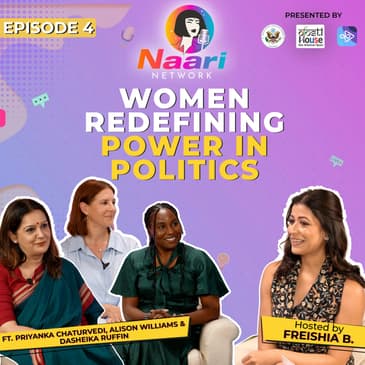

Join host Freishia B. on the Naari Network for a compelling discussion with Alison Williams, Dasheika Ruffin, and Priyanka Chaturvedi. This episode delves into the evolving landscape of women in politics, exploring the challenges of representation, leadership hurdles, and impactful policies for female empowerment. Hear from these influential women as they share insights on overcoming barriers, the importance of mentorship, and the urgent need for equitable support systems. Don't miss their inspiring stories and learn how they are making significant strides in the political arena.
[00:00:00] If I want to wear the brightest shade of sari today, I will wear it. If I want to wear the brightest shade of red lipstick on my lips in the parliament, I will do it. Right? We also have this term in America called the glass cliff. Where women are called in to solve a problem and not given the resources to solve it. If they don't give you a seat at the table, bring a folding chair. Right? And that is something that I live on, but I actually add my own. And once you get a seat at that table, make sure you move over and leave room for your sister.
[00:00:29] It wasn't until 1974 that American women could even own a credit card in their own name. Oh! What motivates you to keep going? I always say this, I don't want to be a footnote in history. I want to be the one who's writing the history. Right? Yeah. That has been something which kind of motivates me. As we say, young women, may we know them, may we make them stronger and may we bring them up into a more equitable and more diverse world.
[00:00:53] I'm Frishia, a master of ceremonies, a TEDx speaker, content creator and the founder of Kata Cleanup, a beach clean up movement.
[00:01:19] In this episode, we're going to get into the evolving landscape of women in politics. We're going to explore the challenges of representation, leadership hurdles, the impact that policies of course have on female empowerment. So join us as we examine global perspectives. We're going to uncover insights and I hope that they can guide and inspire those that are looking to make a difference in the political arena.
[00:01:45] Today, we are joined by Alison Williams, a seasoned strategic planning consultant with a rich background in nonprofit and corporate sectors. Formerly the chief of staff to the Arkansas governor, Asa Hutchinson, Alison has managed policy development, communications, as well as spearheaded the state's first women's commission in nearly 50 years.
[00:02:10] Her work is focused on breaking down barriers for women in the workforce through impactful community engagement. Our next guest is a seasoned attorney advocate. She's a political operator with over 20 years of experience. She currently leads global community engagement and DEI strategies at Google. Her expertise and her insights are definitely going to help us shape impactful strategies that are truly inspiring.
[00:02:40] We're thrilled to have Priyanka Chaturvedi with us today. She's a prominent Indian politician. She's serving as a member of parliament in the Rajya Sabha from Maharashtra and as a deputy leader of the Shiv Sena. With her strong leadership and commitment to political reform, Priyanka brings valuable insights into the evolving landscape of women in Indian politics.
[00:03:04] Thank you, first of all, for coming and joining us all the way from the United States. And Priyanka, thank you for, you know, just marking your calendar and taking the time out to be here. Thank you so much. Thank you so much for having me over. Thank you. We're talking about women in politics. And more importantly, we're also helping young women try and navigate this space. And what they can achieve and what direction they can take.
[00:03:33] Maybe even learn from some mistakes along the way. And maybe also try and understand what would be the right way for them to navigate their path when it comes to the world of politics.
[00:03:45] But in India, we have some very alarming figures. And actually, Priyanka, I've taken this from an article that you published a couple of months back, where you spoke about how today our country stands at the hundred and fortieth rank in the UN when it comes to women in politics. And this is a very recent report from 2023. So clearly, we have a lot of work that needs to be done.
[00:04:14] And what do you think this says about us when it comes to representation of women in politics? What it says about us is that we were a very forward thinking nation when we were coming up with our constitution, where we gave women the equal rights, which many countries had to struggle for, even for voting rights. And where we thought we are equal to just about everyone. We are equal citizens. What it also talks about us is how we created barricades and barriers for women to enter the political spaces.
[00:04:44] And we made it a very male dominated space. What it also speaks about us is that we have now come to terms to realize and understand that while women are coming out and voting in larger numbers, they're voting their mind. We don't have adequate representation of women in political spaces. So how do we bring down those barriers? There was one movement where we began to empower them through local bodies, and we brought in a 33% reservation, which was a very forward thinking policy at that point in time.
[00:05:11] Of course, there were a lot of, I would say there were a lot of negatives also that came along with it, where men were actually controlling their wives and their sisters or whatever to be able to handle their responsibilities. But now we've also come up with the reservation in assemblies and the parliament, which is a 33% reservation. What is unfortunate and what is holding us back is that it will only be applicable from 2029.
[00:05:38] It is not coming into effect immediately like how the earlier provision was, the, you know, the amendment that we made to our constitution. So what is definitely holding us back is a not having adequate representation because the barriers were created. Second, women not choosing politics as a space to contribute, where they feel that they are up for a lot of criticism. They are up for a lot of character assassination. The future is uncertain. They do not know whether they will get these opportunities.
[00:06:07] So those are challenges that we as women face. I have walked that road. I have understood the journey. I would only hope this conversation will lead to making younger women more confident to enter this arena and be, you know, I would be, I would say the decision makers of their own destiny and the country's destiny too. From what I've also seen when statistically it comes to the United States, unfortunately, I don't think it's any more different.
[00:06:34] From the numbers that I've pulled out, it says that there are only roughly 25% of just women that are in politics. And what do you think is the reason? What is holding a lot of women back? Yeah, I mean, the U.S. faces a lot of the same barriers that women in India who are embarking on political careers face, right? The social economic standards. So many times women are the caretakers of their family, right?
[00:07:03] And we're not just talking about mothers and children. We're talking about extended family where they're caretakers. And so those considerations are important when you're going to dedicate your life to public service. There's also other barriers. So in the United States, we are, while we have a third party, but it's mainly a two-party system. And so if you don't have the support and the backing of your party, you don't have the resources to run, right?
[00:07:31] And a lot of the parties are not necessarily as advanced when it comes to investing in women candidates, investing in the leadership, investing in the way that we run for office, right? And then the main barrier that I actually have seen, and this is even before you get to the larger investments and some of the barriers, but it's a symptom that we know as called imposter syndrome, right?
[00:07:57] So many women, even though they're the most qualified, deal with this fact of like, am I qualified? Can I actually really make a change in my community, right? And so we see, I work with women candidates all the time. We see it takes at least seven touches, seven asks for a woman to run for office, right? Which is very different than the male counterparts. Usually, you know, they wake up one day and say, I'm going to run for office, and then they just do it, right?
[00:08:26] And so when you take a qualified woman, you have to ask her seven times. And it has to be seven different times, right? Different perspectives of people asking, you are qualified, you're already doing the work. Without the title, right? Without the prestige, you're already doing the work in your community. Why don't you run for office? And so it is a, it's an institutionalized thing where you're, the framework of thinking, well, maybe I can't make a difference.
[00:08:54] I should just do it at home and locally when they're already doing the work. And so those are some of the main barriers that I see all the time. I mean, there's plenty of more, but yeah. So then what do you think can be done? What do you think could be the support systems that can be extended to allow women to take on this journey?
[00:09:15] Well, certainly one of the things that has happened, our Federal Election Commission has now allowed child care costs to be considered a valid campaign cost. So things like that, that didn't exist before we had so many women in political races, really matter to women who want to be able to either have their children with them or to pay for child care when they're not with them. This helps male candidates as well, but it's, it was brought to the forefront by, by female candidates.
[00:09:41] And in 2022, I led the Women's Commission in Arkansas and child care was the main barrier for women in any part of the workforce. But other things were financial education and financial literacy. So what, how do women know about managing their finances? It wasn't until 1974 that American women could even own a credit card in their own name.
[00:10:04] And so there are things that are relatively new in American history that are really beginning to accelerate women in politics and in the workforce. So Priyanka, then moving this a little bit to India now, what do you think we can do in our country as well, where we can support women to venture out more politically?
[00:10:30] So two, three things which I see as barriers for women usually, a, the mindset, the public mindset about women in political spaces. It's always like, oh, you know, she's coming to politics, either she comes from a political family or she's some already established celebrity who's now choosing to get into politics to change the world. Yeah. People like us who come from totally non-political background with no money bags, but a commitment to serve the cause of the nation.
[00:10:58] Right. So how do we make a pipeline of young, bright, talented women who wish to contribute to these spaces? Political parties need to be committed. If they are not giving them, you know, they are not putting them up as candidates, they're ensuring that they have equally important voices within the organization, within the political organization. Right. I think that begins, that's part one. That's part one. Then having women within the organization making decisions for, you know, who the candidate would be.
[00:11:27] Most of the time, women go up to the position of, you know, being willing to contest, but being let down by the election committees. Who think, oh, she's not the winning candidate. Let's put a male here. He'll be able to struggle because it's a tough constituency. Women can be tough too. Yeah. And when it comes to winning, they are more committed to the idea of winning because they have a lot more to prove. Like you said, imposter syndrome, they have to get out of their own imposter syndrome. Exactly. That, yes, I can do this. So those are things that we can help.
[00:11:55] Also skilling them when they jump into politics, when they choose to serve the cause of their political party, ensure that they are motivated enough to sustain this journey. Second, committed enough for a political party to invest in you and invest in your future growth trajectory. So those are things which works both ways.
[00:12:16] And for women also to find that support system within their families that this is an uncertain journey I'm about to take, but I'm totally committed to it. And it would take an entire village to support my particular, you know, journey. So please come help me and make this happen. Right. So those are things which I would say would probably help enhance the quality of politics that we see and quality of voices that we see.
[00:12:43] So then talking about support, let's try and also look at support from a policy's point of view as well. Are there any specific policies that are now uniquely addressed specifically to women? Yeah. So after, like I said, the 2016 presidential election, you saw this boom of women who specifically ran for Congress. Right. And so in many and state legislative races. Right.
[00:13:11] And so in many of the general assemblies, especially in southern states, weren't used to accommodating women. Right. And so you saw some state legislators and state houses. They didn't have restrooms for women on the main floor. Right. Because they weren't used to accommodating women. Right. And so they had to rethink and refigure even their infrastructure to support women. Right.
[00:13:37] We also talked about the barriers of women being mothers and caretakers. Right. So there's an increase in lactation rooms, just things that we don't think about or people don't think about like every single day, but goes a long way when when a new mother wants to run for office. Right. We talked about child care. But there's all these other options and policies are coming to the forefront.
[00:14:06] There's also organizations. And I know you talked a little bit about that. But in the United States, even though the party hasn't been as strong as it should be in supporting and investing in women candidates and women running for office, there's an emergence of other organizations. They're coming in and filling in the gap. Right. Right. And so these organizations, their goal is to kind of train women. Right. What to expect when you're running for office.
[00:14:35] There's a misnomer of like everything is going to be out in the open when I run for office. You know, all my secrets and how do I deal with that. Right. Right. And so understanding the rules. Right. Right. Like FEC rules. Right. What it takes to be a candidate to get your name on a ballot. Just like having that support system to kind of understand the rules and the policy goes along with it. And it's gone a long way. So.
[00:15:03] So Alison, is there anything that you would want to add? I think policies. I think it's important. I think it's important. I think it's important. Less policies with a big P, capital P, and more in terms of office policies. Yeah. Finding women who are interested in reentering the workforce in particular and inviting them back into the workforce in a space where I know my office was female led.
[00:15:28] And so I actually ended up at one point having to tell my male colleagues that they couldn't let me hire another woman because we had so many women. Good problem. I realized my bias came about so naturally and how easy it is to just hire people that look or think like like I did.
[00:15:49] And and so really made a conscious effort to ensure that our office represented the entire state of Arkansas, not just, you know, some small snippet of a policy agenda. Yeah. Do you where do you feel like we're standing right now with policy? I think what she said is very interesting. A, she's also talking about having more women. Yeah. But that also is an unconscious bias. Yeah. Right.
[00:16:12] So how do we, we women, when we're talking about being in policy spaces, we want to make it more diverse and we want to make it more equitable, which is not how men think. I hate to say it. There are of course many allies who want to participate in this entire women empowerment journey. But it comes naturally to women to think of diversity, to look at equity, to look at being inclusive. So this is something she's made a conscious choice. She's realized is a bias. So that's a very interesting take that I take from this conversation.
[00:16:40] But as far as we are concerned, so we had our washrooms, we had the restrooms, of course, in the assemblies that that was a challenge. But representation, why we are not building a pipeline of women who are confident. Yeah. We are not creating those systems where we say, okay, so she may need support with social media. Yes, she's reluctant about sharing her entire personal life out there for public scrutiny. Because those are hesitations women have. Yeah. They have the sense of more responsibility. Yeah.
[00:17:09] And in terms of policy initiatives, we haven't really asked for any policy initiative except for reservation. We say that, hello, you know, equity, 48% of this country. However, in terms of representation in the lower house, we're just at about 13%. And in the upper house that I come from, it's about 10%. It's absolutely a very schooled representation. Representation. And now let's also look at, okay, I've come in as a member of parliament.
[00:17:39] But in terms of cabinet that makes for ministers, how diverse is it? So my only policy intervention at that time was first, let's open the door for a woman to be able to be in the parliament and in the assemblies. Yeah. Our GDP also, you know, is a shade lesser simply because we don't have enough women. And women talk about toilets, women talking about facilities, women talking about creches, women talking about having lactating rooms. We don't have any of that in the parliament.
[00:18:09] Yeah. When a child comes into the parliament, he's just coming as a guest for two, three hours, even if the mother is in the parliament. Hello, please go back home. There will be someone taking care of you while I finish my work in the parliament. Yeah. And somewhere outside. Yeah. Yeah. Yeah. Everyone's doing koochie koo, koochie koo. Okay. Get that down. Get to work. So yeah. What's interesting is everyone right now has also spoken about social media.
[00:18:37] And it seems, and I'm asking this absolutely from an outsider's purview. And as somebody who puts her life out there on social media all the time, it seems that for women in politics, there is of course a lot of hesitancy. Because how am I being perceived? How are people looking at some of the things that I am doing? So what do you think? So what do you think? How are we letting young women navigate themselves? Is there that perfect balance of how much you put out, don't put out?
[00:19:08] Who wants to go first? Because all three of you spoke about it. Yeah. Yeah. So I definitely think there is a perfect balance, but the key is not to curate a caricature of who you think someone should be. Right? So right now in the U.S., we are in this watershed moment where we can possibly elect not only the first woman, first black woman, first Indian American woman to the United States presidency. Right?
[00:19:37] And so the conversation around just the misogynistic sex, you know, I mean, the dialogue is crazy. Like I'm hearing, you know, she laughs too much. Right? She talks about cooking. She talks about, you know, and so it's these conversations that one, have never come into the political landscape. Right? Because we're usually talking about men.
[00:20:04] But because someone wants to come as their whole authentic self, now we have a problem. Right? And so one of the things I'm really grateful for, even though there is that rhetoric, it also humanizes her. And I feel like people are, you know, it's almost like a new breath of fresh air. Right? We're seeing like this is what a person is supposed to look like coming into the political arena as their whole authentic self.
[00:20:30] So I definitely believe while you should keep some things personal and you have to decide. I mean, that's a personal decision between you, your family, your campaign team. I know we don't talk a lot about that, but also the campaign team. And surely your team should know who you are. That's why I really believe in having women at the forefront, not just for running for office, but also managing those political campaigns. Right?
[00:20:55] Because it's important to understand the problems that women face as women candidates. Women operatives also know those as well. I think the same, I would give the same advice about social media that I would to any young woman, my niece, my nieces, anyone that we meet in these conversations that we're having here in India. And I think that's a good idea is it should be a reflection of who you are as a person.
[00:21:23] And if you are comfortable having your life in the public sphere, then absolutely you should continue with that. I would hate to think that anyone ever got bullied from putting something out that they wanted to share because they were afraid of the consequences. Those consequences should be addressed, those causing the consequences should be addressed, not the woman who decides to put that information out there. And so I think the authenticity matters. I personally am rarely on social media.
[00:21:52] I mean, I certainly am a consumer of it, but I made a very personal choice early on that I was not going to put a lot about my life in the social media sphere. And that works for me, whereas I have friends who put, you know, 12 pictures a day on social media. I know everything. I know what they ate for breakfast and I know what they had for dinner. So I come from the opposite spectrum. I'm a product of social media myself and I have no hesitation in saying it.
[00:22:20] My Twitter journey took me from where I was, where I was handling my own entrepreneurship business. And I came into political arena and from political arena to where I am. I have effectively used social media. And I'm also accused many times of putting up a lot of personal stuff out there for consumption on Instagram. But I have always been a person that this is who I am. Take it, leave it. I don't care for it. And I don't care for your opinion. Right? The only opinions that matter to me are of the people I love the most. Yeah.
[00:22:49] I care about the most. So my children's photos are there. My children, of course, have a problem with that. So most of the time on Instagram you'll see only my photo. Not my family. But because a lot of times photos have been picked up from my Instagram account, which is a public account. Yeah. Okay. So if I'm wearing my denims and I'm outside with my family, I will wear denims. If I'm wearing a dress, I will wear a dress. If I want to wear a saree today, I will wear a saree today. If I want to wear the brightest shade of saree today, I will wear it.
[00:23:18] If I want to wear the brightest shade of red lipstick on my face, on my lips in the parliament, I will do it. Right? So I'm often accused by my colleagues also that you're putting too much of your life out there for trolling, for a lot of pushback, a lot of character assassination. So I have developed a thick skin along the way. And sometimes my children, when they're reading comments, my daughter loves reading the comments. And there's such shady comments and there's such nonsensical comments about what I'm wearing,
[00:23:46] what I'm saying, how I look, am I looking too old? Is my hair looking out of shape? Whatever. It doesn't matter. It's just, I've told my children to learn to laugh at it. Yeah. Because their opinions don't matter. Their opinions haven't shaped me. I have shaped my own destiny. Right? So I'm out there in my Instagram, my Twitter. I speak my mind on Twitter. I get trolled for it. Okay. Thank you so much for at least engaging. So that is how it works for me. I mean, it's my personal idea, but many of my colleagues don't do that.
[00:24:14] No, hats off to you because it really takes a lot to say that I'm going to build that wall. I'm going to be thick skinned and this is exactly who I am. Yeah, because that's who I am. I cannot portray a certain image of myself, which is not. Yeah. Right? I'm not going to do that. Take it or leave it. Lump it. So then let's talk a little bit, of course, you know, with the initiatives that you have taken and the time that you have also taken where you've been leading a lot of Arkansas's first women commissions.
[00:24:44] And those have had a very significant impact, especially in reducing the barriers around women in the workforce. So do you want to tell us a little bit about those as well? I do. I'm really proud of the Women's Commission. So we worked for, we had a very short time period. We had 10 months to put together a report that went to the governor of the state and to the legislature of the state.
[00:25:05] And I recognized that because they were political elected officials, that they were not going to be in office much longer after the report was delivered. So it was very important to me that we find solutions that did not depend on political will to make them happen. And what we did instead was to find what I called sponsors of recommendations to carry the work of that recommendation beyond the delivery of the report.
[00:25:31] I think we've all been made aware of reports that tend to get put on a shelf and gather dust and don't get work. So we had sponsors for four of the eight recommendations that we made. The number one being to more meaningfully engage the business community in the conversation around child care. So what is the business community doing to make sure that women could easily, more easily be recruited and retained in positions?
[00:25:57] But there were also things like navigating government services that would make it easier for single women in particular, single mothers to get state benefits, federal benefits that would allow them to go back to school or go work more full time. And for each of these, we had outside sponsors who, again, would carry this work forward.
[00:26:19] The Women's Foundation of Arkansas continues to go on a statewide tour, taking the report back around to communities that we visited, but also to new communities to talk about resources that are available to them and things that are ongoing in their community. And so I'm very proud of the fact that now two years after leaving the governor's office, this report has legs and is still meaningful to women across the state. So impressive. Yeah, absolutely.
[00:26:46] And Dysheka, coming to you, of course, and with a lot of the work that you've been doing with DEI. I was today years old when I actually did learn the full form of diversity, equity and inclusion. I'm learning. I'm learning as I'm going. And I'm trying to navigate myself in this space.
[00:27:08] So reflecting on your diverse career that you have also had, and especially with unexpected global trends that we have seen within the space of DEI, how can young women leverage on those trends? And especially when it comes to their own careers, their entrepreneurial journeys? Yeah.
[00:27:31] So one of the kind of emerging, I guess, DEI byproducts, especially in the corporate world, is the emergence of employee action. Right. So you have these companies who have taken on the corporate responsibility lens. Right. Like I know here in India, the CSR work is kind of mandated. We don't have the luxury in the United States to mandate the work.
[00:28:00] So some of the companies have taken the mantle on their own. And so you're seeing a large part of employers and employees who are getting involved in DEI work on their own. Right. It's supposed to be on their own time. And the company gives resources. However, there's been a lot of support that comes with it. And so one of the things that I'm really seeing in the DEI work, you know, I come from a Google background. Right.
[00:28:26] And so the amount of women in the technological sector, especially in the United States, is not where it should be. Right. And so there's an increase in programs that to capture them. Right. And not just capture women at our age. Right. To capture them when they're young. And I mean, I'm not talking about just high school or a secondary. It's like primary school level.
[00:28:53] Because if you get them interested at coding and things of this nature in STEM early ages, then they're more likely to follow in that career. Right. Then once we talk about like the college level, university level, there's a conversation around how are we recruiting women. Right. Right. What are the mechanisms that we're using to make sure that they have the skills in order to get a job in Google or take advantage of some of the DEI programs. Right.
[00:29:21] And so being intentional about recruiting is a major factor in advancing DEI, both in the workspace and corporate space, but also in the political landscape. Right. And Priyanka, for you, was there any particular personal incident or a moment that led you down into the world of politics? Because you've already told us earlier that you've had like a different business that you were in and now you're here. What was that like?
[00:29:49] For me, I would say, and I have been saying this very often whenever I'm asked what got me into politics. It was the 2611 terror attacks that happened in Mumbai. I'm from Mumbai. I love the city brought up here, born and brought up here, considered amongst the safest cities of India. And the kind of terror attack that I saw it and it was at that time, televisions were covering it 24 seven.
[00:30:12] It had the attention of the world because there were so many people from across the world who were, you know, who were held hostage in that ongoing attack. And that moved me, that moved me just to a point of believing that I cannot be just a bystander in my city who loves a city, but is happy paying her taxes, is happy with her little family here and is not immediately connected to communities. Right.
[00:30:36] So that it began from there where I started to, I first aligned with a lot of women bloggers, but nothing to do with politics, would never into the social work kind of a space. But when lives were lost and those, especially those who were economically weaker, we handheld them. We handled about 12 to 14 families who had lost their only earning member in that terror attack. Wow. And it was the Tata Foundation who took over after a year from then.
[00:31:05] But that kind of changed my entire perspective on life. And I felt that I have to be a part of this policy making spaces to make safer spaces, to make people more aware. I run a program for women which talks about why women should be involved in their communities, in their societies. Where we take graduate girls, girls who have just graduated. Most of the courses are post-graduates, most of the internship and fellowship that is offered.
[00:31:31] What I do is I give them a six-month program where three months they intern with women parliamentarians. And most of the time women parliamentarians are not effective contributors simply because they are there to placeholders. Okay. Not more as to show that there is representation. And many times they don't get fellows to help them, assist them, research assistants. So they help them for three months for one particular session. And then they have a three-month policy, intensive policy understanding.
[00:31:59] So that even if they choose politics or even if they become citizens, they have to be aware citizens. They have to be citizens who understand what is impacting their immediate vicinity. So that is how it began for me. And I continue to get more and more passionate about it. And the more involved I was, the more I was driven. So it started from there. And then I got into politics because I felt you need a platform to be able to make those changes, to have a voice in the system.
[00:32:29] So every time I speak in the parliament, I come from that space of what changed my course of what I was doing, happily living with my family, a content life, to something like this. So for me, everything takes me to an intersectionality of how women suffer the consequences of some policy where it's not thought through. Many times I'm accused of it also. Many times I'm accused of it. Why do you bring a moment angle to everything? Because women are impacted.
[00:32:58] And we're not talking about it enough. So that is where I come from. And were those policies for women made by women? Absolutely. You don't really, you just need to have a voice there, right? How is a policy going to impact a woman? Her life, her family, her community. So that is what I end up doing most of the time. We also have this term in America called the glass cliff. Yeah. Where women are called in to solve a problem and not given the resources to solve it.
[00:33:27] And so I think to your point, things impact women. But then we are also often called in to clean up the mess that was created. Yeah. Absolutely. I like that. The glass cliff. Glass cliff. Glass ceiling, glass cliff. I see something. And you have to shatter those glasses. Sharing all of the glasses. Where am I still at? I'm going to crush them right now. But let's also talk about support now.
[00:33:53] You know, was there, and this I'm going to ask all three of you. And I'll start with you, Priyanka. In this entire journey, was there like a surprising alley that suddenly showed up from somewhere? Yeah. Not really. Yeah. It is a lonely journey. And in India, a lot of women, I think women across the world, they look for mentors. They look for somebody who they can learn from.
[00:34:17] And unfortunately, there was no, I mean, I wouldn't want to do disservice by saying that there were not many inspiring figures. There were many. But someone who I could, you know, who could handhold me and tell me that this is the path. So that is where I felt a sense of responsibility that I have walked this journey. And it is my responsibility to give back. And that is how this entire fellowship program began. That let's have women who understand, most of the time they're silenced on social media. They don't know, you don't know enough.
[00:34:47] How much do you know about this issue? How much do you know about the economy? How much do you know about crypto? How much do you know about fintech? Most of the time they're silenced, right? So when they go, they make an impact and they're able to hold onto their own. And so I wouldn't say there was any one person who helped me in this journey. Like I said, it's been a collective effort. A lot of learning. A lot of pushback. A lot of changes. A lot of highs. A lot of lows. But I have like seen through this journey.
[00:35:14] But I guess on the way, someone or the other gives you a sense of purpose, a sense of direction, a sense of motivation. And that in itself is the biggest contributor. Because you have to be self-motivated in this particular line of work. Yeah. Yeah. Allison, what about you? I think self-confidence is so important to make it in any of these spaces.
[00:35:35] I was lucky in that I had a director of a program in college that I worked for who was very encouraging to me. I was a first-generation college student. And so she really helped me navigate the systems and understand what was expected of me and what was expected of me in the community. She then later became the chief of staff to Asa Hutchinson, who was then in Congress. I moved out to Washington, D.C. and worked with her.
[00:36:03] And then, of course, I ended up working with Asa for over 25 years off and on. And so that was a little bit of right place at the right time. But I think to your point, being able to, whether it's thick skin or it's just confidence, self-assurance, a good network of friends and family that support you.
[00:36:22] So for me, that has been the key to when I have the hardest periods in a very important work to keep going and to pursue even higher goals. Absolutely. Absolutely. Yeah, similar. I was blessed to have mentors. So I entered the political arena by accident. I was in college and I led a protest. And that caught the attention of the local member of Congress who was a woman at the time.
[00:36:51] She kind of took me under her wing. I was taken to D.C. to meet with other women in the political space. And one of the things that was engraved in me very early on was the lack of women that were in the space. Right. And specifically women of color. And so while I didn't have any intentions on continuing politics, that always stuck out to me. Right.
[00:37:17] And so as I grew in this political arena, I realized in many of the spaces I was the only woman. Right. And many of the candidates I was working for, they have the first behind them. The first woman elected here, the first woman of color. Right. And so it almost became unexpectedly, but like a mission that I sat out for. Right. One of my mentors who I've never met, she passed away before I was even born.
[00:37:47] But I guided myself and rooted in her is Shirley Chisholm. So she was the first black woman to run for United States president. So if you hear Vice President Harris talking about some of the influences in her life, she talks a lot about Shirley Chisholm. And so one of Shirley Chisholm's famous quote is, if they don't give you a seat at the table, bring a folding chair. Right. And that is something that I live on, but I actually add my own.
[00:38:14] And once you get a seat at that table, make sure you move over and leave room for your sister. And so that's kind of the guiding light and the guiding posts that I live by and I work by in this world. When I when I make it to a milestone, I make sure I turn back and help another woman get in that space because it was that same thing was given to me. But for all three of you, what motivates you to keep going in spite of the challenges that you wake up to every single day?
[00:38:42] You know, and you all have been on this path and been on this journey for so long. And it's very easy for someone to just get beaten down, not feel very encouraged, not feel motivated. Like, what's your secret sauce? Stubbornness. I always say this. I don't want to be a footnote in history. I want to be the one who's writing the history. Yeah. That has been something which kind of motivates me every time I'm down.
[00:39:12] Obviously, there are times when I feel absolutely low on motivation. I go off social media. I go off everything that I'm doing. I take time out. I read a book. I do what I have to just charge myself enough to come back with a vengeance. But it's always with a vengeance. In a sense that you have to do better. You can't just give up. So I think that being stubborn, stubborn about the life you've chosen. So I have two final questions for both of you, all three of you. Sorry.
[00:39:40] I have two final questions for everyone over here. What's one major change that you would like to see that gets implemented across all sectors so that we can ensure that women have equitable support as well in their careers? Yes. Hmm. Hmm. Hmm. Hmm. Okay. That's a tough one. One thing. Only one. Only one. We've got the reservation out of the way. Yes.
[00:40:09] And you've done some fantastic work. Yes. So we've got the reservation out of the way. And I'm so happy that it was a part of that history making act that hopefully when the girls and the women participate in the political system, you will at least acknowledge it. But even then, I would say that one thing would be ensuring that there's a 33% representation
[00:40:34] committed by the government and by the legislature to make space for women. Yeah. For me, it would be ensuring access to quality childcare for women or for all families. And even though that doesn't benefit every woman, I don't have children myself, but I see the impact that it makes on other women in the community and the impact that it takes on their performance in the workplace.
[00:41:02] And so that is a fundamental, I think, in any society. And the United States doesn't have universal childcare and pre-K. And so what ends up happening is that the higher socioeconomic strata can afford to have their children in daycare and work, and the lower economic strata cannot. So for me, that's foundational to future work. That's wonderful, Alison, that you're actually able to champion for a cause and have a lot of
[00:41:32] have a cause on your agenda that is not something that's personal. And, you know, put yourself in someone else's shoes and say that this needs to be done for society to move further. Yeah. I guess for me, if I had to pick one... Okay, Daishika, I'll give you two. She was like, one is not fair. I mean, because there's so many. I would start with one of the topics that we didn't talk much about,
[00:42:01] that is the emergence of women in the entrepreneurial space, right? And so helping like those mandates of minority owned business contractors and making sure that they have access to the resources that they need. But I would actually like to see us actually achieve pay equity, right? So we talked a little bit about the Lilly Ledbetter Act, the Fair Pay Act.
[00:42:30] Roughly women make 77 cents on the dollar compared to men. And that's just white women, right? So when we started bringing in women of color, the numbers go down, right? And so we have been talking about this for a very long time. There are studies, there's evidence, there's polling why this should not be a disparity anymore. And we still see it resurface over and over.
[00:42:54] So finally solving for this issue, I think one, will put women in a better position. One, to achieve the career path they want to see, but also run for office and manage campaigns and things of that nature. But also it will just put us back in that utopian society that we're seeking to achieve. All right. I think this has also given me the answer for what should have been my last question.
[00:43:25] You all covered it over there as well. All right. Thank you all so, so much for joining us. And, you know, as we say, young women, may we know them, may we make them stronger and may we bring them up into a more equitable and a more diverse world. I hope that they do watch this episode and get truly, truly inspired by all three of you. Thank you all so much for joining us. Thank you so much for having us. Thank you.
[00:43:53] Thank you for joining us on this very powerful episode on the Nari Network. Today's discussion with Alison, Dasheka and Priyanka has illuminated the incredible strides that women are making in politics. And of course, we are looking at the challenges that we still have ahead. Their insights do remind us that women are not just participants, but they're leaders, they're change makers in the current political arena.
[00:44:19] Catch their inspiring stories on YouTube, Spotify, or maybe your favorite podcast platform and continue advocating for gender equality in all sectors. Until next time. Ciao.