
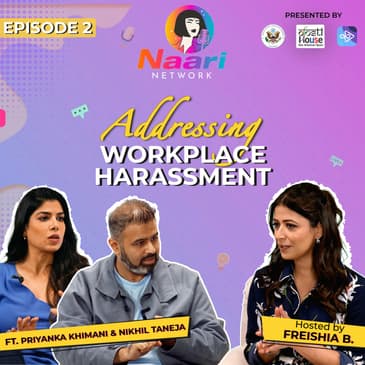
On this episode of The Naari Network, we are joined by dynamic entrepreneur Nikhil Taneja and leading global entertainment lawyer Priyanka Khimani to discuss the critical issue of workplace harassment faced by women. They explore various aspects of harassment, including power dynamics, microaggressions, and the importance of fostering empathetic workplaces. The guests share personal anecdotes, highlight the role of social media, and offer practical strategies for leaders and employees to create safer, more respectful environments. Tune in for valuable insights on how we can all contribute to making workplaces across India more inclusive and supportive.
[00:00:00] So if you are a leader in an organization, you have to ensure that some of this s**t is not taken for granted. You have to have that no a** policy and it has to be consistent policy.
[00:00:11] Every woman will agree when I say this, we always know. You instinctively know when the touch isn't correct.
[00:00:19] And if you look at some of the women who have accused men during MeToo in India, a lot of them haven't actually found enough work afterwards and the men have continued working.
[00:00:27] In a lot of places till date, I've seen that it's usually the person that's in the lesser position of power that will end up bearing the consequences.
[00:00:37] The ideal workplace for me actually very simply if I had to put it in one word is a workplace that is empathetic. Don't be a silent person. If you consider yourself a decent person, if you are in a position to do something about it, do something about it.
[00:00:51] Hi there, I am Freesia. I'm an award-winning master of ceremonies. I'm a content creator and a TEDx speaker.
[00:01:14] And welcome to today's episode where we are going to tackle the crucial issue of workplace harassment faced by women.
[00:01:22] Together, let's discover how each of us can contribute to creating a more safer, more respectful workplace for women across India.
[00:01:30] Joining us today is Nikhil Taneja, a dynamic entrepreneur. He's a storyteller and a mental health advocate.
[00:01:38] He is the co-founder of YUVA, a purpose-driven youth media organization that speaks on very meaningful conversations on mental health as well as gender.
[00:01:48] Our next guest is Priyanka Khimani, a leading global expert in entertainment as well as music rights.
[00:01:54] Priyanka is a key player in the industry. She's navigating high profile deals and strategic partnerships with star-studded clients.
[00:02:03] Priyanka is also the visionary behind Women of Music India, a vibrant community that is supporting women in the music industry.
[00:02:11] So guys, just to like get into the mood a little bit. Can you tell me something about you that a Google search would never tell me?
[00:02:23] Nikhil, you go first. I'm just thinking because I put so much of my life online. I'm just trying to think what is it in my life that I don't put online.
[00:02:30] It's such a like everything in my life. Oh, I have one. But you go, you go first. I'm just thinking if you have one please.
[00:02:37] Yeah, so you go and he'll get inspired. Yeah, possibly 100%.
[00:02:41] I have very severe misophonia. For those of you who don't know what misophonia is, it is the reaction to sounds of people chewing food, which can extend into, you know, loud crunching, people chewing with their mouth open, breathing.
[00:03:00] Yeah, so severe, severe misophonia. So much so that in our office, there's like, I think there's an entire section devoted to things not to do around Priyanka, which includes don't walk in with a slice of cucumber.
[00:03:13] Don't generally walk in with popcorn chips, anything like not around her. Yeah, it's very bad.
[00:03:18] God. So if somebody wants to psych you, they need to send you a mukbang video. Yeah, there have been moments that I've logged off a call because I can hear the person chewing or talking with their, yeah, talking while there's food in their mouth. It's a mess. It's more than a pet peeve.
[00:03:34] Amazing.
[00:03:36] Yes.
[00:03:36] It's difficult to try that.
[00:03:37] Yeah, that is really good.
[00:03:39] No, no, but you don't.
[00:03:39] This is such an interesting fact.
[00:03:42] All my interesting thing is that because I am perennially online and you know, I also have a, and I've been one of the early adopters of the internet from a sense of I was one of the, I think the first few people on Twitter also. I've been on Twitter since it launched in India.
[00:03:56] So I'm like, I am someone who has my full name on every platform because I was one of the first few people. Yeah. So I have actually put everything of my life on the internet. I'm just thinking what is not, I would say the only thing I can think of right now is which is only private activity I suppose I do.
[00:04:14] I make like these lists of movies and TV shows that I watch for the last 10 years. I've been doing that. Like I rank just for myself. This is not like a public service in that sense. It's just for me. Yeah.
[00:04:25] I just watch it. I watch a lot of TV. I watch a lot of movies. And then I just keep ranking them like every year, like this is my list of so I have going back to 2011-12. I have like lists of every year what I've seen, what I've liked, what I've disliked.
[00:04:41] Wow. And then in Excel sheets and they're all ranked in different places. They're ranked by where I saw them. They watch it in theater. They watch it at home.
[00:04:49] But why is this not online?
[00:04:51] But I also feel like we don't have so many sites like this for Indian audiences. Like there's Rotten Tomatoes and there's IMDb which will give you the rankings. And I feel like very soon coming from India, we're going to have like the Nikhal meter.
[00:05:08] No, no. I'll tell you why I don't put it out. Oh, I love that. Because a lot of the people who are actually working on these shows and movies are friends of mine. So the moment I start putting this out, then I will have questions.
[00:05:18] Right. So I prefer to keep this private and just be like, oh, I really like this but not as much. You know, so yeah.
[00:05:25] How is it feeling right now? I know that we're swapping places.
[00:05:28] I mean, as I said earlier as well, I'm much more comfortable on that side than this one because, you know, unlike Priyanka, I don't have that many interesting things to say beyond a point.
[00:05:39] So I'm always like thinking and making sure that I also feel like given that as a host, I am always in my head thinking of, you know, is the guest being interesting enough or not?
[00:05:48] I'm always thinking of, you know, will this episode be good or not? So the moment I'm a guest, I also have that. I feel like there is a pressure I know you have.
[00:05:56] Yeah. That I should be interesting. So there's a lot.
[00:06:00] Okay. No, no, no.
[00:06:02] I should not let Frisha down today. You know, not at all. And you've actually had such an interesting trajectory with your work and you've worked in some very interesting places also in your career.
[00:06:19] What would you define as the ideal workplace?
[00:06:24] The ideal workplace for me actually very simply if I had to put it in one word is a workplace that is empathetic. You know, I feel like I have worked in enough places that were just, you know, we've started talking about the word toxic right now.
[00:06:40] We've started understanding what toxic means now. There is a conversation around what not to be done in the workplace.
[00:06:47] But when I think as millennials, when you're in the workplaces, this was almost expected behavior, you know, out working beyond office hours, not getting paid for that.
[00:06:59] You know, sometimes just having work on the weekends without that seeming as almost as an expectation that, yeah, obviously, you know, if you're working and if I'm paying you, then I own your life.
[00:07:10] And that's something that I feel like especially in the media industry, it's almost seen, you look down upon if you are not matching up to the standards of the organization has for you.
[00:07:23] So it doesn't matter how you are as a human being, it really depends upon if I'm paying you this, then at any point of time, I can have work for you and you should live up to that.
[00:07:32] And I feel like that's now also true for many other industries.
[00:07:35] So I would say that an ideal workplace is that is something that's empathetic to the employees and recognizing that the employees of the office and the workplace aren't just IDs, you know, they're just not a number in the system.
[00:07:49] They're human beings with lives of their own, recognizing that, being compassionate about that, looking at the development of a person in the workplace from a holistic way versus just like what can I get out of this person.
[00:08:01] So kind and empathetic is possibly the most important thing for me.
[00:08:05] Do you think the ideal workplace can exist?
[00:08:11] Hell yeah, I think so.
[00:08:13] I mean, I think we can, I can speak safely for Nikhil and myself.
[00:08:18] I feel in, you know, in our respective journeys, we've gone above and beyond to create workplaces that like he said, right?
[00:08:27] I mean, I call it professional empathy is the term that I use.
[00:08:30] And we say it express it to, it extends to both, right?
[00:08:33] To your clients as well as to your colleagues at work.
[00:08:35] But again, he and I come from similar cultures where we've seen what a truly abusive task force can look like.
[00:08:42] Entertainment, the legal fraternity is no better.
[00:08:45] And I think we've gone above and beyond to make sure that we create an environment that is, that has, I don't want to use the term work life balance loosely.
[00:08:53] But I think you create an environment that's conducive, right?
[00:08:56] Where you let people find accountability, find how they can be responsible.
[00:09:02] Like for years and years, for example, we've never had a leave policy, right?
[00:09:04] And not felt the need to.
[00:09:05] It's been over 10 years now since I've run the place.
[00:09:08] And I don't think we've ever had a situation where someone has taken undue advantage of it.
[00:09:12] Because I think the minute you induce that, they'll make their choices in a way that, you know, they know they're accountable and responsible towards the work that they're doing.
[00:09:20] So yes, I very much think it's possible.
[00:09:23] I don't think it's easy.
[00:09:25] Yeah, it's very top down.
[00:09:28] It is very difficult.
[00:09:30] It comes at a steep cost to you as the leader, as the founder, to you as an employer, to your clients, right?
[00:09:39] Because ultimately, they're going to turn around and say, oh, but how come nobody's responding to me?
[00:09:43] You know, it's totally okay.
[00:09:45] I feel only in India that someone can send you something on a Friday evening and think that they will still have a response.
[00:09:50] Right? It's unheard of saying you, why don't we wait until Monday?
[00:09:54] Correct.
[00:09:55] Like I said, it's doable, but it's definitely not easy.
[00:09:59] And it's a give and take, right?
[00:10:01] Because the making of an ideal workplace is not just about the employer.
[00:10:08] It's also the people around, the employees, how they react with each other and the environment that everyone kind of like ultimately makes.
[00:10:18] And one of the things that, you know, we really wanted to focus on, especially on this episode also was how can we create that safe workplace?
[00:10:27] And of course, yes, this is the Nari Network. And we would be talking about creating a safer workplace for women.
[00:10:34] I do want to also acknowledge the fact that harassment is both ways. It can be both ways.
[00:10:41] So, you know, Nikhil, just starting with you, how do you think that we can create a safe workplace and a working environment?
[00:10:50] You know, I feel like empathy and what Priyanka called professional empathy.
[00:10:57] I think that's a decision. It's not something that, you know, it's not just an expectation.
[00:11:04] It is something that everybody in the company has to come on board with.
[00:11:08] It has to be something that has to be a joint effort of the entire workplace.
[00:11:16] As you said so rightly, right? It is, it goes every way.
[00:11:19] So you can't have a system where, you know, if for example, leaders are being empathetic, then the employees are taking advantage of that.
[00:11:27] Or for that matter, the employees are creating systems, but the leaders really don't care about those systems every way.
[00:11:34] It is, it is, if we want to encourage cultures that are safe for everybody, then they truly need to be safe for everybody.
[00:11:43] But that's something I feel like we're still understanding, especially in an environment where, you know, now we started to understand, we've just started learning and recognizing the needs of different communities in different ways.
[00:11:57] As an example, when we're talking about women at the workplace, there is still so many companies that don't give menstrual leaves, that don't understand what the reason for that is.
[00:12:07] There is, we are still just now recognizing how do we make inclusive environments for people from the LGBTQ community or for that matter, you know, people who are differently abled, neurodivergent people.
[00:12:20] We don't have policies for that right now that are truly inclusive, but that inclusivity again, I feel like it really, it starts top down, but it also has to be peer to peer.
[00:12:31] You know, you can't make sure if, if, if, if the head of the company is doing whatever they can to create a better environment for the people, the people also need to uphold that environment with each other.
[00:12:44] So it is a decision and it's also discipline.
[00:12:47] You have to ensure that you are being kinder to each other in general.
[00:12:51] How does that interact with professional discipline?
[00:12:54] That's always the, the difficulty.
[00:12:57] How do you put boundaries there?
[00:12:59] How do you ensure that you're also not overburdening each other or yourself in trying to make this happen?
[00:13:04] You can't be kind at the, at the, I mean, cost of, I was going to say risk, but not the risk, right?
[00:13:12] But how do you be kind at the cost of, at the cost of your company's growth?
[00:13:19] That's something that, you know, ultimately you, no company can actually do.
[00:13:23] So if everyone really comes together and decides that this is something that we need to do together as a team and as a unit, then it's something that you can actually pull off.
[00:13:31] But if, if everybody has a different understanding of what that means, that's where the issues start.
[00:13:36] Issues will start.
[00:13:37] What do you think?
[00:13:38] I, I just feel, you know, there's, there's so many different elements to look at culturally, socially as well.
[00:13:45] Yeah.
[00:13:46] When it comes to ensuring workplace safety.
[00:13:49] Yeah.
[00:13:49] And I think to what Nikhil is saying, right?
[00:13:52] It is a, it's sure it may start from one person taking the initiative, but it is collective effort, right?
[00:13:59] It is something that has to be ingrained in the ethos, in the culture of the place.
[00:14:02] I've personally, you know, I, one of the big reasons for me to move out and start my own law firm when we did over 10 years ago.
[00:14:12] A big part of it was culture.
[00:14:14] Same, same. Absolutely.
[00:14:16] Right?
[00:14:16] I think that we had worked in so many different places here, outside and, you know, within the legal industry, within the entertainment industry.
[00:14:22] And I knew that the one thing that I wanted to do was set a place, create a place where I was proud of the culture that we were going to inculcate.
[00:14:32] It has to become almost agnostic of who came in to run the place in the future, right?
[00:14:36] Today it has my name on the door.
[00:14:38] It could be somebody else, but the value system has to be the same.
[00:14:42] And again, I'm going back to the industries that we're from, right?
[00:14:45] They're not easy places to be in.
[00:14:48] They're very tricky.
[00:14:50] I personally have been in a lot of situations that are not easy to navigate.
[00:14:54] And I won't get into those for the time being, but I therefore feel it's a conscious decision.
[00:14:59] And I think being, you know, what amounts to safety is also you having a year to the ground.
[00:15:04] That I think safety can mean different things really for different groups of people, for different communities, different genders.
[00:15:12] So I feel it's also as founders, as leaders, having a year to the ground and understanding what is safety for them.
[00:15:21] So well said.
[00:15:22] And how do we contribute towards creating that environment?
[00:15:25] That's one.
[00:15:26] The other is a dialogue, right?
[00:15:28] Because again, sometimes when things become very top-down, think, okay, I've done my homework.
[00:15:32] I sat down with this particular group of persons.
[00:15:34] I understood what they want.
[00:15:35] And now this is policy across the board.
[00:15:39] Without having a dialogue from the others who are actually going to be in that environment saying, does this work?
[00:15:45] Is this going to create barriers?
[00:15:48] Like he said, it can't come at the cost of growth, right?
[00:15:50] Is this going to create barriers in your workflow?
[00:15:53] Is this going to affect a certain output towards the client, etc.
[00:15:56] So I feel, understand it, have a dialogue and then implement something.
[00:16:02] And you know, to one other thing that Nikhil mentioned, I also want to quickly say, I feel that is culturally, this instinct in us that we are so resistant to abiding with policy or law.
[00:16:13] I'll give a simple example, maternity leave, right?
[00:16:15] Where it says six months.
[00:16:17] I will have organizations coming up with all sorts of creative ideas as to why it isn't applicable to them.
[00:16:25] And I'm saying, not just, you know, the smaller setups who feel like, look, I have a tiny team and every person is indispensable.
[00:16:33] You know, I can't let somebody go for six months.
[00:16:35] I'm talking about sophisticated professionals, you know, somebody who's leading a celebrity setup, right?
[00:16:41] Who feels like, no, why? Why should I do six months?
[00:16:45] We don't have this applicable.
[00:16:46] You know, either I'm not some company above a certain threshold or I'm a proprietorship or whatever is the argument.
[00:16:52] And I'm like, just sit and some of these are women led, right?
[00:16:55] But I'm like, sit back and understand what is the spirit of the law?
[00:16:58] Why was it introduced?
[00:17:01] So I just feel that culturally that instinct that we have, how do I succumbent?
[00:17:06] I'll just add something to this. It's so interesting that every time we try to implement a policy, which has been very pro people, you realize that, and you kind of have so many people telling you don't do this.
[00:17:17] This is not going to work. This is not something that will, you know, you are actually making sure that your company isn't going to be in a loss if you're not implementing this, right?
[00:17:27] But people themselves don't take this up as much as we think they will. We had our first person in our team to go on maternity leave.
[00:17:37] We gave her a complete, we said work from home, even during her pregnancy. Last trimester, we said work from home.
[00:17:42] And you start to leave, after six months, and if you want to take even further, it's all good.
[00:17:49] She came back in I think two and a half months. She's like, I can't sit at home for that long.
[00:17:54] Like, I need to get out and I need to make sure that I feel worthy of, you know, I mean, in my life, I'm not just, and that's the brilliant thing about today's culture, right?
[00:18:04] Women want to make sure that they are a part of every aspect of their lives, that they are not just mothers and they're not just professionals.
[00:18:12] If they want to choose to be both great, good for them. So then even if we had given her a certain amount of free space and free will, and I've seen this also in the mental health policy as an example.
[00:18:23] So many people have told, warned me, don't put a mental health policy because young people are entitled, Gen Z is going to misuse it.
[00:18:30] They're going to take it for granted, etc. I'm telling you, I have probably had maybe three people in our entire five or six years who've actually taken a mental health leave.
[00:18:39] Like it's been, we have to constantly keep telling people, please take this leave. It's meant for you, but they don't take it because it's a, it's so hard to kind of go up to your manager or an HR and say, oh, I'm going through something with my mental health.
[00:18:53] Because you don't want to come across as weak.
[00:18:55] Exactly. So it's such a huge barrier that people don't even feel like we don't want to. Yeah, we don't. It's so hard to be that vulnerable in a professional environment.
[00:19:03] But that's what the leave policy is for. But, and then I'm, and I've seen whenever we have pushed a young person and said, go ahead, take this leave.
[00:19:11] We can see you're burnt out. We can see there's something going on with you. Every single time that they've come back, we have seen them even more motivated purely because they feel like this is a work environment that cares for me as a human being.
[00:19:22] It's not just so much about the policy. It's also about the care you're showing for that employee.
[00:19:26] Yeah. Yeah. You said something, Priyanka, you said it where you said that when you're talking about safety, what there are different types of safety, right?
[00:19:36] And what safety means differently to different people. And from the obvious sexual harassment that has been experienced in the workplace, there's also things like micro aggression.
[00:19:50] Yeah. Right? Some people don't even recognize maybe that as a form of harassment that can take place. And it's also equally damaging.
[00:20:02] So, what can we do for women to maybe make them realize that these are moments of micro aggression, toxic environments, sometimes young people don't even realize that they're in it.
[00:20:18] I think I want to rephrase that a little bit. I don't think it's only women. I think what can we do to generally tell people what acts amount to micro aggression.
[00:20:29] Yes, sure.
[00:20:29] Because sometimes the person doing it also, perhaps may not, maybe they're conscious, they may not realize or you can see a colleague doing it to somebody.
[00:20:37] So, I just feel generally maybe everyone needs to be aware of what are these acts of micro aggression. I personally feel it's almost always in response to something.
[00:20:47] Right? I don't know if people, at least I haven't experienced it in isolation, right? It's like there is a certain power play if it's happening.
[00:20:56] And I'm now sort of taking the context of it being in a workplace since that's the conversation we're having.
[00:21:01] Yeah.
[00:21:02] It's almost like I said, I personally feel it's a response to something. There's a certain dynamic at play. You've either expected something, wanted something, it hasn't happened or you want something and therefore you employ different sort of tactics for lack of a better word.
[00:21:21] Yeah.
[00:21:23] I, so I just feel, you know, in terms of micro aggression, there could be a variety of things. Yes, it may, I think the person who's at the receiving end of it almost always knows it. You're recognizing it. You may not be able to stand up to it.
[00:21:35] Right.
[00:21:36] You may not be able to react to it. You may not be able to report it. You may not be able to call out, call it out, right? For a variety of reasons, you fear that, hey, it's going to have a certain consequence. I'm not going to be liked. Likeability is such a big factor in a workplace, right?
[00:21:50] I'm going to upset somebody. It's going to stand in the way of a review. It's going to, you know, be reported to XYZ or XYZ or people are going to talk this, you know, what will be said.
[00:22:00] It extends to our workplace as well, right? So I feel that's something that there needs to be more of a dialogue about. And again, it is perhaps unfortunate, but in a lot of places till date, I've seen that it's usually the person that's in the lesser position of power that will end up bearing the consequences, even if they decided to say something, do something, you know, ultimately it gets, you get so fed up of the system.
[00:22:28] We're like, you know, what to hell with this. Maybe I should just look for something else or start over. I don't know, Nikhil, if you experienced something differently.
[00:22:38] Yeah. Have you experienced this or maybe seen it differently? Maybe seen a situation which was then maybe even addressed?
[00:22:44] Yeah. You know, it's so interesting. You said that young people are probably not recognizing. I think young people are the only folks who are actually recognizing these things.
[00:22:53] They're very good at it. Yeah, they are actually now pointing out, you know, issues within companies. And it's very interesting and very inspiring to see them speak up.
[00:23:04] On the other hand, when it comes to older people, I think that's where the huge gap is, right? I remember in a previous workplace, something that happened.
[00:23:11] So I had joined a workplace and I'm not going to name it obviously, but where there was already an established dynamic. Okay. There was a three member team.
[00:23:20] Yeah.
[00:23:21] There were two men and there was a woman in that team, right? And I was the third man in that team and the fourth person in the team.
[00:23:26] Now, when I went into the team, I saw that there's clearly a dynamic already at play. The two men would keep having jokes at the expense of the woman.
[00:23:37] And it was, it almost seemed like, you know, and she would also laugh. And I was like, okay, you know, I saw it first time. I saw it second time.
[00:23:44] First, I thought it's friendship because they've been clearly together since so long. Yeah.
[00:23:49] There's no harm in this. And then I was just like, but it's never from her side to anybody else.
[00:23:54] She doesn't make a joke on even the person who's a peer, who happens to be a man and or her senior.
[00:24:00] She's just the butt of the jokes and she's just taking it quietly. At some point when we became friends,
[00:24:05] because also I don't want to overstep. And it continued for a while. And then I think we became friends.
[00:24:10] And I actually sat with her and I said, I just want to bring this up to you because I see that there is a dynamic because they would try,
[00:24:17] the men would try to involve me in the joke, but I would, I don't want to laugh at this. This is not funny.
[00:24:22] You are just constantly making the butt of the jokes. And I think this is uncool.
[00:24:26] So I would just smile and politely, like not say, but I wanted to have a one-on-one with the woman before I could, you know,
[00:24:34] be any part of any kind of a dynamic. So I did speak to her. I took her on the side and told her,
[00:24:39] I think that what is happening right now to you is you're really being the maid of butt of jokes.
[00:24:45] And possibly because you're a woman, possibly because you and the peer are at the same level of power.
[00:24:51] Why is he, I would even imagine if the boss is doing this both ways, then I would say that, okay,
[00:24:56] he's a toxic s*** for that matter. And it's just something he does with everyone, but he's only doing it with you.
[00:25:01] He's not doing it with the guy. So at some point you need to make it very clear that you are not okay with this.
[00:25:07] And she did. It took her some time to kind of get that courage. But then she did say that, you know,
[00:25:11] and I saw it in a meeting where she said it, that, you know, this is not cool. You can't continue doing this.
[00:25:17] And of course, the first immediate thing was, oh, it was just jokes. If you don't like it, etc.
[00:25:23] Right? And then you feel, but the fact is that it's not. And the fact that, you know,
[00:25:28] I was there to tell her that whatever his reaction is, you are on the right.
[00:25:33] And then she had the strength to kind of do and then the jokes stopped. They completely stopped.
[00:25:37] But then again, you know, how do you sometimes even recognize these sides?
[00:25:42] It's not something, these are just accepted behaviors everywhere.
[00:25:45] I have been on the face and the reason I was able to spot this is because it has happened with me in the past.
[00:25:50] I've been at another workplace where I was constantly bullied because I was a new member in the team at that point of time.
[00:25:56] There was already a senior member and it was a culture where everybody, you know, it was a, I mean, this I can even name.
[00:26:02] I was at MTV at that time and MTV overall is a culture where everyone does, you know, like a joke.
[00:26:08] Right? So, but then you don't know what is the boundary between, oh, this is just joke or this is bullying.
[00:26:12] So, I've been in a position, Frishia, where it started as a joke where like, you know, every morning I come and, you know, there is a funny thing about me, you know, whether it is an email or on the, and then it started getting crazy where, you know, suddenly there is a picture of me taken and then there's photoshopped somewhere and it's on a wall when I come in the morning.
[00:26:30] And then after a point of time, I was like, this is not cool.
[00:26:33] This is not funny anymore.
[00:26:34] Right? So then I, again, I mean, I didn't know what to do.
[00:26:37] I didn't know if I should go to HR with this because you're in a culture like MTV where you are known, like literally MTV used to introduce employees through Bakara.
[00:26:45] They used to make fun of those employees.
[00:26:46] At that point of time, how do you even respond to this?
[00:26:49] So then I said that either now we need to escalate or we need to de-escalate and I was not going to take it.
[00:26:54] So I escalated. I actually did a, I made like a response on an email and I marked to everybody.
[00:27:00] I love that.
[00:27:01] And then the HR came, you know, because he's like, how could you do it? He's senior team, you know, but the fact is she also, and she was kind enough and I have to really, you know, say this.
[00:27:12] She was kind enough to say that if you have done something knowing the kind of employee you are, I know it would have been from someone else first.
[00:27:18] So it was a table where both of us were sad that why is Nikhil doing something like this?
[00:27:22] I understand it must have been as a response because he wouldn't do it on his own.
[00:27:25] Because he wouldn't otherwise do it.
[00:27:27] But then how, again, and then I'm able to spot when it's happening somewhere else because I've gone through this in the past.
[00:27:33] Otherwise, how do you spot this? It's not an easy thing to know that when you're at the butt of this.
[00:27:37] It's not only just about spotting it. It's also about then recognizing it, saying that yes, this is actually happening to me and then having the courage to respond to it.
[00:27:47] So what about social media?
[00:27:50] Yeah, let's also like talk about that because I also think that social media has a very, very big role to play when it comes to making one aware, drawing attention.
[00:28:04] It can be used positively. Sometimes it can be used a little negatively.
[00:28:09] It, you know, really depends.
[00:28:11] And I know that you are also very active on social media because also all the mediums that you use.
[00:28:19] So what do you think about like the power of social media, especially when it comes to highlighting moments, cases of sexual harassment?
[00:28:28] Again, you've seen through Me Too, it is a huge, huge way of putting your voice across.
[00:28:35] It is, and in today's world, it is probably an, it's probably the greatest tool that, and a resource, and available free resource that anyone has to put out their grievance.
[00:28:49] The only issue right now is, again, I mean, it's so complex, you know, this is not an easy topic to talk about.
[00:28:55] If you have somebody who's put up a, you know, put up their story on social media, the fact is after a point of time, again, in the gendered world we live in, in a gendered bias world we live in, a lot of the times the victim is not going to be believed also, right?
[00:29:09] Because when you're talking about things on social media, even if it is harassment, it becomes, now it's reached a place where there's so much of a backlash that has happened from people over a period of time about this idea of cancel culture, which is not actually a culture because nobody is really canceled.
[00:29:27] Everybody is back.
[00:29:28] Who's canceled?
[00:29:29] Tell me one person who's canceled.
[00:29:31] Actually canceled.
[00:29:31] Not a single person.
[00:29:33] Yeah, a couple of months and you're back again.
[00:29:34] Yeah, and I'm not, we're talking, I'm not even saying like, you know, harassment right now.
[00:29:38] People, you know, people who are jailed for rapes, you know, have been released.
[00:29:43] What are you talking about?
[00:29:44] You know, so it is this idea that it's actually become almost, it's gone the other way now where it started as a tool for empowerment, started a tool where people can actually use.
[00:29:55] Now everyone has to, yeah, to actually create awareness or talk about your own story, etc, etc.
[00:30:00] Now it's become scary for someone to use it because you are putting your name and face on about a story that you're putting out.
[00:30:08] You may not have the proof of it because it's a personal lived experience that may have happened.
[00:30:12] And then someone else can actually turn around and, and, and mostly sometimes when you're specifically talking about powerful people, they have the resources to make your life hell on social media.
[00:30:23] So social media is now also being used as an organized tool to, you know, scare people, to frighten people.
[00:30:27] So I think it's, it's very important that we recognize all of this, which I think people don't recognize.
[00:30:34] If you are going to use social media to speak about something that you find important enough to put your name and face behind, you need to understand the consequences of what that happens.
[00:30:47] When your name is out there, you are open to receiving hate, trolls, disbelief, anger, rage, and, and organized, uh, trony organized scare tactics.
[00:31:00] And if you have to recognize that before you get into it.
[00:31:03] So use it smartly.
[00:31:05] I would say the best way to use social media is to just create awareness about these things as topics and themes of importance.
[00:31:11] I think when you're talking about personal stories, make sure you know what you're doing given, especially when the power dynamic is lopsided, because you may be at, at, you may ultimately end up, uh, uh, harming yourself a lot more than you think.
[00:31:26] And he's right about that.
[00:31:28] And I say this to clients often, right?
[00:31:30] Who are caught in a media storm or when we're in the midst of some reputation management or a big crisis that is unfolding is that think of social media as one of the weapons in your arsenal.
[00:31:42] Not the only weapon.
[00:31:44] You know, I think early days, and he's absolutely right.
[00:31:46] I feel there was a time when perhaps it was your end all and be all, right?
[00:31:50] Like it was a make it or break it and everything unfolded, unfolded on social media.
[00:31:54] It's changed.
[00:31:55] It can equally backfire.
[00:31:57] It cuts both ways, right?
[00:31:58] When you decide to use social media.
[00:32:00] So use it strategically as one of the many tools or one of the many weapons.
[00:32:05] Uh, follow it up with something else or have it have some other strategy to enhance what you're saying.
[00:32:10] And then of course, as some of the basic checks and measures, right?
[00:32:13] Like when it comes to defamation, for example, because that's by and large become one of the biggest defenses.
[00:32:18] Right.
[00:32:19] And I think people do it for the asking that, okay, there is an allegation against me.
[00:32:23] Let me go and file defamation, which is okay.
[00:32:27] Right.
[00:32:27] You have the right to initiate something.
[00:32:29] I have the right to defend it.
[00:32:31] But what I want to explain is it's not the end of the world just because someone has filed or initiated defamation.
[00:32:37] So when you are going to post something, what is the ultimate defense to defamation?
[00:32:43] It's not defamatory if it's the truth.
[00:32:45] Right.
[00:32:46] Right.
[00:32:46] That's the golden principle.
[00:32:49] So every single time, you know, if we've been on this side where someone wants to take a stance, talk about something, say something.
[00:32:59] Our first hygiene point is that, hey, do you have sufficient evidence to back this up?
[00:33:07] That's number one.
[00:33:08] If you think you have enough to support the position that you're taking and what you're saying is the truth, then it's fine.
[00:33:15] You will eventually even counter defamation.
[00:33:17] Just because someone files a defamation lawsuit is not the end of the road for you.
[00:33:22] And I really hope enough and more people can understand this like any other thing.
[00:33:26] Okay, someone's initiated it.
[00:33:27] You have the chance to respond to it.
[00:33:29] And when you respond, you will respond with everything else that you were relying on when you decided to make the public statement and call someone out.
[00:33:36] That's one.
[00:33:37] The other thing, which is not really legally related, but again, something that we tell clients often and, you know, Nikhil, we agree with this.
[00:33:45] I think people don't talk enough about the mental aspect of it, right?
[00:33:51] You need to have some amount of mental fortitude.
[00:33:58] You need to be slightly thick skin.
[00:33:59] Not slightly, you need to have thick skin.
[00:34:01] If you are going to take it on, then decide that, look, I'm going to either turn off comments.
[00:34:05] I don't want to read it.
[00:34:06] I know my truth.
[00:34:06] And that's that.
[00:34:07] That's what I'm saying.
[00:34:08] Use it like it has to then be used as a tool, as a weapon, saying, I've said my piece.
[00:34:13] I don't want to get involved in everything else.
[00:34:16] That's it.
[00:34:17] You, sorry, go ahead.
[00:34:18] No, there is this Gen Z term called receipts, you know.
[00:34:22] Okay.
[00:34:22] Bring the receipts.
[00:34:24] If you are actually, if you're actually accusing someone for anything, make sure you have those screenshots.
[00:34:30] Make sure that you have, you know, a conversation that you're putting out.
[00:34:34] Make sure you have things that will actually completely without exception prove that you are right in what you're saying.
[00:34:42] Even then people might say this is photoshopped or whatever it is.
[00:34:45] But if you have the receipts, then it becomes very difficult for people beyond a point to attack you.
[00:34:49] I know, I know.
[00:34:50] Look, I mean, there are still, sorry, there's still plenty of instances where, and it's the biggest thing that happens, right?
[00:34:55] And a lot of harassment matters where there are plenty of instances where you're not going to be able to record things.
[00:35:01] Absolutely, yeah.
[00:35:02] Yeah.
[00:35:02] So, but we're saying in and around that, you know, it's if you have material that you can gather and put together, it's always better to have it.
[00:35:10] I know of a case where an IC was able, I know very closely of a case where an IC was able to, you know, fire somebody, because the person who had accused them of something, actually had an audio recording of a conversation between them,
[00:35:30] which was about the IC. So they, they kind of, once the IC was done, the man ended up calling the person who had blamed them, saying, please don't do this, please don't accuse me, it will, and they just smartly recorded the conversation plated in the IC.
[00:35:45] And the IC was done immediately, you know.
[00:35:48] So, I mean, again, it's not something that it's very easy for us to say over here, there is so much power that goes into it, there's so much power imbalance at that point of time, you may not be in a position to record it, but
[00:35:59] everything that happens, you may not be in that position. But if you are, and this I'm very specifically, very sensitively talking about cases where this is digital as an example, or if it is happening repeatedly, but it is not extremely serious, but it is inappropriate, but maybe not to an extent where you can't do anything about it, then try to just cover your bases.
[00:36:21] Okay, now let's talk of a story of hope.
[00:36:24] Yes.
[00:36:25] It has, is there any like example that you have seen or a real life incident that you have seen, where there was something taking place, and they've managed to, you know, turn things around, and it had maybe a larger impact on the law or the organization, or, you know, something that can give us a little bit of hope also where we've seen things turn around.
[00:36:50] I'll just say that I've seen ICs work, you know, I have really seen that work.
[00:36:56] Yeah.
[00:36:56] I have seen that when organizations actually care about justice, and they put together ICs, and they put together it diligently with thought, with the intention of, you know, making sure that the survivor is, receives justice. In many such situations, it works. And I've seen it in at least a couple of situations where the accused, the harasser was fired, or there was action taken against it.
[00:37:26] And I've seen it against that person purely because the organization where this happened, took it extremely seriously.
[00:37:32] And also the good news is that these can be very, very fast tracked compared to some of the other proceedings that you might initiate on the legal front outside of your options, you know, at the workplace. So I think it's cost effective, it's expeditious, relatively expeditious. So that's also another thing that instills more confidence.
[00:37:53] What needs to happen though, is just more awareness within the workplace, within the organization, multiple reminders of saying, hey, this is what you can do. This is who you can reach out to. These are your people. This is where you go.
[00:38:05] So I agree with him that I think that really has brought about, at least in a lot of corporate environments. And you don't have to be a large setup when I say corporate, right? But I think just having that an implementation of that has seen quicker turnaround times to a lot of these grievances.
[00:38:21] Have you also seen cases where sometimes caste, socioeconomic status, gender, of course, we have spoken a lot about that as well. Where that impacts harassment cases a lot?
[00:38:38] Of course, all the time. You know, like, for example, I feel like, you know, what is microaggression for me may not be microaggression for someone from a completely different cultural background or socioeconomic background, right? They might be like, why are you being so touchy about XYZ?
[00:38:57] For example, right? Or, you know, things like, I'm going to use a broad context here, but body shaming, right? I remember once we had this particular instance,
[00:39:07] Yeah, I was just going to say that.
[00:39:08] Yeah, in a setup and, you know, they're in that sense, a large organization, but still a traditional family sort of setup. And, you know, the people that you have, someone kept commenting on how her skin was breaking out.
[00:39:23] And, you know, it looks like you're suddenly having a lot more action in your life and something to that effect, right?
[00:39:30] Right. In his world, there is nothing inappropriate about what I've said. But to the person receiving that comment, it is completely inappropriate.
[00:39:38] And if I look back at it, they come from two totally different cultural backgrounds. And that's what has led to it. I mean, on the, if I just look at it bare bones, yes, it is still offensive.
[00:39:49] It is harassment. It is clear. It's inappropriate for you to have made a remark of that sort to this lady, right? But I often notice that a lot of the disconnect comes because what's like, which is why I started this conversation by saying that what does safety mean?
[00:40:04] It means different things to different people. And a lot of it has to do with our socio-cultural backgrounds. Sorry, I just want to add one other thing. Also tolerance.
[00:40:16] Okay. And this is, I think on us, as women, we've normalized a lot of behavior.
[00:40:25] Generationally. Yeah. Right? Yeah. We've seen our uncles, people around us make those comments in a family gathering, everybody's laughed. Ha ha ha. So what?
[00:40:36] Even at the workplace that I feel maybe, you know, again, generationally, today, you're seeing more and more women in the workforce. But early on, when there were few of us, right, you also did a lot to blend in to fit in.
[00:40:49] You, I think, tap into more of your sort of masculinity for lack of a better word, right? So a lot of the behavior, the touching, the patting, the, you know, waist grabs have been to a great degree end up normalizing.
[00:41:05] And there are times where, you know, you have to consciously stop yourself and go like, that's not okay. And I think every woman will agree when I say this. We always know. You instinctively know when the touch isn't correct. It's just that we've sort of switched off somewhere when, as far as our response or reaction to that is concerned.
[00:41:26] So I think that's also one of the things to bear in mind as to, you know, what it could be wrong, but I think our trigger is somewhere just not kicking in fast enough, hard enough for us to realize it.
[00:41:38] Yeah. You know, I feel like so much of what happens at the workplace actually comes from the way people are outside of the workplace, right? Yeah.
[00:41:47] It comes from who they are as people and they bring that to the workplace thinking because that behavior is normalized in the bubbles that they live in. It is also something that they believe will be normalized in the workplace.
[00:41:58] And so much of this has to do with privilege, right? There is caste privilege, there is class privilege, there is male privilege, there is, you know, majoritarian religion privilege, all kinds, you know, able body privilege, anything.
[00:42:09] It could be so many different things. And you believe that because in your setup, there are now conversations about, oh, this is dark humor. This is dang humor.
[00:42:20] We just make fun of it. Like, you know, I do it. I consider you a friend and hence I can say this. And I'm, you know, and the fact is, this also happens between men and men are not even able to say it out.
[00:42:33] Because when you spoke about being seen as weak, no man can be seen as weak on a workplace.
[00:42:40] But let's also flip it and let's advise people that are listening right now. What if they are the person that's in that position?
[00:42:48] So we're talking about the role of a leader, don't do this, don't be that person. But let's also flip it around. And now let's look at it from the point of view of the person who was there, couldn't pay the bill.
[00:43:01] Everybody's calling me like a chindi right now. Do I, what do I do? Do I turn to the organization? Do I address this personally? What advice would you give someone then?
[00:43:16] You know, it's so different for different organizations, right? And that's why this whole conversation is such a difficult conversation to have.
[00:43:25] Because it's not one-size-fits-all. There is no right or way. There is no one-size-fits-all.
[00:43:29] No, there's no one-size-fits-all. There's no one-size-fits-all. It's so nuanced. It all depends so much on the circumstance.
[00:43:35] Now I can sit over here and tell a young person who has probably spent their entire life, you know, trying to escape from a background that they came from to come to a big city as an example and got a great job and they're facing bullying.
[00:43:48] Now, I can say don't take it, you know, stand up or complain. But if you are part of a system that is complicit, I'm reading this fantastic book right now. It's called Complicit.
[00:43:58] You know, and it is, it's by Rhea Bravo. And it's about the, it's about Me Too. And you know what happened? She was, the person who's written it was the assistant to Charlie Rose who was called out for sexual harassment and, you know, sexual assault multiple times and lost his job, etc.
[00:44:15] But she's written an entire book about the fact that it's not that this behavior wasn't known, but everyone just ignored it after a point of time because everybody is complicit in all of this.
[00:44:24] Because there is a tribal mentality about the fact that, you know, we don't want to be the ones to kind of bring something up, but everybody else is also taking it.
[00:44:33] You know, if this is part of an entire group of people saying this or doing this, why should I be the person when I'm getting money also ultimately, okay, let me take those jokes and let me also get my money.
[00:44:44] Why should I upset this whole thing when I will be in power? I will do differently.
[00:44:49] It's very hard to give that advice to people who may not have an option.
[00:44:54] The thing is that you have to realize is your mental health getting is suffering. If your mental health is suffering to a point where you feel like you need medicine, you need therapy, you need, you are, you know, it's very difficult for you to continue on a daily basis.
[00:45:09] If you have a mental health, then please just make sure even if it's giving a lot of money, take a decision to look after yourself versus the job, you know, but in all other situations, it is case to case.
[00:45:19] You have to see how much are you willing to take. And are you again, are you willing to stand up to a system that may not be or that will not be biased towards you that may bias actually towards the person in power?
[00:46:00] Right? Take away all of these other factors and I'll come to that in just a second. Number one is, am I really good at my job? Because if you are, the organization wants you, your team wants you, everybody else around you wants you needs you. Right?
[00:46:19] Number two, I say this to a lot of people who want to do something about it. Not everything is an extreme, right? That oh, I have to now take a stance and it's going to become a big deal and it's going to be either I have this job or I quit or that person is getting fired.
[00:46:36] There's a lot of steps in between. You could always end at a middle ground that is and of course different. I'm not generalizing and I'm saying different incidents have different outcomes and you know, the more severe the incident, of course, the outcome is going to be very, very different.
[00:46:53] But I'm talking about day to day acts of you feeling uncomfortable, you feeling that this is not okay, this is abusive, this is toxic behavior. Find a way to, one is you're going to have to learn at some point in our professional careers to become better at communicating, to become better at having difficult conversations.
[00:47:14] There is no shortcut around it. Right? And the sooner you start in your professional life, the better you are going to be for it. It's taken me a lot many years to do this. I've learnt it, I've practiced it, it is not easy and I think every, and this is gender agnostic.
[00:47:34] Absolutely.
[00:47:35] You know, but I feel the sooner you start and Nikhil's diet in that sense, I feel the younger kids are far better at just saying it, right? It's just nipping it in the bud.
[00:47:43] I'm just going to add something to that. I mean, absolutely so well put back, I feel like we don't, you know, sometimes we can actually just talk it out, especially when, I mean, again, I think you have to give it a shot at least, right?
[00:47:57] Yeah. If it doesn't work, it doesn't work. I'll give you two very small incidents, one that happened to someone else, one that happened with me. I heard from a senior person, you know, in a very big tech company, who, you know, is a friend and told me, like, you know, she was facing almost like,
[00:48:15] gaslighting from her boss, you know, she was facing these microaggressions, as you said, and she gave me many instances, I'm not going to get into that. But after a point of time, she's like, should I just quit my job? And instead of that, she's like, let me just try once talking to him.
[00:48:27] And then she spoke to him. And it turns out that this guy just did not know that he was doing these things in a way that could be harmful for someone. And he's like, he took it very well. And he said, I'm so sorry, I just did not know that this behavior is something that can be harmful. You know, and in that case, and in this very specific case, this guy just actually backed off and was much kinder.
[00:48:50] And, you know, she said that he ended up becoming a really big mentor of mine. And I ended up doing really well in my life. But you know, sometimes, again, as I said, you know, especially when it comes to men, there is a certain kind of behavior that is normalized between men, that you also feel like is, which is again, I feel wrong, even when you do it from a senior man to another younger person in the team, I don't think that's also cool.
[00:49:10] But like, you also think that you can do the same behavior with the women in your team. No, you have to, you have to have that sensitivity across every gender, every community, every place, right?
[00:49:20] The second thing is something that happened with me and happened very recently with me, you know, where I was so, you know, I work through the week, right? And I'm typically out, you know, they do meetings or whatever shooting, etc, etc. On the weekends, I try to take a Saturday completely off, try to rest it out.
[00:49:36] On the night before Monday, you know, I feel like I need to get a heads up for the work for the work week ahead. So I always end up sending a few emails on Sunday to my team that, you know, again, I might have a long week. Now, there was a new person who came into the team who's in a senior capacity actually told her that listen, I send these emails on Sunday, don't think of them as something that, you know, you have to worry about. It's just that I am, I actually just like to organize myself in my mind.
[00:50:03] It's not an obligation that you have to respond to it on a Sunday, you can respond at any point of time, just want to send them on Sunday night, right? Now, this is a person who's also told me when you're hiring that she has some anxiety issues when it comes to, you know, working on the weekend, etc, etc. Now, I did this for two, three weeks. On the fourth week, she came to me and said, I get very anxious when I see those emails.
[00:50:23] Because whatever you put it on a, whether you put it on a, if you have given me a task, which I feel like, you know, is something on my plate, and you send it on a Sunday, I see it on a Sunday, I end up seeing it for sure.
[00:50:34] And I start, it starts playing in my mind that yes, you know, I am, you're right, I have not done this, or I need to do this in this way, etc, etc. And it ruins my Sunday evening, you know, and now, again, I could have been now, listen, toughen up, I've told you, I've already given you a heads up.
[00:50:48] But I recognize that this is something that happens. And I have to be understanding, if I'm talking about empathy, I can't be the one who takes this personally and says, no, you have to do better.
[00:50:57] So I made a very simple shift, you know, I'm sending those emails on Sunday, but I'm scheduling it for 8am the next morning.
[00:51:02] Correct.
[00:51:03] As simple as that.
[00:51:04] Yeah.
[00:51:04] I literally made that one effort. And she's now again, she just came and thanked me a little later and saying, thank you for doing that. It's a very simple thing that I've done.
[00:51:11] But I've been kinder and thoughtful about the employee who's brought this concern up to me. At the same time, I realized it was a much easier solution, which I never thought of myself.
[00:51:21] Leveraging technology.
[00:51:21] Yeah, I could actually be scheduling those emails. Why am I sending them on Sundays?
[00:51:25] Oh, so now are you just not, you're scheduling them?
[00:51:27] Yeah, absolutely. Everyone of them.
[00:51:29] Amazing.
[00:51:29] They're all at 8 o'clock in Monday morning, you want to get a bunch of emails.
[00:51:32] I love it.
[00:51:33] Love it.
[00:51:34] There's so much technology out there that you can also use, you can leverage, make your life simpler, the people around you, their lives.
[00:51:41] Life's simpler. And let's now also talk a little bit about like something that we hope for or we dream for. Any one transformational change that you would like to see in the workplace, maybe with the existing laws that you want to discuss and talk about?
[00:51:59] Well, with the laws, I think there's a lot. It probably would need a separate episode.
[00:52:03] Another episode?
[00:52:04] Yeah, I will. But more from, again, more from the perspective of just enforcement, timelines, you know, how can we make sure that the process is more efficient, more friendly, moves quickly.
[00:52:16] And, you know, those are all logistical things that I'm sure every single person who's ever experienced it and has tried to even lodge NFIR or try to see a criminal complaint through is going to agree with and resonate with.
[00:52:27] But on the other hand, you know, as someone who is a part of the legal profession, I know that our courts are severely overburdened.
[00:52:36] There is a lot of backlog and there's a variety of systemic issues and reasons there. Right.
[00:52:41] But the one thing that which is within our control and I'm kind of hopeful for, again, bringing the conversation back to workplaces, I feel, you know, any workplace that has an IC clearly is, you know, well informed, is doing their bit.
[00:52:57] I would say give it, I would love for all workplaces to give some thought to how do you make the IC process accessible to both parties.
[00:53:11] And when I say that, I mean, give some thought as to legal costs and give some thought as to therapy or how do you want to support that process.
[00:53:20] And I'm saying this from both perspectives, accused and victim.
[00:53:24] I feel that is something that's missing and can go a long way in lending more support from a workplace perspective to anyone that is being subjected to these proceedings.
[00:53:38] Nice. Yeah.
[00:53:39] You know, I'll just say from a perspective of we've spoken a lot about victims and we've already spoken about, you know, people who are perpetrators of all of this.
[00:53:49] I would say, let's also talk about allies.
[00:53:52] Let's talk about everyone who considers themselves a good person, but is a silent good person.
[00:53:56] Don't be a silent good person.
[00:53:58] If you are, if you consider yourself a decent person, you know, yeah, if you see something happening, if you see there's a power imbalance, if you see somebody, you know, harassing someone in whatever manner, whether it is sexually, whether it is body shaming, whether it is microaggressions, gaslighting, anything.
[00:54:14] If you are in a position to do something about it, do something about it.
[00:54:18] The bystander effect is something that absolutely exists.
[00:54:21] Absolutely.
[00:54:21] And people are so afraid just to step in and take onus.
[00:54:26] Yeah.
[00:54:26] And, you know, a lot of these folks who are, you can do it on both accounts, right?
[00:54:30] You can, you can just express solidarity to someone who's going through it so that they realize they're not alone in this and they realize it's not all in their head.
[00:54:37] Somebody is noticing it.
[00:54:39] Somebody else is saying, yes, I see something going wrong.
[00:54:42] Maybe you're not in a position to do something about it, but at least you can offer your support and solidarity.
[00:54:47] And if you are in a position to do something about it, do something about it.
[00:54:51] Talk to the person who's doing this, have a conversation.
[00:54:54] Maybe the person who's in the other side of the power dynamic may not be able to bring it up.
[00:54:59] You bring it up.
[00:55:00] You tell them, I see this happening.
[00:55:02] Let's stop doing this.
[00:55:03] You can be gentle about it.
[00:55:05] You can be kind about it.
[00:55:06] You can do it in whatever way you want.
[00:55:07] But it's so important that the folks who consider themselves to be decent people at the workplace do not stay silent.
[00:55:15] That's what true allyship is.
[00:55:17] It's showing up.
[00:55:18] It's not only about putting, you know, hashtag allies on your social media.
[00:55:23] Yeah.
[00:55:23] Yeah.
[00:55:24] I support.
[00:55:24] Both of you, thank you so, so much.
[00:55:27] I think for a lot of the viewers, what's going to happen after they watch this episode is that a lot of preconceived notions are going to change.
[00:55:37] And I think a lot of them are going to get very inspired and a little more armed with how to face a situation that they've always wondered and pondered, you know, what do I do when I am actually in that moment.
[00:55:50] Thank you both so much for coming and joining us on the Nari Network.
[00:55:53] It's an absolute pleasure.
[00:55:55] Thank you for having us.
[00:55:56] Thank you for having us, Prisha.
[00:55:57] I think this is such a tricky conversation, but I'm, you know, you've done it so well.
[00:56:03] I'm hoping it is of help for some people.
[00:56:06] Yes.
[00:56:07] Thank you so much for joining us on today's episode of Nari Network.
[00:56:11] We've uncovered those subtle lines between humor and harassment and explored strategies with Nikhil as well as Priyanka.
[00:56:19] For creating safer, more respectful workplaces for women.
[00:56:24] Remember, fostering a positive environment starts with each of us.
[00:56:29] You can catch the episode on our YouTube channel or you can even stream it on Spotify or your favorite podcast app.