
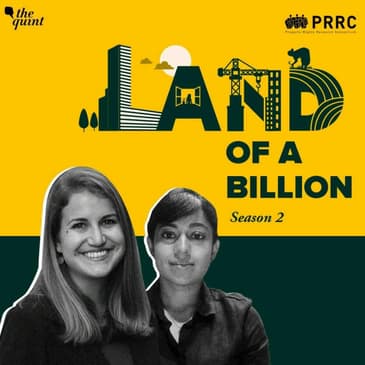

In our final episode of Season 2, we speak with Rachel McMonagle, climate justice and land rights advocate working with Landesa and Krutika Ravishankar – the co-founder of Farmers for Forests, to understand the connection between property, land rights, and climate change. We talk about various climate adaptation strategies with relation to land rights and also analyse the Glasgow Declaration and its outcomes.
We also bring the voices of three farmers from Maharashtra to understand how climate change affects their livelihoods and what are some innovative ways in which they are tackling climate change.
About The Guests
Rachel McMonagle is a climate justice and land rights advocate and practitioner with experience advancing climate resilience efforts with a social justice focus through non-profit and U.S. government initiatives.
Krutika is a co-founder at the non-profit Farmers for Forests, where she's primarily responsible for leading the forest and land use monitoring work and providing operations, fundraising and financial management support.
About The Podcast
‘Land of a Billion’ brings you expert conversations about the most contentious of the holy roti-kapda-makaan trinity – the makaan over our heads, and the larger ecosystem that governs it. Listen to Season 2 of this series for a rundown on the latest charcha around land and property rights in India. In case you missed it, you can also catch up on Season 1 of this series here.
Hosted by Bhargavi Zaveri, a researcher interested in land and access to finance, Land of a Billion is a fortnightly podcast series produced in association with the Property Rights Research Consortium.
Learn more about your ad choices. Visit megaphone.fm/adchoices
[00:00:00] Welcome to Season 2 of the Quinn Spot Nightly Podcast, Land of a Billion.
[00:00:21] We aim to bring you expert conversations about the most contentious of the holy Roti-Khapra
[00:00:27] Makhan Trinity, that is, the Makhan over our heads and the larger ecosystem that governs
[00:00:32] it.
[00:00:33] The podcast is produced in association with the Property Rights Research Consortium, supported
[00:00:38] by Omidya Network India.
[00:00:40] I am Bhargavi, a researcher interested in land and access to finance and your host for
[00:00:45] this season.
[00:00:49] A key idea in economics is the tragedy of the commons, that is, a resource that is owned
[00:00:58] by everybody is owned by nobody or in other words, nobody has the incentive to preserve
[00:01:03] it.
[00:01:04] The most common example given to explain this concept is that of a pasture land that belongs
[00:01:09] to many cattle owners and each cattle owner ends up overgrazing his cattle because the
[00:01:14] benefits of overgrazing are internalized by him but the costs are borne by all the
[00:01:18] owners.
[00:01:19] Now, for regular listeners of this podcast, you know what I am talking about.
[00:01:23] Throughout this season, we have explored issues relating to property rights in India,
[00:01:28] whether it be better information systems for recording existing titles or formalizing
[00:01:33] existing titles, conferring new titles and so on.
[00:01:36] Now, how do these discussions feed into a near existential question that arguably stares
[00:01:41] humanity in its face today?
[00:01:44] That of climate change.
[00:01:45] What is the connection between property rights and climate change?
[00:01:48] Are property rights the problem or the solution?
[00:01:51] To break these connections down, I have with me Rachel Mechmonagal who is a climate
[00:01:56] justice and land rights advocate.
[00:01:58] She currently leads the Climate Change and Land and Your Program at Landesa,
[00:02:01] a non-profit working in the field of land rights in several countries.
[00:02:05] I also have with me Krithika Ravi Shankar, co-founder of Farmers for Forests, an Indian
[00:02:10] non-profit dedicated to revolutionizing India's forestry sector, creating green jobs
[00:02:14] and protecting fragile ecosystems.
[00:02:17] But before we get started on our conversation with Rachel and Krithika, I want to bring
[00:02:21] you some voices from the ground.
[00:02:23] These are the voices of three farmers from Harashtra whose integral relationship
[00:02:27] with land makes them some of the leading voices on understanding climate change.
[00:02:31] We ask them to share their experiences on climate change and its impact on their
[00:02:35] lives and livelihoods.
[00:02:36] And here's what they had to say.
[00:02:44] Due to sudden changes in the climate, cash drops which are important to farmers
[00:02:49] are getting affected.
[00:02:50] Both the farming seasons are getting affected.
[00:02:52] Because of this, there's financial burden on the farmers and bank loans to repay
[00:02:57] and farmers are unable to fulfill whatever plans they have.
[00:03:00] As a result, farmers are under financial and mental distress.
[00:03:05] As a solution, agriculture universities and NGOs working in the field of agriculture should
[00:03:10] help farmers with the information, technology and help provide reliable weather updates.
[00:03:22] Today we are seeing the effects of climate change that has been happening over a long
[00:03:25] period of time.
[00:03:27] As we can see, there's a crisis looming over the farmers with heavy rainfall causing
[00:03:31] huge damage to the crops.
[00:03:33] Also due to climate change, there has been an increase in crop diseases and I'm
[00:03:38] experiencing this myself.
[00:03:40] I have planted onions in my field but due to persistent climate change, the incidence
[00:03:44] of diseases on onion crops is increasing so we have to do something about this crisis.
[00:03:50] And to maintain the balance of nature, we must cultivate more trees.
[00:03:54] Maximum number of trees should be planted without cutting them down.
[00:03:57] We should ensure that we do not do anything that will harm nature.
[00:04:01] We could do this by avoiding the use of plastic, maximising the use of solar energy and protecting
[00:04:06] our natural wealth such as rivers and lakes.
[00:04:16] The most important thing is that agricultural crops are getting affected in every season.
[00:04:21] Even after working hard, farmers are not getting the expected yield or profits from
[00:04:26] the farm.
[00:04:27] Due to climate change, crops are getting affected.
[00:04:30] Sometimes it's due to less rain and at times it's due to heavy rains.
[00:04:34] During periods of less rain, crops dry out and during heavy rains, crops which are ready
[00:04:40] for harvest gets washed away in floods.
[00:04:43] Due to sudden cold, the mango flowers fall off and it impacts all other fruiting trees.
[00:04:49] Similarly, extreme heat is also affecting human and plant life.
[00:04:54] Personally, to mitigate the effects of climate change, firstly, I planted a lot of trees around
[00:04:59] my house and also on the boundaries of the farm.
[00:05:02] As a result of this, the extent of carbon emission will go down and will help increase oxygen,
[00:05:08] decrease soil erosion and will also increase the population of essential and beneficial
[00:05:13] microbes in the soil.
[00:05:15] This will increase the yield of crops.
[00:05:18] Human life has one obligation – maintain the balance of nature and plant and care
[00:05:22] for as many trees as possible.
[00:05:26] In the order we heard, the voices were that of Bharat Dhavale, Anil Valnuch and Nanabhao
[00:05:31] Mangde from Maharashtra.
[00:05:33] Their experiences gives us a glimpse into the range of climate change impacts on people,
[00:05:38] particularly farmers across the world.
[00:05:41] This leads us to today's conversation where we look at the connection between land,
[00:05:45] property rights and climate change.
[00:05:47] Welcome, Rishal and Krutika to the land of a billion podcasts.
[00:05:50] Thank you for having me.
[00:05:52] Thanks for having me.
[00:05:56] Okay, so you know, I want to jump straight to the meat of the matter, which is that why
[00:06:02] do we care about land tenure or why do we care about property rights and land rights
[00:06:07] in the context of climate change?
[00:06:10] How can it be used as a climate change adaptation strategy, especially in emerging economies?
[00:06:15] Rishal, would you like to take this question?
[00:06:18] Sure.
[00:06:19] So, a bit of background on Landesa might be helpful.
[00:06:22] Landesa has been working for over 50 years at this point using land rights as a tool for
[00:06:28] poverty reduction.
[00:06:30] So this is really built on the idea that when you secure land rights for individuals and
[00:06:34] communities, you're really securing their access to land, which is often the foundation
[00:06:39] for food security, their shelter, often their safety, livelihoods, incomes.
[00:06:45] It unlocks this huge realm of possibilities for communities to feel more secure in their
[00:06:51] access to tools to their well-being.
[00:06:54] And over the past few years, we've been exploring land tenure as really a foundation for effective
[00:06:59] climate action.
[00:07:01] This is built around the idea that if we want people to be managing their land more sustainably,
[00:07:07] they really need to have an incentive structure that can support that.
[00:07:10] So they need to have that long-term vision that the activities and the investments
[00:07:15] that they make now in their land will play out for them in the future.
[00:07:21] So these examples could be tree planting for a household that doesn't have secure rights
[00:07:27] to their land and has fear that they might be driven off of it or not be working
[00:07:33] the same plot of land.
[00:07:34] There's really no incentive to invest in trees that are going to take many years
[00:07:39] to bear fruit and really benefit the household itself.
[00:07:44] So it could be tree planting, it could be climate smart agriculture techniques, it could
[00:07:48] be thoughtful fertilizer use.
[00:07:51] But really working with communities to support them and having this long-term vision can
[00:07:55] really support sustainable land management, which both benefits the households themselves
[00:08:01] in securing their livelihoods and food security, but it often also benefits the entire globe
[00:08:07] in supporting climate mitigation.
[00:08:10] So often these sustainable land management techniques are also climate mitigation techniques
[00:08:15] in storing carbon and sequestering it from the environment.
[00:08:18] God, if that makes sense to me, and you know, it relates back to one of the most fundamental
[00:08:25] I guess notions of economics, right?
[00:08:27] Which is the problem of the tragedy of the commons, which is that, I mean, it's
[00:08:33] an old concept, many people are probably familiar with it.
[00:08:36] But the idea that where a resource is meant for common use for everybody, it is likely
[00:08:41] to get depleted faster.
[00:08:43] It is likely to get overused.
[00:08:45] On the other hand, when you actually define property rights better, people are incentivized
[00:08:50] to use it and preserve it for a longer period of time.
[00:08:53] So it just makes sense to me that if I know that I have access to my land and
[00:09:01] that nobody can take it away from me, I'm more likely to take a more precocious approach
[00:09:08] towards using it.
[00:09:10] So now one thing is to say that defining property rights better and getting better land tenure
[00:09:17] will actually incentivize people to managing their land and resources more carefully.
[00:09:25] But what about the existing situation?
[00:09:27] Which is that we are already probably in the midst of climate change period.
[00:09:33] And how do we use land tenure and how do we use community ownership to deal with the
[00:09:39] consequences of it?
[00:09:40] So in that context, Krithika, I mean, you founded Farmers for Forest at the age of 30.
[00:09:46] What was the motivation and how do you think it helps with climate adaptation?
[00:09:51] So I think that's a great question, Bhargavi.
[00:09:55] Like Rachel was saying, so secure land rights are basically at the foundation of everything.
[00:10:02] But what we also realized is that once communities have secure land rights, there's also additional
[00:10:09] support that's needed for them in terms of knowing how to really leverage this land
[00:10:15] well.
[00:10:16] So when we founded Farmers for Forest, the problem that we were really trying to
[00:10:21] target is the financial drivers for deforestation.
[00:10:25] So why does say a family has trees on their land?
[00:10:30] They have land rights.
[00:10:31] Why are they cutting down the trees?
[00:10:34] And in most cases, what we realized is that those drivers were financial.
[00:10:38] So there's a wedding in the household or they want to sell the soil on that land
[00:10:44] for highway construction work or there's a medical emergency.
[00:10:49] Essentially what we realized is that in addition to the really large causes of deforestation,
[00:10:58] which is mining or infrastructure development, there are also all of these smaller causes
[00:11:03] which are slowly tripping away at Forest.
[00:11:07] But they are not really being addressed.
[00:11:09] So we wanted to work on, of course, preventing deforestation and then we also wanted
[00:11:14] to work on the other side of the coin, which is at the same time you have in some of the
[00:11:20] areas that we're working, we have a lot of land that because of years of unsustainable
[00:11:26] agricultural practices is now so degraded that farmers don't want to cultivate it
[00:11:32] anymore because they feel like it's just too much of an investment without enough
[00:11:37] of a return.
[00:11:38] And then you also have in the recent years rainfall has become so erratic that
[00:11:44] farmers were just not very sure of what they would get if they even cultivated this land.
[00:11:51] So you have this case where they have an asset that was previously a valuable asset,
[00:11:56] but now because of land degradation and sustainable fertilizer use, it's lying unused.
[00:12:03] So we essentially wanted to solve for both of these problems.
[00:12:07] And when we were looking at the literature around the world,
[00:12:11] we thought that payments for ecosystem services, which is essentially paying people
[00:12:16] to conserve forests or paying people to protect forests could have very promising results.
[00:12:22] So in the most recent case, we've seen Costa Rica use it pretty effectively.
[00:12:27] So that was sort of the idea behind which we wanted to start the organization
[00:12:32] because what we also realized is that in India, forests were generally seen as
[00:12:37] something that is under the purview of the government.
[00:12:41] So the private sector or civil society are not for profits.
[00:12:45] They've generally had a sort of hands off approach from this sector.
[00:12:50] And we really wanted to change that.
[00:12:53] Got it.
[00:12:54] So you mentioned that there are similar models that you have seen around the world,
[00:12:59] which is to pay to conserve forests.
[00:13:02] And I believe that there are some policies in the US as well where the government
[00:13:08] actually pays people living on the boundaries of forests to not cultivate their land.
[00:13:13] Rachel, what is your experience?
[00:13:15] What models have you seen around the world where people are actually paid to not deforest?
[00:13:23] There are quite a few models of communities both relying on payments
[00:13:27] for ecosystem services or perhaps engaging in the carbon market
[00:13:31] to gain financial support for the stewardship that they're already doing.
[00:13:36] I think another interesting model that Landasa often operates under
[00:13:41] is trying to find interventions that benefit both the community's livelihoods
[00:13:46] and also environmental sustainability at the same time.
[00:13:50] And I think creating this incentive structure and this foundation
[00:13:55] to incentivize environmental work is a really it's a strategic move.
[00:14:01] Effective balance, yeah.
[00:14:02] Yeah, effective balance is what came to mind.
[00:14:05] Yeah, I think linking livelihoods and environmental sustainability
[00:14:10] is a smart strategy to ensure that longevity in the event
[00:14:14] that climate finance would would run out.
[00:14:16] So an example of that is our work in the Bay of Bengal,
[00:14:20] where Landasa has been working for years with coastal communities
[00:14:23] that live in mangrove forests.
[00:14:25] And we've been supporting these communities through the process
[00:14:28] of receiving community forest certificates.
[00:14:31] So these are government recognized land use rights
[00:14:35] for a collective group of people and the outcomes are so powerful.
[00:14:39] You have protection of these mangrove forests
[00:14:43] and the communities themselves from corporate interests.
[00:14:45] So if there's shrimping companies or palm oil interests trying to come in
[00:14:52] and degrade some of these mangrove forests,
[00:14:55] communities now have rights and a defense against this intrusion.
[00:15:01] There's reduced conflict between neighboring communities
[00:15:04] because there are clearly delineated borders between the communities.
[00:15:08] And as as Krutika was talking about,
[00:15:10] there's also access in addition to payment for ecosystem services.
[00:15:14] There's access to other government resources like tree saplings,
[00:15:18] different reforestation programs, maybe agricultural extension services
[00:15:24] that these land rights connect them to these greater services.
[00:15:28] So what we're seeing is reforestation, aforestation of mangroves.
[00:15:33] And the really cool thing there is that mangroves are such a strong carbon sink.
[00:15:37] And so we're having climate mitigation of greater sequestration of carbon
[00:15:43] and really a protection of this existing carbon sink
[00:15:46] in addition to the climate adaptation benefits of preserving and restoring mangroves.
[00:15:53] So the mangroves are along these coasts and can really provide protection
[00:15:58] for communities inland agriculture.
[00:16:01] We're seeing increased storms from climate change,
[00:16:04] this storm surge coming in and can have really damaging effects
[00:16:08] on both the infrastructure and the farmland inland.
[00:16:13] And so to have sort of a wave break there is a really powerful climate
[00:16:18] adaptation strategy, both on a food security front,
[00:16:21] but also a livelihood and income front for the different crops that are being grown
[00:16:26] or different products that can be sold at market.
[00:16:29] And then beyond the communities, it's really reducing the pressure
[00:16:32] from perhaps the forest department or different government officials
[00:16:36] who are already limited in their capacity to monitor the forests
[00:16:41] and really survey this land by sort of passing off that power
[00:16:46] to these communities and securing their rights that they have deserved for generations.
[00:16:53] It takes the pressure off of these government officials for monitoring this land
[00:16:57] and really allows the community to step up and defend the land that's rightfully theirs.
[00:17:02] That's right.
[00:17:03] So it seems to me that, you know, if we were to classify all interventions
[00:17:07] with respect to climate change, right?
[00:17:10] You could broadly bucket them into three categories.
[00:17:13] One is the local level interventions of the kind that Rachel and Krutika just described,
[00:17:18] which is that you assist to incentivize local communities
[00:17:21] to make sure that the land that they use and that they are not forced to rather
[00:17:29] adopt deforestation and have enough incentives to preserve the resources
[00:17:33] and adopt better land resource management practices.
[00:17:37] The second is where you have the state coming down from the, you know,
[00:17:42] from the top and imposing penalties and imposing restrictions
[00:17:48] on what communities can and cannot do with the land that has belonged to them for generations.
[00:17:53] And the third is of the kind that we just saw, right?
[00:17:56] The Glasgow COP26 conference, which is where internationally efforts
[00:18:05] are decided upon countries resolve to take certain initiatives
[00:18:08] to make sure that their countries have lower emissions, etc.
[00:18:13] And my question is that which of these strategies in your opinion actually works better?
[00:18:19] So I know this is off the bat, but if any of you want to take this question,
[00:18:25] go for it.
[00:18:26] Do you think localized interventions are better than global interventions?
[00:18:31] Do you think national level interventions are more effective?
[00:18:34] What's your view been on the field?
[00:18:36] So what do you think communities respond to the most?
[00:18:39] So I think we actually need all levels of interventions in order to address
[00:18:47] this problem effectively, because it's such a large problem
[00:18:51] and it's happening everywhere in the world.
[00:18:54] So I think fine tuning the interventions to that particular context
[00:19:00] can sometimes make a big difference, because, for example,
[00:19:03] if there is legislation at the global level or at the national level,
[00:19:08] that kind of directs finance and attention, which can then be used
[00:19:13] to kind of mobilize communities at the local level.
[00:19:17] So and at the same time, if you have communities that are at the local level
[00:19:22] aware, like one of the communities that we work with in Gatsiroli,
[00:19:28] they ran this huge campaign to kind of lobby for their community forestry rights
[00:19:34] and that ended up putting pressure or setting a model for the rest
[00:19:39] of the country to kind of follow.
[00:19:42] So sometimes even the local interventions can actually lead
[00:19:47] to change at the national and the global level.
[00:19:50] So I think personally, I think it has to be a mix of all of these things.
[00:19:55] I completely agree, Krutika, and I think that was very well said.
[00:20:00] You know, unfortunately, climate change is not bounded by our political boundaries.
[00:20:05] And so we're often seeing national policies that are very powerful
[00:20:09] in a very limited context.
[00:20:11] And then the neighboring countries are not necessarily following
[00:20:15] those audacious goals and the pollution and the greenhouse gas
[00:20:20] emissions are affecting the whole world over.
[00:20:23] So it's certainly not the climate crisis is not something that can be taken on
[00:20:29] by an individual country with individual policies or a local community.
[00:20:34] I think also, you know, while imperfect, these global agreements
[00:20:39] and international commitments also start chipping away at the climate justice
[00:20:44] question where you have some countries, particularly the US,
[00:20:48] which I will speak to as someone from there, on a per capita basis.
[00:20:54] The emissions are really, really high compared to largely the rest of the world.
[00:21:00] And I think when we're seeing other countries bearing the brunt
[00:21:04] of the negative impacts of climate change caused largely by the lifestyles
[00:21:09] and emissions that are happening in other parts of the world,
[00:21:13] it really raises questions around climate finance and coming together
[00:21:18] as a global community to take responsibility for the way that individual
[00:21:23] countries actions or choices not to act are having a really disproportionate
[00:21:28] impact on other communities and other countries that have not contributed
[00:21:32] to the climate crisis at the same level.
[00:21:35] So I think completely agree that all three levels are critical
[00:21:40] in building solutions and that the conversations at the global level
[00:21:45] are at least starting to engage in this climate justice conversation
[00:21:49] and recognize the mobilization of finance that will be needed
[00:21:53] to undo some of the injustices that have been done.
[00:21:58] Right. So I'm assuming your views on the Glasgow Leaders Declaration
[00:22:02] on Forests and Land Use, the COP26 conference that just happened recently
[00:22:08] that they will that it will have a positive impact
[00:22:12] on how countries look at land resource management.
[00:22:15] Yes, I think I think it's imperfect, but it's it's a start
[00:22:20] and I'm cautiously optimistic.
[00:22:22] I think the deforestation pledge in particular is a massive commitment
[00:22:27] that's really exciting with over 140 countries pledging to halt
[00:22:32] and reverse deforestation by 2030.
[00:22:34] That's just a massive commitment made by so many countries together
[00:22:39] is really powerful.
[00:22:41] Also, having these discussions around forestry and climate smart agriculture
[00:22:45] as essential pieces of the climate mitigation puzzle
[00:22:49] is also exciting because so often the land use sector
[00:22:53] is left out of these conversations.
[00:22:55] I think what's most interesting about this pact
[00:23:00] is is finally seeing this explicit emphasis on the role of indigenous
[00:23:04] peoples in local communities as key climate actors
[00:23:08] and the need to listen and support them.
[00:23:11] It's amazing to see one point seven billion dollars committed
[00:23:15] to supporting indigenous peoples in this effort
[00:23:18] that said the money has historically failed to reach these indigenous communities.
[00:23:22] So I think we're at a point where only time will tell if this recognition
[00:23:27] of indigenous peoples in the text is truly a turning point
[00:23:31] for investment in climate finance for indigenous rights.
[00:23:35] So I think as we wait to see how that funding is delivered,
[00:23:38] securing land rights for these indigenous peoples is such an obvious step
[00:23:42] to ensuring that these actors remain in a place of power
[00:23:46] and decision making over their own land.
[00:23:48] Inclusion of these stakeholders is a critical shortcoming
[00:23:52] of many decisions like the Glasgow pact
[00:23:54] and ensuring that these resources that have been committed
[00:23:57] ultimately reach indigenous peoples and that they are included
[00:24:01] in the design of the implementation plans will be a powerful step
[00:24:05] in reaching the goals set out in the pact.
[00:24:07] India did not sign the Glasgow Declaration and I'm wondering,
[00:24:12] I mean, how do we bridge these gaps in the way
[00:24:15] we look at land, land rights and land use in India?
[00:24:18] Kritika, what have you seen on the field?
[00:24:20] What have you seen amongst policymakers?
[00:24:23] Do they really see the connection between land rights, land use
[00:24:26] and climate change or we need to do more on this one?
[00:24:31] So I think this point also goes back to a little bit
[00:24:35] what Rachel was talking about, which is how climate change
[00:24:39] is a global injustice in the sense that countries like India
[00:24:44] that have fairly low per capita carbon emissions
[00:24:47] or that have historically had very low carbon emissions
[00:24:52] are actually going to be countries that are some of the worst
[00:24:56] affected by climate change.
[00:24:58] I mean, India in particular because of our tropical location
[00:25:03] because of the fact that we have such a long coastline,
[00:25:07] we're really going to be bearing a lot of the sort of brunt
[00:25:11] of climate change in the in the next few years.
[00:25:14] So while I understand this and I also, you know, see India's
[00:25:19] point that trade should be decoupled from the Glasgow Declaration
[00:25:24] and that's why they didn't want to sign it.
[00:25:26] But at the same time, I think for us as a country,
[00:25:30] you know, given the extent like the size of our population
[00:25:35] and the fact that, you know, soils in the country are
[00:25:39] depleting fast. We have groundwater depleting.
[00:25:43] I think taking very progressive, decisive and immediate
[00:25:47] climate action is extremely necessary so that involves,
[00:25:51] you know, halting deforestation, investing in restoring degraded
[00:25:56] lands either through deforestation or through, you know,
[00:26:00] more sustainable methods of agriculture that involve,
[00:26:06] you know, cultivating a more sort of biodiverse set of crops,
[00:26:10] intermingling crops with trees.
[00:26:13] So I think all of these things are are going to be
[00:26:17] absolutely critical as we grapple with problems like food
[00:26:22] security or, you know, as we face more and more extreme
[00:26:26] weather events like cyclones or floods like we've been seeing
[00:26:30] in the last few years.
[00:26:32] So I think that, you know, that we need to take action against
[00:26:37] this is, I mean, there's absolutely no doubt about that.
[00:26:40] But what that action will be in the form of whether it's
[00:26:44] signing international agreements or mobilizing even more
[00:26:49] government finance towards these causes or mobilizing more
[00:26:53] community efforts, I think it has to be a mix of all of these.
[00:26:58] But without a, you know, without a doubt we need to take as a
[00:27:02] country, we really need to take very progressive, decisive
[00:27:07] and immediate action to address all of these issues.
[00:27:11] Right. You know, since you mentioned government finance
[00:27:14] and mobilizing government finance towards, you know,
[00:27:17] setting in place, let's just call it the right incentive
[00:27:20] system for land resource management.
[00:27:22] Right. One thing that occurred to me is it is true that
[00:27:25] communities are bearing the brunt of climate change, but
[00:27:29] it is equally true that the government is not actually
[00:27:32] bearing any brunt of climate change because it seems to
[00:27:34] me that we have in place since many years subsidies
[00:27:39] that incentivize the exact wrong thing for effective
[00:27:43] land resource management.
[00:27:44] Right. So whether it is subsidies for fishing, which leads
[00:27:48] to fishing, whether it is subsidies for, you know,
[00:27:51] cultivating crops that are guaranteed to be purchased by
[00:27:55] the government, I mean, I think reversing even some of these,
[00:28:02] you know, subsidies before putting in more funds into what
[00:28:06] the, you know, what the government believes is the
[00:28:08] right strategy for land resource management may
[00:28:13] actually do us some good.
[00:28:14] It may be a good point to good starting point to begin with,
[00:28:18] but on that note, you know, we're running out of time.
[00:28:22] So I'm just going to ask the last final question of the
[00:28:25] last final episode of this season.
[00:28:28] Since this podcast is called land of a billion, Pruthika
[00:28:31] Rachel, if you had to pick one problem that you would
[00:28:34] put your weight behind to secure land rights for
[00:28:38] a billion plus population, what would that cause be?
[00:28:42] Let's begin with Rachel.
[00:28:44] My answer would be securing land rights for women.
[00:28:48] It's such a simple yet super complex intervention of
[00:28:53] challenging social norms and identity and gender roles.
[00:28:57] I would say this for India, but also many, many countries
[00:29:01] across the world.
[00:29:03] It's it's such a powerful solution, both on the gender
[00:29:07] equality front and also on the climate resilience front.
[00:29:12] Across the world, women are not seen often as equal
[00:29:15] rights holders and decision makers with men.
[00:29:18] And without land rights, women often lack the
[00:29:21] political power and voice both at the community and
[00:29:23] household levels.
[00:29:25] When you combine these disadvantages with
[00:29:28] the layered vulnerabilities from climate change, women
[00:29:31] are increasingly marginalized.
[00:29:33] On the other hand, we have seen that when women
[00:29:36] have secure rights to land, there's evidence that
[00:29:39] efforts to conserve biodiversity are strengthened.
[00:29:43] Climate resilience improves food security and
[00:29:45] income increases.
[00:29:47] It's really a broad swath of benefits that benefit
[00:29:51] both women and men at the household level all
[00:29:54] the way up through the community level.
[00:29:56] So I think with a challenge as complex as
[00:29:58] climate change, we need all of the innovative
[00:30:02] ideas and creative solutions and resilience from
[00:30:06] every person on the planet.
[00:30:08] And we cannot afford to miss out on half of the
[00:30:10] world's potential.
[00:30:12] Right.
[00:30:13] So land rights for women is critical.
[00:30:14] What would be that one cause that you would put
[00:30:17] your weight behind?
[00:30:19] I think it would be securing community
[00:30:22] forestry rights or indigenous communities.
[00:30:26] So what we've seen is that when communities get
[00:30:30] the rights to manage their own forests or forests
[00:30:34] that they have historically been managing and
[00:30:40] been depending on for their livelihood, for their food.
[00:30:44] So I think when communities get these rights
[00:30:47] to manage their forest, I think it can really
[00:30:50] transform not only their attitudes towards
[00:30:55] the forest, which is now looking at the forest
[00:30:59] as an asset that they own.
[00:31:01] Having that pride in, you know, like this
[00:31:04] this forest belongs to my community.
[00:31:06] So, you know, we want to take care of it for
[00:31:09] the next generation and we want to preserve it,
[00:31:13] you know, as opposed to I think you mentioned
[00:31:16] the tragedy of the comments, which is looking
[00:31:18] at the forest as something that's owned by
[00:31:21] the Forest Department or somebody else.
[00:31:23] So, you know, not really caring about,
[00:31:25] you know, whether it's cut down or burned
[00:31:28] or things like that.
[00:31:29] So I think when communities have the rights
[00:31:33] to manage this forest land, it also helps
[00:31:36] because generally if you have any schemes
[00:31:40] that are targeting payments to communities,
[00:31:43] those payments legally need to go to landowners.
[00:31:47] So for communities having those rights
[00:31:50] of ownership on their forests is also
[00:31:52] an extremely important part.
[00:31:54] If you want to be able to financially
[00:31:56] support them to protect and restore forests.
[00:31:59] So I think for me it would be community forestry rights.
[00:32:04] OK, so land rights for women and land rights for communities.
[00:32:07] Thank you so much for making time
[00:32:09] for being on the Land of a Billion podcast.
[00:32:11] And I hope our listeners have enjoyed this episode.
[00:32:14] Thanks a lot.
[00:32:15] Thank you for having me.
[00:32:17] Thanks for having me.
[00:32:22] This brings to an end the second season
[00:32:24] of the Land of a Billion podcast.
[00:32:26] During the season, we spoke to people
[00:32:28] from very different walks of life,
[00:32:29] former and current civil servants,
[00:32:31] academic researchers and civil society,
[00:32:34] all dedicating the prime of their lives
[00:32:36] to one goal that is improving land governance in India.
[00:32:39] Personally, the themes in these 10 episodes
[00:32:42] of this season have actually come a full circle for me.
[00:32:45] We started by talking about the importance
[00:32:47] of formalizing property rights
[00:32:50] and improving the quality of land records.
[00:32:53] We had a few conversations about how the law
[00:32:56] can actually exacerbate existing inequalities
[00:32:59] and how sometimes the law actually favors
[00:33:02] some stakeholders over the others.
[00:33:04] Sometimes that stakeholder is the state.
[00:33:07] We also spoke about the opacity of the law
[00:33:10] and the importance of giving access
[00:33:12] to the content of the law
[00:33:14] so that people can actually enforce their rights better.
[00:33:17] We had a dash of optimism on the urban side
[00:33:20] by laws such as DRERA,
[00:33:22] which actually enable and strengthen
[00:33:25] the rights of the average home buyer
[00:33:28] and by initiatives such as the JAGA mission,
[00:33:32] which actually formalized the rights of slum dwellers.
[00:33:34] And we ended with a theme that we began with,
[00:33:37] which is how we're formalizing property rights,
[00:33:40] defining them better, not only empower the individual,
[00:33:43] but also contribute towards the cause of climate change.
[00:33:47] I wanted to end by thanking
[00:33:48] the Property Rights Research Consortium
[00:33:50] and the Quinn teams for putting this season together,
[00:33:53] Omedya Network India for supporting this initiative.
[00:33:56] A special shout out to the teams at the Quantum Hub
[00:33:59] and Abhishek Shah for designing the content of this podcast,
[00:34:02] the marketing material and editing this podcast.
[00:34:05] And last but not the least,
[00:34:06] thanks to the listeners for staying with us through this season
[00:34:09] and for being the reason that we do all of this.
[00:34:12] Thank you and goodbye.
[00:34:31] Thanks for listening.
[00:34:32] Log on to the Quinn's website and check out our other podcasts.