
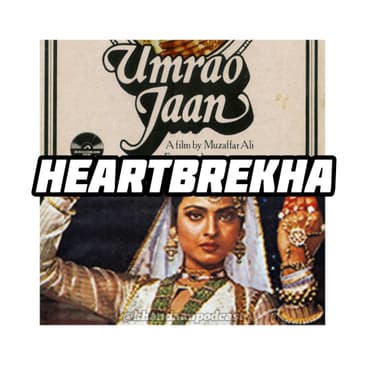

Welcome to Khandaan: A Bollywood Podcast where we’re continuing with our 80s Dhamaaka episodes. This week we have UMRAO JAAN.
One of the most iconic cinematic moments of 1981, Umrao Jaan is widely considered to be Rekha’s most celebrated performance. Directed by Muzaffar Ali and with enduring music by Khayyam, Rekha plays the role of a famous courtesan who navigates love and family in the midst of the Sepoy Rebellion of 1857. Costarring Naseeruddin Shah, Farooq Shaikh, Raj Babbar, Shaukat Azmi, Dina Pathak and others, Umrao Jaan is an essential part of 80s Hindi cinema.
A big Shoutout to our friend Dj Shai Guy for the 80's Dhamaka Theme song. You can check out more of Shai's work here
💖 Join Our Patreon & Get Exclusive Perks! 💖
Love Bollywood? Support Khandaan: A Bollywood Podcast on Patreon and unlock amazing benefits:
🎬 Early Access & Ad-Free Episodes – Be the first to hear our 80’s Dhamaka series without interruptions!
💃 A Bollywood-Loving Community – Connect with fellow fans who share your passion!
📺 Bonus & Video Content – Get exclusive behind-the-scenes clips, extended discussions, and more!
🗳️ Vote in Polls & Pick Movies – Help decide which films and shows we cover next!
✨ Join now and be part of the ultimate Bollywood experience! 🎧 Link in bio!
🌟 Support the Podcast:
Enjoyed this episode? Don’t forget to leave us a review and a 5-star rating on Apple Podcasts. Your support helps us reach more Bollywood fans and keeps us inspired to bring you the best content!
We are now on Blue Sky!
Follow us on Socials:
- Amrita, Sujoy, Asim
- YouTube, Facebook, Instagram, Tik Tok
- Sujoy's Instagram
- Amrita's YouTube Book Channel- Amrita By The Book
You can listen to Khandaan- A Bollywood Podcast episodes on the following apps:
[00:00:00] Dhamaka Dhamaka My name is Blackhand Where you stand, start with Lion Y
[00:00:25] Hi and welcome to a new episode of Khandaan Podcast. My name is Asim Burni and I'm joined with my lovely co-host Amrita and Sujoy. Hey Amrita, hi Sujoy. Hey everybody. Hello.
[00:00:35] We are continuing our 80s Dhamaka Series with Umrao Jaan, 1981 movie starring Rekha and nobody else, it's just Rekha. Nothing else is important, just Rekha, called the movie Rekha, directed by Muzaffar Ali starring Faruk Shekhtu and a bunch of other actors. This was one you were dreading Amrita. This was one you were, you were warning us. The red flags were a red flag basically.
[00:01:05] Yeah, I was pretty sure that I was the only one who had actually watched this movie out of the three of us. You had not watched this movie. Yes, I was, I was absolutely certain that you had not watched it and I was, I was like 90% certain that Sujoy had not watched it. But maybe like, you know, it was playing on BB or something and then he might have watched it. But did you watch it before Sujoy? No, I have watched all the songs before, but I have not sat down and watched the entirety of the movie.
[00:01:36] Like I know bits and pieces of it, but not, not the whole movie. Did, did you watch the songs, Asim? I knew the songs and I mean, I think I've seen the songs. There's not much going on in songs. I just sitting and singing, right? Like, so I've seen parts of it for sure. I just want people to know that like, uh, during like one of the Coke studio seasons, um, there was like a, uh, there was a guzzle. I can't remember which one it was.
[00:02:04] I think it was, uh, when Jushi Sahi or something came out and I was like, oh my God, so beautiful. And then Asim said, I don't like all this adultery type music. The moment in Asim was like, let's do Umrao Jaan. I was like, yeah, it's like 100% adultery type music. Old people adultery, that was the thing. Old people cheating on their wives, you know, like thinking about this girlfriend they used to like, you know, exchange glances with on the bus.
[00:02:34] Like Umrao Jaan is like the OG of like old people adultery music. So I was like, I don't, I don't think this is going to be a good time. I'm an Uchi Hai building guy. Umrao Jaan. You know, like this is what's happening here. But I did, I, I, and, but I remember when we picked this movie, we were already kind of dreading it. But the reason is I actually got it from Wikipedia, I think.
[00:03:00] So upon release, Umrao Jaan received widespread critical acclaim, especially if you, specifically for Adi's direction and Rekha's lead performance, widely considered one of the greatest of Hindi cinema. It also emerged as a commercial success ranking as one of the highest grossing film of the year. At the 29th National Awards, Umrao Jaan won four awards, including Best Actress, Best Director and Best Music. Best Music.
[00:03:29] So I, I knew of this movie and I knew that this was a very beloved movie. And even because there's a, it's very hard to find a decent print. We had to watch it on YouTube and it was really, really bad. Um, and you go to the comment section. It's like all people just praising this, loving this movie. It's all like, you know, I love Pakistan. I give my life for Pakistan, basically. Like that's what's going on. And I'm like, that's grape, you know? So we had to cover this movie.
[00:03:59] Like we had to, like, it's the 80s. We had to cover the movie. So that's why Umrao Jaan is part of the package. I think, you know, it's like you're Charlie Brown and like Hindi cinema is constantly offering you a football to kick. Like, you know, Hindi cinema is like Lucy. And it's just like, look, not Hindi cinema, but Hindi cinema audiences are Lucy. And they like come up to you with a football and they're just like, no, no, no, no. This football, this football is special.
[00:04:25] And I need you to understand that people will say one thing, but they, it is absolutely never followed through with their behavior. Like 100% of the movies that Bollywood audiences talk about, like, oh my God, that is cinema. How wonderful. Nobody cares. This was also one of the 50 movies I loved by Anupama Chopra when she was making like film companion things. So she also made a video.
[00:04:54] So it is, I'm not, I'm just saying like a lot of people are gaslighting me basically. See, Anupama Chopra, yes, I believe her when Anupama Chopra says that she loves this movie. I believe her. But when like, you know, like rando Bollywood audiences are just like, oh my God, have you seen Earth? And have you seen Umrao Jaan? And have you seen Garam Hawa? I know for a fact that none of these people like any of these movies.
[00:05:22] They just feel as if they should say, oh, I love this film because, you know, it's, it gives them a certain cachet. They say Garam Hawa, but they mean Garam Masala. You guys having said that, I actually liked Umrao Jaan. So, so I saw your Letterboxd review and I was like, yes, Joy is quite on board, man. Like I'm like, I don't know. I've not gotten into the movie yet.
[00:05:49] I'm just saying what, I've not given my opinion on it. I was very happy to see that you were quite positive about it. No, I'm not sure where my sort of liking for this movie came from, whether it was surrendering to the idea that I cannot switch it off because I have to watch it all the way through. And whether it was like Stockholm Syndrome sort of seeping into me or it was the movie itself. You know, there is a certain surrender required, I think.
[00:06:19] Stockholm Syndrome only happens to white people. It doesn't happen to Bram Kishnan. Okay. That's the thing. It's an aspect of Stockholm Syndrome that only happens to white people. It is in Stockholm. You have to be from Stockholm. Not in Brazil. It just looks like you come from Stockholm. Okay, I get it. So, yeah, I mean, let's get started. So, Joy, you first, like, what do you think of Umrao Jaan?
[00:06:44] Oh, wait, should we do a, Amrita, do you want to do like a little bit summary of it first, maybe? That would be a good idea. Yes. So, I'll tell you what the IMDB summary is, which is, Amiran is sold to a brothel by a corrupt cop after her father testifies against him. Many years later, she grows up to be an accomplished poetess and a renowned courtesan Umrao Jaan. So, that is correct. He wasn't a cop.
[00:07:13] I mean, yeah, but he was, he is a criminal. Yeah, he goes to jail because her dad, you know, testifies. He was a deroga. The father was a deroga. Yeah. Yeah. Yeah. So, he's a cop, technically. So, I think, like, maybe, huh. So, this guy's name is Dilawar and he, you know, like, he runs a pigeon business, I think. Like, that's... Yeah, there was stuff going on about pigeons too, yeah. Yeah. But he basically kidnaps Amiran and sells her to a brothel.
[00:07:43] And then, you know, like, she grows up and becomes this very, very beautiful Rekha. And she then falls in love with a local Nawab who has, you know, a big ego and a spine made of cooked noodle. And it's also the... There's a lot of, like, political unrest happening.
[00:08:10] You know, there's, like, war and all sorts of things happening. And she tries to go home and she realizes that some things can never happen. And it's ultimately a tragic tale, but it's also the story of a woman who's surviving the tragedies in her life. That's what Umlaojan is. Sujoy, your thoughts on... Umlaojan. Yeah, as I said, like, it really takes you on this really tiresome journey.
[00:08:39] And if it really tests you, whether you are willing to sit through that for the love of Rekha. And it really tests your fandom of Rekha in a way, I think. But if you are enamored by the beauty, the lyricism and the poetry display, the music that happens on this journey, and everything that happens alongside with that, I think the tragedy in a way is...
[00:09:05] We watch all of this for a certain catharsis as an audience, right? When the tragedy unfluers and we sort of cry alongside with the tragedy and sort of empathize and sympathize with these characters. I think it is a beautiful tragedy in that way. If you are willing to surrender that I know we don't necessarily have that sort of a patience as audience anymore. But Umlaojan requires you to have that.
[00:09:33] And I think I was in that frame of mind. Because by the end, when one tragedy and then another and then another sort of piles on this character. And Rekha just breaks down at the end where you have all these successive tragedies accumulating on herself. It ends on a weird note for me, but all of that cumulatively worked for me.
[00:10:03] And that is only because of Rekha. Only and only because of Rekha. Her emotiveness, her acting. It's just so beautiful. Like nobody else could have been Umlaojan. And possibly we will talk about the remake later. But yeah, this movie worked for me just and just because of Rekha. And the music that accompanies this movie. Amrita, what about you? You'd seen it before.
[00:10:31] You were warning us. But how did it feel revisiting it? So my warnings were really for you guys. It wasn't really for me. Like I don't actually have any problems with this film. It is what Sujoy said earlier about it being an immersive experience that requires you to surrender to its storytelling. That is very true. This is very much an art movie. It is not meant to be a commercial movie.
[00:10:59] You know, it solidly belongs to the parallel cinema movement. And it sort of builds. It's so interesting, this film, because it builds on Rekha's career up to that point. You know, I think earlier on when we were talking about something else, Asim was talking about how Amrishpuri is often used in the 80s to give weight to the character of a villain because we know who he is.
[00:11:29] And he brings this history of menace to his roles. And it's the same thing for Rekha. You know, she slayed that courtesan with a heart of gold in so many movies. And she brings that, you know, like that gravitas and that sensibility to this role, which is quite amazing, according to me, because she's as South Indian as they come. I mean, you know, she's super South Indian.
[00:11:55] And she's like a dark complexion South Indian woman, you know. And that's kind of addressed as well in the beginning. Yeah, yeah, yeah, yeah. And she plays this Laknavi Tawayef. And she does it so well that I don't think we've had anyone who's done that role any better than Rekha in, you know, the nearly 40 years since this movie has come out.
[00:12:22] Or more than 40 years, actually, because I think this movie came out in 1981. So, yeah, it's a there's so many things going on for this film. But also, I think when modern audiences are told to go watch this as a classic, I don't think they're given that caveat.
[00:12:45] And I think it's very important to sort of put in a little warning up front being like, listen, you might be used to a certain level of filmmaking. And this is not that. Yeah. Yeah. I think. I was worried going into this movie because it's just not my genre, you know, and you knew you knew it. But I did enjoy it because it's it's so different from anything we've covered.
[00:13:13] Like, you know, you can maybe put it close to Earth, but Earth is not like it both are maybe, you know, parallel or art movies. But this is a very this is a very like and I was watching some interviews with the Muzaffar Adi, the director, and he is a very kind of like Sanjali Lab and Salikana character. Right. Like, you know, in Kurta's long flowy hair, I'm a painter and I'm an artist and I'm a you know, so he's a he's also like, what do you say?
[00:13:42] Sorry, I blank on names because I'm like fasting. So sometimes my brain just goes like for a toss. But like, he's like active in like causes and things like that. Right. So he's like very like Sanjali Lab and Salikana is like, yeah, I paint all my scenes out and stuff like that.
[00:13:57] And I think that shows very much in this movie within that era where to me and I think it's Rekha really because the command of Rekha and everybody else have such a command of the language to write that it makes Hiramandi because that was obviously the thing connection I was making with Hiramandi. Right. Hiramandi almost feels like cosplay compared to this where although doesn't make sense. This was also shot in 1980, 1981. It's not that it was of that era. Yeah.
[00:14:26] But the way people are the weight that they're bringing to these characters, the there's a language, there's a way of acting that has since gotten lost and not enough actors can kind of connect with that. I think Sonakshi Sina can to a certain degree. I think Aditi Rao Haidri can to a certain degree, but I don't think Manisha could, you know, that kind of thing.
[00:14:50] Maybe they should have gone with Mahira instead, you know, but I do think the storytelling does it is very slow paced, but it still doesn't give me enough of what I needed of this world. The way it's edited, the way the story kind of comes in, it jumps from one place to another and doesn't really explain who is who, what is happening. And I think if they do want to remake, they remade it with Aishwarya Raya and Abhishek later on.
[00:15:20] But this, what I'm more excited about, it was announced that this is going to be remade in Pakistan by Sajjal Ali in an eight part series. And that excites me because I think this does need more time that you can explain these characters, you know, who is, you know, Nasiruddin's character. Like, I don't, never really understood what the thing was. He was almost, they were, they were sleeping together for a second and then they got caught.
[00:15:48] And then he's still kind of like his lover. He is. Yeah. Yeah. But I think it's like, who is this guy? Like, why is he there? Like he's a pimp, but all of these things were happening. Like suddenly they, the reveal of this lady coming in and no, Rekha going to this house and then getting insulted. Like, who are these people? You know, a lot of these things, they were not really explained really well to me where I was like, oh, what's going on?
[00:16:15] And I think having maybe more time, more time in this world would make it a better storytelling. But I'll be honest, there were also moments where I just watched the movie on 1.25 speed because it was just taking so, so it's so languid in its spacing, but it's still not giving me enough in terms of storytelling. And I think that's the problem. The main hook is just how mesmerizing Rekha is, you know?
[00:16:40] And I wish I just had a better print of this movie that I could really also appreciate the costumes, the design, the world, because they put a lot of effort in that and it doesn't show. But on the other hand, because it was a bad print, it almost feels like you're appearing in the past. You know, like it feels like, you know, it is like something from a bygone era where, you know, everybody was just in the candle lights and there were not good lighting and stuff like that.
[00:17:09] So, yeah, no, I'm glad I watched the movie. I sent you the DVD rip, but you clearly did not watch that. It wasn't working. The link wasn't like working for me. Oh. So that's what the... Yeah. I have another question. And I was like, I'm already halfway through, I'll just finish it the way I have. You guys know my feelings about Farouk Sheikh. This is a very Farouk Sheikh role.
[00:17:32] I also laughed at the point where his name is written in the French version was Farouk, O-Q-U-E, which I thought was just like an interesting... That's how he spells it. Is it? I thought it was O-O-R-Q. I think that's how I've seen it most of the time. But anyway... I've only ever seen it as like Farouk in that way. Like O-Q-U-E. Yeah.
[00:17:55] But I watch it and I understand why, you know, Rekha was obsessed with the most alpha of all alpha males in the 80s when Farouk Sheikh is near on their side. You know? Well, Sil Sila came out the same year, yeah. Yeah, I mean, I get it. You know, you don't want to be with a Farouk Sheikh. Yeah. What I don't understand is A. Asim is a man of contradictions. A. He's like really tired of this world and watching this at 1.25x speed.
[00:18:23] And then B. He wants an eight-part series of the same world where he wants to know characters. Yeah. Told in a more competent manner, I feel like. I think the problem is probably the director, Muzaffar Ali, in this. I also feel like a lot of the acting is very pantomimish. It's very play acting. Yeah. It is that. It's definitely... This is what I mean when I say that it's like very firmly rooted in the parallel cinema movement.
[00:18:52] Because it's very much people with a theater background coming together and doing these things. You know? It's like Ishaban Azmi's mom. It's, you know, it's Dina Patak. It's like all these people. And it's very... The print was terrible. But I...
[00:19:13] Even if the print had been pristine, you would have seen that the sets, they were sort of built on actual locations. And I really, really loved the way that they were using these ruins, basically. You know? Into the thing. So it wasn't...
[00:19:35] See, this is the issue that I have in Bansali, which is the unrelenting pressure for everything to look beautiful. Yeah. You know? Whereas there... Like Muzaffar Ali is a real artist. And he understands that even in ugliness, there is a certain kind of beauty. And he's able to bring that out. You know? It felt lived in. Yeah.
[00:20:00] Like the thing is like even if these, you know, these availis and these places were there back in the day, they weren't pristine. There is no way. Yeah, yeah, yeah. You know, even then their walls were kind of like, you know, paints coming off and things like that because that's just the climate, you know, of India and Pakistan and things like that. So I think this felt much more real to me than anything I've ever seen. But it also like the whole, the grit, the texture of the reality of these availis is that they are very, very hard to maintain.
[00:20:28] And you get information from the characters themselves of how they struggle from day to day. They are solely relying on Rekha being the breadwinner for this entire quota, you know. And then the BB is like obsessed with her because Rekha is the insurance policy, the only breadwinner. And they have to wait for the next one to succeed Rekha.
[00:20:50] So you get all those information from the storyline of these characters and why they have to rely on Umrao Jan to be their breadwinner. And you can't have that simultaneously with a pristine set, which is like, you know, completely clean. And yeah, you just don't get that with Bansali movies. Yeah, no, it's, I'm glad I watched it for sure. But what I'm confused is like, like you said about Farouk's, Farouk Sheikh's character.
[00:21:19] And then Malvi, like Raj Babur's character confused the heck out of me because I think the editing jumps like frantically. And like the whole Raj Babur angle just came and went before I could even realize. And then I had to catch up like what the hell happened. So the editing... It took me 10 minutes to figure out it was Raj Babur. Like with the hair and the thing, like, yeah, I was like, what's going on?
[00:21:47] Did you guys watch the Aishwarya Rai, Umrao Jan? No, I still haven't. I watched a little bit of it, but it was unbearable. And like, I see why they cast Aishwarya in it because, you know, they were just like, oh my gosh, you're so beautiful. It'll be amazing to see her in these pretty quilts. But that's not the point of Umrao Jan, you know, like the tragedy is the, you know, the point of it.
[00:22:15] And that is something that Rekha can just like turn on like that. The other thing is that we already said like Rekha is Bhanu Rekha Ganeshan. She is as South Indian as it can be. And then she turns into this poetess who's writing Urdu poetry and making it believable. She is reciting her own work to the poet of their sort of Lakhanavi Kotha.
[00:22:39] And that I don't see, like, it's as believable as Aishwarya being a poetess in Aedil Hai Mushkil, right? Do you remember that? Yes. Oh, poor Aishwarya. Yeah. Yeah. Yeah. Let's talk about Rekha a little bit because I think we've spoken about like how she's beautiful and everything. But what a performance. Like, holy mother of God.
[00:23:08] Like, she's honestly, she's mother. It's my father. Oh, yeah. She's amazing in like everything I've seen her in. She's amazing in, right? But this is like, I think if you probably ask her, this is probably her favorite role, no? Like, it feels like this is one where she could really sink her teeth into it and really give nuances. And all the things that she seems to like. There's poetry and art and there's dancing.
[00:23:35] But the dancing is never like, I don't know, like, I don't want to use the word vulgar. But like, it's not vulgar in the old sense. Not in the vulgar of sensual. But like vulgar meaning like, you know, very. Yeah. I don't know if I'm a Tawaiif in Mukaddar Ka Sikandar before this, right? As Zohra Baai. But compared to Salam Eishk Meri Jaa, the whole, all the songs in this soundtrack where she's doing the Kathak here, it's very subdued.
[00:24:04] It's very much a Nawaab Saab log dekh rehen hain. It's a performance in a way, not a filmy Zohra Baai performance. So Amrita, where was Rekha in terms of her career when she made this movie? Yeah. Good point. Where do we kind of place that? Because I think what has come out, Silsala came out that year. So leading up to this, she had like, Ghar was really 78.
[00:24:33] Mukaddar Ka Sikandar came before this. Natwar Lal, and then 1980, just before this, she won the film fair for Khoopsurat. Yeah. So she was at home, you know, in her peak, I think. So, yes. So she arrived in Hindi cinema in 1970 with Saman Bhadong.
[00:24:55] And for a long time, she was just sort of, you know, she went through that struggle period of just being sexualized and objectified and not really having much to do. And she also received a whole bunch of racial discrimination for being dark skinned, for her accent.
[00:25:20] On her very first film, like Biswajit assaulted her in front of like the entire cast and crew. And, you know, like she just had to roll with it, you know, and she was like, she was like 15 or something when that happened. And she was just like, you know, in like tears and nobody really cared because she was just so low down the pecking order. So, Reika really struggled for a long time.
[00:25:44] And then when she started delivering those hits with Amitabh, I think that's when, and also like, you know, when her relationship with Amitabh became, I mean, I know we are all, we are all saying alleged relationship with Amitabh Bachchan. But when her alleged relationship with Amitabh Bachchan began, I think that's when she got an amount of protection from the way that the rest of the industry was teaching or was treating her. And she was also a real lightning rod for scandal.
[00:26:14] And that continued even like, you know, like well past this era. And it was, so she was, you know, she had, she'd gone through like all these link ups, right? Like I think she was, she was basically linked up to pretty much anybody who was single or married in Bollywood at the time. And she was famously rumored to have married Vinod Mehra.
[00:26:42] And his mother apparently like beat her and threw her out of the house when he took her home. Which always, you know, I always wanted to know like what was he doing when his mother was like beating up on her? Like, and also why was his mother beating up on her? Like she was a really successful actress. Like I don't, but anyway.
[00:27:01] Um, so around 1981, I think she was not only a top actress and a sex symbol and, you know, a guy, you know, like a humongous movie star, but she was also getting recognized for her acting chops. And this is like about 10, 11 years after her debut.
[00:27:23] Um, and she likes Joyce said, like, you know, she won the, uh, film fair for Khoop Surat, which is a iconic movie up to this day. Um, and then Silsila came out, which was a Mawke Pe Chowka by Yash Chopra, who must have the, you know, the, the persuasion skills of, I don't know, angels or something.
[00:27:48] Because he apparently managed to sweet talk Amitabh, Jaya and Rekha into making that film. And he talks about it too. Like if you watch that interview that he did with Shah Rukh, he was just like, I just went up to them and said, I don't want any problems, but this is who I want to make this movie with. And they were all just like, okay. And Amitabh said, okay. And he apparently convinced the two women to do it, which. Wow. That man is a skunk and a half. Like my God. Alpha behavior. Alpha behavior. Like.
[00:28:18] Who are we talking about? Yash Chopra or Amitabh? Amitabh Bachan. Like my God, what a rat. But anyway. Um, so this is the height of the Rekha-Amitabh affair. Rumors. But the end also, na? Like I'm looking at her IMDb while we're talking. She had, this was, uh, Silsila was the last movie her and Amitabh worked together on pretty much. Yeah.
[00:28:42] And I think like she didn't really do, uh, um, uh, a courtesan role either after this. Because I mean, how, how are you going to follow up? How do you top this? Yeah. It's just not possible. Right.
[00:28:55] Um, and it, I think like one of the reasons why this movie is so special in the history of Bollywood is because it's sort of, it is impossible to watch her performance as Umrao slash Amiran. Hmm. Hmm. And not also see the parallels with her life as Rekha slash Bhanu Rekha. Hmm.
[00:29:24] You know, um, because both Amiran and Rekha, like, you know, the, the narrative is always that they wanted stability. They wanted, uh, you know, uh, a stable male figure in their life, uh, who would love them and respect them. Um, and they never had that. And the doors to their, they were like exploited by the people who should have taken care of them. And they can never really go home.
[00:29:51] Like the, the concept of home is something that they're always searching for and can never quite find. Um, and Rekha, of course, like, you know, she built her own home. She was like, you know what? Like, screw all of you. I'm going to like build myself a home. And that's how she's been living her life for the past, uh, several decades.
[00:30:13] And, um, but both of them, like, you know, like Amiran and slash Umraojan, you know, they go through that, uh, Badnam Gali, as they call it in Hindi cinema, where people just say things about them and don't really recognize the humanity in them. Because all they see is the beauty and the sexiness.
[00:30:41] And eventually they build their own homes, both of them. Yeah. I want to, also the, I want to talk about the kidnapping scene of Amiran. Because I actually found that quite harrowing. Um, yeah. The way she gets kidnapped. And the way she's just, uh, in that era, like, you know, the dad just, his father, her father just kind of leaves her when, when there's like this convicted criminal next door.
[00:31:07] But there's this idea where that's how life was, I imagine, right? Like, you had to just kind of, like, hope for the best. And she just gets kidnapped. And they, like, just the thought of this child being kidnapped and nobody looking for her. It was just like, you know, to the point where she doesn't even, you know, her parents don't even, her mom doesn't even recognize her. And her brother doesn't even want her in the house anymore. Yeah. It was just such a horrific thing, you know. I mean, it's, it's, it's stupid.
[00:31:36] But it was like that scene in Bajrangi Bhaijaan where Salman comes back to save Munni. It, it kind of like made me think about, you know, like you kind of wish that like a Bajrangi Bhaijaan comes and saves every daughter that gets kidnapped this way, you know. But it was just the, the callousness of it, the ease of it also. Just the ease of being able to just like snatch a woman, a girl away from her family and then forcing her to do this.
[00:32:05] Where the girls are old enough to understand that they have no choice. They cannot rebel. They cannot fight back. They are completely prisoners of it. And then the idea that making this abusive slavery situation into creating bonds of love and creating a bond of family within that, that was such kind of a messed up situation, you know.
[00:32:31] It was just so horrible that like we were talking about, you know, Nasir Adin's character who play, who's playing kind of the pimp. But it's like also the only male character that she can have a relationship with that's of her age. You have the Malvi character that's helping her with the poetry and stuff like that. And I guess that becomes kind of a surrogate father figure for her to a certain degree. But he's also part of that system that's exploiting her, right? Yeah.
[00:33:00] And that was just kind of the inherent tragedy. I wish the movie had been a bit more explicit about that. And they're not really. But it's very kind of subdued in that. But those moments were really hitting me. It really expects you to fill the gaps of what the movie is not telling you. It like expects you like this is implied in a way.
[00:33:25] What I found like quite jarring, to be honest, is like the language of the movie is so pristine. It's so Urdu. It's so Lakhnau. But then you get this jolts of the language breaking and making me shocked as an audience when like Yunus Pervais comes in. And he is the one character who is like, you know, a customer in a way. And he says a randi for the first time. Multiple times in the movie.
[00:33:55] It hits you like a brick the way they kind of use that word, right? Yeah, because it's so tehsi, tehsi, tehsi. And then randi, you know. So it's just, yeah, it was such a. And then you had Leela Mishra who plays the, you know, when Umraw visits the, I can't exactly remember who the characters were. And she's not welcome in that house. And they have that conflict. And this old lady is like bad-mouthing Umrawjaan in front of everybody.
[00:34:21] And she keeps, relentlessly keeps calling Umrawjaan as a randi. And it was like, wow. Yeah. Yeah. I think it's just the idea that they've created this. It's a horrific world. Like, obviously there's prostitution and stuff like that. But they created with this veil of, you know, with poetry and beauty and like manners and things like that, you know. But when it hits reality. Yeah.
[00:34:47] When it hits reality of the Yunus Pervais character or, you know, these other women that treat her horribly. I think the shock becomes so much bigger to us, right? Right. But the other thing that I, sorry, Suriyah, you were going to say something? Yeah. Yeah. The other thing that I noticed was the volatility of this environment where the courtesans and their brothel in a way or the kotha is supposedly very high society.
[00:35:16] And only the Nawabs and the rich have access to it. But then in the blink of an eye, if something happens, the whole system crumbles. Like the British invade. And then everybody is like, you know, just like, they move away in the bullock cart and their whole world is, you know, uplifted, uprooted in a way. It's that was shocking as well. So, yeah.
[00:35:43] I mean, like the there's like a context, I think, that we haven't touched upon for this. And the backdrop for this, for the adult Umrah's, you know, life is the what the British call the mutiny of 1857. And what Indians and I don't know if Pakistanis also called us the same thing, but the Indians call the first war of independence. Sepoy mutiny. And the Sepoy mutiny.
[00:36:07] So, basically, what is happening with Umrah and the backdrop to like, you know, like all the like the reason why she's like sort of shuttling back and forth is not just that she is following her lover, but also the fact that the British have are basically dismantling Lucknow. They are killing people, they are destroying property.
[00:36:37] And these are all like recorded things, you know, like the because Lucknow was one of the hotspots of the of the rebellion. And when the British came through, they made sure that Lucknow became an example. And the place where she goes to, you know, from Lucknow is Kanpur. And Kanpur is the site of a very famous massacre of British people.
[00:37:05] So when the British came through Kanpur, they basically murdered everybody, like every man who was like above the age of five. So like, these are like points of like historical violence. And then you have, you know, like the violence that Umrah is going through as well. And I believe I have not read this novel. It's based on a novel called Raojaan Ada. I have not read it. It's apparently considered to be the first novel in Urdu.
[00:37:37] And it's meant to be like a metaphor for India being exploited by, you know, like successive waves of invaders. And, you know, like people who are dazzled by its beauty and its wealth, but in the end only want to exploit it. So, yeah, that's a little bit of context. I wish the movie had given a bit more. I don't think there's even a mention of British at all in the movie, except for one.
[00:38:05] And I think this is another point that I really, it really struck me watching it. Because I think a lot of, at the moment, I've made the joke left and right about masculinity. And I've made this point a few times just generally on the podcast. I just watch Adolescence 2 on Netflix, which is amazing. I would recommend people watching it, which also speaks about masculinity. Where the Raj Babur character says that all of these Nawabs, when the British come, they will run with their tails between the legs, basically.
[00:38:35] And that is really a big thought that was kind of playing. Like, whenever you talk about Alpha, Beta and stuff like that, like, what is a Farouk Sheikh going to do? You know, like, what is he, like, even when he's in that room with Eunice Parvez and he's like, you know, I'll shoot you in the arm and all that nonsense that's going on. It's like, they've created all of this false poetic nonsense around it. But when it comes to really, like, standing up, they can't. And I think it's something that's happened throughout history.
[00:39:02] Like, even if you look at, you know, British dandies or before the French Revolution, there's this idea where we get so enthralled with beauty and, you know, manners and things like that. When something, when the harshness of the real world comes, we're not able to kind of withstand it. And I'm saying this because I feel we're in that time again where the harshness is coming towards us and we are not ready for it.
[00:39:30] And I think it's just kind of like this thing that was maybe it's just what's going on in the world at the moment. That's just kind of making me think about these things. But like, what a, I, like, I have no, like this whole Nawabiyat era, like, I have no respect for it necessarily. Like, I don't, it's not something that I hold in a high regard, like this idea where we could just like drink wine and be poetic and like, you know, just languid in gardens. And I think it appeals to a lot of people.
[00:40:00] Like, this is something that, you know, oh, it was an era of distinguished gentlemen. I don't have that. I don't have that. It's a very Tory thought process in a way because it's sort of saying that it's very distinguished, but at the cost of what? It's built at the cost of oppression of other people, right?
[00:40:22] So it's very much that it's totally negating that it's the oppression that's, you know, is the foundation of feudalism or of the Zameen Dari and Nawab Zadha culture. But it's also a very cowardly way because you're detaching yourself from everything ugly in the world to create your little pristine, privileged world where you're only you are allowed and only you have the money and only you can, you know, have access to beautiful women.
[00:40:51] But the rest of the world may burn and we don't care about it, you know. So it's just like something that, like, it struck me because that's the one thing that I think Hiram Andi did well. They did show that these Nawabs are really despicable, you know, as human beings. I think Hiram Andi showed that really well. Whereas here when we're looking at, you know, the Farooq Shik character, yes, he is weak.
[00:41:14] But I don't think the movie kind of, it still kind of exalts this era, which I sometimes have a bit of trouble with. I think it's interesting, like, when you talk about masculinity in this film, because I wouldn't, like, the least problematic person in this, like, man in this film. Is the pimp.
[00:41:42] Like, he's genuinely a friend to her, you know, like, he, you know, he's sort of her guard as well. But he cares about her and he, you know, he hangs out with her like a friend and everybody else in her life. From her father, by the way, who is the worst Daroga that I have ever seen in my life.
[00:42:05] Like, when we see him, when Amiran is a child, he is so lackadaisical about the fact that, you know, the man that he put away in prison has now moved in next door. He's just like, oh, yeah, like, yeah, what was I supposed to do? Like, they just put my hand on the Quran and said, testify. And then I was like, okay, testify. Just testify. I'm like, you're like the worst. Yeah. Yeah.
[00:42:32] And poor Amiran has had to basically, and the Malvi, you know, he's a Malvi. And he's basically watching this child be dragged into this world of, you know, assault and... And how many other children has he seen being dragged into this world, right? And he's just like, yeah, let's do some shairi then. And I'm like, what is wrong with you?
[00:42:59] So, yeah, the masculinity, the things that this movie wants to say about masculinity are very interesting, I think. Hmm. I did not see the Gohar Mirza story arc turn really dark towards the end, though, by the fabricating the marriage statements and dragging her to court just so that she, Umrao, can be kept in business with the babies. I did not see that coming. Like, but yeah, Nasiruddin plays it really well.
[00:43:28] And also that he just, like, says that I have no choice. Like, this is literally, I'm one that it's living on begging and scraps, and I have no choice either, you know? So, he's also kind of, like, just stuck in this system where he can't get out of. So, there's also a context that I can't remember if the movie made clear or not, but the context is that he is the illegitimate child of, like, one of the Nawabs, you know? Yeah.
[00:43:53] Like, he's, um, and he doesn't have, it's not like he has another way to survive. Yeah. Like, his only career option or life option, really, is to be the pimp in the brothel where his mother was bought and sold. So, he's just like, well, what am I going to do? So, this is, like, this I got from Wikipedia, and that's what I meant when the movie doesn't explain the Nasir character, right? Like, there's a lot of context that's not really provided by the movie.
[00:44:21] And I just think it's a shame when it's a movie that's, you know, it's taking such, is at such a languid pace when there's so many just, like, essential plot points and, like, context that you could provide, and it's not doing that. It's interesting because I feel like, I don't know where I got all this context from. I think it's mainly because I have a real interest in that era of Indian history.
[00:44:45] And, therefore, you know, like, I've read up, like, quite a bit about the courtesan culture in that part of the world, etc. And I could just sort of, like, build these connections based on what I was seeing on screen. But if you don't have that, if you don't have that context setting off screen, I don't think, you're right, it doesn't really translate on screen. Yeah, but I think that's just a general theme of men not protecting their women, right?
[00:45:13] Like, Farouk Sheikh can do it. You know, he, like, the moment where he invites her to her friend's house because he cannot come to the kotha anymore. And then he just leaves her to this abuse by these women. Like, how are, why did you invite her when you knew that the space was not safe, right? And then he just goes off and marries some other woman, you know. He has the audacity to invite her to the wedding. Yeah, yeah.
[00:45:42] I think that's, in a way, it was, like, a very skewed kind of honorable thing that he was doing. He was like, no, I'll have to face her and tell her. So, I think this was the height of his, like, honor, in a way, to do this. But also when they're, like, in a, they have, like, they're in a park or something or they're just going somewhere. And one of the, one of her friends get kidnapped, right? I was like, what are you doing? Like, who is protecting these women in this park? Like, it's just Nasiruddin Shah. That's it.
[00:46:11] Nasiruddin Shah and Maulvi is supposed to protect these women. Like, it's just this constant way of nobody can protect women. Not the father, not the lover, not the pimp, not the society, not anybody, you know. And it's just constantly happening. You're talking about Bismillah getting kidnapped. Yes, yes, yes, yes. And even, like, when... Weirdly, she ends up in a much safer place than the Kota. Yeah, but by luck, by chance, right?
[00:46:39] Like, and also, she's saying, you know, okay, what... I don't think she got married to the Raja Sahib, right? He was a courtesan again. So, she's, again, forced into the same role, but in a different situation, right? So, she's like, I live like a queen, but she's not a queen. She's living like a queen, right? So, there's a difference there. But also, just the lack of security where I was like, Yunus Pervais comes into the Kota and he's, like, super violent. Nobody checks him. Then Raj Babar comes into the Kota.
[00:47:08] Nobody checks him. You know, like, there's no checks done, no security provided. These women are just left to their own devices, right? So, those kind of things were constantly, like... And maybe that's just me as the person I am. I have this thing about protecting, right? And it just jars me when this happens where... The father thing already just stood out to me straight away and it never kind of leaves me. And then I see somebody like Farooq Sheikh, like, you know...
[00:47:36] Or Farooq Sheikh's father, you see, where he's, like, has this relationship where he's also kind of, like, divorced his mother, I think. And then has another woman or got remarried or just been, like, gambling his life away, it seems like. I don't know. Again, Amrita, do you have context for what happened there? Because I think I missed it. I don't think he's divorced. I think he just is, like, a neglectful husband. So, he has other interests. And there's very flexible morals all across.
[00:48:04] Like, the father thinks he's okay to be gambling away or, you know, attending courthouse. But he has a problem with his son and attending courthouse because, obviously... And then there's the BB. When they receive Amiran for the first time, they sort of blame it, like, when Shatish Shah's character... What's his name? Dilabhar. Dilabhar bring the young girls and they are literally, you know, buying them. He's like, where are you?
[00:48:35] The sin is not upon us. It's these people who captured these girls. If we are not buying them, somebody else will. So, we are not responsible for this whole system to work. It's a bad, bad world. Which I kind of tend to agree with, though. I do agree kind of to a point where the women do not have agency in this situation.
[00:49:02] It's the men that are kind of instigators to this, right? But, so there's also the element where two girls are kidnapped, which again was so horrific seeing these two little girls in a, you know, and they're just like hugging each other and crying about their faith. And then they get split up. And then one of the girls later on gets married to Farouk Sheikh, right? Yeah. That's the person he's married to? Yeah, yeah, yeah. Again, the movie goes very quickly about all of those things.
[00:49:30] I even feel like the last 20 minutes of this movie, there's like large chapters that are happening, which is like three, four minutes. I was like, looking at the counter of my movie, I was like, wait, there's only 15 minutes left. And she meets her mother. She comes back to work now. You saw the edited version, though, which is like two hours and some minutes long. In the DVD, it's two hours, 24 minutes, where it's pretty okay, I think. Oh, okay. Yeah.
[00:49:54] So you're talking about the tragedy of her, you know, escaping Lucknow and going to these other cities because they are trying to escape from the British. And then she comes across Rande, who was the little girl with whom she was getting sold off to in Lucknow.
[00:50:12] And they have this conversation about, you know, if it was her who got sold first, then Umrah would have been the one getting married to this guy. And then, you know, the switcheroo would have been the fate, perhaps. And then she realizes that Faruk Sheikh is the one who got married to Rande. Yeah. Crazy. Crazy.
[00:50:41] We have to talk about the music, though. That's literally where I was. Yeah. Yeah. Let's talk about the music. It is literally like, you know, old people. This is it. Like, this is exact. But this whole movie is exactly what I thought this movie was going to be. It had, like, no surprises to me. Yeah. The music is my jam, man. It's totally my jam. I was going to say, this is your jam. Yeah. Like, I don't know why. I love. Yeah.
[00:51:09] It's just part of my fabric, man, of being. I grew up with this music, playing every time. Like, my earliest memories are of this cassette playing in my old-ass Philips stereo or whatever. And, yeah, all of this, all of the songs are great, great. Like, this is speak Asha Bosle for me. Yeah. Yeah. It's amazing.
[00:51:40] And, like, watching the movie itself, it's because it's so chronologically short. The narrative goes from, it tells you the story of Umrao Jaan from, you know, from Dil Cheez Kya Hai, which is her first poem as such. And then In Aakhokhi Masti Me is pretty much her trying to seduce and fall in love with Faruk.
[00:52:05] And then to, like, from there to Justu Juski or Yeh Kya Jagai Hai, Dosto, which is the final sort of tragedy. It's, yeah, what an arc told within the music itself. When Yeh Kya Jagai Hai, Dosto started, I just started crying. I couldn't stop. Me too.
[00:52:24] It's, it's like, yeah, because I did, I had not watched this movie, Yeh Kya Jagai Hai, Dosto, like, really hit, like, because of the context of her standing on the same piece of land where she grew up in and then not realizing or not sort of finding her own identity in the, in the same place where she was born. It was just magical, tragic, all of that at once.
[00:52:53] And, and, and Rekha delivering the performance of her lifetime with just her eyes was amazing. Amrita, what were the standout tracks for you? I mean, Dil Cheez Kya Hai is, like, on my playlist all the time. Like, it's always playing, you know, like, um, and, um, this also has, like, a really great, uh, version of, uh, uh, Kaahe Ko,
[00:53:20] Yaki Bides, you know, like, it's a really great version of that, uh, which is like an old Amir Khosrau song. And, um, uh, Yeh Kya Jagai Hai, Dosto, is perhaps one of the all time greatest songs ever filmed in Indian cinema. Um, like, the rest of the movie, you know, like, I can forgive all of it. Like, the fact that it looks like a play that is mean, uh, filmed.
[00:53:46] The fact that parts of the movie are out of focus on there. The print is terrible. All of that is fine. It's just Rekha with that face and those eyes. The eyes, yeah. Like, my God. Amazing. Amazing. Yeah. No, it's beautiful. And I think the, I mean, just the, yeah, the way it's shot Rekha and yeah, the songs and the lyrics, it's all kind of beautiful.
[00:54:13] The only track that like, the Farooq Sheikh track was the one that really didn't work for me. Where they're just sitting in a field and holding hands like that. I love that. I love that. I was like, it's a little bit. Yeah. Like, yeah. It's just a Farooq shakness of it that just annoys the crap out of me. I just can't stand it. So, uh, but yeah, this is becoming a theme. Yeah.
[00:54:31] I want to say though, like, it's so tragic that a movie of this caliber, which is on every like a hundred movies must be, you must watch before you die has been, has not been restored, remastered or, you know, archived for posterity. It's so like infuriating in a way. And I'm not a fan girl. You know, this, this, this requires kind of like a criterion kind of thing. Like this is what it deserves it, you know?
[00:54:59] So I, and it's a shame that it's not available. Unfortunately. No. Cool. Uh, let's wrap up. Um, Amrita final words on Umaraujaan. If you, uh, would like to watch this film, then, well, first of all, best of luck because the prints on YouTube are terrible. I don't even know if they have subtitles. Do they have subtitles? I didn't notice. They have AI generated auto captions.
[00:55:25] And I swear to God, they like the poetry of the language and then having AI translate them. It is the most hilarious, ridiculous thing that's going on. Um, but I think you could probably find a better print of Junoon, which is also set in a similar time period. And it's Shashi Kapoor, Jennifer Kendall. Um, and it is, uh, a gorgeous, gorgeous film.
[00:55:52] And it is also talks a lot about the same, uh, sort of, uh, themes, I would say, you know, um, not exactly like it's not about courtesans or anything, but it's set in that same world. Um, and there's also Shatranjitra film, which goes, which is a Satyajitra film narrated by Amitabh Bachchan.
[00:56:17] And it is directly related to what Asin was saying earlier about, uh, the masculinity of this particular era and the Nawabiyat and how it sort of turned these men into people who couldn't do anything and couldn't accomplish a thing.
[00:56:42] And Shatranjitra Khiladi is basically an entire treatise upon that thought. It was one of the related videos when I was watching, uh, Umrah Jahn and I was like, I actually want to watch this. I was really like ready to click on it. Yeah. A good companion piece. Yeah. The AI captions of Umrah Jahn translate Shere as lion. Uh. Oh. Oh.
[00:57:12] Did you have final words on Umrah Jahn? Uh, not final words. You already know my thoughts. I really liked this movie because I had to, I sort of gave in and surrendered myself to the Nawabiyat and Lakhanawiyat of this movie and the Rekha fandom took over. Uh, but our one random scene that I wanted to mention is the, we have talked a lot about the masculinity.
[00:57:36] Uh, when Yunus Parvez and Faruk Sheikh's character, Nawab Sultan, they have this, uh, one-on-one, you know, uh, spitting a rap battle going on against each other. And like Faruk Sheikh is getting really alpha in his own way. And Yunus Parvez says, um, abhi to tum khud chumne laik ho. Such a good dish.
[00:58:02] Um, how does he come back from that, you know? He can't. That's why he shoots him, you know? Yeah. Like, don't you like lift his own hands to slap him, you know? It's just so ridiculous. Abhi to tum khud chumne laik ho. I love that. And he says it in like, Deemo's Yunus Parvez way, you know? Like, it's like so creepy in the way that he says it. Like, he would kiss him. He would kiss him. Yunus Parvez.
[00:58:31] Um, you know what? I think this is one of those movies you would, you should hope that gets a re-release and you watch it in cinema. And not only for the print quality, but also the attention it requires. This is not a movie made to watch when you have a mobile phone next to you. Um, because it actively goes against that idea where you have to engage with it. I think you need the, you need the concentration of a dark hall and like dimly lit, you know, that kind of situation.
[00:59:02] Um, so that's really the only way. I think the way I watched it is actually doing a disservice of it. And I think a lot of the problems where I have where I couldn't connect in certain points of the movie is because of the print. And watching it into things and having ads, you know, about Grammarly in the middle of it. Um, so I think, uh, yeah, I think it's basically a disservice to watch this on streaming. You really, if you can, and if it is one of those movies that gets a re-release, that's the way to watch it, you know?
[00:59:32] Um, but I'm glad I did watch it, um, because I think Rekha is just amazing in this, you know? Um, but yeah, Amrita, where can people find you online? You can find me on Blue Sky and still on Twitter at AmritaIQ. Sujoy? You can find me on Twitter, Instagram, TikTok, Blue Sky at 93K. You can follow Khandan Podcast on all our socials at Khandan Podcast and do check out our YouTube channel also at Khandan Podcast. I'm Alasim Burney.
[01:00:01] Drop us an email at upodcasting at gmail.com. Shout out to our patrons who make this show happen every week. And, uh, join us there. Join our lovely community. And thank you for listening. I don't know if this one is coming out first or the Tehzab one is coming out. But it's Tehzab with this and then we're going to be talking about Sakhantar soon. So, yeah. Thanks for listening. Hey, what the, what the thing? Fuck, fuck, fuck, fuck, fuck, fuck, fuck, fuck, fuck.
[01:00:36] Khandan Podcast from the Epiglottis. Papa, are you podcasting again?