
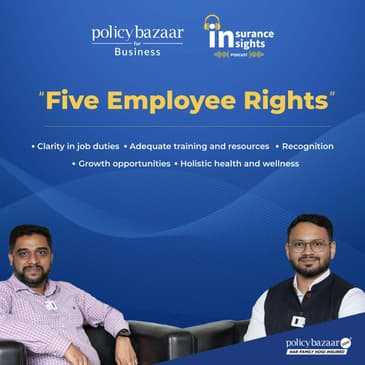

Tune in to the newest episode of #InsuranceInsightsPodcast, in collaboration with Policybazaar For Business! Vaibhav Gangrade (Policybazaar's Business Head - Employee Benefits) and Chandra Kumar CS (CHRO at Varthana) engage in a compelling discussion on the importance of nurturing employee wellness and overcoming unique business hurdles. Tune in now!
[00:00:00] Hello everyone and welcome to another episode of Insurance Insights Podcast by Policybazaar.
[00:00:05] I'm your host Debuff and today's episode is brought to you by Policybazaar for Business,
[00:00:10] the corporate insurance division of Policybazaar.
[00:00:14] I am honored and thrilled to be introducing to you our next guest up today,
[00:00:19] Mr. Kachender Kumar CS, Chief Human Resources Officer and Head of Customer Experience at Bhatana.
[00:00:26] Bhatana has been a catalyst for revolutionizing finances and have been empowering students
[00:00:31] to make education more affordable and accessible across schooling and at hand college side of things.
[00:00:37] Welcome, welcome to the show and thank you for giving us this opportunity.
[00:00:41] Thank you, Bhatana.
[00:00:43] So sir, since Bhatana has been in this business for more than a decade now,
[00:00:47] can you tell our viewers a little bit more about what exactly does Bhatana do?
[00:00:51] And what do you stand for? What are the mission and mission values of the company?
[00:00:54] Thank you, Bhatana. I work for considering Bhatana and it is pleasure meeting you.
[00:01:00] Bhatana as an organization, the word itself Bhatana is derived from the Sanskrit word Bhatana,
[00:01:07] which kind of stands for transformation.
[00:01:10] So we are India's largest school-to-school provider.
[00:01:12] There are other banks or in BFCs providing school loans.
[00:01:17] But as an exclusive school loan, probably Bhatana is the largest as of now.
[00:01:23] We are existing for last 11 years. This is our 11th year.
[00:01:28] We have present-secrose 15 states in India around 40-41,
[00:01:33] and this we have from an employee strengths point.
[00:01:36] We are around 700 plus employees as of now.
[00:01:39] And if you look at how we are transforming our vision or how we are working towards our vision
[00:01:43] of transforming the affordable education, is that you look at there are two parameters
[00:01:47] as far as education is concerned.
[00:01:48] One is the access. How fast or how accessible the education is.
[00:01:52] Second is the quality. So if you look at the government sector,
[00:01:55] the accessibility is very high. You can immediately get an admission in a school.
[00:01:58] And if you could look at the private sector, the high-quality education accessibility is limited.
[00:02:03] So we are actually trying to bridge, bring it there to make the accessibility and the quality
[00:02:08] somewhere catering to the larger population.
[00:02:11] So that is role and private players have a very good role to play in it.
[00:02:15] So that is the place where Vardhana comes into picture.
[00:02:18] And we generally give loans to the societies or this trust who are running these education institutions.
[00:02:24] You can run an education as a profitable business in India.
[00:02:28] It should be done under some society or trust or that model.
[00:02:32] So the banking norms, this education and it is don't fall under in a regular banking norms.
[00:02:39] This is the area where Vardhana has pitched in.
[00:02:41] Our job is not just to give some money to school and collect the AMI money.
[00:02:45] That we have never thought about that our passion is to make the school moving to a trajectory of quality and accessibility.
[00:02:54] And we are trying to explore all possible options to support a school.
[00:02:59] And we actually came up with a lot of products also as per the requirements of the customers.
[00:03:04] So that is the way we are actually looking at this particular aspect and trying to help the schools.
[00:03:09] So these are all the things which is very fulfilling.
[00:03:12] I am with Vardhana for last, this is my eighth year with Vardhana.
[00:03:15] So I have seen how this organization is grown and I am well connected to the purpose of this organization.
[00:03:21] I was leading the HR team for some time in Vardhana and last year I took over the customer experience also.
[00:03:28] So this is the larger perspective about Vardhana.
[00:03:32] And this is also one of the rare times that I see a single individual being the chief of human resources
[00:03:37] and also the head of customer excellence and customer experience.
[00:03:42] So I just want to understand how exactly does this work internally?
[00:03:45] How did it come into being and can you elaborate a little bit more on that?
[00:03:49] So I am handling both the HR function and the CX customer experience function in Vardhana.
[00:03:54] The HR function has started with the HR function in fact.
[00:03:57] And Vardhana have been continuously in the great place to work, one of the best companies in India.
[00:04:02] The project we for the last five years and this is a sixth year we got again certified.
[00:04:07] And in the last year we were third position in the best mid-sides companies in India.
[00:04:13] And in Asia we ranked 9.
[00:04:15] So from the people practices, Vardhana has been very strong over the last seven years
[00:04:21] with the help of the leadership, the managers, the team.
[00:04:24] And the most importantly the values which Vardhana holds.
[00:04:27] So our values actually stand for doing the right thing, unlocking potential, serve others and having fun.
[00:04:35] So the ender culture of this organization is built on these four values and philosophy
[00:04:41] which is always highly people oriented.
[00:04:44] Our focus is on people we love nurturing talents because we work in a segment which is on the transformation
[00:04:51] and this work transformation is in building Vardhana and it is glued to every people who are working closely with Vardhana.
[00:04:58] Whether it is our customers, whether it is our employees, whether it is our managers leaders, everyone actually carry this.
[00:05:04] We are trying to develop the customer experience on the base of the culture.
[00:05:09] Yes we have a very strong culture.
[00:05:11] Apart from that the new modes of connecting to the people because if you look at the society
[00:05:18] the digitalized people are there, people who are transforming to the digital mode is there.
[00:05:23] People who are facing too much access to digitalism is there.
[00:05:26] There is a lot of analytics data which is available which can actually help us predict the people's behavior
[00:05:31] which will help us to give better service to them.
[00:05:34] So we are using these kind of tools blended with culture strategy to provide excellent exceptional customer experience to the people
[00:05:43] who started this journey and we are moving towards that.
[00:05:46] And you mentioned that the businesses spread across the country and you operate in 15 states as of today
[00:05:53] and show that it brings its own set of unique challenges and unique problems that you try to solve.
[00:05:58] Can you explain a little bit more about those things and how exactly are the solutions that we have basically curated over past couple of years,
[00:06:06] how has the business evolved more than a recent past?
[00:06:11] We have doubled tripled our employees, strength over last couple of years and we are now around 750 employees organization
[00:06:20] which is spread across all the geographies you can, I told you that 41 branches,
[00:06:26] our farthest branches located in Jelender and the nearest own ASE in the Bangalore itself.
[00:06:33] So the challenge from an HR standpoint is how you cater the same culture, same services to the people who are spread across.
[00:06:43] And again we start with the basis of our values.
[00:06:46] You know all over philosophy start there and we have managed to provide a strong culture like I told you earlier
[00:06:57] by giving a proper leadership level engagement across the locations.
[00:07:04] Based on this culture plus the technological capabilities we have built in over a period, I would tell you that in HR it is almost 100% the age paper unless we are running.
[00:07:14] So that means anybody any employee in India can get any HR services accessible through the technology without any use of paper.
[00:07:23] The reachability accessibility for the amount of choice is really good.
[00:07:26] Now we put a lot of effort, lot of investment on people whether it is in their learning and growth supporting them in terms of getting their work done.
[00:07:37] And we never create unnecessary pressure in the system.
[00:07:41] Right? I mean some some philosophies are like that you put too much of pressure the best we will get.
[00:07:46] We never do that. Our philosophy towards people is that basically you can 4-5 things very importantly whether it is there for the employee.
[00:07:54] The first and foremost thing is that whether we have communicate with the employee what to do is a bit clear about what they are supposed to do.
[00:08:01] Right? The second thing is that whether we have trained this person properly that how it is supposed to be done, whether training, whether knowledge we have shared or skill capabilities we have built to the person to deliver those responsibilities.
[00:08:16] The third thing we always look at is that whether are we providing enough resources and support for that person to get his job done.
[00:08:22] And the fourth thing is that are we providing enough recognition and motivation to the person to get the work done or we are creating toxicity or negativity to get this.
[00:08:31] So that is the fourth part.
[00:08:33] And fifth part is that whether that job is kind of exciting for the person is there any learning growth opportunities we are giving for that person.
[00:08:42] Right? These 5 things we will ensure for all the jobs in this army of we call it as 5 rides of employees in Vartana.
[00:08:51] I also want to understand that how do you ensure that our employees are motivated and how do you ensure that the same culture, the same vision that originates out of HQ is also cascaded to your employees which are spread across the country and how do you drive a singularity between those employees more from a motivation and wellness point of view.
[00:09:11] So from the growth perspective we are not just looking at giving a promotion over a repair of period of time or just increasing the salary or compensation just to meet the employee aspiration.
[00:09:20] It is about making an employee better aligned to their aspirations and the need of the organization.
[00:09:27] So this is on the leading end growth aspect and if I look at the wellness aspects of it, the first thing we strongly believe on the wellness is that creating a conducive environment for employee to work.
[00:09:38] That is where the first the wellness starts. If an organization's culture is not supporting a physical or mental or emotional wellness of an employee, what ever which we are provided is not going to work because employees always under stress.
[00:09:52] So we train our managers, we invest time in our managers to ensure that they are good people managers.
[00:10:00] We create ventilating systems where employee can raise any concern in terms of the managerial you know deficiencies or grievances.
[00:10:09] We listen to them and we solve them. People feel that always there is a support for them.
[00:10:14] You know you've been consistently ranked in the need of a system work list. So what are the key decisions that you and your team have probably made to ensure that their employees are happy, they are motivated and they are all driven towards a single mission of what you're also trying to drive it really as a person.
[00:10:29] So we have a formal policy of behelty, a documented policy of behelty which talk about physical, social, emotional, I mean the mental or emotional and financial wellness.
[00:10:44] So in terms of the financial wellness we have created the systems for the NPAs and wherever people want to invest, voluntary, proud infants, best advice on the taxation, giving flexibility for the people to manage their financials.
[00:10:57] If they have any kind of financial emergency there are support systems within the organization. Within 24 hours they will get the additional money.
[00:11:05] So we have a policy here which is called as a childcare benefit. So five years back our diversity was just a six percentage.
[00:11:12] So when we was looking at it we realized that there are so many things which actually stops the women employees from getting it because they are a banking company, so much of field jobs you know people coming here at the age after maternity they are not able to continue you know because of various factors.
[00:11:28] So we create a policy called a childcare policy where we give certain additional amount to women employees till the time the child achieved two years of age.
[00:11:36] So that extra financial support is actually converting a lot of women employees to continue in the work.
[00:11:41] So this is an example of an financial kind of a wellness thing which we are kind of providing.
[00:11:46] Similar to that from a wellness standpoint yes we have insurance, we have a counter-biltry parental insurance scheme also.
[00:11:53] So we provide this online consultation in terms of an OPD or those kind of things are there. There is tie ups which we have had for the annual health care assessment and I can tell you most of the times these are certain checkboxes for most of the organization but we are not like that.
[00:12:09] We really encourage people to use all the preventive health related facilities which we are offering and what the feedback I got from our partners is that we are of the best consuming organizations.
[00:12:22] Both in the learning and in the wellness our partners feedback is that we are one of the best consuming for the employees.
[00:12:27] So these are the things we are doing emotional and social wellness we are very, very clear.
[00:12:31] We don't allow any toxicity within the system but these are the places where generally people will get struggling.
[00:12:37] People lack of sleep, having food on time, unnecessary stress, anxiety.
[00:12:42] These are all due to mostly the work environment.
[00:12:46] You need to understand that an employee spend around 30-33% of their time in an organization and the environment should be equally conducive.
[00:12:57] That of a family. So if you have done this service and all we ask people when we talk about what comes to your mind, people say it is family.
[00:13:06] So people are feeling it as a home. How comfortable you are at home? Similar comfort we need in office.
[00:13:14] So that is the thing from an wellness standpoint we are providing to the employees. This is our general feedback we are getting also.
[00:13:22] Thank you so much sir for this wonderful and delightful conversation.
[00:13:26] I am sure that people like us and the viewers and the community who is watching this podcast has some great takeaways from this conversation.
[00:13:35] Thank you for giving us an opportunity, thank you for taking our time speaking to us.
[00:13:39] And we look forward to having more conversations like such in the future.
[00:13:42] Pleasure, pleasure having this conversation. It's a great honor for me. I look forward. Thank you.
[00:13:48] Thanks.
[00:13:52] Thank you.