
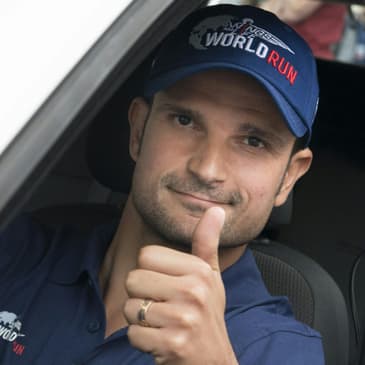
Vitantonio Liuzzi's love for Formula 1 is unmatched and infectious; his love story with Formula 1 is next to none. Tonio went from being World Karting Champ one year to making his Formula 1 debut in the next; and beating the then 4-times Formula 1 World Champion Michael Schumacher in go-karts.
Tonio proudly calls himself the "start up" driver for Formula 1 teams after racing with "start ups" Red Bull Racing, Force India and HRT. In this episode of the Inside Line F1 Podcast, Tonio shares his journey through Formula 1, the highs-lows and why he is so proud of his appointment as FIA's Driver Steward.
For the geeks, Tonio's story on how the f-duct ruined his career in the sport is one definitely worth listening to!
🛑 Subscribe for more F1 insights: https://podfollow.com/inside-line-f1-podcast
💬 Follow us on social media: @insidelinef1pod
Tune in!
(Season 2025, Episode 01)
Follow our hosts: Kunal Shah & Soumil Arora
Image courtesy: Red Bull Content Pool
Learn more about your ad choices. Visit megaphone.fm/adchoices
[00:00:18] Hey there everyone, wishing you all a very Happy New Year and welcome to the first episode of 2025 of the Inside Line F1 Podcast.
[00:00:26] Before we tell you more about our guests for today, we'd like to invite all of you to our first F1 community meetup of the entire season in Mumbai.
[00:00:35] This is the Inside Line's F1 pit stop at Car Social on the 12th of January.
[00:00:40] It's gonna be an evening full of conversations, quizzes and banter around Formula 1.
[00:00:45] It's the first time in the year where we get to talk about Formula 1 with all of you in person.
[00:00:51] And if that's not enough of a reason for you to join us, even Mithila, the most popular host of the podcast will be there in person,
[00:00:58] telling us the evolution of the business and politics of the sport over the course of the last few years.
[00:01:03] You just cannot miss this event, can you?
[00:01:06] You can register for the event by clicking on the link in the description.
[00:01:09] Once again, join us for the Inside Line's F1 pit stop at Car Social on the 12th of January in Mumbai.
[00:01:16] Now, to our guest.
[00:01:17] Our guest for today is probably one of the most multifaceted individuals you can find in a Formula 1 paddock.
[00:01:24] He started his Formula 1 journey by becoming a karting world champion and on the day he did so,
[00:01:29] he beat a then four-time F1 world champion, Michael Schumacher.
[00:01:33] A year and a half later, he was there testing Formula 1 cars and soon enough,
[00:01:37] he was one of the foundational members of the Red Bull Racing Formula 1 team
[00:01:41] that has now gone on to become one of the most successful teams in the history of the sport.
[00:01:46] After that, he moved to Force India where he met our co-host Kunal and then he moved on to the HRT racing team.
[00:01:53] Do you get a trend here?
[00:01:54] This driver seems to be the best person you want to have in your team if you are starting up in your journey.
[00:02:00] Candelac, you better take notes.
[00:02:02] Today, he is one of the very handful drivers who have now gone on to become the FIA's driver stewards.
[00:02:09] The responsibility is huge, but a very important one.
[00:02:13] This guy is an excellent storyteller who was on our podcast to share some phenomenal anecdotes in his incredibly charming style.
[00:02:21] We are talking about Veet Antonio Luzzi.
[00:02:23] Let's dive in and listen to all of his incredible stories, shall we?
[00:02:27] Veet Antonio, it's so crazy that we have you on the Inside Line F1 podcast
[00:02:31] because all of us here have so many great memories of you,
[00:02:35] particularly of the suit that you have in your background, the 2008 Force India 1.
[00:02:40] I can say I was actually there. It's the first time I saw an F1 car and an F1 driver in the flesh in Mumbai.
[00:02:46] I was only, what, five years old back then.
[00:02:48] And I particularly remember supporting you a little bit extra because your helmet, the Italian colours,
[00:02:54] actually matched the Indian colours of the Force India Formula 1 car.
[00:02:57] Totally correct. It was a beautiful match. Seemed like it done on purpose.
[00:03:02] Exactly. And that's one of the reasons why I was so hooked on to that team.
[00:03:06] And Kunal, you were there at Force India when Veet Antonio was actually racing.
[00:03:10] Yeah, you know, we can actually just call him Antonio because that's what we've always called him.
[00:03:15] Antonio was the driver.
[00:03:18] And, you know, for me, that was this... I've never told this to Antonio, so he's going to hear this live.
[00:03:22] When you're not working in Formula 1, you always look up to everybody in the paddocks as your heroes and you want to get there.
[00:03:30] And I remember one of my first in-depth conversations at my first race in Turkey was with Antonio.
[00:03:37] And I remember what we spoke of, which we will bring up later on in the episode.
[00:03:42] And that's why there's a reason why Antonio, Adrian Suttle, Nico Halkenberg are always some of those really close bonds I carry through my life.
[00:03:51] So thank you so much for accepting the invite to join us on this episode of the Inside Line F1 podcast, Antonio.
[00:03:59] You've got a beautiful story yourself, lots of narratives which we will bring out.
[00:04:03] And who better than Samuel to help us bring that out on this episode?
[00:04:08] Thanks a lot. Thanks for inviting me.
[00:04:10] It's a pleasure to have some good memories and some good stories from the past.
[00:04:13] So I spent four years in Force India. It was a beautiful time with Vijay Malia and all the crew.
[00:04:22] It was really nice, nice feeling and nice to be back and talking about what has been done during that time.
[00:04:28] Because it was a different time for Formula 1. It was not that easy. It was quite a competitive period.
[00:04:34] But we did great things and we'll always remember with the hype.
[00:04:39] Yeah, and you also have a special India connection. So there is Force India.
[00:04:44] Then you almost raced in the X1 racing league.
[00:04:47] And I remember just when you were signing up, you and I spoke about the league which unfortunately did not take off.
[00:04:54] And then the famous Indian driver Naren Karsikeyan, again a dear friend of ours, was your teammate at HRT.
[00:05:00] So lots of subtle and not so subtle Indian connections you've had over the years.
[00:05:05] Yes, definitely. Also with Naren, it was a great partnership, a good teammate.
[00:05:10] We had always good fun and we always fought hard during the season in HRT.
[00:05:14] But I know him since his Formula 3 times and he's a great guy and it was really beautiful to share the team in HRT with him.
[00:05:23] But you've had such a fun journey, right? Starting from karting, then so many Formula 1 teams you've tested for, so many teams you raced for.
[00:05:31] Now the official driver steward and I'm not even counting the immense amount of work that you've done after Formula 1 and motorsport.
[00:05:38] The different series you've driven in. That's a separate conversation altogether.
[00:05:42] But I want to start at the very beginning, Vigit Antonio. It's the karting, right?
[00:05:46] So many people forget about Formula 1 drivers and their background once they're in the sport.
[00:05:50] But we can't because your background was quite something.
[00:05:54] A karting world champion, second in one year, now the champion in 2001.
[00:06:00] That is such a tremendous background you bring in.
[00:06:03] But I'm more curious about how you got into Formula 1 because you were karting until you were 21.
[00:06:09] Was that normal at that time?
[00:06:11] It was more normal. Let's say now in the last 10 years, drivers like Vettel, Verstappen, Leclerc, they changed a little bit the attitude of approaching single-seater and Formula 1.
[00:06:25] Now everything is shrinked in the age of 16, 20 years old when you need to be in F1.
[00:06:30] If not, you're not anymore a super talent.
[00:06:33] But in my time, it was different.
[00:06:35] You know, we used to reach Formula 1 at the age of 25, 27, 23 when you were younger.
[00:06:41] Because there was a different maturity, let's say.
[00:06:45] Nowadays, they throw the kids in Formula 1 even if they are not maybe mentally ready or prepared.
[00:06:51] And they coach them, they grow them up during the season.
[00:06:55] In our time, you arrive into Formula 1 where you are already a mature driver.
[00:07:01] It happened with me, with Fernando, with Raikkonen, with all these young drivers that they needed to show up performance, strong performance first, strong maturity first.
[00:07:14] And then ending up and fighting and racing with Schumacher, Kulter, Dakinen, all these guys that were the idol of the time.
[00:07:21] Now everything has changed. I raced definitely until late in go-kart, but it was also my thing.
[00:07:28] I really wanted to win my karting world championship in Formula Super 8.
[00:07:32] It was the pinnacle of karting motorsport at that time.
[00:07:35] And that's why I got a lot of offers to step into single-seater before, earlier.
[00:07:40] But I always say, no, I don't do it until I win.
[00:07:42] I don't do it until I win because this is my...
[00:07:45] It was for me like a stamp.
[00:07:47] If I win the World Cup, the World Championship, I would have been good enough to try and approach a single-seater career heading up maybe into Formula 1 one day.
[00:07:56] So it was something more mental for myself than something that was really happening around me.
[00:08:04] And the follow-on effect from that was insane.
[00:08:07] Because in your karting World Championship success season, in the last round, you actually beat Michael Schumacher.
[00:08:14] And not just any Michael Schumacher, a four-time world champion Michael Schumacher at that time.
[00:08:19] I want to talk about the whole emotion of that weekend.
[00:08:21] Because I'm sure if you're doing a full season, it's such a tough championship.
[00:08:25] You're focusing on your competition, on yourself.
[00:08:27] And suddenly, here comes one of the greats of the sport.
[00:08:31] That must personally create so much agitation, right?
[00:08:33] Like, why is this guy here with us?
[00:08:35] Totally, totally right.
[00:08:37] When I was there fighting for my world title against my competitors,
[00:08:41] and then knowing that Michael Schumacher, the time-for-time world champion, was coming into our race,
[00:08:47] it changed a little bit the perspective.
[00:08:49] Because obviously, media-wise, all the media were only interested on him.
[00:08:54] They lost the focus on our championship.
[00:08:56] So we thought that a little bit was not good for us.
[00:08:59] But I will always be thankful to Michael Schumacher that he came there to race the last race,
[00:09:05] the last round of the Karting World Championship.
[00:09:06] Because I became definitely the most famous karting driver that won our world title ever.
[00:09:13] Because Michael was there.
[00:09:14] I beat Schumacher in that race.
[00:09:16] We became good friends during that time.
[00:09:19] Because he had a lot of respect for karting drivers.
[00:09:22] And the fact that I won at his house, at his home race, in his circuit,
[00:09:27] and was a really strong win.
[00:09:30] I don't know.
[00:09:31] I think inside his head, he showed that this guy has talent.
[00:09:35] I gained respect with him.
[00:09:37] And it was amazing.
[00:09:38] Because after, I think it was like eight or nine months since my last time I drove a go-kart in Kerpen,
[00:09:45] I tested my first time a Formula One kart that was a William F1 in less than a year.
[00:09:51] And it was such a short step.
[00:09:53] Definitely, I left go-kart really late.
[00:09:55] But then my road to Formula One was really, really short.
[00:09:59] Because the maturity that go-kart gave me was incredible.
[00:10:02] And that's why I did such a short way to Formula One really quickly.
[00:10:07] You know, if you were to tell any of the New Age fans that you went from karting to Formula One in nine months,
[00:10:14] they would just not be able to fathom it.
[00:10:16] So we will dig deep into that journey of yours as well.
[00:10:19] But, you know, from being a karting world champion, okay, to then making it to Formula One,
[00:10:26] you joined, of course, you're a part of that illustrious list of drivers.
[00:10:30] I think Ricardo Patriz was there.
[00:10:32] Yarno Trulli was there.
[00:10:33] Guido Van Descartes as well.
[00:10:35] Nick DeFries as well.
[00:10:37] A very interesting positioning here.
[00:10:39] There were just two drivers, I think, Alan Prost and Max,
[00:10:42] who became a Formula One world champion and were karting world champions as well.
[00:10:47] Now, as a driver who's experienced both, you know, racing in karts, winning there,
[00:10:52] trying really hard in Formula One,
[00:10:54] seeing run out of luck before you ran out of talent.
[00:10:57] At least that's what I would like to believe, right?
[00:10:59] What do you think is more difficult to win?
[00:11:02] Is it the karting world championship, given how many drivers compete,
[00:11:05] how close the field is, or is it Formula One world championship
[00:11:09] where there is so much more politics and luck that's needed?
[00:11:13] It's a totally different approach because obviously they're both really, really difficult
[00:11:19] because competition is super high.
[00:11:20] But obviously we all know how important it is having a good team,
[00:11:24] a good kart in Formula One to achieve a result such as winning a world title.
[00:11:30] You know, at the end of the day, even in my time when we had only 16, 17 races,
[00:11:34] you needed to be perfect, consistent, focused all the year.
[00:11:40] You couldn't make any mistake.
[00:11:41] You couldn't have any kart failure.
[00:11:43] It was so important to achieve a karting, a Formula One world championship.
[00:11:48] In karting, the World Cup is in a single day or sometimes like it happened to me in 2001,
[00:11:54] it was on five races.
[00:11:56] Really competitive, really amazing.
[00:11:58] But in karting, the driver can make a little bit more of the difference,
[00:12:02] you know, can work with his body to improve the setup,
[00:12:06] to improve the, to handle the race differently.
[00:12:09] In Formula One, you are always super important.
[00:12:13] Definitely. I'm not saying that it's much easier if you have a good car,
[00:12:16] but, you know, the car makes such an important part of the overall result.
[00:12:23] So, I have to say, two really difficult championships to win,
[00:12:28] two really tough competitions, super high, but different approach,
[00:12:33] a different kind of problems, let's say, to handle during the season.
[00:12:37] So, they're both in the same way, totally hard.
[00:12:40] But I would say that in the Formula One, you need to be linked with a really good car
[00:12:45] and a really good team to achieve the result.
[00:12:48] More than a team, because the team is more often pretty good.
[00:12:51] But, you know, I always say, when you make a Formula One car,
[00:12:54] it's like when you make a cake.
[00:12:55] Until you don't taste it, you don't know how it came out.
[00:12:58] So, many times teams believe this year I'm going to have a super car,
[00:13:02] then they go to Barcelona for the first test of the year,
[00:13:05] and the car is totally trash.
[00:13:08] Or many times it's happening the opposite.
[00:13:10] You believe it's not a good car, you put it on the track,
[00:13:13] and it's fantastic.
[00:13:14] So, it's really important to be lack on creating the right package in the car,
[00:13:20] to give the driver the best opportunity to finish up with the world title.
[00:13:25] It's not easy.
[00:13:25] We also see that sometimes a really good car like Red Bull this year,
[00:13:29] is not matching with the Parrots style, and is struggling a lot.
[00:13:33] And we see Max Zeddy won the championship.
[00:13:35] So, it's not that easy.
[00:13:37] There are different characteristics, different problems in Formula One,
[00:13:41] but still a high level of difficulties to win the title.
[00:13:46] And it's like the driver is the final finishing touch.
[00:13:49] But these days, drivers come to Formula One so much more prepared.
[00:13:53] Like I think of Oliver Behrman and Franco Colapinto this year.
[00:13:56] So many simulator miles, so much running in Formula Two.
[00:14:00] For some of them, like Behrman, there's some previous car testing as well
[00:14:03] that gets them prepared.
[00:14:04] But when you drove your first Formula One test,
[00:14:06] nine months after you became the karting world champion,
[00:14:09] there was nothing.
[00:14:10] So, how was that shift for you?
[00:14:12] Like the transition from being a young karting driver to a Formula One driver
[00:14:16] must have been so much tougher than it is today.
[00:14:19] Actually, I'm getting goosebumps because I remember, you know, the feeling.
[00:14:23] And it was really tough because it's like if they throw you in the cage of the lion.
[00:14:27] You know, you have no time to prepare yourself.
[00:14:29] You just have to perform it.
[00:14:31] And my first test, I remember after nine months, it was together with one Pablo Montoya,
[00:14:37] Ralph Schumacher, and Giorgio Pantano.
[00:14:39] That was my competitor for the seat at that time.
[00:14:41] And I had zero experience of a single-seater.
[00:14:46] So, I went to Valencia driving one of the best cars at the time in the Formula One field
[00:14:51] because it was the BMW Williams where they finished second in the championship.
[00:14:55] And it was a pure beast.
[00:14:58] You know, I could, at the end of the day, I could handle my neck.
[00:15:01] You know, I was having dinner, handling my neck with one arm
[00:15:05] and feeding myself with the other.
[00:15:08] You have no time to prepare yourself.
[00:15:10] You just have to do it.
[00:15:12] And it was an incredible feeling.
[00:15:15] But, you know, many times you have to just close your eyes and do it.
[00:15:20] You have no, no, no, not a second chance.
[00:15:22] I didn't know if I would have had a second chance.
[00:15:24] So, I went for it.
[00:15:25] And it was a really strong test.
[00:15:26] I think it opened up also the mind of F1 people that realized that I had the talent,
[00:15:32] I had the skill to end up where I ended up at the end.
[00:15:37] But it's important, you know, because the circle of Formula One is small.
[00:15:41] So, even if I do a test with a different team, you know, the rumor spread around.
[00:15:46] So, I grew up with the, let's say, the vibe, the shadow of being a super fast driver.
[00:15:54] And that's why I ended up obviously, luckily, in Formula One.
[00:15:58] Luckily or not luckily for results.
[00:16:00] But I ended up there because I had, you know, behind me, you know, the noise that I was a super fast driver.
[00:16:05] And I deserved to arrive there.
[00:16:09] No, and you did.
[00:16:11] And I am so intrigued about the pathway there, right?
[00:16:15] Because Formula One, such an illustrious club.
[00:16:18] So many teams that are looking at so many other different drivers.
[00:16:21] You mentioned someone like Juan Pablo Montoya.
[00:16:23] Someone who actually won so much in IndyCar at that stage as well.
[00:16:27] So, it's such a tough competition that you're getting into.
[00:16:30] But in your journey particularly, it's interesting.
[00:16:33] You were one of the very few drivers who went from karting to Formula One so quickly.
[00:16:37] Kind of like Max, right?
[00:16:38] Because he barely had any single-seater career.
[00:16:41] Do you think that gives you an advantage somewhere?
[00:16:43] And at that stage, what did you have to improve in your driving?
[00:16:46] Like, what were you missing out on because you made that quick jump?
[00:16:51] I think that Red Bull gives you different approach.
[00:16:57] Dr. Marco used to give a different approach to drivers.
[00:17:01] In many other teams, they want to see a driver fully prepared to jump on a Formula One car
[00:17:07] and to deliver with no mistakes, consistency, and so on.
[00:17:12] But in Red Bull, I think Dr. Marco was perfectly linked to the brand.
[00:17:16] And he wanted to see a driver with no fear, basically.
[00:17:21] Both adrenaline drivers, not scared of anything.
[00:17:25] They just were going for it.
[00:17:27] And I think Max had a similar characteristic of mine.
[00:17:30] I remember when I signed with Red Bull, it was because Dr. Marco, he put me in a Formula 3000 car
[00:17:38] straight after the go-kart, right after the Formula One test.
[00:17:42] And the Formula 3000 car at the time, they were massively physical, you know, super heavy to drive.
[00:17:47] And I mean, I was not physically ready.
[00:17:50] But I remember in a high-speed corner with more than 230, 240, I just spin 360 and go.
[00:17:57] And I kept going.
[00:17:58] And then I came back to the box and said, wow, physically I struggled.
[00:18:02] But then I went back again.
[00:18:03] I did a similar thing.
[00:18:04] And Dr. Marco was super excited that, you know, I was not fearing that feeling, you know.
[00:18:13] I was not scared about what happened that I could have crashed.
[00:18:16] But I still went for it because my only aim was being the fastest on track.
[00:18:20] And I think that's something that he showed of me that I want always more.
[00:18:24] I want to drive more than 100% every time.
[00:18:27] I want to be on top of what the car can do.
[00:18:31] And I think there is some similarities, you know, from me and Max that he liked.
[00:18:36] You know, Red Bull is a different brand from a lot of other teams.
[00:18:39] And I think they also analyzed drivers differently.
[00:18:43] And I think that was a characteristic that Dr. Marco used to like in drivers.
[00:18:48] Why Red Bull?
[00:18:49] Because, you know, at that time, we should remind all our viewers and listeners,
[00:18:53] Red Bull was not in Formula One.
[00:18:56] So there was no pathway that you would have been offered at that time.
[00:18:59] Even though conversations to buy Jaguar were probably just going to start.
[00:19:03] The other point is, why not some of the other Formula One teams, Antonio?
[00:19:09] At that time when I was karting, basically, I had a few connections with Jaguar
[00:19:17] when they were buying the team a few years before Red Bull came in.
[00:19:21] I had a good link with Williams.
[00:19:24] And actually, obviously, my first test became with Williams because the son of Sir Frank, Jonathan,
[00:19:30] he was one of my huge fans because he used to love go-kart.
[00:19:33] He used to follow a lot of go-karts and he was my huge fan.
[00:19:36] And he actually made everything my dream come true with my first test in Valencia.
[00:19:41] And I was dealing with him.
[00:19:44] But then when Red Bull came in, I was also in talk with Flavio
[00:19:49] because he used to support the Italian driver growing up.
[00:19:54] But then when Red Bull came in, I saw a different mentality,
[00:19:59] different approach, different way of working.
[00:20:02] And I always felt like Red Bull was... I was down for Red Bull because I'm an adrenalinic person.
[00:20:09] I do all the crazy things in life, you know, like...
[00:20:13] I was a perfect brand ambassador also for Red Bull because it's the kind of brand that suits my style in life.
[00:20:21] And that's why I think there was a good empathy from the first time.
[00:20:26] And that's why we end up together and we grew up.
[00:20:29] And the project of Mr. Matyshitz was straight away really futuristic.
[00:20:36] And I don't know, it was like more for empathy than for business, let's say.
[00:20:43] And when you were joining them at that time, did you have even a slight thought or idea that they would become this big?
[00:20:49] Like not just in terms of success, but operationally, like having the setup that they have, the number of people that they have.
[00:20:55] Was there any vision shared with you that is similar to this?
[00:20:59] I knew from the beginning that they were going to put a lot of effort into this investment, into this project, into this dream.
[00:21:06] Because at the beginning was another dream organized from Mr. Matyshitz.
[00:21:12] And when you speak to him, obviously, you know that at the time he didn't have much ideas of Formula One world.
[00:21:18] But you can see that he was a visionary and he had the idea of really big investment in this project.
[00:21:26] And I fell in love with this.
[00:21:29] Mr. Matyshitz for me was like a father, because he was an amazing person, a really great character, really great attitude, a person of heart.
[00:21:39] And, you know, every time you speak to him, it was really little about motorsport, but was all about the feeling of being part of the Red Bull family.
[00:21:49] It was really great.
[00:21:52] And I couldn't expect it was what they would have become what they are now.
[00:21:56] Because obviously, when I arrived in Milton Keynes for the first time in 2005, end of 2004, the team was like 300 people.
[00:22:04] And now they are a total city, you know, they are big, they grow up like five times bigger.
[00:22:10] The company is huge.
[00:22:12] The factory is incredible.
[00:22:14] And, you know, there are like 1200 people in Milton Keynes.
[00:22:17] It's a total city right now.
[00:22:19] And I couldn't believe that the step forward would have been that high.
[00:22:22] You know, I was visiting Christian in September last year at Milton Keynes, just driving through the parking lot.
[00:22:30] And I was like, how is it that you can't be lost with so many people and so many cars?
[00:22:36] And mind you, these were not Red Bull Formula One cars.
[00:22:39] They were road cars that Red Bull employees were, you know, driving to the factory every day.
[00:22:44] But, you know, Dr. Helmut Marko is a great friend of the podcast.
[00:22:48] What were your early interactions with him?
[00:22:51] Because, you know, we've known him to be very honest, very direct.
[00:22:55] How did he approach you?
[00:22:56] How were your first conversations when you became a part of the Red Bull team, when you were being evaluated to become the first of three Formula One drivers for Red Bull?
[00:23:06] What were those conversations and memories like for you?
[00:23:09] Of course, with Dr. Marko, the conversation was always really short and direct.
[00:23:14] Everybody knows how he is.
[00:23:15] And I have to say that the beginning when I entered the motorsport world and I had to deal with him.
[00:23:22] You know, when you see Dr. Marko's name on the phone when he's ringing you, you start shaking because you know that you never know in which mood he was going to answer.
[00:23:32] Because sometimes you just open the phone call and it was like shouting.
[00:23:36] Or sometimes, you know, it's an open conversation.
[00:23:39] But, you know, I always liked to deal with him because he was such a straight person.
[00:23:44] And with him, white is white, black is black.
[00:23:48] You know, he was always a straightforward person.
[00:23:50] And I have to say that I feel proud that I've been part of the beginning of Red Bull because in a way, we structure.
[00:23:58] I was supporting the team and I was, let's say I was an advisor as well, a little bit of, you know, how you're putting the team together.
[00:24:07] And I feel great because I won my FOMO 3000 championship together with Christian Horner as well.
[00:24:13] So in a way, I was part of the match between Christian Horner, Red Bull, Dr. Marko, because we talk a lot who would have been the right person to put on top of the team.
[00:24:24] And I was always pushing for Christian Horner because he was a super smart team principal.
[00:24:29] And he showed already Narden in his own team when I won the 3000 championship.
[00:24:34] And I'm happy that I helped, let's say, to make this wedding many years ago.
[00:24:39] But it was amazing.
[00:24:40] Dr. Marko, Christian Horner, the group, you know, was like when at the time, you know, in Ferrari, you had Ross Brown, Jean Todd, you know, was a group and they were working.
[00:24:50] Everybody was put at the right place at the right time, I think.
[00:24:53] And that was the biggest thing for Red Bull.
[00:24:56] I think that's beautiful, right?
[00:24:57] Because you worked with Christian at Arden when he was team principal, when it was his racing team, before you actually even got a chance to work with him in Formula One.
[00:25:07] And must have been such a beautiful moment because as a driver, you're hoping to be in Formula One.
[00:25:12] As Dr. Marko, as an advisor to Red Bull, was hoping to be in Formula One.
[00:25:16] And Christian Horner as a team principal of Arden was hoping to be in Formula One.
[00:25:20] And then suddenly there is this, you know, season 2005 and all of y'all are in Formula One.
[00:25:27] But I loved your insights on how you were so involved even in getting Christian hired, because usually it's the other way around, right?
[00:25:34] The team principals are deciding who the drivers will be.
[00:25:36] But in a way, y'all were all helping each other's dreams come true, I guess.
[00:25:40] But for me, when I worked with Arden in 2004, we won everything.
[00:25:45] We took like a nine pole out of ten, a seven win out of ten.
[00:25:49] And the team was working perfectly, you know.
[00:25:52] And that's why, you know, I felt so great inside the Arden team.
[00:25:56] And every time we were talking with Dr. Marko about this new project of the Formula One team,
[00:26:00] I was in love with the way Christian Horner was working because it was so professional, so good.
[00:26:07] So I cannot say that he was put there because of me.
[00:26:10] But, of course, I was pushing a lot to have somebody like him heading the team.
[00:26:17] And at the end, this wedding came true.
[00:26:21] And I think that the partnership between Christian Horner, Dr. Marko in a different position of the team,
[00:26:27] as an advisor of Mr. Matyshitz, and Mr. Matyshitz on top, you know,
[00:26:33] obviously I have to say that the first few years were not so easy because there were a lot of politics inside.
[00:26:38] You know, we had Danny Barra, Niki Lauda, Thomas Huber, a lot of other people, you know,
[00:26:45] that they were there to get the power.
[00:26:47] The first two, three years were difficult.
[00:26:49] But after 2007, I think everything started to get a clear line.
[00:26:54] And that's where they made the switch, the big switch.
[00:26:59] And they brought them to where they are.
[00:27:02] Because in the beginning, it was great for me because I had a lot of fun.
[00:27:05] But in 2005, the team was more focused on parties and marketing, let's say,
[00:27:11] more than giving a super fast car.
[00:27:14] But in the background, the team was working highly.
[00:27:17] It was amazing that they were putting the structure to grow up.
[00:27:19] So, but for sure, I had a great time.
[00:27:23] But maybe if I look behind now, I would prefer to have a 2005 super fast Red Bull car
[00:27:30] more than a marketing parting situation.
[00:27:34] But I'm always proud and happy to what has been achieved in the time because we put the bases.
[00:27:40] I always say that I've been the start-upper of a lot of Formula 1 teams.
[00:27:43] You know, Red Bull the first year, Toro Rosso the first year, Force India the first year,
[00:27:48] HRT the first year.
[00:27:50] And then after, obviously, all the team, I was helping the team to grow,
[00:27:53] putting the bases, developing the car.
[00:27:55] But then after, when you start getting results,
[00:27:58] politics enter inside the team.
[00:28:00] And that was really weak politically.
[00:28:03] Many times I lost the seat because of that.
[00:28:06] But that's part of the business.
[00:28:07] You need to be strong in every side.
[00:28:10] Antonio, Cadillac is coming in.
[00:28:12] They need a driver to set the team up.
[00:28:14] I'm open.
[00:28:15] You can still take a look.
[00:28:17] Actually, I wanted to send my CV.
[00:28:19] You know, if you can help me out with Andretti.
[00:28:24] That'll be more like it.
[00:28:26] That's the kind of return we all want to see.
[00:28:28] I'm still ready.
[00:28:29] I'm like, you know, Hulkenberg.
[00:28:30] He was always jumping into teams.
[00:28:33] And now he's set it up.
[00:28:34] But I'm ready.
[00:28:35] The hunger is still there.
[00:28:38] Love it.
[00:28:39] Love it.
[00:28:39] But on that Red Bull time, I find it fascinating.
[00:28:42] Because back in 2005, when you were there, Christian Horner was just 32.
[00:28:47] Which means you had worked with him earlier when he was just in his early 30s, right?
[00:28:51] 30, 31.
[00:28:52] Which is weird.
[00:28:53] Because at that point, Formula One team principles were all in their mid-50s or 60s.
[00:28:57] And what that guy has achieved in Formula One is insane.
[00:29:01] From running an F3000 team to now an organization this big.
[00:29:04] What did you particularly like about him?
[00:29:07] What characteristics made him such a good leader?
[00:29:10] And what's he like with drivers when you're there?
[00:29:12] Because we know that Dr. Marco is largely the one who speaks to drivers.
[00:29:15] But how involved was Christian when you were racing in that team?
[00:29:19] No, he was definitely highly involved.
[00:29:22] Also Christian, both of them were leading the team.
[00:29:25] And many times we were discussing all together.
[00:29:28] But definitely they have two different positions inside the team.
[00:29:32] They have to deal with things, with different things, let's say.
[00:29:37] But Christian, what I saw in his mentality, in his approach, in his handling of the team,
[00:29:44] he was super organized.
[00:29:46] He had everything printed in his head and he knew where he wanted to arrive.
[00:29:51] And he has the British approach that also is really important many times in dealing with Formula One.
[00:30:00] And he was always really smart because he knew where he wanted to end up.
[00:30:05] And he knew how to end up there where he actually wanted to.
[00:30:08] So he can be really political when he wants.
[00:30:12] He really knows how to talk.
[00:30:14] And he's super smart.
[00:30:15] So I think these are the quality of a team principal.
[00:30:19] And that's why they made him arrive where he is now.
[00:30:23] And he fully deserved the position.
[00:30:26] You know, given how ruthless Red Bull is with drivers, we are now pretty much going into every season,
[00:30:35] expecting them to do some sort of a mid-season driver switch.
[00:30:38] And that's the level of ruthlessness we are used to now.
[00:30:41] But you were used to a different level of ruthlessness, don't you?
[00:30:44] Because in your debut year, you actually agreed to a seat sharing arrangement with Christian Klein and at Red Bull.
[00:30:52] What were those circumstances like?
[00:30:54] Because eventually you got, I believe, just four races there.
[00:30:57] You scored points on your debut.
[00:31:00] At that time, points were given only the late position.
[00:31:02] You scored a point then.
[00:31:04] Why did you agree to a seat sharing arrangement for your debut season?
[00:31:10] Because basically, you know, they were always super great to me.
[00:31:15] You know, I always talk to Dr. Marco and Mr. Matisci about this project.
[00:31:19] And let's say we build it together.
[00:31:22] But, you know, I was part of this first idea of building the team.
[00:31:27] And obviously, since I won the Formula 3000 Championship, it was kind of an automatic step.
[00:31:35] I had no more to win before Formula 1.
[00:31:38] And obviously, it was a time where the year before, I pre-signed a contract with Sauber
[00:31:46] when they were sponsored from Red Bull.
[00:31:48] And then after Eccleston stopped everything because they wanted to have back Jacques Villeneuve in the grid.
[00:31:54] So, basically, even though I signed a three-year contract, we had to delete it.
[00:31:59] And after Red Bull really wanted to have me in Formula 1 with them.
[00:32:03] But they already had Christian Klien and my team mate, a super friend,
[00:32:07] that they had the Red Bull contract since before, that he already made two seasons in Formula 1.
[00:32:12] So he was a more experienced driver.
[00:32:13] So, basically, the idea was to put him and me together.
[00:32:16] But obviously, the first year of a Formula 1 team is not easy.
[00:32:19] If you jump into the circus with the two young drivers, with a little experience from Christian and zero from me.
[00:32:26] And then after, basically, David Coulter entered into the package.
[00:32:30] It was difficult to understand how it would work.
[00:32:34] And basically, they came out with this decision that me and Christian, obviously, the two young Red Bull junior,
[00:32:39] we would share the seat for the full championship.
[00:32:42] And we tried.
[00:32:44] We tried at the beginning of the season.
[00:32:45] Christian started after there was the first swap with me.
[00:32:48] And then when we came back to him, we realized that it wouldn't work.
[00:32:52] You know, you need continuity.
[00:32:53] You need to build a group of engineers.
[00:32:56] Your data, your race engineer with you working together.
[00:33:00] So even though we had an amazing relationship with me and Christian inside the team.
[00:33:05] But it was not good for neither of us.
[00:33:08] And that's why, obviously, I was the younger one in Formula 1, even though Christian is younger than me as the age.
[00:33:17] But I decided to step out of this because Mr. Matisic was super good to me.
[00:33:23] He said, listen, you know, I understand the difficulties of this year.
[00:33:27] You know, next year we'll make it work.
[00:33:29] We'll find a way.
[00:33:30] And during the season, they start thinking about buying a second Formula 1 team.
[00:33:34] So I said, okay, if you want, Mr. Matisic, you know, I know how much I love you.
[00:33:38] And we decided together.
[00:33:39] I step out of this because it's good for the team to grow up for the result, for everything.
[00:33:44] I step out of this and we let Christian finish in the season.
[00:33:48] And then we will work for next year to build something together.
[00:33:54] And then after it was a super shock because basically he decided to buy Minardi,
[00:33:58] to build the Toro Rosso team, to make a full Italian package.
[00:34:01] He said, okay, you will be the number one driver of the team.
[00:34:04] We make a full Italian package, Italian brand, Italian name, Italian location.
[00:34:09] And we created the Toro Rosso team.
[00:34:11] And I was super proud of this position.
[00:34:14] I just didn't expect at that time there would have been a B team with a lot less investment.
[00:34:20] So that I didn't work the best for me.
[00:34:23] But I have to say that I grew up in an amazing family because Toro Rosso, for me still,
[00:34:29] I see mechanic from my period, the engineer from my period inside the team.
[00:34:33] And it's amazing when I'm at the track working as a FIA steward,
[00:34:37] I feel always to be in a family with them.
[00:34:39] You know, the Italian vibe inside, you know, it's incredible.
[00:34:45] So it's always great to be in the paddock with them.
[00:34:47] It was an all Italian team, which is still running strong,
[00:34:51] deciding to change their names.
[00:34:53] It reduced, you had the Italian power units.
[00:34:55] There was Ferrari power unit as well.
[00:34:57] So everything, everything was Italian.
[00:35:00] And then of course, you spend a couple of seasons there
[00:35:03] before you move to my favorite team ever in Formula One.
[00:35:06] And I'm very biased about it. It's Force India.
[00:35:09] How did that conversation happen?
[00:35:11] Because clearly you were also leaving the Red Bull family at that instance.
[00:35:16] So were you on loan?
[00:35:17] Or was it an understanding that, you know, we'd let you, you know,
[00:35:20] we give you wings to your Formula One carrier, even if it's not in one of our cars?
[00:35:24] What was that arrangement like?
[00:35:26] Yeah, it was a little bit confusing at the time.
[00:35:29] Because obviously when me and Red Bull we split, it was,
[00:35:35] actually when I was in Red Bull, I thought my career, my full career would have been with them.
[00:35:39] Because I was linking perfectly with the brand.
[00:35:43] And it was a big family.
[00:35:45] But then after, since Berger came into the team of Toro Rosso,
[00:35:49] we started having the first friction because he had his own interest towards other drivers,
[00:35:55] other, let's say, link of engines.
[00:35:58] You know, he was supporting Bourdais together with Nicola Todd.
[00:36:03] And that's why he started putting pressure to, in that year, in my last year of Toro Rosso,
[00:36:09] basically, Mr. Matisic decided to put Vettel instead of Scott Speed.
[00:36:16] And I did a super season because I was super competitive in the second part of the season,
[00:36:21] also when Vettel was my teammate.
[00:36:23] But Berger had different ideas.
[00:36:27] So at the end, even if I was pretty sure that my position would have been confirmed for 2008,
[00:36:33] because in terms of pace, consistency, handling the team, you know,
[00:36:39] and working together with the team was a really great year.
[00:36:42] Gerard had totally different ideas, let's say, for the future.
[00:36:47] So in not the nicest way, we ended up breaking up due to Gerard.
[00:36:54] And he was, let's say, my breaking point with Red Bull.
[00:36:57] Because if not, I think I would have been with Red Bull for all my career.
[00:37:01] Because Mr. Matisic was really believing in me and was the same for me.
[00:37:07] As I said, he was like a father to me.
[00:37:10] It was really great to work with them.
[00:37:12] But Gerard was the breaking up link at that time.
[00:37:18] You know, it's a long story, you know, the way he did it,
[00:37:23] but was not in the nicest way and in the cleanest way, let's say.
[00:37:27] But that's how it is when you are in such a big sport.
[00:37:30] You know, you have to fight with every kind of situation.
[00:37:33] And actually, okay, sorry.
[00:37:36] No, no, go on, please.
[00:37:37] You're the storyteller.
[00:37:38] We're just going to sort of direct you, yeah.
[00:37:41] Because we fought pretty hard with Gerard.
[00:37:43] I got really pissed off with that situation
[00:37:45] that I couldn't even go and say to Mr. Matisic,
[00:37:48] because obviously they are partners since many, many years.
[00:37:51] I started talking with Colin Colles at the time he was.
[00:37:55] He had me driving a Formula 3 previous years
[00:37:58] and he knew about my speed.
[00:38:00] We were always in touch during my Formula 1 time.
[00:38:03] And he told me about the project that was coming together,
[00:38:06] about the Forsyna project.
[00:38:08] And I thought it was a really interesting project.
[00:38:11] You know, Mr. Malia was another visionary of motorsport.
[00:38:17] You know, was definitely a different character from Mr. Matisic,
[00:38:21] but was pretty blinking.
[00:38:23] You know, I really like Vijay.
[00:38:28] He gave everything, you know, at the time for being in Formula 1.
[00:38:32] It was not a little investment, but he made it work.
[00:38:36] And I liked the project.
[00:38:37] I liked the idea, you know.
[00:38:39] And even though at the beginning I had to step down
[00:38:42] from the racing driver's seat,
[00:38:44] but you know, I straight away signed a four-year deal
[00:38:46] with two years of testing and two years of racing.
[00:38:51] I liked the project.
[00:38:52] So I linked with this new adventure.
[00:38:54] And I was super happy about it.
[00:38:57] Even though, you know, my Red Bull life,
[00:39:01] my Red Bull war ended up to breaking up.
[00:39:05] But, you know, when you say here we say,
[00:39:07] you close a little door and a huge gate, it opens.
[00:39:10] So it was kind of similar to these.
[00:39:14] It was just a shame that they couldn't really match the two things together
[00:39:16] because I wanted to bring Red Bull energy drink into Force India.
[00:39:21] We were talking about this, but then at the beginning,
[00:39:24] Mr. Mali had the idea to create his own energy drink.
[00:39:26] So the two things were not matching together.
[00:39:29] So it was just like stopping my previous life
[00:39:32] and opening a totally new chapter with Force India.
[00:39:35] Yeah.
[00:39:36] And it's a, you know, you've actually picked up some beautiful snippets.
[00:39:39] You mentioned Nicola Stort and Gerhard Berger
[00:39:41] and the whole politics behind a driver staying or not staying with the team.
[00:39:47] So everyone listening in, you know, if your favorite driver
[00:39:51] doesn't suddenly find himself in a favorable position,
[00:39:54] there is more than just talent involved in Formula One.
[00:39:57] Keep that in mind.
[00:39:59] I've seen that happen with Tonyo myself.
[00:40:01] Another beautiful thing you mentioned was how Dr. Mali wanted to start
[00:40:04] his own energy drinks because there were so many sponsors
[00:40:07] that were talking to us purely with wanting to get onto the car
[00:40:12] and access the Indian market, right?
[00:40:14] Whether it was through the Kingfisher beer distribution
[00:40:17] or through some of the other spirits that we had.
[00:40:20] And you also mentioned Colin Collis
[00:40:24] because your conversations at Force India
[00:40:27] were before Otmar Safnauer was even hired out there.
[00:40:30] So you spoke to the older management
[00:40:32] to get yourself this two plus two year deal that happened.
[00:40:36] And then of course Giancarlo Fisichella got the podium at Belgium,
[00:40:41] moved to Ferrari.
[00:40:42] And what a beautiful coincidence.
[00:40:44] An Italian driver gets a break with an Italian team
[00:40:46] and an Italian driver gets a break then, you know,
[00:40:49] with the Indian team they're on.
[00:40:51] Well, it was really amazing, you know, to do that step.
[00:40:56] Everything happened in a few days, in a few hours basically,
[00:40:59] since Giancarlo and the team foreseen that they made this amazing result in Spa.
[00:41:05] Then after everything changed, moved up so quickly in like 24 hours,
[00:41:10] I remember on Monday it was a back-to-back race, Spa in Monza.
[00:41:14] And I remember on Monday Vijay calls me and says,
[00:41:17] Oh, Tonio, you have to come to Cannes
[00:41:20] because at the time he had his base in Cannes.
[00:41:23] So I said, but Vijay, I'm preparing, we have the race in Monza this week,
[00:41:28] I'm doing simulator and so on and so on.
[00:41:29] I said, no, no, we have to talk, it's really important.
[00:41:32] I said, okay.
[00:41:33] So I went into his island in front of Cannes
[00:41:36] and we had this discussion like it was midnight when I arrived there.
[00:41:41] He was waiting for me and he said, you know, Tonio,
[00:41:43] now Giancarlo is doing a step up into Ferrari and we believe in you.
[00:41:47] We want you to drive for us.
[00:41:49] Now, finally, we anticipate the contract.
[00:41:51] We believe in you and welcome to the race seat for Monza F1 Grampino home race.
[00:41:58] So I was like, wow, you know, it was such an incredible change in 24 hours.
[00:42:04] And I was super happy about this step coming earlier, like half season, half year ahead.
[00:42:12] And I have to say that Monza did my first race with Forsyna,
[00:42:17] the debut with Forsyna was incredible because we were ending up finishing on the podium
[00:42:23] and then for failure of the gearbox, we lost an easy P2 or P3
[00:42:29] and would have been a really great comeback.
[00:42:31] You know, what you actually just said, again, some interesting snippets.
[00:42:36] So Dr. Malia, of course, used that base in Cannes before he would move to the Indian Empress,
[00:42:41] his big yacht for, you know, for the Mediterranean part of the season.
[00:42:46] But you said something I've never heard before.
[00:42:48] He was waiting to meet you.
[00:42:50] I think you're the first person who hasn't waited to meet him.
[00:42:55] Okay.
[00:42:56] Meeting him at midnight is absolutely normal.
[00:42:58] Sometimes I've waited until even four in the morning, but wow, he actually was waiting to see you to announce
[00:43:03] that you're going to drive at your home race for Forsyna.
[00:43:06] Yeah.
[00:43:06] No, but it was amazing because, you know, he wanted to tell me face to face this.
[00:43:11] And it was really a beautiful thing, you know, because you understand the mentality of a person like that.
[00:43:18] You know, it was not enough to say, okay, Tonyo, good luck for, you know, we start this new project on the phone.
[00:43:24] But he wanted to see you in the house.
[00:43:26] And I remember I arrived, I felt like James Bond because I had to take, I went to Rome to take my flight,
[00:43:33] take a flight to Nice, then a boat to the island, then a private car to the villa.
[00:43:38] And that's why I arrived so late.
[00:43:40] And they were all waiting for me with a barbecue there.
[00:43:43] It was midnight.
[00:43:44] I think they were starving, but it was him, Bob Fenley, the wives.
[00:43:48] And it really was something when I arrived, I felt like, okay, I felt bad because they were all waiting for me.
[00:43:55] But it was such a nice thing when I went up there, when obviously Mr. Malia told me that I was going to race.
[00:44:02] And, you know, it was like a great vibe, let's say, in the villa that night.
[00:44:06] And I think it reflected into my first racing monster that he was ending up in a really strong way.
[00:44:14] You know, that first race of yours at home at Force India, when you had the failure, Twitter had just about started.
[00:44:21] Facebook was still one of the bigger things.
[00:44:23] And I remember teams, I think 2010 was the time when teams actively took to Twitter for doing race by race updates.
[00:44:33] So before in the seasons before that, we were warming up to that.
[00:44:37] And I remember one of those failures that happened, somebody from the team tweeted, there goes the Mercedes engine.
[00:44:44] And Mercedes was so furious with us saying, how do you know it's our power unit or engine at that time that's failing?
[00:44:53] You cannot say it to the media until we actually say it.
[00:44:56] Because F1 creates so much PR, whether it's positive or negative.
[00:45:00] So again, one of those beautiful snippets that comes out, you know, from all the time we've spent.
[00:45:06] But I have to take you back to that conversation in Turkey 2010.
[00:45:11] I think when we had the F-duct, the big F-duct that suddenly McLaren, I believe, had innovated and everybody went on to copy.
[00:45:20] It was that pinhole through the entire engine cover to really the billboard Formula One cars, as we call them.
[00:45:28] What was your experience with that F-ductonio?
[00:45:31] I remember our conversation very well.
[00:45:33] I'd love for you to share it with the audiences.
[00:45:35] It was my nightmare.
[00:45:37] I have to say, you know, it really killed my ear.
[00:45:40] For me, it was incredible.
[00:45:40] But just going back on what you said, when I stepped up for Cyndia, you know, for me, the only difference, you know, that we had from Red Bull that maybe was a little bit more politically followed.
[00:45:52] Let's say, you know, I really, I remember like if it was today, you know, there was Dominic Harlow, he was the team manager and he was always telling us what to say to the press.
[00:46:03] We couldn't say liberally what we wanted to, what was happening or what, and he said, you know, it was really not tough for me.
[00:46:11] You know, in Monza, obviously, we had the gearbox problem, was not related to the engine, but it was a gear, it was still a Mercedes part, but it was not linked to the Mercedes engine.
[00:46:21] So it was a gearbox, a little issue that something like a 50 cent part of the gearbox broke down.
[00:46:29] And it was a big shame.
[00:46:30] But then after going back to the 2008, it was really my nightmare because since for Cyndia build the new F-DAC, like all the teams, because they all rushed to build up this system without having any knowledge or development, let's say, on how the system should work.
[00:46:46] Basically, in my car was never working.
[00:46:49] You know, we used the system around in 13 or 14 races during the 2009 season.
[00:46:56] And it was really, no, it was 2010.
[00:47:00] And it was really, really a nightmare because in my car, for whatever reason, was never working.
[00:47:06] And in a subtle car, it was.
[00:47:09] So sometimes I was in qualifier like eight tenths, one second, one second and a half, slower as him, only because of straight line speed, that there were difference of 15 k's, something like that.
[00:47:20] And then I was finishing super pissed off the qualifier or the race.
[00:47:24] And before going to the media, they were saying, ah, you cannot say that there was a problem on the F-DAC.
[00:47:31] I said, OK, but I explained to the media that I was 20 k's faster, slower on the straight.
[00:47:37] And for whatever reason, I was backing off the throttle.
[00:47:40] I was fighting as well inside, you know, but they didn't want us to say, they didn't want me to say that there was a problem in the F-DAC system.
[00:47:50] And so it was a year where obviously I was always super fair and tried to follow their request.
[00:47:55] But for me, it was a really negative year because, you know, I was sometimes beaten, many times beaten from a subtle in qualify or in the race.
[00:48:05] And I couldn't say the reason why, you know, maybe outside in the outside world, it looked like I was super slow, you know.
[00:48:14] And it was so frustrating, you know, sometimes I was freaking out and I was telling anyway to the media.
[00:48:19] But then we had internal discussion and so on.
[00:48:21] And that's why I think that's where everything started to break down between me and Forsythia
[00:48:27] because I wanted to have more commitment from their media side and say, okay, guys, you know, we have a problem in Antonio's car, whatever.
[00:48:36] We changed because I'm pretty sure it was not done on purpose.
[00:48:39] You know, I'm pretty sure it was. They were doing the purest effort to make it work.
[00:48:44] But that was not my year. It was an unlucky season for me.
[00:48:47] And for whatever reason, in my car, it was never working.
[00:48:50] And in Adrian Sutil, it was and it was working fine.
[00:48:52] So I don't know what was that we never came out to a reason why.
[00:48:56] You know, there was always a leak in a park.
[00:48:59] Because this basically F-DAC was a system that was from the cockpit to the rear wing in one piece.
[00:49:04] In our car, because it was not developed at the beginning of the season, it was a lot of little pieces of connection, like a puzzle.
[00:49:11] And for whatever reason, there was always a leak into my car.
[00:49:13] And in Turkey, I remember, it was a super nightmare because basically I raised all the rays with F-DAC on, even if I was not closing this hole.
[00:49:23] So basically, I was like Colin McCree during the whole race, you know, always sideways because I had basically a lot less downforce on the rear wing
[00:49:30] because it was always a stall that this system was stalling the rear wing.
[00:49:35] But I couldn't tell this to the press.
[00:49:37] So it was a really, really frustrating season for me.
[00:49:40] And you remember this conversation many times when I was talking internally that I was on the rev limiter because, you know, inside myself, I was dying.
[00:49:48] I was exploding because I wasn't to tell to the world.
[00:49:51] And more than everything, I wanted this problem to be solved.
[00:49:55] But it's not that easy sometimes, as I said, you know, politics in this business are so big that you need to be having a package, you know.
[00:50:04] You need to be fast.
[00:50:05] You need to be smart.
[00:50:06] You need to be lucky.
[00:50:07] You need to have the team and the team owner with you.
[00:50:12] Because, you know, even for me, like it happened in Red Bull, Toro Rosso, where Bourdais had a big connection with Gerard Berger,
[00:50:22] that they wanted to have a different project for the future.
[00:50:25] The same was in Forsythia for me when Mercedes, Di Resta and Bob Ferli, they were working together.
[00:50:32] And, you know, Sutil had the big support of Median as a sponsor.
[00:50:38] Me, I was bringing only my suit and my skill.
[00:50:42] Not even the suit, my helmet and my skill.
[00:50:46] And it was not enough to pay for what was the future that we all know.
[00:50:52] We should have got you to design your own F-duct and bring it.
[00:50:56] And maybe that would have worked on you.
[00:50:58] But, you know, this conversation that you shared was for me and I, I hope now,
[00:51:02] because of what I said, you know, you always looked up to drivers as the heroes of the sport.
[00:51:07] And when I spoke to you, I remember how vulnerable the conversation was because you were helpless.
[00:51:14] And that gave me this accessing, wow, even drivers are so human.
[00:51:18] Yes, they are super quick, super athlete, but there is a psychology of driving, of competing that matters so much more to them.
[00:51:26] And if I can actually switch to, from this nightmare, to a dream car launch you had in Mumbai at the Gateway of India.
[00:51:34] It was you, Giancarlo, Dr. Malia and Adrian.
[00:51:39] In what I would say is one of the grandest F1 car launches that I have seen in this part of the world.
[00:51:44] Because the Gateway of India is one of the most protected monuments, but we still got permissions and we had a launch there.
[00:51:51] And Somil, you were probably four years old when you stood up there watching Antonio up on the stage.
[00:51:57] I had a poster of the entire car and you guys right up there. It was on my wall for 10 years. It is insane.
[00:52:05] And what a moment that was because it felt like the start of something so special.
[00:52:10] And that's the one thing I can gauge from this, Antonio.
[00:52:13] It's like you invest so much into a project hoping that it works.
[00:52:17] And that's such a big part of being a successful Formula One driver.
[00:52:21] For any driver coming up now, what sort of guidance would you give in terms of choosing a project?
[00:52:26] For instance, if you're an F2 driver coming up today.
[00:52:30] It's basically really important to follow the empathy of what you're expecting.
[00:52:35] You know, it's so difficult, you know, to make all the piece of the puzzle together at the same time.
[00:52:42] So you need to be lucky sometimes, but I need to analyze all the possibilities you have.
[00:52:49] Definitely, I followed my dream, but I always choose by heart.
[00:52:52] And I think this is what brings you, let's say, in the best package you can get.
[00:53:01] Obviously, I was ashamed that my life with the teams didn't work more than three, four years.
[00:53:06] But as I said, you know, then after different kinds of problems of issues that come together in the package.
[00:53:14] But at the beginning, you just need to follow your heart and work with the person you feel good at.
[00:53:20] And you feel well and you have a warm welcome, you know.
[00:53:23] In all the teams where I work with, I always had a great family working with me, even with the Vijay Malia team.
[00:53:30] And the Forsinia was amazing. And I will never forget the grand opening in the gate of India was really incredible.
[00:53:38] Actually, that year, I went after my first year in Forsinia, I went up to do my winter vacation in New Year's.
[00:53:45] I went in Goa and I was in Vijay's house.
[00:53:47] You know, I really wanted to become part of the culture.
[00:53:52] And it was amazing because I could see in Goa all the poster of me and Sutil with the Kingfisher beer publicity and advertising was really, really nice.
[00:54:02] You know, I was walking through Goa beach areas and everybody was looking at me.
[00:54:07] Oh, this is the guy of the poster, you know, it was big vibe in India was really amazing.
[00:54:11] And I always will remember Vijay and the group of the family really, really well.
[00:54:16] Yeah, that Kingfisher villa was something incredible.
[00:54:21] And, you know, Dr. Malia was always so welcome, welcoming towards all the drivers, towards the team.
[00:54:27] I'm so glad you experienced that.
[00:54:29] But when it comes to the facilities that Forsinia had, it was pretty much the Jordan factory with a bit of upgrades that was running all the way till racing point and Aston Martin happened.
[00:54:39] How different were the facilities, say, for example, I wouldn't even take Toro Rosso in spec because that was still coming up.
[00:54:47] But say when you compare it to Red Bull Racing.
[00:54:50] I believe that they were doing an amazing job with the spec of facility they had at the time, because the team was really small.
[00:54:59] The factory was small.
[00:55:00] The team was really little in terms of number coming from Jordan at the time.
[00:55:04] It was not a super wealthy team instead of economy.
[00:55:09] So, in fact, of economy.
[00:55:12] And also when it was Spiker, Midland, they didn't have a, like, super budget.
[00:55:16] So the team was working with really little budget and they were making great effort.
[00:55:20] And I think this was the key for such a team like us, like Forsinia, making the result.
[00:55:28] It's really important.
[00:55:29] When I arrived into the team, I see that there were not many people, but the people were working there.
[00:55:34] They were super committed.
[00:55:36] They were loving their job.
[00:55:38] They were loving working in the factory.
[00:55:41] They were loving developing.
[00:55:42] And, you know, the effort they were putting was like twice more than other people that have been seeing working in Formula One.
[00:55:49] Sorry, my diva.
[00:55:55] My little pet.
[00:55:59] My little pet.
[00:55:59] The commitment they were putting into the work was amazing.
[00:56:03] And I think that's why with little budget, they were achieving big things.
[00:56:06] And this was incredible to see.
[00:56:10] And after that.
[00:56:11] Sorry, I'm still proud of, you know, going back to when I was working with Forsinia.
[00:56:15] I'm still proud that I see my steering wheel in the Aston Martin car.
[00:56:19] Because I designed the steering wheel.
[00:56:21] I don't know if you remember when I was there.
[00:56:23] Because I remember at the beginning when we used to use that suit.
[00:56:26] We had such a small steering wheel and was looking like a little toy.
[00:56:30] I said, no, guys, it's impossible to drive a car so heavy, so difficult with this steering wheel.
[00:56:34] So I started drawing things because I used to have a GP that now is with Max Verstappen as an engineer.
[00:56:41] And together I was stressing him.
[00:56:42] And it was incredible.
[00:56:44] I get goosebumps when I think of it.
[00:56:46] And I was saying, guys, you cannot drive with this steering wheel, you know.
[00:56:49] So I started designing on paper.
[00:56:51] I get some rubber things.
[00:56:53] So I did like a piece of wooden things.
[00:56:57] And I did like a mock-up of a steering wheel with all the buttons, the rotary switch, the paddles, changing the position of everything.
[00:57:04] Because the ergonomy of the steering was so important.
[00:57:06] And I stressed everybody at the team.
[00:57:08] But what I used to love in that team, they were saying, okay, we do it.
[00:57:13] Nothing is impossible.
[00:57:15] And within a few days you have a mock-up, you have something to project on things.
[00:57:19] Because even if we didn't have money, we had heart.
[00:57:23] We had smart brain work inside the team.
[00:57:26] And I'm so proud to see that the team build up to where they are right now.
[00:57:32] That steering wheel story is insane.
[00:57:34] And you're right, it's the same one that's being used even today, the same sort of design.
[00:57:38] Functionality-wise, they must have changed it a little bit with new functions.
[00:57:41] Of course, of course.
[00:57:42] With the new power unit, you have a lot of different tricks that you have to do it.
[00:57:47] But the ergonomy, the shape, all the rotary and the buttons, you know, they are in a really good part.
[00:57:53] And I'm proud of it.
[00:57:54] When I see the onboard of Aston Martin now, I know that steering wheel.
[00:57:58] Because I think somewhere in my old house, I have the mock-up we made with the rubber hand.
[00:58:07] Because I remember, you know, I used, I don't know how it's called, the pongo.
[00:58:10] Something that the kids use to make the shape, you know, to work.
[00:58:14] And I did with that, you know, the grip, the button was really good things.
[00:58:19] And I used to spend a lot of time in the wind tunnel because I was a freak.
[00:58:22] I was always, you know, I wanted to understand how aerodynamic was working,
[00:58:26] why the car was going fast or better.
[00:58:28] And I used to spend hundreds of hours in the wind tunnel with my engineers.
[00:58:33] It was a really good time.
[00:58:36] It's unbelievable.
[00:58:37] Wait, do you have that steering wheel at home by chance, still?
[00:58:39] I have to see because I'm not sure if I have it in my old house or if still
[00:58:45] GP Gian Piero Lambiase was my bro, my race engineer,
[00:58:52] and we used to be on the phone every day.
[00:58:54] I'm either yes or I have somewhere.
[00:58:57] I have to check it out because now it's 12 years has gone.
[00:59:00] What, 2007, 2008, so more, 15 years.
[00:59:05] So it was long ago.
[00:59:07] We need to find one of those for you.
[00:59:09] It would be amazing.
[00:59:10] It would be amazing.
[00:59:11] That'd be the perfect gift.
[00:59:13] But, you know, I want to touch upon the point you mentioned about following your heart.
[00:59:16] That is so cool, right?
[00:59:18] It's something I can sense is a trend across your journey.
[00:59:22] And that followed on into stewarding, which is so cool because so few drivers actually make that step.
[00:59:28] People end up becoming driver managers.
[00:59:30] People end up becoming coaches or something or the other.
[00:59:34] They start their own racing team.
[00:59:35] But stewarding, how did you become a referee from a racing driver?
[00:59:39] Is that something you actively thought about initially?
[00:59:42] No, definitely.
[00:59:45] Neither me, myself or my friends, they thought that they would end up with the FIA shirt.
[00:59:50] Because when they look at me, they say, no, I cannot be matching these two things.
[00:59:54] Because the FIA, they're meant to be the villains, right?
[00:59:57] When you're the driver, they're the people who are imposing things on you.
[01:00:00] Yeah, exactly, exactly, exactly.
[01:00:01] But now I feel really good in the position because I think I'm supporting the driver to have clarification
[01:00:09] or to have more of a, let's say, fair analysis and fair talk, fair conversation.
[01:00:15] Because obviously I'm friends with the most of the field.
[01:00:19] And I like to talk and explain why we end up to decision.
[01:00:23] I have to say that in my last five years where I've been taking a lot of really tough decisions,
[01:00:30] everybody and all the drivers understood.
[01:00:32] Obviously, many times at the beginning on the media, you hear a lot of fights between drivers and decisions.
[01:00:38] And so there's a few words.
[01:00:39] But at the end, you know, when we sit down and we explain how we ended up to decision,
[01:00:45] I have to say that I always found in front of me really good and smart people.
[01:00:51] So, but especially because there is this, I think this link of friendship, you know, that they trust in what they do.
[01:00:57] They know that I love the sport.
[01:01:00] I love Formula One.
[01:01:01] I love the paddock and I'm friends with everybody.
[01:01:03] They know that I will never, I will be always neutral and try to do this in a really good way, in the correct way.
[01:01:13] And I think that is a really important position to have an ex-driver internally in the steward commission.
[01:01:21] And it's really good in the conversation with the driver to make this understanding work better.
[01:01:27] Yeah.
[01:01:28] And I think it was 2010 when the FIA introduced having a driver steward within the stewards panel.
[01:01:33] And I think it's a very important addition because you bring the driver's perspective of what happened in that situation.
[01:01:42] And you access all the telemetry and the radio and basically try and put yourself in the seat and be like, hmm, was that driver actually out of control or was he pretending to be out of control?
[01:01:55] And so on.
[01:01:57] Totally right.
[01:01:58] Yeah.
[01:01:58] And you know, we've got, of course, 24 races, six sprints.
[01:02:02] How many races do you travel to now as an FIA driver steward, Tonio?
[01:02:07] At the moment, between six and seven races a year because there are four ex-F1 drivers that are sharing the position of a steward.
[01:02:16] And we basically share the whole championship.
[01:02:19] We decided at the beginning of the season who is going where.
[01:02:23] And yeah, six races average, sometimes even seven.
[01:02:29] But obviously we do, we do this because we all love the sport.
[01:02:33] It's not something that you do it for business because our position is not, there is not, let's say a salary or something.
[01:02:41] So it's something we do definitely do for the love of the sport, you know.
[01:02:44] And it's, I think it's really important that the position is done for something, you know.
[01:02:54] And we spend a lot of time traveling and working around, you know.
[01:02:57] And the position, it can change, you know, at the end, find a result.
[01:03:03] But, you know, we love so much sport and especially me.
[01:03:05] You can see me when I'm at the track.
[01:03:07] When I look, when I still look at the car, I get tears, you know, because they are beautiful, you know.
[01:03:11] When I'm at the grid before the start.
[01:03:13] But I think you can still feel my love, my passion for this business.
[01:03:19] And it's incredible.
[01:03:21] When I see now the Formula One cars, even the driver, because the new generation of drivers is super amazing, you know.
[01:03:27] Mixed with the old ones, with the Lewis, with Fernando.
[01:03:29] And it's really amazing to see the match of mentality.
[01:03:35] It's such an incredible sport.
[01:03:36] I don't know.
[01:03:37] When I think of it, I'm really proud to be still part of it.
[01:03:41] Exactly.
[01:03:41] It's like life without it would be weird.
[01:03:45] Like you can't imagine life without Formula One, right?
[01:03:47] It's so all-engrossing, so many things.
[01:03:50] Exactly.
[01:03:51] On one of those things, Tony, I want to touch upon stewarding particularly.
[01:03:54] Because it's been in the light recently.
[01:03:57] There have been lots of comments being made.
[01:03:59] Mohamed Ben Salaam said that if drivers want consistent stewarding, they'll have to pay for it.
[01:04:04] Drivers say that we should have more consistent stewarding because incidents can be, let's say, viewed in different lights by different people.
[01:04:12] Firstly, I want to know where do you stand on this?
[01:04:15] And why don't we have consistent stewarding all throughout the year?
[01:04:18] Is it something operational?
[01:04:20] In this, I cannot really say much.
[01:04:22] Obviously, there is a lot of discussion about this position.
[01:04:25] You know, obviously, I think that the position can be changing in the future.
[01:04:31] Maybe we'll change a little bit.
[01:04:33] And I'm sure that the president is talking closely with the team because we all want that teams move forward in a better way.
[01:04:43] You know, at the end, you see a lot, you hear a lot of stories, you know, FIA, F1 discussing drivers.
[01:04:49] But many times it's done to make things bigger than they are.
[01:04:56] I think Formula One and FIA, they are working really well together.
[01:04:59] And I think the business is growing in both ways.
[01:05:02] Let's say, you know, Formula One, I think now is getting bigger and bigger.
[01:05:06] And we see great racing every time, great competitions.
[01:05:12] So I'm sure that the president is talking, the president Suleyem is talking with F1 to find the best solution for all of us.
[01:05:24] Obviously, we prefer it. It will be a position, a little bit different, a little bit review of the position.
[01:05:31] But whatever the desire is, it will be good for both of us.
[01:05:36] For both of us, I mean Formula One and FIA, I mean.
[01:05:39] But is there like a handover that you do?
[01:05:41] So when, let's say, when you are not doing a race and you speak to the next steward that's going to come up to tell them,
[01:05:46] Okay, this is what we've decided. These are the guidelines that we've followed.
[01:05:49] Exactly.
[01:05:50] So you have to have that chat, right?
[01:05:51] Yeah, of course, of course.
[01:05:52] We make a lot of meetings during the season because we analyze what happened during the season.
[01:05:59] And everybody's aware of the point of view of each of us.
[01:06:04] There must be disputes within the stewards also, because every driver has a different way of looking at it, right?
[01:06:10] Of course, of course.
[01:06:10] But that's why we do a lot of chat meetings because we want to explain how we ended up taking one decision or another one.
[01:06:18] And I have to say that we have a really smart commission of driver stewards and also overall stewards between chairman and second steward.
[01:06:27] I think it's a great group and we are working well together.
[01:06:30] You know, sometimes you cannot make everybody happy because, you know,
[01:06:34] everybody would like to dive into an overtake and then not being penalized or whatever.
[01:06:39] You know, they have different point of view.
[01:06:42] But at the end of the day, I think we are, every race, we are looking at amazing competition, amazing show.
[01:06:49] And this is good for the sport.
[01:06:52] Wait, so am I correct in inferring you prefer drivers to have, let's say, you prefer drivers to let them race basically,
[01:07:01] instead of having no contact whatsoever?
[01:07:02] Some understanding.
[01:07:04] That's your philosophy?
[01:07:05] Is that right?
[01:07:05] No, but we all want to let them race, let them race hard, let them race for the show.
[01:07:11] But we have to let them race in a safe way, you know, so we cannot mix the two things.
[01:07:16] So this is our, let's say, fine line when we need to understand where this can end up too much, let's say.
[01:07:24] You know, we saw, I believe that in 2021, you know, Hamilton and Verstappen raise up the level of competition
[01:07:32] because it was an amazing season, maybe one of the most beautiful of the last 20 years.
[01:07:36] But obviously they brought it to a more dangerous, you know, in Monza could have ended up in a more dangerous situation.
[01:07:42] The year after Budapest, you know, was quite dangerous.
[01:07:45] We don't want to, let's say, be linked on luck.
[01:07:50] We want to be super safe for the good of the sport and of the drivers that are in the car.
[01:07:55] And I think we are working super well in this.
[01:07:58] We have a great show.
[01:07:59] We just want that it's all more clear for the drivers for how they can handle the competition.
[01:08:05] You know, I love that as a driver, you were challenged, right?
[01:08:11] And now as a steward, you're also being challenged.
[01:08:13] And with newer and newer and younger drivers coming in, there is more pressure on stewards to getting it right.
[01:08:22] I can understand how difficult the position is.
[01:08:25] Do you think it's a thankless job at the end of the day?
[01:08:28] Because you said you cannot please everyone, right?
[01:08:31] And at the same time, what do you think the FIA can do to change this perception?
[01:08:36] Because, you know, we are lucky that I know you and we can bring out your story so openly.
[01:08:41] But can the FIA do something more with making fans realize how difficult this is
[01:08:46] and how accurate you all still are as a stewarding panel?
[01:08:51] I'm sure FIA is doing a lot of effort to work together with F1 to improve, not improve, to get better and better every time.
[01:08:59] You know, they are in an ongoing talk, discussion to make this partnership working at the best for the good of the sport.
[01:09:07] So nothing to say or nothing to add.
[01:09:11] I'm sure Mr. Suleyem, the president, Suleyem, is working really daily on daily basis on this.
[01:09:18] So I'm proud to be part of this environment.
[01:09:22] For sure, for us, it's difficult many times when you are dealing with social media and the fans.
[01:09:30] Because many times they just don't accept the analysis that you give or the decision.
[01:09:38] And many times, you know, obviously drivers, they move population.
[01:09:42] They are so popular.
[01:09:43] They are so strong in terms of, you know, many times we get messages on Instagram or Facebook really bad.
[01:09:50] And I think this is something for the future needs to be controlled more.
[01:09:54] But I don't know if it's possible or how it can be possible.
[01:09:57] But it's not that nice when you are just doing your job seriously and professionally
[01:10:02] and your driver or your athlete doesn't get what you're expecting too.
[01:10:08] So this is something that maybe in the future should be more accurately controlled
[01:10:13] because it's not nice to get, you know, bad messages.
[01:10:17] I don't want to get deep into the message, but bad messages on your phone.
[01:10:25] So everybody of us does the 110% for the sport and for the show.
[01:10:31] And we just want the good for it.
[01:10:35] Antonio, can I ask you a tough question?
[01:10:38] It's one on racing and the apex particularly, because we have that rule where drivers, if they are first to the apex, have the right in the corner.
[01:10:50] We all know why it's come about.
[01:10:52] Technically, it makes sense, right?
[01:10:53] Because that's how you can figure out who is actually ahead at the corner and then hence who deserves to have that place.
[01:11:00] But some drivers are saying it's slightly over-regulated.
[01:11:04] Some drivers like Max have tested that regulation to the limit.
[01:11:07] I'd say he's very smart for doing that because he knows exactly what the rule is.
[01:11:11] You answered.
[01:11:12] But on that, how would you police it if you were to write the rules on that?
[01:11:17] Because it's so hard in the car to tell when you're ahead or when you're not, right?
[01:11:22] Or is it easy according to you?
[01:11:24] No, it's not easy.
[01:11:25] But obviously now, sometimes more than drivers, they are, how can I say, they are technicians because they have so many buttons, so many things.
[01:11:35] They talk to the engineers every two corners.
[01:11:38] They do so many things that they are forced because this is how Formula 1 developed in the last 10 years.
[01:11:43] So it's part of the business.
[01:11:45] We actually gave these appendix, let's say, to the driving standards because obviously we wanted the driver to know how they should behave.
[01:11:55] And obviously we analyze every time.
[01:11:56] We have telemetry.
[01:11:58] We have radio.
[01:11:59] We have tons of cameras.
[01:12:01] So we can analyze deeper to know if some driver does on purpose or not, or if he's not under control or it is.
[01:12:10] So it's at the end, we have all the tools to analyze if a driver is smart or pretending to be smart, requesting to be smart, all these things.
[01:12:20] So that's why every time I take a decision, I'm pretty sure that it is quite correct.
[01:12:28] But obviously, as I said before, you cannot please everybody because they are fighting hard and sometimes you can make mistakes.
[01:12:35] But at the end of the day, they were complaining about inconsistency 10 years ago where this was not in the idea, in the page, let's say, of this.
[01:12:46] You are now that we try to give ideas how we would like them to compete, they are complaining for the opposite.
[01:12:52] So as I said, you will never make everybody happy.
[01:12:55] It's part of the business.
[01:12:56] We are working hard together with the drivers, together with the teams and FIA to make this satisfying as high as possible everybody.
[01:13:06] Yeah, it must be so challenging, right? Because on one side, we all feel that racing is so grey, but then drivers, we all need to come to a black and white solution.
[01:13:17] It must be such a mentally challenging job to actually figure out, okay, this is how we want to police it.
[01:13:23] But man, it's such a tricky thing.
[01:13:26] Well, of course, we want to try to give every answer as fast as possible. It's really important for the sport, it's really important for the driver, for the team.
[01:13:35] But, you know, I think we are working, as I said, we are working really hard because we want the team to have the best support from us and also the driver to know, you know, because I know white lines, you know, track limits are so difficult to police when you are sitting in the car.
[01:13:50] But at the end, we just do, we follow the rules and we just police it that we should. So at the end of the day, I think it's just, you have normal discussion every time like it should be for a penalty in soccer or for a goal that is not a goal.
[01:14:07] You know, it's part of the business. When you have this high competition, you will always find like a dark area where you have to work better on it.
[01:14:16] And I think we are trying to remove these dark areas and to make it as clear as possible.
[01:14:21] Well, well, well, he is an incredible storyteller, isn't he?
[01:14:25] What a fun conversation that was with Vita Antonio Liozzi.
[01:14:28] And I hope that you enjoyed it as much as we did here on the Inside Line F1 podcast.
[01:14:33] If you enjoyed this chat, please, please, please feel free to subscribe to us and to share this episode with any friends or family members who you think might also enjoy it as much as you and I did.
[01:14:43] Well, thank you for listening. Thank you for watching.
[01:14:46] And we shall be back with more off season content on the Inside Line F1 podcast because the Formula One season might be over and done with, but we always keep on going.
[01:14:55] See you for more. Bye bye.