
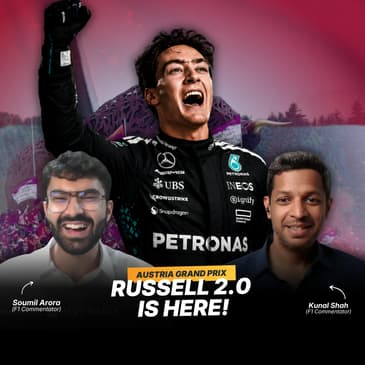
Soumil Arora and Kunal Shah re-live the drama, excitement & narratives from the 2026 Austrian Grand Prix.
Most Formula One fans are still buzzing after an Austrian GP where the race was won well before the lights went out. Turns out, Saturday's qualifying might have been more decisive than the Sunday wheel-to-wheel drama—who knew?
George Russell’s first win since Melbourne, a chaotic Ferrari showing, and a cheeky surprise pod over Verstappen and Mercedes’ latest upgrades. The Austrian GP proved that in F1, everything from tire strategy to driver experience can make or break your weekend—and sometimes, it’s all about the tricks you learn before the race even starts.
You'll discover how Russell tapped into newfound confidence to snatch his first victory of the season, how Antonelli's rookie mistakes actually gave him a shot at the podium, and why Ferrari’s strategy blundered big time in the relentless heat. We break down how tire challenges, lap one chaos, and the elusive art of tracking position kept the top teams on their toes—and why Mercedes’ tire game is still king. Plus, get the inside scoop on Verstappen’s steady upgrades, the uncertain future of Mercedes customer teams, and the underrated importance of team mentality and experience in racing’s high-wire act.
This episode isn’t just a review—it’s a masterclass in the high-stakes chess game of Formula One. Miss out, and you might just miss the crucial details that could turn your understanding of racing on its head. Whether you’re a Verstappen fanatic, a Ferrari skeptic, or just love racing drama, this episode will leave you feeling like a seasoned F1 strategist—ready to take on Silverstone or any race that comes next.
And let’s not forget: George Russell’s unpredictable genius, the tire temperature debate, and Ferrari’s seemingly cursed heat strategy all point to one thing—if you’re not paying attention, you’re missing the plot. Perfect for die-hard fans who crave behind-the-scenes insights and casual viewers ready for the next big twist.
Buckle up—because in F1, the race for your attention is always at full throttle.
Chapters:
00:00 - Austria GP: A spectacle or a strategic mess?
01:01 - The Saturday takedown: How Verstappen’s rear wing mishap changed everything
01:57 - Russell’s renaissance: From confusion to victory
02:23 - Antonelli’s inexperience: Speed versus track position
02:49 - The importance of awareness in racing
04:00 - Ferrari’s disaster: A perfect storm of strategy and heat
04:36 - Ferrari’s overconfidence: Did the heat punish their hype?
05:32 - Antonelli’s early laps chaos: Inexperience meets racing reality
06:02 - Learning on the fly: Antonelli’s quick growth
07:20 - Verstappen’s upgrades & Mercedes’ battery boost: The tech war heats up
08:27 - Ferrari’s struggles: Power unit, heat, and misjudged tire strategy
09:46 - The Mercedes comeback and the tire game
10:11 - Ferrari’s Friday struggles: How it all went wrong11:08 - The importance of pace over strategy
12:23 - Leclerc’s bad weekend: Brakes, heat, and the pressure to bounce back
13:40 - Hamilton’s cooling dilemma and tire choices
14:37 - The pace divide: Mercedes vs Ferrari & the importance of reliability
15:36 - Red Bull’s secret sauce: Balance, upgrades, and Verstappen’s hunger
16:44 - The driver’s influence: Max’s mastery and the future of F1 dominance
17:14 - Max’s team: Red Bull’s winning formula and future outlook
18:29 - The importance of a solid foundation: Power unit & engineering
19:14 - A quick look at Silverstone & McLaren’s rising star
20:44 - The Indian connection: Mercedes’ diverse team & motorsport diversity
22:37 - The looming question: Why no comments from Mercedes customer teams?
23:45 - George Russell’s unpredictable nature and experience gap
24:57 - The mystery of Mercedes’ quiet support for teams
26:16 - The power of representation: Motorsport as a platform for diverse talent
28:06 - The upcoming Silverstone preview & what to expect #F1 #F1Podcast #AustriaF1
Learn more about your ad choices. Visit megaphone.fm/adchoices
[00:00:00] Unsere Empfehlung für deinen Podcast? Frisches Obst und knackiges Gemüse von Aldi. Immer gut, immer günstig, immer vielfältig. Kurz gesagt, frische für alle. Zum Aldi-Preis. Diese Woche Mini-Wassermelonen, das Kilo für nur 1,29 Euro. Oder Nektarinen, die Ein-Kilo-Schale für nur 1,89 Euro. Entdecke jetzt viele weitere Angebote in deiner Aldi-Nord-Filiale. Und weiter geht's. Einfach lauschen und genießen. Aldi. Gutes für alle.
[00:00:30] Could we have asked for a better Austrian Grand Prix? I don't think so. Unless you're a Kimi Antonelli fan, and you're sad about seeing your boy not beating George Russell this time out as well. Or you're a Ferrari fan, and you're sad about the fact that your team, after having a lot of hopes and dreams, have crumbled to finish outside the podium, with one driver having an even worse result being passed around by everyone in the big four top teams. But if you're a Formula 1 fan, generally, and you enjoy the spectacle and you enjoy the racing,
[00:01:00] I don't think you can pick much out from the Austrian Grand Prix, because we have a new winner. We saw the top three finish within two seconds. And on top of that, we saw Verstappen and Hamilton going wheel to wheel with each other. In the end, Kunal, that is an excellent set of stories for us to review on the Inside Line F1 podcast for an Austrian GP review episode.
[00:01:19] That it is. But I'll tell you, the Austrian Grand Prix was won on the Saturday. And let me explain to you why. And this is where I'm like, I wish Max hadn't had the rear wing, you know, closing a half a second later or less than half a second later.
[00:01:35] I wish it had been there. Max would have been P2, P3 on the grid. And then Kimi Antonelli, who's inexperience, is showing now in the title battle and in the 2026 Formula 1 season, and we'll get to it. Kimi Antonelli would have also been P2. Now, why am I saying this? It's because then I think George Russell would have been even more challenged in the Grand Prix. Remember, he wasn't challenged as such. But had these two been there, he would have been even more challenged.
[00:02:05] Having said that, I'm just complaining because we still had a fantastic race and can't wait to dissect more of it. Yeah, where do we begin? I think let's start with George Russell because he ended up being the victor. And as you mentioned, race was won on Saturday. We'll talk about why that happened. But the headline story, Russell felt like he's found a newfound confidence. He said that he had to remind himself that he could win races and here he is doing so. First win for him since Melbourne at the start of the year.
[00:02:34] And he's now taken off 10 points from Kimi Antonelli's championship lead, which was 50, now comes down to 40, which is a much more of a closable distance given the grand scheme of things. So solid weekend for George Russell. But Saturday, that lift, that experience, the awareness. You often talk about Formula 1 drivers by just talking about their speed or how good they are with their team. But awareness? Awareness is a critical factor that won Russell polled and the race as well.
[00:02:59] Indeed. And you know, while we talk awareness, I would also call this experience. And Saturday was Kimi Antonelli's inexperience where he heard Bono say it's a yellow, yellow. He heard yellow, yellow twice. He thought it was a double yellow. And in the heat of that moment, he also thought that his dash was showing him that diagonal yellow flag, which meant that it was a double yellow.
[00:03:24] But George Russell saw single yellow, knew exactly what he had to do, knew where his delta was in terms of the overall lap time. And he gets a delta off his previous attempt. So he knew he was still quick enough. Dabbed the brakes, lifted off, turned in, saw the green, used all the energy onto the line. So very interesting, you know, how Kimi Antonelli, while he's got this inexperience on these tires and, you know, in general in Formula 1 and how cars operate,
[00:03:51] is able to use that inexperience to go faster than George Russell, as George Russell himself has been saying. But that same inexperience cost Kimi Antonelli a front row starting position. In the race, Antonelli was actually quicker than George Russell. But at the end of the day, the final result was very track position dominant. OK, and where you qualified, essentially you finished thereabouts, unless, of course, you are Ferrari.
[00:04:20] Well, and it disintegrated for them big time. Like Lewis Hamilton was second at a point. The clerk started this race in second place, let's not forget. And then to finish, what is it, fifth and ninth? That's where they were? It was disappointing. And I know we should touch more upon Russell and we should touch more upon Antonelli because they're winning and it's great. We should. Why don't we dissect that?
[00:04:44] Because this is that, you remember a couple of races ago when he had that 61 point gap, 67 point gap. What did we say then? That that gap will help him with two things. First was reliability, which we saw he faced his first DNF in Barcelona. That gap still remained and now was inexperienced. He lost more points to George Russell. But imagine he still has 40 points out there.
[00:05:09] And if I can expand on that inexperience as well, Somel, where did Kimi Antonelli lose the race? It was the opening three to four laps. At the start, there was one driver who went out breaking himself onto the outside of turn one, used the designated exit to join. Did the same thing at turn three. And Kimi himself said he was very, very excited. He was finding braking markers, which he never used in the build up to the race weekend.
[00:05:36] So he was basically trying to undo the angst of missing out on a front row because of his qualifying. The excitement of being in, you know, in the Mercedes trying to chase down every driver he could in the opening laps. And by virtue of doing that, he lost track time. He lost lap time, race time and his tires. So it was a mix of these things, which was down to inexperience. And it was a mix of that, which is inexperience that eventually still got him on the podium, given how quick the Mercedes is.
[00:06:06] But what a beautiful way to look at it, right? That when we talk of how experience helps, here's an example. And honestly, if we were all in Kimi Antonelli's place, we would do the same thing. Like, I feel that sometimes during a broadcast where you feel like you've got to overcompensate. At times, if you've made one small error and in doing so, you can end up fumbling or making a mistake. Whereas if you just say a line stably and consistently, you could probably get through. But then the mind doesn't accept it, right? You're like, you're chasing greatness. You're chasing excellence.
[00:06:34] So that's a fine balance you've got to strike up. And Antonelli learned that the hard way. But he's built that buffer for himself, which is a good thing. And if there's one thing we've learned about Kimi, it's that he learns quickly. So I'm hoping, for his sake, that he's able to get up close a little bit earlier. And also, fight those fights with someone like Max Verstappen, which he also needs to do more often to be able to win a championship. Like now, we're not seeing much wheel-to-wheel action, at least since Canada. But there will be a point where Kimi will have to duel with Russell.
[00:07:04] And he will have to fight Verstappen once his car gets to a better position. So the fact that he's doing these things and he's in that fight and he's chasing for a position in the last lap is solid for the championship, I'd say. Yeah, it is solid. And, you know, on one hand, yes, while we say Antonelli was quicker than Russell, let's remember Russell was under little pressure. And he knew he had a buffer. He knew that even when Max was chasing him down, like we say in motorsport, like we say it on the commentary when we do at Sommel,
[00:07:32] it's one thing to chase a rival down. It's another thing altogether to pull off an overtake. You need to have an overtaking delta and the likes and so on. So all in all, I think the fastest three drivers in Austria made it to the podium. The surprise element was Max Verstappen ahead of Kimi Antonelli. It would have otherwise been a Mercedes-Benz 1-2. Doesn't matter who was first, who was second. But it still goes to show different track, different conditions, hotter conditions.
[00:08:01] Mercedes is still the quickest. They brought a new battery pack to Austria to help them with these battery-related retirements that they've been facing, especially in hotter conditions. So all in all, great work for Mercedes. They build further. I think it's almost 100 points ahead of Ferrari in the Constructors' Championship. George Russell is now up in second place, you know, ahead of Lewis Hamilton, who was, of course, you know, on this mega run, which I would say is still a mega run.
[00:08:30] And we can now get to what on earth was happening at Ferrari. Seriously, what on earth was happening at Ferrari? How do you explain that? Fred Vasseur said that during the race, Ferrari were way too focused on Mercedes' strategy. And ended up making calls that didn't really make sense according to their pace. They weren't in line with how Ferrari's pace was, given everything. They obviously were very confident about themselves.
[00:08:57] Let's just say they were maybe overconfident after Barcelona, thinking that they could challenge Mercedes. But the track punished them. The tyres punished them. The heat was relentless. And they just could not hold on to their tyres as well. Leclerc having to pit before everyone else. Hamilton consistently losing positions. Did we overestimate Ferrari? Did we overestimate the impact of their engine upgrade?
[00:09:22] And if we just overestimate how consistent they would be in relation to Mercedes, who still are the benchmark? I would say as fans, yes, of course, we were overestimating. We love the hype. Hamilton winning at Ferrari, beating Leclerc. And there's nothing against Leclerc. But it's just great to see a seven times world champion doing what he's doing. But I'll tell you what.
[00:09:43] This was track layout dependent for Ferrari, which is not a good sign when you're putting up a world championship together. Because if you look at Mercedes, it's a more versatile package. The chassis, the car, the power unit and everything. For Ferrari, it was the first half of the circuit, which is so power sensitive, which was the biggest deficit. And to that, there were a couple of other factors. Mercedes was just able to make the tyres last longer in sector three, especially on the single lap.
[00:10:13] So Mercedes continues with their tyre dominance as well. Ferrari had a very poor Friday. And they admitted that because of their poor Friday preparation, they struggled on the race on Sunday as well. So all in all, it was track dependent, team operationally being challenged. And, you know, we say this often, Samuel, again, on the commentary, that a good strategy helps you when you have a car fast enough.
[00:10:40] But strategy cannot compensate for pace. Yes, Ferrari gave up track position. They threw everything they could at it. And I say full marks to them for that. They knew they didn't have the car. So they were trying different things with strategy. And that's usually what we see. If you're matched on pace, say you and I are matched on pace and you are ahead of me and I'm behind. If I do the same thing as you're doing, I'm going to finish behind you. Okay. So I have to challenge you by trying different things in strategy.
[00:11:08] And that's what teams are doing all the time. That's what Ferrari attempted without success. We are going to Silverstone. Lots of high sweeping bends. None of them that existed at Austria, barring one or two corners, literally, if you were to add it. So it was just down to the track layout not benefiting the Ferrari package. But on top of that, the heat did not help out as well. And Charles Leclerc is facing his own problems. As one would expect him to be at least close enough to Lewis Hamilton, he wasn't.
[00:11:36] And coming into this weekend, Kunal brought the story out on the podcast. He was like, Leclerc has to bounce back because he's losing a lot of momentum to Lewis Hamilton. Since Canada, Leclerc has just been slipping away in this whole picture within Ferrari. And yes, he's still on the carbon industry brakes, we would assume. Whatever it is, the brakes, the car, the tires, the upgrades, whatever it is, it's just not working out for Leclerc. And I think as a racing driver, when you're beaten by a teammate for three or four races nonstop,
[00:12:05] and in such a terrible manner this time in Austria, he will go back to the drawing board before we come back to Silverstone. That is for sure. He has to. He should. He needs to. And, you know, there's a comment from Avinash Chawla, which I'm going to take in a bit. But thank you for joining the stream, guys. Always wonderful to have you all. Deep down discussions on Ferrari. You're right about the Leclerc scenario.
[00:12:26] And I think we were all flattered by Ferrari's starting position because two of the other fastest drivers, Antonelli and Verstappen, didn't finish their final laps in Q3. Otherwise, I believe Ferrari would have been third and fourth or yeah, third and fourth. Oh, fourth and fifth, actually, because Max and Antonelli would have been ahead of them. So Ferrari was deceived with their starting rate position, which was, of course, inflated. Leclerc still on the carbon industry's brake test. Very interesting.
[00:12:52] You know, when you sit to understand the nuances, his tires did not cool down after he warmed them up on the formation lap because it's a short lap. It's a short lap time. By the time everyone turned back and formed up, he was like, oh, wow, that was really quick. And hence, already when he started the race, his tires were outside of the operating window. And then once the race starts and you're in battle, which is where he was, you know that the tires anyway end up overheating. So it was all down to the tires.
[00:13:22] It was the heat, which brings me to this question. Why did Ferrari put Hamilton on the soft during the VSC considering it was so hot out there? Well, they were throwing everything they could at it. Their tire choices were also limited by what tires were made available. Most drivers had one hard and two mediums available. No, it was the other way. Two hards and one medium available. And Lewis, when he put on that soft, it was a soft that he used on his final or on his aborted first run in Q3, if I'm not mistaken.
[00:13:52] So a lot of strategy considerations, but they didn't have the pace. So that's where they went. And that's the end of it all. Pace is pace. Mercedes may be facing issues with their reliability. Their drivers sometimes may end up battling and losing time to each other. I don't know. Sometimes they may have inexperience issues with Kimi Antonelli, but pace is pace. And for a world championship, you need pace. You just cannot have any substitute for that. And that's what we were all very happy to see from Max Verstappen too, that there was pace.
[00:14:22] Yes, that qualifying crash was a bit absurd. It's hard to tell how balanced that Red Bull is consistently as well. And that's a trait we've seen from Red Bull over the last few years now, where they come in with a really unbalanced car. Verstappen then rings it his way over the weekend and then finds that balance that allows them to be better during the race. But nonetheless, the fact that the car overall seems to be faster than only a couple of tenths on an average away from the Mercedes and the Ferraris is a good sign.
[00:14:48] Because that means Verstappen can take that car by the scruff of its neck towards fighting at the top. And it shouldn't have been a Mercedes 1.3 this weekend. It should have been a Mercedes 1.2. But guess who's the difference maker? It's the driver. It is what he could do in that Red Bull. And what are we, eight races into the season? At the opening race of the season, Red Bull was one second away from the Mercedes. They introduced an upgrade in Miami, which cut half a second. So then they were half a second away.
[00:15:18] And their massive upgrade in Austria now keeps them less than two tenths away from the Mercedes. And from here, Max was already being asked, can you fight for the driver's title? There were comparisons to the points deficit last year and how it is much longer this year. Max didn't say no. He said the cap is longer this year. It's larger. But we also have more races remaining.
[00:15:44] And this is what we want to see Verstappen at their up front battling. They made it very clear, the Max Verstappen camp leading into the home race with all the Red Bull management around. We feel at home at Red Bull or we are not here to fight in the midfield. There was also this story of will he go to McLaren? Because Mercedes unofficially confirmed their lineup for 2027, George Russell and Kimi Antonelli.
[00:16:09] I believe in the build-up to the home race in Silverstone, which is, you know, of course, Russell's home race, an official announcement and extension will come through and the likes. But I think the pieces are falling in place if Red Bull continues to deliver those upgrades, keeps Max in the fight. I don't see why he will move because they have been judged the best ICE engine.
[00:16:30] OK, and despite all the people leaving Red Bull and so on, if Red Bull continues to develop the car the way they have, game on, Max will remain at Red Bull. It's his team and they're doing everything for him. Why not? Why wouldn't you? And it's one thing to be impatient about this, that, hey, I want the good, I want a good car now and I want it fast. But I think Max is mature enough, like all of us, to also realize that a good car is also a moving goalpost.
[00:17:00] You can have a good car one year and you can have a good car. You cannot have a good car the next year. What matters is how competent is your engineering team? How well is their process organized? How much budget do they have? And how solid is the foundation? That's the power unit. And then if it's in a decent space, even if you're like at 95 or 96% of the top team, your driving ability can make a difference, which is enough for Max. He doesn't need to have the best, best car in the title.
[00:17:28] It's he needs a package that's organized around him. So I think being at Red Bull is not a bad idea overall. It's although the McLaren rumor is tempting because of Jan-Pierre Lampiasi. But I don't know how it'll fit from a culture point of view. It's just too much, right? It's too much to break a relationship of those many years to go for McLaren, who's completely opposite from a culture point of view. And dear Max, we know you listen to our podcast.
[00:17:51] When you sign for McLaren, the first clause should be that there will be no papaya rules, whether it's Piastri with you, whether it's Lando Norris with you. Because I can't imagine Max holding station for his teammate who's had a bad pit stop. Imagine that. Okay. But let's see where it goes. Yes. Exciting times ahead for Max, for McLaren, for GP, for Red Bull. Great stuff for Formula One that the top four teams are all mixing it. Eighth race. Eighth different podium combination again, which continues.
[00:18:21] And I'd love for this trend to go on. I don't know. Maybe finally we'll run out of combination options. And somebody is going to say, saying, this is exactly the same podium we saw all the way back in China, for example. So let's see. But there's an interesting comment from Avinash Chawla. Very good. Very good questions. Hamilton was asked. Hamilton asked if his car had cooled down, prompting a response from his race engineer that he can go into race mode. Why did the race engineer not tell him without Hamilton asking?
[00:18:48] Well, a lot of the radio conversations when you sit on the feed is, you know, sometimes you're surprised that the drivers are having so much to talk while they are still driving in battle. So it was not that the race engineer wouldn't have told him. It was just a conversation. And we get to hear just one part of it. But yes, thanks to that conversation. Now, the whole world knows that the Ferrari has a race mode, which is where they go. And their cooling down mode is called PS mode, wasn't it? I believe so. Yeah. Yeah. It's good.
[00:19:17] It's good we get to hear these things. It's small little nuggets that we find out every so often. And that's what we love to pick up on. We've got more comments, by the way. Pricky Prevy says, I sense an Oscar Piastri victory at Silverstone. Someone's giving McLaren a real chance. And by the way, we should touch upon McLaren that way in our Silverstone preview episode, which comes out in a few days time. But you can join us live for that and be a part of that discussion because McLaren will be a talking point.
[00:19:43] We should do a feature on the British teams and what their season has been like. Even Aston Martin, because we haven't been able to touch upon them quite a lot. But this is an interesting comment. But there's also comments, Kunal, around other things. And I think we should take it. It's Ankita asking us about Stefano Dominicali's interview with Fancord, which I'll just put it out there. You organized, you arranged. So congratulations on that. You got Stefano and Formula 1 to speak to Fancord. Wonderful.
[00:20:10] Yes, you know, and there's a lot of history behind this interview that happened. So the final interview was what FOM and Fancord arranged between themselves. But Stefano was going to be here in Oslo. Not going to be. He was here in Oslo. So there was a time that we were trying to meet in Oslo and get the interview done as well. But, you know, these interviews that come need a lot of great relationships, which I'm great to see that Fancord is building just the way they're building the audiences in India.
[00:20:38] We get to do the commentary on the official Fancord broadcast, which is a great thing. And my reaction to that interview is that Stefano for the first time is admitting that there is the right partner, promoter that they are talking to. We just have to wait to see when it comes, if it comes. I know Ankita has always asked, when will the Indian Grand Prix return? And, you know, we just have to be patient. Whether it's 2028, 2030, 2032, we don't know.
[00:21:05] But we just need a lot of things to fire right the first time so that the promoter and the government are able to guarantee a longer base for the race in itself. So that's my sense of it. And I liked your idea, Somal. We should do a British teams, British driver preview when we do the British Grand Prix preview in a couple of days' time. But what else do we have? I have one comment before we close in the next three to five minutes is, why is George Russell so unpredictable? Okay.
[00:21:35] And that also is down to experience. And George has been going to lens to explaining what and where the gap is. He's saying, I am very confident in myself, but I'm not confident in the car, in the setup and putting the entire package together, which puts it in a sweet spot where I'm able to trust it, rely on it.
[00:21:57] And then he, of course, you know, takes it upon himself to say this is exactly what Charles is feeling, that there are so many variable components to this, that hitting that sweet spot and remaining in that sweet spot is difficult. And then he also explained, he's been racing in Formula One forever. He said, the last four years we had Pirelli tires. So I have muscle memory on how to drive those tires on hot conditions, cold conditions, smooth and rough tarmac and low grip, high grip, medium grip. But he said that those memory banks are not useful for this year's tires.
[00:22:27] And that is the gap between George Russell's experience actually not letting him do what Antonelli's inexperience is letting him do. And it's such a big thing. Tires are the most important thing in motorsport. They are your contact patch with the tarmac. And if they are not firing up well, that is it. Remember, George was so good last year because he gained experience with the tires. And that's why you were so consistent.
[00:22:52] And that's a big, big point for us to watch for throughout the season about how quickly Russell's able to pick up that muscle memory. It's not just about the car. It's not just about the buttons. Not just about overtake mode or straight mode, but also that feeling you have with the machine. By the way, we should end in the next minute or two. But I love this question that Avinash has put forward. And by the way, I'm loving the fact, so is Kunal, that you guys are sending in your comments. It's good to be able to chat with you guys properly and get your takes as well. But Avinash is asking,
[00:23:20] Why have there been no comments from Mercedes customer teams about not being able to compete? Have they realized that they are behind on the car development? Or has Merck shut them up? I get a feeling McLaren has realized where its place in the pecking order is. Because they were complaining a lot initially. But they've quietened down. Yeah, it is. McLaren's issues are down to the integration. They've admitted that. Also, you know, Williams, we all know, is overweight. While Alpine is just happy to be leaders of the midfield.
[00:23:47] So if there's anyone needing to complain first about the power unit, it would be McLaren. And I believe, you know, Mercedes is extending all the support they can to get McLaren settled in. Listen, it's a different power unit to previous years. It's a different way you extract lap time from it, especially with the engine mapping that we've spoken about. And of course, at the end of the day, Formula One is a massive PR platform.
[00:24:10] So every word you make about your customers or people you buy your, you know, components from, you have to say it with some context. So that it is not blown out of proportion. And, you know, you're not risking relationships which are important and vital to your world championship hopes. Exactly. And one of those relationships actually came to fruit on the podium. Arun Rajkumar, Mercedes' power unit engineer, was on the podium celebrating that win. And he's one of us, Kunal.
[00:24:39] That's what I'm, you know, I'm believing. He's an Indian origin British engineer. Although some people on social media have now pointed out that he's actually a Sri Lankan origin. Which is like, okay, we don't know till I'll probably get to studies too. Still one of us. Yeah. It's based, I mean, again, history and everything. It's basically been the same place. I'm not immediately claiming Arun as one of us. But I mean to say, it's a big thing for Southeast Asian Motorsport. Because how many of us are there? Yeah, that's true.
[00:25:09] So great, great. You know, he's been with Mercedes HPP, which is the power unit, you know, supplier, of course. And he's the performance, trackside performance engineer for the power units. And I love how, you know, Mercedes winning is giving so many people the opportunity who are contributing, you know, to the, who are contributing to the team's success on the chassis and the power unit side. They're getting the opportunity to be there. I know George Russell, I believe, wanted Gwen LeGroux, the head of the driver development program.
[00:25:40] But Mercedes decided this is for the power units team to go up. And they sent up Arun out there. But very proud. I know a few people have been like, oh, you guys just go about claiming, you know, Indian origin means Indian. No, what I mean is, you know, it's tough for people outside of Europe to make a career in motorsport. The sheer number of requests I get on, I'm doing this, how do I become a motorsport engineer are so many that when you have people you can relate to, you know, whether it's Indian or Indian origin.
[00:26:09] I believe it's a motivation, motivating factor for those millions. And I say millions because we are in the millions and billions, right? For those millions who harbor hopes of, you know, joining a Formula One team one day, having a motorsport career one day. But on that note, since Samuel has suddenly been kicked out, I'm going to end this stream. And thank you very much. We will see you in a couple of days for the live stream where we will preview the British Grand Prix. Adios.