
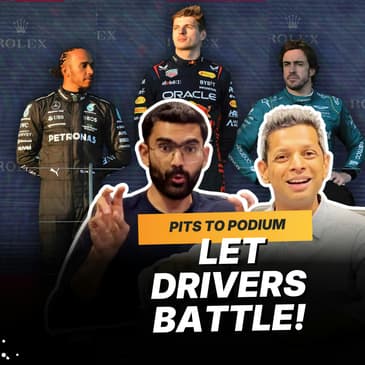
Soumil Arora and Kunal Shah discuss if Formula 1 is broken...and if Carlos Sainz's fix is one of many possibilities. In this episode of the Inside Line F1 Podcast, Soumil Arora and Kunal Shah dive into one of the wildest ideas in Formula One: what if drivers had to switch teams every few races? Inspired by Carlos Sainz’s suggestion, the discussion gets into the biggest question in modern F1 — is the sport still too dependent on the car, or can the driver be brought back to the center of the championship? The conversation explores how much of Formula One is about engineering, team politics, brand identity, and raw driver talent. From Lewis Hamilton’s resurgence at Ferrari to the dominance of Red Bull, the hosts debate whether equal cars, simpler machinery, shorter setup time, and reduced in-season development would create more exciting racing. They also compare F1 with MotoGP, IndyCar, WRC, and Formula 2, asking what Formula One could learn from other motorsport categories. This is a fun, high-energy, and opinionated deep dive into the future of Formula One — and whether the sport should lean more toward spectacle, fairness, or engineering excellence. The episode also features reactions to fan comments and plenty of back-and-forth on some seriously outrageous ideas, including reverse grids, equal engines, and even team-wide driver rotation. If you love Formula One debates, racing opinions, and bold takes on how to make the sport more entertaining, this episode is for you. 🎧 Subscribe to Inside Line F1 Podcast for more F1 discussions, race analysis, and short-form clips. 📩 Share your thoughts in the comments — should F1 stay as it is, or should the sport get a major shake-up? Chapters: 00:00 - 06:30 - Radical Ideas for Formula One 06:30 - 15:44 - The Role of Drivers and Teams 15:44 - 20:12 - The Dependency on Cars in F1 20:12 - 25:46 - The Current State of Formula One 25:46 - 30:40 - Tinkering with Formula One's Structure #Formula1 #F1 #InsideLineF1Podcast #CarlosSainz #LewisHamilton #MaxVerstappen #MotoGP #IndyCar #Motorsport #F1Podcast
Learn more about your ad choices. Visit megaphone.fm/adchoices
[00:00:00] Very good, very good, very good! Very good? Visum Steuer is very good. That's all people say. Cool, who says that? Stiftung Warentest, Computer Build, Focus Money, Chip, Finanztip, such dir was out. Mega, but that's definitely complicated. No. Just make a photo of the loan-steuer-bescheinigung and done. Sounds very good. Is very good. Get your money back with Visum Steuer. Carlos Sainz has some ridiculous ideas to make Formula 1 more entertaining.
[00:00:28] He suggests that drivers should spend two races at each team and they should swap around, hopping around to every single team on the Formula 1 grid to prove that they can adapt to each different car. And only that's when we will find out who can be the true driver's champion and who is the true team's champion. Because that way, the teams will have so many different drivers they'll have to have in the entire season.
[00:00:56] And that's only when we find out that which car genuinely is the best across circuits, across drivers, across conditions. He's suggesting radically changing what Formula 1 stands for. We're here to discuss this crazy idea and generally, how can we make Formula 1 more entertaining here on the Inside Line F1 Podcast. Welcome along folks. Make sure you subscribe, make sure you follow us for all the crazy things we do.
[00:01:23] We've got lots of short-form content on YouTube and Instagram. Make sure you're checking that out. It's myself, Somal Arora. And I've got Kunal Shah here with me. Both of us commentate on the Hindi Formula 1 broadcast for FanCode. Kunal goes one further and he's also part of the pre-programming for Viaplay Network's Formula 1 coverage in the Nordics. Whereas I end up doing MotoGP's coverage here in India. So, lots to talk about Kunal. Let's get right down into it.
[00:01:49] Formula 1 drivers spending two races each with each team. How crazy can we get? You mean should they get one race? Because then that is absolutely crazy. But I'm totally for trying these gimmicks. I mean, let's remember the Formula 1 that you and I grew up to. Or at least I grew up to. You're still growing up. Come on. But the Formula 1 we grew up to was so different.
[00:02:17] And every time some new change is being introduced or discussed, I remember what Stefano Dominicali says. That the new fan knows what they want from Formula 1. So, maybe Carlos Sainz has done his own bit of research, given how popular he is. Given that he just had a home race in Barcelona. That maybe this is what fans want. Maybe this is what fans think. That there is too much dependence on the car. And hence, let's take the car out of the equation.
[00:02:45] Let's give everybody the same car. And I'm saying, go crazy. I mean, we were thinking of reverse grades. We've already had a DRS. Okay. I think those are all sporting unfairness. So, let's go crazy on a sporting fairness aspect. I think this would be fair. Yeah. This would be fair. I think it's more fair than Fernando Alonso's claim back in 2017, where he said, I want equal engines for everybody.
[00:03:11] Now, he said that in a very similar context to 2026, because he was with a very slow Honda-powered car. So, you kind of feel for him and you get why he said that. And a similar caveat can also be applied to Carlos Sainz. Because he's again in a team that's struggling. It's not that fast. And he feels somewhere that maybe he's not able to showcase his true talent. So, let's put a big asterisk on top. But do you agree, Kunal, that this would be more fair and more fun than having something as preposterous as a reverse grid?
[00:03:40] Which I totally stand against. I totally stand against that. I think it'll be more fun. I think it'll be more challenging. And I believe it'll be fair as well. And here's why I think that. And I'm saying this just after Lewis Hamilton has pulled off a miracle with his resurgence in Ferrari. There is a strongest story of how a driver has, you know, changed aspects of his team within a large racing organization.
[00:04:06] And gone on to deliver some stellar performances in the last three or four years that he's been racing. So, on one hand, we've got to keep that in mind. That the driver still is a very important part of the team. But, Samuel, here's the part. How much of Lewis' back-end work with Ferrari is visible to fans who are new? How much of his inputs that have gone into changing his engineering team?
[00:04:31] How much of Frederic Vassour playing the politics, making sure Lewis gets what he wants, is visible to the teams? Very little of it. It's only when people like us, you know, who commentate on it. And there are the journalists who are accredited, who are reporting stories from the paddock. But is this what the new age fans really follow? Do you believe new age fans are following the carbon industry versus Brembo break discs? No, they are just saying Lewis has gone and started to do well in Ferrari.
[00:04:58] So, maybe the changing dynamic of the sport is more brand-driven, the driver-driven. It is stuff that you can't see, which is what's happening in the background. Just eliminate that and say, can you jump into a new car every third race and still perform at the top of your capabilities and drive around everything else that comes? I like that. I'm fine.
[00:05:22] I literally do because we are now hearing only one such story of a driver making it work with a team. Imagine if a driver hops around to all the teams and is telling us technical little nuggets about each car and how it's different and how it's got different brake travel and different ways in which the throttle delivers power or different weight dynamics and all these different things. Different buttons on the steering wheel as well. It's fascinating. If anything, as nerds, we would enjoy it a lot more.
[00:05:52] And for the new Formula 1 fans, is anyway the novelty factor of seeing a driver that they love with a different team every other race? I know it's all theoretical, but I like this. Yeah, it's all theory. People, we are not drunk on our Saturday night trying to do this live stream and, you know, go completely bonkers with our ideas. We are trying to build on Carlos Sainz's idea.
[00:06:14] We're trying to discuss that if Formula 1 had to start afresh and not have a history from 1950, could these models have been several models? And this is not the only model. There are several models. Samuel and I often debate it very deeply. We'll bring some of those models up. They have been a part of our Pits to Podium episodes before. But to me, the greatest sporting unfairness in Formula 1, Samuel, is that you did not get the best car.
[00:06:42] There is so much dependency on the car that you get. We remember back in time, it used to be 50-50. Then it became 60-40 in favor of the car. In ground effects, it was even debated. It's probably 80-20, where 80% of it was just down to the car you get. And you look at Yuki Tsunoda and Liam Lawson, their racing bulls is an easier car to drive. It's easier to pull to the edge. And suddenly, anyone you put in the car, including now Arvid Nindblad, suddenly getting, you know, some really stellar results.
[00:07:10] So it takes away that sporting unfairness that we've seen in Formula 1 for over 76 years. It gives everybody an equal chance, much as I believe it gives every team an equal chance as well. So we are trying to see it more from a driver's point of view, because that's the PR aspect of the World Championship. Yes, the business aspect is where you get the points in the Constructors' Championship and where you finish on the table. And that decides how much money you make.
[00:07:37] But the driver's championship, and I was having this argument on Twitter, 2008 is not remembered for Ferrari's Constructors' Championship win. It is remembered for Hamilton's Drivers' Championship win. So it goes back to the point that you made. Are the teams adaptable in working with different drivers? How many times have we heard this? Red Bull is making the car only for Max Verstappen. Will that theory get debunked with such an idea? I definitely think so.
[00:08:04] And by the way, I must say, caveat, Samuel Arora is absolutely in love with Carlos Sainz. Which is probably why this is when he said, we gotta talk about this. And I get a feeling Carlos Sainz for AFIA president, because a former AFIA president, Max Mosley, actually had proposed this very same idea, I think 20 years ago. Yeah, well, Max Mosley knew what he was talking about.
[00:08:27] And before you guys say, listen, are you guys just completely disrespecting the legacy of Formula One and all other motorsport and what it represents? Guys, to me, a true world championship is one where you're tested across multiple different environments constantly. Like the WRC, where one weekend you're driving in the mud of Kenya and the other weekend you're in the mountains of Monte Carlo. And then you're in the grasslands of Portugal. And it's all different. Or all these other places. Like in IndyCar, there's a short oval.
[00:08:57] There's a long oval. There's an Indy 500 type oval. Then there's a street course. There's something coming at you. And with Formula One, the one thing I feel is temperatures and everything around keep on changing. Yes, circuit to circuit. Same with asphalt and grip. But we're coming to a point where a lot of circuits are very similar in terms of character now. Stop-starty, street circuit types, one-stoppers are kind of the way to go unless you're at Barcelona, which always produces something. It'll be nice to have some change. But let's also then zoom out, Kunal, and ask the question, is Formula One worth changing?
[00:09:26] Because, in my opinion, I think we're currently at the strongest position, entertainment and financial security-wise, that Formula One has ever been in its life. I would say so. I mean, yes, it is at the best. It's been teams are valued at billions of dollars. There is a line of people waiting to get in who are not getting a chance to go in. And I remember the time when I used to work in Formula One.
[00:09:50] There used to be a joke that there used to be an 11-year-old cycle for the middle private-tier teams where every 11th year, they'd have a new buyer because the previous buyer would run out of money. And most of the sales that used to happen with the teams were distressed sales because you've run out of money, not because you're profitable. So the business of Formula One is very good. The sport of Formula One is also very good. We are seeing several new... I think it's the strongest driver 22 lineup, 22 driver lineup.
[00:10:19] Like, I often wonder how are the other drivers going to get a break into Formula One? And if that was to happen, who would go? And even the ones you think of leaving would probably just be because... Not because they're bad, but because, oh, we need to make a change. So you've got to pull somebody out who's less good than the others. Okay. And I think... Yeah, I mean, Esteban Ocon's... There we go. Esteban Ocon is being considered to be pulled out because he's being beaten. He's teammate by three tenths.
[00:10:46] Whereas flashback 10 years ago, that would have been the normal gap between any teammate. Yeah. So Formula One is actually in great health. But let's ask ourselves, these top four teams are top four teams for a reason. They were top four in the ground effect, Sira. They were top four before that. Okay. And yes, it's lots down to team setup. And I would actually add to what Carlos Sainz's idea was. That ban all in-season development. Okay. Okay.
[00:11:15] What teams should do is you have 24 races. You're going to have 12 drivers drive for you. So you're getting circular. 24 drivers driving for you. Circulate, right? And then you collate all drivers' ideas and you build for the next year. Okay. I don't know about that. I mean... I don't know about that. This is where it gets interesting. 12 minutes in, we finally find an idea. We do not see eye to eye on. I don't know about that.
[00:11:41] Formula One is built on so many engineering talents and so many impressive engineering companies, be it data or composites or so many other cool things that they do. You're getting rid of the backbone of the sport? No, I mean, I'm just putting it this way. I don't want to put the cart before the horse. Okay. It is still... That's also... It is still a race where the horses need to run first and then comes the cart. Yes, the cars are important.
[00:12:10] Yes, the development of it is important. This is a fundamental question that you and Enzo Ferrari will not see eye to eye on. Now, you know why I had to be born in an era after he passed. Because Enzo Ferrari always used to say the driver is like a light bulb. If one goes away, you can add another one. Maybe that is the idea, right? That is Carlos Sainz's idea. We are light bulbs. Let us be contracted to Formula One as branded light bulbs and just keep changing us in the cars. I mean, see, it's never going to happen, this idea.
[00:12:39] It's a good discussion on a weekend when we don't have racing so we can discuss how to go better when we go racing. Okay. No denying that. It goes against the DNA, the whole construct, the whole fabric of Formula One as an engineering sport. Also a sport which is over the years built on this team driver dynamic. I mean, Schumacher, Ferrari, that's what you look at. Verstappen, Red Bull, Hamilton, Mercedes. These were all the core relationships.
[00:13:08] But maybe that's what we are expected to drop as the sport grows bigger and bigger. Would we get bigger audiences if you had Alonzo driving a Mercedes and Max driving a Williams? I think probably for the first few years. But then it would tank because... Well, actually, would it? Because you will find out who the icons are. But then would you be able to make that... And this is the thing about branding that I love a lot, right? To establish good branding, you need consistency and repetition.
[00:13:38] So Verstappen and Red Bull are so iconic because we've seen it together for 10 years now. And that image sticks. Imagine if Verstappen was driving for Red Bull one weekend and Mercedes the other and Ferrari the other. When you think of Max, what color would come to your mind? What would he be wearing? What would he be doing? What color would his car be? Would he be an icon as big as he is today? Had he been wearing multiple colors every other day this weekend? I don't know. Or maybe he chooses his own color the way he has his own helmet.
[00:14:07] The way he has his own driver number. Maybe he wears the orange color, which is a Dutch color. Assuming he wants to wear that. Or, you know, a mix of Dutch and Belgian colors if that's what he wants to wear. That's basically just GT3 racing now, isn't it? You can go around to different makers, have your own livery, drive around different circuits. I'm fine with that, by the way. I love it. And to me, maybe we are going to see hidden stories. Maybe Gabriel Bortoleto is the best talent out there after Oscar P3.
[00:14:36] Because they won F3, F2 in successive years. And suddenly they can win in Formula 1 in successive years. Maybe. I don't know. I mean, I think it'll be extremely entertaining. And Somal, you know, this is where I would also say, can we introduce non-championship races to take such tests? Okay. To try out such racing ideas. I mean, we are trying out something like a sprint and we are telling the whole world it is brilliant, it is brilliant, it is brilliant. Okay. Maybe something like this could be tried out in a sprint format.
[00:15:02] Maybe the sprint format could be where you just give everyone equal cars, equal engines, equal brakes, equal tires we anyway use. Or are we just saying, forget it, guys. Let's just enjoy F1 for what it is. I don't know. I mean, it's good to think of the greener pastures. It's always good to think of the greener pastures. We have comments. Would it be greener? Okay, go for it. We do have perspectives. So let's take them in. Faiancho says, Bernie, Bernie Eccleston would be proud of this idea.
[00:15:30] Because Bernie Eccleston once suggested we should have sprinklers on the track to simulate wet races. Which I, by the way, think it's a great idea. Why not? I've been talking about it for the last 10 years. Do it. Like, just, it'll be fun. And Faiancho, on the other hand, Kunal, also has a comment. He says, how will it be decided on which track what teams will perform with what pair of drivers? Different tracks suit different cars. Lucky draw. This is where I will simplify it. Give everybody the same car, Somal.
[00:15:59] Same car, same engine, same brakes. No. Then what happens is you're letting the teams brand the cars with the colors and livery and all of that. See, again, do you see these cars being manufactured? No. Do you see them being designed? I mean, there's that one video of Adrian Newey's on a board using his left hand and drawing. And that video has been used every year he switched teams. We don't actually go and see what they are designing. Maybe just give them the same-ish cars. I mean...
[00:16:27] So, are you saying Formula 1 should be IndyCar? I'll put it this way. Formula 1 needs IndyCar's level of racing. Yes. Unpredictable results. Lots of drivers able to pull out surprising results. And IndyCar needs Formula 1's marketing. Yes. Yes. I agree. I absolutely agree.
[00:16:52] So, we actually then are taking out this whole scenario of the Ferrari is better in Monaco. But if you get the Ferrari in Monza, you're going to struggle. Well, no. It's the Ferrari in look, feel, brand colors. Yes. But deep down inside, it is maybe just a Dallara chassis with a Mechachrome engine for all the people. Are we going Formula 2? Well, look at us trying to convert Formula 1 into every other form of motorsport. And then we all know.
[00:17:21] We've spent enough time in this business to know what happens behind the scenes when every car and every engine is supposed to be the same. We all know what happens there. My goodness. This is where the racing papas come into play, no? Oh, man. That should be your documentary. I would pay to watch that. How did the racing dads navigate this landscape? The Tifo CO5. I read many people saying this is Formula 1, not rental carting. And the Tifo CO5 continues to say this is a terrible idea. One of the worst ideas I've ever heard.
[00:17:50] Well, there's merit in discussing it, even if we'll never see the light today. Or maybe there's a Formula Sawmill one day where I'll be the CEO and just taking forward Sawmill's idea and ambition. But yeah. Only Indian drivers. Reverse colonialism. Just kidding. It should be on merit. But just to put it out there, now that we're in the last few minutes of this episode. Objectively, right? We know this is not going to happen. But if we had to tweak one thing about today's Formula 1 to make it better, what would it be, according to you? Well, okay.
[00:18:20] We cannot tweak the Pirelli tires because everyone gets those tires. So that's one thing out of the way. I would say... It's not off the table. It's not off the table. So this is what I'd pick. Okay. Then this is what I'd pick. Okay. I'd continue with Pirelli tires. We've not seen a lot of other racing tires. So we don't know. Pirelli tires of 2026. Good. Seeing lots of back and forth racing. I would take the Ferrari chassis with the Mercedes power unit, but the Ferrari power unit for the race start.
[00:18:49] So Ferrari chassis, which you have for the start of the race. So you've got those rocket ship starts. When you come into the pits, you actually swap it for a Mercedes chassis. Not Mercedes chassis. Sorry. Mercedes power unit. So Ferrari chassis with a Ferrari power unit, you start the race. You run the first thing. You come into the pits. You swap your tires. But you also swap your Ferrari power unit with a Mercedes power unit because over the race distance, it is the Mercedes power unit that's more powerful. Oh, man. That would be bonkers. That would be Lewis Hamilton's dream.
[00:19:19] Honestly, he's getting the best of both of his beautiful worlds. Only thing that's left is a McLaren branded car. So his entire multiverse would be coming true. But to answer my own question, I'm thinking, what if we allow more capital expenditure from all the now financially healthy teams? And we allow it in multiple folds because Alpine are where they are and Williams are where they are and Cadillac are where they are because there's only so much they can spend on capital expenditure.
[00:19:48] As Otmar Safnauer told us on the Inside Line F1 podcast a few years ago. What if we do that? Because on track, I'm pretty happy with how things are. Maybe just refueling. Sure. But imagine now if everything... I see slowly and steadily you're adding things from the past. Like, let's get refueling. Let's... But this is an interesting point that, again, the Tifosi's brought up, which you were also discussing. Would Carlos have said this if he had a good car? Because we have many times that once a good driver gets a bad car, you start to see reactions like this.
[00:20:16] And there is a point in that because Fernando Alonso said, give everyone equal engines. It was when he had that Honda engine in the previous McLaren Honda era. Okay. Then, you know, various times he said, give everybody Mercedes engines, obviously. And to my mind, yes, this is more like socialism in a capitalistic world of racing. But I don't know. I'm happy to try it. I think if Formula One is in such a healthy space, why not give it a shot? And I understand the downfalls of this.
[00:20:44] Teams will always be the biggest brands that will outlast any driver legacy. By making a driver-first approach, you risk that. Apart from risking all the engineering and the imagery and the, you know, all the NDAs and all the secrecy that goes on. And, but, you know, I'm very willing to find out where Max is in a Williams and Ocon is in a Ferrari and Lewis is in an Alpine. I would love to do that. I would love that. I would love that.
[00:21:12] We have more perspectives on this. Feyanshu has an idea. He says, only one practice session to set up your car. Which, by the way, is exactly what we have during sprint weekends. And I think it works. I think sprint weekends are some of the most fun weekends in Formula One. Not just because of the sprint, but also because of the volatility it causes. I like this idea. Oh, yeah. I mean, the lesser the track time and the lesser the data F1 teams have, the better the entertainment normally ends up being. So I wouldn't mind that.
[00:21:42] I mean, you know, you're swapping cars, but you're also getting lesser time to get acclimatized to them. Then it becomes truly rental karting. Because when you go rental karting, you're literally counting down saying, I have six laps before I figure this out. And then I'm done. And I'm in another cart altogether. Literally, literally. Oh, man, people are joining in. There's one more from Sawick. Yeah, I love this. You know, make driving simpler. Few knobs and buttons on the steering wheel. Lesser changes that drivers have to make while driving. I think this is also crucial. Because the easier the cars get to drive,
[00:22:11] the more adaptable it would be for the drivers as well. And you know, this year specifically with these power units, all the drivers have been complaining at the sheer number of things they need to do, even on things like outlaps. So previously, it was outlap was keeping temperatures in place and then managing your gaps. But now, if you don't manage your power unit delivery and engine maps, you're going to struggle when you go on your attack lap. So yes, I would love for the cars to get simpler and driving to get easier. But Samuel, since we've been watching Formula 1 for so many ages,
[00:22:40] is there one era where you're like, that's it, that's the Formula 1 era for me? 2000 and 2006, 7, 8, those cars, but with the refueling from the early 2000s and the pit stops. So it's just a mishmash of the two. I think we came close. The fact that we had this stupid rule where you couldn't pit during races, I think 2005 and 2006 with the Michelin's all around, that was just so boring.
[00:23:09] But imagine those cars with refueling and changing tyres. Oh, that would be... What era would that be for you, Kunal? You know, I actually don't have an answer to that. For once, I am the one struggling with an answer because when we look back, I increasingly feel that those eras of Formula 1 were good, were great. We look back with a lot of nostalgia for reasons that they were legendary drivers using easier tech, using better sounding engines, if we call it that.
[00:23:38] But those eras were not necessarily better for racing. Those eras were not necessarily better for finding out who the best driver was. Hence, I truly believe that Formula 1's best seasons are the ones to come ahead. Now, I'm talking very utopian and like a politician and saying, vote for me. But I get this feeling. We still haven't seen what the depth of a very, very competitive season in Formula 1 could be. Yes, there will be those races in the 70s where, you know, the Heskets of the world could just go up and win a race.
[00:24:07] But I don't think that's the only part that defines Formula 1 and underdog result. That's one of many things that would define a good era for Formula 1. I think simplifying the sport, having great engines and letting the driver quotient win back against the car quotient. Fine, keep it an engineering championship since a lot of fans are piling on to be on Twitter saying, what are you talking? It's always been the DNA. We've always been an engineering championship. Sure, keep it. But at least bring the driver focus
[00:24:36] back more than what it is today. I agree. Yeah, I agree. Just a little more. Make it more accessible. Show us the craft. And by the way, a good reference for that is going to be MotoGP because next year they are going to become the first of the top premier championships to scale back on how complicated their machines are going to be. So they're going to have less aero and they're taking away all ride height devices. So the riders are basically only going to be left with traction control. Which is good.
[00:25:04] It's going to be a very interesting guinea pig for sorts to see if other sports can follow along in the world of motorsport. Even WRC are scaling back their level of hybrid power. So keep an eye out on these motorsports. Just watch and learn and just keep attention on how these series change and what Formula One can learn from each of these things. Praveen has a comment, by the way. Another idea would be to have roughly the same amount of workforce in every team. Well, you know why? Why are all our ideas going down to what IndyCar does?
[00:25:34] What Formula 2 does? What Super Formula does? Because maybe there is a reason why we sort of believe in that. Again, you know, by simplifying these things, what does a team care about? Of course, winning. Of course, having the best driver. But crucially, also having the best balance sheet. By having the same number of workforces, having more capex or equal assets that you build on and, you know, just in general, having a more social circle or socialism-driven Formula One, they still continue
[00:26:03] to build their brands and they still continue to have access to all the drivers out there. I know we've sounded silly enough on Saturday, Somal. Do we have any more ideas since it's your favorite driver? No, I'm good. I'm good. But we should end with what Rishab has very kindly put out. He says, I read another stat that Hamilton has 66 poles before turning 30. Meanwhile, Max has only 48. People talk about Verstappen as generational, but they don't talk about Hamilton in that same bracket. Well, they used to. People have just forgotten
[00:26:33] who Lewis Hamilton is. And thank you for reminding who he is in Barcelona. But truthfully, Lewis is of the previous generation much as Max is of this generation and Antonelli is of the next generation. Isn't that the, largely the, isn't that the belief in the paradox, Somal? As we see it. Yeah. And we're so lucky we get to see them all together in one generation. Along with the grandfather of Formula One, who is Fernando Alonso. I swear, man, it's, it's great time,
[00:27:02] but let's keep the ideas rolling on. Send us your ideas on at InsideLineF1 Podcast. Make sure you're subscribing to us. And if you're watching this video afterwards, or if you listen to this podcast after it's gone live, you can still send in your comments and we will very gladly react to them the next time we go live, which is only in a few days time because we've got more racing coming your way. So make sure you subscribe, make sure you're following us, make sure you click on the bell notification because we are going to be back very soon and you're going to be here with us joining along and sharing your comments.
[00:27:32] Take care, guys. Peace out. Enjoy Saturday.