
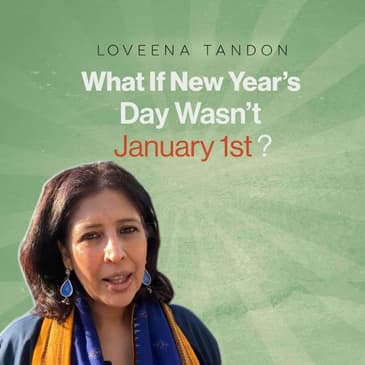

Are there traditions around New Year that might speak more deeply to the planet?
Across cultures, time has always been more than numbers on a calendar. From the Islamic Hijri to India’s Vikram Samvat, calendars were crafted to harmonize human life with nature, seasons, and spirituality. But in our rush to modernity, have we lost that vital connection?
What if New Year wasn’t just about flipping a page, but about realignment — with the planet, with each other, and with us?
A moment to pause, reflect, and begin anew in a way that truly matters.
FULL VIDEO
You Tube:
https://www.youtube.com/@loveenatandonofficial
PODCAST SMART LINK
https://bingepods.com/podcast/podcast-rn7moe
Loveena Tandon: HOST: SOCIAL MEDIA HANDLES
https://www.linkedin.com/in/loveenatandon/
Twitter/X
https://twitter.com/loveenatandon
https://www.instagram.com/loveenatandonofficial/?igshid=OGQ5ZDc2ODk2ZA%3D%3D
https://www.instagram.com/tandonloveena/?igsh=MW5tOHdlc3cyMGJrOA%3D%3D&utm_source=qr
Tik Tok
https://www.tiktok.com/@loveenatandon
Learn more about your ad choices. Visit megaphone.fm/adchoices
[00:00:00] The human being needs the nature to exist. Why still are we continuing with January 1st? Well, it all began with romance. Two New Years, one for the soul and other for the material world, which is about a time to reflect and renew. A New Years wouldn't just be a date, it would be a celebration of life.
[00:00:23] Happy New Year! But have you ever wondered why January 1st is what starts our New Year when there are many other calendars? Well, it all began with romance.
[00:00:41] Julius Caesar in 45 BCE introduced the Julian calendar to honor Janus, the god of transitions and new beginnings.
[00:00:51] This calendar was refined in the form of Gregarian calendar in 1582, mainly based on politics, trade and convenience. So more to do with practicality than nurture and nature.
[00:01:07] But there are other calendars that are based on nurture and nature. Let's start with Islamic Hijri calendar, which is purely based on the moon cycle lunar calendar.
[00:01:18] And it marks its beginning or the new year with Muharram, the festival Muharram, which is more about a time to reflect and renew.
[00:01:29] Then it's the lunar Chinese calendar, which starts with spring is when they would celebrate their New Years.
[00:01:38] And it is more about prosperity and bringing the family together. And then it is the Indian one, the Vikram Samvath.
[00:01:44] The Vikram Samvath was established by King Vikramadetya in 57 BCE. Now he comes from Ajahn. I am from Ajahn too. I was brought up in Ajahn.
[00:01:58] And it is a very spiritual city. It is also quite considered in the Vedic system, the navel of the earth and it still has the time meridian actually.
[00:02:09] Moving on to Vikram Samvath, I don't want to get flown into and drawn into Ajahn. A very important seat of Vikramadetya actually.
[00:02:17] But talking about Vikram Samvath, it has two beginnings in the year.
[00:02:21] The first one is the Chaitra Shukla Paksha or Pratipag, which begins in spring. The time when earth renews or is anew.
[00:02:32] When we crop the new seasonal produce. That is the time. So it's aligning with the nature cycle. When the nature starts its cycles.
[00:02:44] The day symbolizes spiritual renewal. Aligning ourselves or reminding ourselves of our place in the cosmic cycle.
[00:02:53] Or the cycle of life as we may say. And the second one is in the Diwali season. What we mark as Diwali, which is the October and November.
[00:03:03] But it is actually the end of the harvest. It is the time when we make use of this harvest to earn money.
[00:03:10] So it's the financial season. And we can look at it from the point of view of practicality.
[00:03:16] So there are nature, nurture as well as finances. So practical as well as being aligned with cosmos.
[00:03:23] So two new years. One for the soul and other for the material world.
[00:03:28] Both celebrating duality of life. Better being in sync. The human being needs the nature to exist.
[00:03:37] And needs the spiritual world. So it's the body, mind and soul as they say these days.
[00:03:41] Then why still are we continuing with January the first. As the global standard for new years.
[00:03:51] Well if the answer is in the world. Globalization, marketing and clever marketing at that.
[00:03:57] But imagine if we followed calendars like the Vikram Sambath.
[00:04:01] Our new years wouldn't just be a date. It would be a celebration of life.
[00:04:06] Where nature, humanity, spirituality all came together in harmony.
[00:04:11] Very much the call of the time. The call of the planet.
[00:04:15] Do share how you celebrated your new years. And if you have such cultural traditions.
[00:04:21] I would love to know. So thank you for watching and have a blessed 2025.
[00:04:25] May your prayers be answered. Thank you. Take care.