

Millions of young Indians are walking into a workforce that AI is quietly rewriting.
India is growing faster than almost every major economy on earth, 6.4%, says the IMF, even as the rest of the world wobbles.
That's the dichotomy we sit in today, the rules are being rewritten as we speak.
So how does India sustain this growth when its greatest asset, its demographic dividend, sits on such uncertain ground?
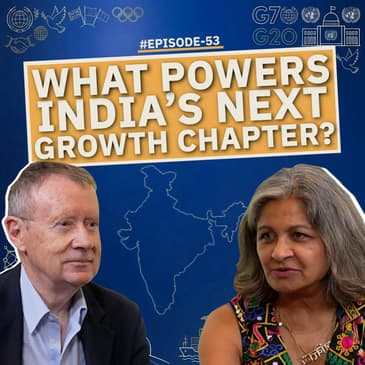
Episode 53 of India: A Story in the Making goes straight at itwith the question: What Powers India’s Next Growth Chapter?
In conversation:
Recorded during Idea for India Week. Thank you, Bridge India, for making the conversation possible. Episode 53: What Powers India’s Next Growth Chapter?
LIVE NOW
📺 YouTube:https://www.youtube.com/@loveenatandonproductions
🎙️ Podcast – Smart Link:https://bingepods.com/podcast/podcast-rn7moe
💬 Join Our Discord Community:https://discord.gg/p2UYt9uV5d
• Tim Willasey-Wilsey, Visiting Professor at King's College London and former British diplomat.• Vee Bharkhada, Insolvency Expert at NBR, London.
Learn more about your ad choices. Visit megaphone.fm/adchoices
[00:00:00] In 1993 I was posted to Pakistan. I then had a lot to do with India for the next diplomatic years, dealing with Indian government and the old India of files and files where decisions take, you know, three years to come. Suddenly I was in this new India, very democratic India, where decisions are taken in milliseconds. I beg to disagree with that a little bit. Eleven million new people come onto the job market every year. The unemployment in India will always be there. The jury is out.
[00:00:28] AI is the next generation for Indians. The tech revolution is astonishing. What I see in the youth in India is aspiration. Things have got to change dramatically. Maybe we should ask AI for the answer. If you had a trillion dollars, which industry in India would you invest in? This is India, A Story in the Making and I'm your host, Loveena Tandon.
[00:00:56] Hello and welcome to India, A Story in the Making. India has been the fastest growing economy for a long time. It has the largest number of young people on the earth. But the big question is, how will it sustain that growth? Where does the next chapter of India's growth come from? To unravel this, I have two fabulous people here.
[00:01:21] We, who rescues businesses. And Tim, will it be we'll see. Got it? Will it see. Will it see? Thank you very, very much both. So can I just dive in with the question? What will power India's next chapter of growth?
[00:01:47] God, if anybody says manufacturing, I will be so annoyed because I think manufacturing has been done to death for such a long period of time. People keep saying India is really great for manufacturing. And you know, would you agree with me, Tim? I would. I mean, I, my answer to the question is, and I, you know, I've spent the last 13 years having a lot to do with the big tech cities in India. Bengaluru, Mumbai, Gurugram, Noida. And I think that's where it's going to be.
[00:02:16] I mean, the tech revolution is astonishing in India. There's a marvelous book called The Maverick Effect written by a man called Harish Mehta, which tells the story of the creation of NASCOM and the building of all these tech cities. And of course, the secret to their success was that they kept the Indian government out of it. And that was actually with agreement to the Indian government. The Indian government, they said, look, just let us do it to ourselves and it'll benefit India as a whole.
[00:02:43] And of course, it really has done it. It's made India the tech superstar. So AI is the next generation for India, isn't it? You know, they seem to be up and coming. All the tech people that you see in the UK, one of the top tech leaders here you see in the UK, they're all from India. You know, you go into the tech valley of the UK, you'd find 95% are from India. Yes. I think AI is a very pertinent question because, but you said you worked in India. I've done the Yorktale, your connection.
[00:03:12] I spent the early parts of my diplomatic career in Africa and Latin America. But in 1993, I was posted to Pakistan for three and a half years. And following that, I then had a lot to do with India for the next diplomatic years, for the next 15 years.
[00:03:33] And dealing with Indian government at a senior level, discussing all sorts of regional problems like India, Pakistan and Sri Lanka and India, China and all of that sort of stuff. There were lots of good friends of India from that period. And then I did this sort of amazing transition, really, where I went to work for a major British bank who employed 16,000 people in India. And suddenly I was in this new world.
[00:03:56] And so I saw the old India of files and files tied up with pink tape and where decisions take, you know, three years to come. And suddenly I was in this new India, very democratic India, canteens where senior management sit down, have the same deal with young apprentices. Obviously, you know, no problem about discrimination of any sort, gender or whatever, and where decisions are taken in milliseconds.
[00:04:25] And this is the new India. So it is extremely exciting. Sorry, now you've got a much deeper relationship with India. I was completely infected by the new India. I mean, that's what excites me now and what is so remarkable about the country. When did you last go, Tim? Oh, goodness. I mean, I've got a son who lives there. Do you have a son who lives in India? Yes.
[00:04:49] And I've got, I've got, you know, I was talking to Indian investors in the Gulf, actually, only a few months ago. So now I'm a regular visitor. Oh, and we, you, do you get to go or you've married a British guy and you want to settle here now and you don't want to go to India? It's the other way, flipped. No, do you know, I was actually born in Gujarat in a little place called Rajgore. Rajgore is no longer a little place anymore when I was born. So it's massive. It's a city. It's one of the up and coming.
[00:05:17] And I came to the UK when I was five years old and met my husband at 19, just before my 20th birthday, Frank, Frank Wesley. And I'm still with him. He saved me from crossing the road and killing myself. I was rushing around trying to cross the road, grab my hand and said, what the hell are you doing? And I'm still with him. How wonderful. And I haven't been back to India, sadly, since until last October where I went with my sister-in-law.
[00:05:47] And I have to tell you this because I'd never experienced this feeling like going back to your birth town. And I was there with Mina, my sister-in-law. And the plane landed and everything. We'd got our suitcases and we got to the airport at Amdavad Airport. And I kid you not, there was this, I don't know if you've ever had this kind of like out-of-body experience, but I had this seriously goose bumpy feeling of going back in time.
[00:06:17] And I was so overwhelmed. I was like in tears. I was saying to my sister-in-law, like, are you cold? I said, I'm so cold, you know. So she gave me a little shawl. But I got very overwhelmed. I got in the taxi to the hotel. I got very upset and cried. And like, why did I not come back? Why did I not come back?
[00:06:41] And I'm 59 and I wish I had gone back because I came, I felt like I went home. Does that make sense? Yes. Yeah. And when the two weeks finished, I was like, oh, ringing Frank almost every day, trying to tell him, you know, what I'd been up to, seeing all the Mondays and the temples. And seeing the relatives that like fed and fed and fed me more, that hadn't seen me. Third generation relatives, you know. That's very typical India. I hope you go back again and again.
[00:07:09] Oh, I'm going to be 16 January. My husband's taking me for a month. Oh, that's good. Yeah. But I'm frank on saving you from everything. The road should not go into it. So true. So true. So true. Anyway. So now coming to AI, do you think that's a threat or an opportunity for the country? I have a go with that because I've been talking to people about that. I was talking about the Maverick effect and the amazing development of NASCAR and all these big tech cities. So I'm very concerned about that.
[00:07:39] I mean, already we're noticing AI affecting employability in the UK and employments of young people in the UK. In India, I'm assured it's not going to have that effect because India is actually going to be in the forefront of the AI revolution. So in the short term, as I understand it, there are going to be more jobs in India. And what you're going to see is a lot of the jobs existing in some of these tech cities are going to be upgraded from some jobs which are more sort of transactional in nature to jobs which are more sort of tech savvy in nature.
[00:08:08] So I believe that in the short term, it's going to be better. But in the medium term, the jury is out on this. And I know that Prime Minister Modi is very, very wild about employment, as it is at the moment. I think 11 million new people come onto the job market every day, every year probably, and it's difficult to find jobs for them. I think there is a real concern that this huge population that India has is going to really struggle to find employment.
[00:08:36] I'm not talking about now, but maybe 10 years time. But of course, we don't know what other sorts of jobs AI is suddenly going to free up and create. But you know, there's a domino effect. I kind of beg to disagree with that a little bit. Like you say that there's 11,000 people coming on the job market in India. I did quite a lot, like three days worth of research while I was there about employability. And I was thinking of like sort of starting a small business for the underdogs when I was out there. True Gujarati.
[00:09:06] Go on. Sorry, not to interrupt. No, no, no. But you know, it's like that Gujarati blood in me, you know. But it's like a 360, Tim. OK, so you have 11,000 people coming in looking for jobs. What people don't look at is that if you've got, I don't know, I don't know the statistics, but if you've got, I don't know, 500,000 businesses that are looking for employees.
[00:09:31] So you've got 11,000 here and you've got, say, hypothetically, 50,000 or 500,000 businesses. What people don't count is how many people the companies are making redundant and getting rid of. So when you marry it all up, you've got 11,000 coming in, but actually you've probably got 15,000 going out. Right? So that 11,000 actually isn't 11,000. Or a million. Or a million.
[00:09:57] You see, the unemployment in India will always be there. Things have got to change dramatically, like phenomenally change. What? Well, without getting too political, I think Modi needs to make available other privileges to those 11,000. And I keep saying 11,000, it might be a different figure. But I think there are so many underprivileged students.
[00:10:26] You know, it needs to start at, like, here. It doesn't need to start at 18, 20 years old. But if you want to be a little bit more hopeful, I mean, I absolutely agree. But you want to be a little bit more hopeful. You know, the first industrial revolution in the sort of 1780s where suddenly they produced spinning mills and everybody thought everyone was going to be unemployed. Well, actually, new industries developed. And until quite recently, we had pretty much full employment in this country. And in India, there is unemployment, but there's also quite a lot of employment.
[00:10:54] So, you know, what we don't know, maybe we should ask AI for the answer. What are the new industries that AI is going to create for us? You know, the point is what we can't do is just say it's all too dangerous. Let's not do it because it's going to happen. We've got to go with it. So I think there is unemployment. There is no doubt about it. There is an increase in employment. There is no doubt about that as well. And yes, AI will take away jobs.
[00:11:22] But what is it that the youth of India has in it which could turn the tide? Do you think because your son lives there, you've been there. What do you see in the youth of India? What I see in the youth in India, which is so inspiring, is aspiration. Everybody wants to do well. And that, I think, marks out India as a power that is going to do really well in the world.
[00:11:48] Because, you know, it's these extraordinary levels of aspiration, which is something we've been sort of slightly lacking in the West for many years. And of course, China, while it's ruled by a communist party, isn't going to be able to replicate that. So I think this is something uniquely Chinese. Incidentally, the English language, I think, is a great benefit. I know there's a controversial thing to say because I know the Indian prime minister doesn't, you know, would much rather people spoke regional languages rather than English.
[00:12:17] But I think the English language is actually a huge benefit for India. So you've got, as are the demographics. It's a young country, whereas China is an increasingly old country. So I think the demographics of India, the aspiration and the fact that universities turn out people with IT skills is a huge advantage. You said everyone wants to do well. But does India actually have the resources for everyone? For somebody who doesn't live in India, doesn't really understand what doing well in India
[00:12:47] is, Loveena. They don't understand it. Try living there for five years. Then you'll understand who wants to do well, Tim. I take the point to this. There is a big... I'm a bit lost about what you said. Exemplify that. So Tim said everyone wants to do well. Is that right? Correct me if I'm not. I did. I did. So in the word everyone, define. No, I mean, it's a fair criticism. But I think what I would say is that what's very interesting about these big tech cities,
[00:13:13] and incidentally, I should add that these concrete and steel cities, I hope India doesn't all become like that. It would be awful. I love the old India. I love the old culture. I hope that doesn't get thrown out with us, the whole thing. But what I think is very striking, in the very early days of the tech revolution in India, they took people from the top universities and the top cities. So this is people from Mumbai and New Delhi and Chennai and places.
[00:13:42] What's so interesting is that they then went to second-tier cities, and now they're on third-tier cities. So they're bringing in people from much more remote universities and stuff, still coming into the employment bracket. Now, the point will come when, you know, that sort of runs out. I accept that. But at the moment, I don't think they're having any difficulty finding people as long as there is work. No.
[00:14:07] But also, you know, the 18-year-old or 19-year-old, I don't know what the age living that is for a teenager leaving university, you know, in India. So when that child of 18, say 18, put 18, put 1,000 of those 18-year-olds together.
[00:14:30] Now, if they want to come to the UK to do well, excel, do we feel that there are resources in India to give them that stepping stone? Do their parents have to apply for visa? Do they have British passports? I mean, I could make a list of 150, 200 things, steps that that person or those 100 or 1,000 people need to climb.
[00:14:55] So where you want somebody to come here and be brilliant, that everybody, there just isn't a resource. There is no resources there. Aspiration is there. Aspiration, but there's no resources there. Yes, yes, of course. And that will be a problem with India because of the large swap. It does such a fulfillment. So many people. I would have loved to take this further, but just for the sake of time, I would need to ask you, top three things that India is doing right at the moment.
[00:15:23] The top thing India is doing right at the moment is the government letting the tech sector run itself. You know, butting out of it, let it get on and develop itself. The second thing, which I think it is doing right, is that it is now allowing the sort of work ethic of the tech sector to begin to infiltrate into New Delhi now. So I think you are now guessing bureaucrats who now do take quick decisions, who are more tech savvy.
[00:15:52] And I think that will all be to the benefit of India. India is the great hope, really, of international democracy, I think. At a time when the United States is seeming less reliable and more unpredictable, and when Europe finds it difficult to sort of get its act together, India is, I think, the great hope for international democracy.
[00:16:13] OK. So if I was going back to India, if I was there in October, if I was to answer sort of three things from when I was five to now, yes, it's excelled. It's done amazingly well trying to compete with China at the moment. And the fact that in the last 55 years where I have been there, it's got to a stage where it has, of course, it's got loads and loads of passion. You see passion in India all the time when you go down there. I don't know enough about India because I only spent two weeks there in October.
[00:16:43] But yeah, there's an immense amount of hope there. Forgive me, I've just got to dash. I'll have to let Tim go, but I'll... Carry on with me. We've had to let Tim go, but we'll have the most amazing conversation. But I continue the rest of the conversation with we. What is it that Indian must do to sustain this growth, be the fastest growing economy and the challenges it faces?
[00:17:06] So I think education, when I was growing up, my father and my mother were always talking about educate, educate, educate. So I feel like that seems to be a worldwide theme anyway. So I feel India really needs to focus on under 30s, possibly education, sustainability, skills, you know, implement new skills and growth. So these young kids turn into not just multimillionaires, but they can be maybe the next modi.
[00:17:36] If you had, let's say, a trillion dollars, which industry you'd be able to invest in? Probably AI. I mean, I would like to see, and you can cut this out if you want to. I mean, I would like to see lots and lots of Vs cloned all over the world, you know. Doing good things. I don't think there are enough people doing good things. I'd have to ask your husband, V, whether he wants so many Vs around. You should meet him later.
[00:18:04] I'll have a frank conversation with Frank. Yeah. I know this lady's Frank, whether he wants Vs around you or not. Honestly. But you will invest in AI. I would invest in AI. I would also invest in education. Education was something that my father did not invest in me, my sister and my younger brother. My older brother, Ashok, went to university because in those days, you know, it was £3,000 to send somebody to university.
[00:18:34] So, I didn't go to university, but when I left, I did my A-levels and then I got my lawyers LPC contract, a training contract for five years with a firm in Kingsbury, which is where I met Frank crossing the road and he saved me. But education would be top of my list, you know. Invest in education.
[00:18:56] Upskill those young people because we have some really amazing, clever people that don't really get the, that they live in like, you know, Jupri and little huts. If we can bring a dozen of those out and give them food, give them education, they could be the next world leaders. There's so many of them hiding in those things. So, the next chapter that powers India growth is? Education. Education. Now, on that note, since we reached that point, we'll have quick high-fired questions.
[00:19:30] India for you in one world? Love. You didn't go there for so many years and you felt love when you went. Yeah. I felt like, like I lived there, like it was my country. Even though I haven't been there for 55 years, it was like, oh, everyone just hugged and kissed and cuddled and I cried so much. Really?
[00:19:53] I cried a lot because I didn't feel that these relatives of mine, Loveena, my dada, hasn't seen me since I was four and a half years old. Right? You know what the word beam, beam means? Beam. He's six foot seven. He's built like a massive. So, we used to call him beam dada. He hasn't seen me since I was four.
[00:20:21] When I got to his village in Bordar, Lavina, I've never seen an old person cry so much. Aw. He howled when he saw me. I'm the youngest in the family. Why did you guys go? Why didn't I go? Well, I don't know. If I talk any more about it, I'll probably cry. I should have gone. I have two children. I got career focused.
[00:20:50] I guess I prioritized everybody but me. If that makes sense? Complete sense. My time didn't come. So, you wanted to go, but you didn't. So many times. So many times. Like, I say that, you know, Krishna probably didn't want me to go. Krishna said, you know, When the time is right, you'll go. Is it about India that the world doesn't get? I feel India has so much hope and reassurance there. You just feel like. My neighbors are white.
[00:21:19] Ian and Julie. They go to India like twice a year. Because they feel love. They feel the color. They love the food. You know, I feel like even anybody that goes to India. India just is like an envelope. You know? You feel like this big jadar over you and you go. That you just feel, oh, I don't need anything else in the world. I'm in India. You know? You get that feeling. You know? When you have felt that, no? Yes.
[00:21:50] Yes, indeed. That's what I feel. I feel like very. And I am not a very experienced Indian person. Because I've only been once in October. But I'm going to go every year. Yeah? I'm going to go every year. Yes. Once a year, I'm coming with you. I'm going to take you with me. Okay, done. I'm going to go to Ahmedabad. I love Angabad. Me too. I have relatives there. We'll stay within the house. They've got loads of houses. We'll just stay free in the house. It's great. It sounds great to me. We'll go. Okay. Promise? Promise. You're making a promise? Pinky promise.
[00:22:19] Pinky promise. Okay, then. This way. This way. Yeah. Pinky promise. Pinky promise. We'll learn more. No matter what. Later, we'll learn. We'll learn more. Okay. Any national figure that you want to meet and what do you want to ask them? Oh, I wish I could have met Mahatma Gandhi. I've read so much about him. And I live a life like him. I live a life like Lord Shiva, Krishna. I'd like to meet Indira Gandhi. I'd like to meet them and say, like, what bloody happened?
[00:22:49] Why don't you take good care of your security systems? Because I feel Mahatma Gandhi had so much to offer still. And I feel like his time came too quickly. He had so much good to do. Have you read his books? Yeah. They make you cry. What is the British in you? Oh, what is the British in me? Frank, probably. So you've not been to India, but you still consider yourself an Indian. What is that?
[00:23:18] My skin, my beliefs. I'm a big believer in dharma and karma. Your good deeds. So you did go to India for 55. I didn't go for 55 years. 55 years. And you still got connected to all of this. Yeah. So look, what do you feel inside? Indian. And what is that Indian? Love, connection. I'm there even if I'm not there. Because in my house, I have a mandir.
[00:23:47] I wear janjara because I feel Indian. I wear janjara on. You're wearing a gujju. I wear shakti is like, you know, I have three or four different necklaces that are shakti. I wear shakti. Why shakti? I think every woman needs to be shakti. You know, we all have a, we just don't know how to take it out. We all have shakti. Even the men. Poonam and Seema, my sisters, cousin sisters, they gave me this because they've kind of grown up with me.
[00:24:17] And they say, when we see strength, we see you. When we see shakti, we see you. When we make people, when we see people making things happen in the family, we see you. You are the face of our shakti. So they gave me this, you know. So I'll end up with asking you, what is India shakti? So I think there's a word called Bharatanari, women of India. You know, I feel like we don't, I put myself in there as well. I feel they don't get a lot of recognition.
[00:24:44] They don't get the impetus that they deserve. But also I feel it's a generational thing, you know, that they've been born into a family that dictates to them that you can't do this, you can't do this, you can't do this, you can't do this. My real thing is you must go to India often because I don't think India is any more like that. And they never were. Why they knew? So, you're right.
[00:25:16] You teach in some way. You do. That you, that, you know, a country that had Dunga, Kali and Chandi ended up being, having dowry and it's still there. And infant, fetish side as well. But at the same time, Indian Nari is doing a lot of Jing man now. Oddly. Oddly. On bad note, like when I find. No, let's do it better. Hang on.
[00:25:44] Thank you very, very much. Thank you. I heard that was good. That was absolutely smashing and wonderful. I almost ended up in India with all those colors and vibrancy with V. But sadly, Tim had to leave. But we did come to a point where we say that AI is booming. India might do quite well when it comes to OI. But there will be some bloodshed in the interim. But they'll come out at the end of it.
[00:26:12] Like which industry, Indian industry, or where do you think the next power growth chapter of India comes from? Do write into me on India, a story in the making. Thank you. Take care and God bless. This video is created for educational, informational and entertainment purposes only. The views and opinions expressed in this video are personal and may include commentary on geopolitics and global affairs.
[00:26:34] We are shared for general awareness, discussion and understanding and are not intended to offend, harm or misrepresent any individual, community, organization, country or religion. The information presented in this video is based on publicly available sources as well as material provided by our guest. All visuals and content used in this video have been included with the consent of our guest. While efforts are made to ensure accuracy. Viewers are encouraged to do their own research and form their own opinions before drawing any conclusions.
[00:27:12] Hi everyone, so if you're not watching Loveena Tandon, show called India, a story in the making. I watch it all the time. It's got some amazing stories. I actually love it. You should follow Loveena Tandon.