
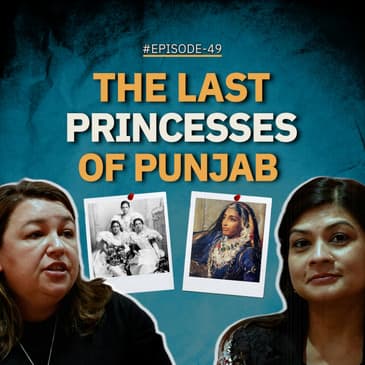
This is history that doesn’t need dramatising. It already surpasses fiction.
How do you befriend the very Crown that exiled your family?
Born to Maharaja Duleep Singh, the same ruler who, as a child, was made to sign away the Koh-i-Noor, raised in Britain, and moving within the inner circles of the empire that stripped their family of everything the Duleep Singh princesses lived between worlds.
Indian heritage. Mixed lineage. Royal blood.
And yet, at a time in Britain when women couldn’t vote, Sophia, Catherine and Bamba found their voice and used it to fight for the right of every British woman to be counted and heard.
In this episode of India: A Story in the Making, I go inside Kensington Palace’s stunning exhibition The Last Princesses of Punjab, exploring lives that span suffragette activism, exile, empire, identity, and an extraordinary search for belonging.
And behind these three women? An equally remarkable lineage. Their mother, Bamba Müller, of Ethiopian and German heritage, raised Christian. And their grandmother, Maharani Jind Kaur, imprisoned by the British, who escaped in disguise and crossed mountains just to hold her son again.
These princesses lived through the most seismic chapters of modern history, India’s freedom struggle, the suffragette movement, two World Wars, and more. Their story is inseparable from the story of the age itself.
They though, were never just witnesses to history, they were inside it, shaping it, surviving it.
Fascinating falls far short of what they lived through. And what they did.
✨ A must-watch for connoisseurs of real-life stories that inspire.
📍 The Last Princesses of Punjab exhibition at Kensington Palace runs until 8 November 2026 ( https://www.hrp.org.uk/kensington-palace/whats-on/the-last-princesses-of-punjab/ )
EPISODE LIVE NOW ON:
📺 YouTube: https://www.youtube.com/@loveenatandonproductions
🎙️ Podcast – Smart Link: https://bingepods.com/podcast/podcast-rn7moe
💬 Join Our Discord Community: https://discord.gg/p2UYt9uV5d
Learn more about your ad choices. Visit megaphone.fm/adchoices
[00:00:00] In England, Princess Sophia is a celebrity. As the family of somebody who had gone against the royal family, the mother was very deeply Christian, his father who converted to Christianity, they were born into royalty, became a close friend of Queen Victoria. Princess Sophia selling newspapers outside Hampton Court Palace, it caused a scandal. Their relationship with Queen Victoria remained very strong. It's just outrageous that this princess would do this. They did suffer social ostracism.
[00:00:25] This is India A Story in the Making and I'm your host, Loveena Tandon. Indian heritage, mixed lineage and royal blood. This is a fascinating story of princesses who were born to the last prince of Sikh empire, Duleep Singh.
[00:00:48] But they had a massive impact on the British society, especially if today the women have the right to vote, they have a huge contribution that they have made towards it. And that is being celebrated here in Kensington Palace in a special exhibition, The Last Princesses of Punjab.
[00:01:12] And I have had the privilege of speaking to the curator and the historian who have put this exquisite exhibition together. Thank you very much for talking to me on India A Story in the Making. Tell me about the exhibition first. It is 2026 marks Princess Sophia's 150th birthday. And so I thought it might be a good idea to sort of celebrate her in some way.
[00:01:41] And when it came to putting the exhibition together, I thought, oh gosh, we're going to have to explain why she was in England. And that's a really long story. And we thought, I could talk about Ranjeet Singh, but actually for a woman who in her sort of debrett, sort of wrote about herself and described her hobby as the advancement of women. And why don't we tell her story through the women in her life, starting with her grandmother, Maharani Jindh Kaur. My specialism is in global and imperial history.
[00:02:10] So I look at the history of empire and the British Empire in particular and global histories of South Asia from the late 18th to the mid 20th centuries. And I was brought into this exhibition to offer contextual history to the stories of these women and to bring in the ways in which they connected with these wider global histories.
[00:02:34] Because this is a family whose histories are very intimately connected with the biggest events of the 19th and 20th centuries. So the decline of the Sikh Empire, the decline of the Mughal Empire, the expansion of the British Empire, the rebellion of 1857, the takeover from the company to the crown, Queen Victoria becoming Empress of India. Britain widening its power over the world.
[00:02:57] First World War, suffragette movement and across the world, not just in Britain, movement for women's rights across the world. The Second World War, the Jewish Holocaust, independence of India and Pakistan and partition. All of these, all of these women were involved in or shaped or witnessed. Yes. And so my job here has been to recognise how these histories connect with the women and to bring that context in, not just in terms of South Asia, but also Egypt,
[00:03:26] where the three sisters, their mother came from Egypt. The most important thing for me in this exhibition has been to show how that these histories are reflected and given new life through this small, apparently small history of a single family. Contextualise the family for me, you know, the history. Gosh, where do we begin?
[00:03:49] Maharani Jindh Kaur was the youngest wife of Maharaja Ranjit Singh, who founded the Sikh Empire. She acted as regent for her son, Juleep Singh. He came to eventually live in England. And then he had five children and three daughters. So that's sort of the context really starts in Punjab and then comes to England and across the world.
[00:04:15] I actually was doing a story on India, a story in the making, on the impact that Indian origin women or those who have the roots they have had here. And the other context was that while there was this whole freedom struggle and home rule and rule attack and Jalayan Wana Bagh happening in India, but the women of India and Britain were together and fighting another battle.
[00:04:41] Tell me about the three princesses and their role in the suffragette movement. So probably if anyone or any English people know of anyone in this exhibition, it's Princess Sophia. And she was a prominent suffragette. She was a member of the Women's Social and Political Union, the WSPU, and also the Women's Tax Resistance League, who campaigned under the banner, no vote, no tax.
[00:05:09] Her sister, Princess Catherine, was a prominent member of the NWSS. So these are the less famous, less well-known organisation and the original organisation that campaigned for women's rights in this country. They were founded by Millicent Fawcett. But they campaigned using legal means. They were the ones who kind of wrote boring letters to members of parliament and so on.
[00:05:37] So they were the kind of the less exciting, less dramatic end of the suffrage movement in the UK. But their contributions should actually be recognised more. The thing that I really wanted to speak about in this exhibition was really to make the point that this wasn't just something that happened in Britain. It was something that was going on worldwide. So there are movements in New Zealand, America, India, all going on at the same time.
[00:06:06] But also importantly, in this country, Princess Sophia is kind of recognised as the only non-white woman fighting for women's rights. So I wanted to kind of very much correct that myth. But I didn't want to just sort of mention any random suffrage fight. I wanted to talk about women who Sophia had a connection to.
[00:06:28] So there's this moment in 1919, and it's during a time where there are people petitioning for various government reforms in India. And Sophia joins with Mitham Lam, Sarajini Naidu, Harabrai Tata, and people like Annie Besant. And they all go to Montague House. So this is the India office to campaign for the rights of women, the right for women to vote,
[00:06:57] to be part of this sort of wider set of government reforms. So she's standing alongside other women. And for me, that's something that's, I think sisterhood is always just such a beautiful moment. We just have done something on Hirawan and Mitham Tata, who studied together as mother and daughter in LSE. A lot has been said about Sophia or Sophia, some people would call her. But tell me about Catherine and Bamba as well.
[00:07:26] And was Sophia who got them into a suffragette movement? One of the things that's really interesting is that Bamba and Catherine both went to the University of Oxford, to Somerville College. And the moment at which they entered Somerville College was a really significant moment in the history of the university. And in the history of universities in Britain, women started being allowed to study at Oxford and Cambridge from the 1860s. 1860s in Cambridge, 1870s in Oxford.
[00:07:53] And it was around the same time that Oxford and Cambridge started to admit anyone of any religion on an equal footing from 1879, because before that you had to be Anglican, otherwise there were restrictions. So at the same time, there's this influx of diversity into the University of Oxford. And that is the kind of Oxford that Bamba and Catherine go to. And when they're at Somerville, they're studying with some really very strong women who went on to shape the histories of their countries.
[00:08:22] And one of them was Cornelia Sarabji, who was there at the time. And we have photographs of the college, college photographs of the whole college together, which show Cornelia Sarabji and the two sisters. And it's a wonderful moment because you can see Cornelia Sarabji with her pallo on her head, staring fiercely at the camera. And the two sisters looking much more English girls in contrast. In this environment of experimentation and pushing boundaries, that that had an influence on them.
[00:08:52] We also know that at the principle of Somerville at the time, there were other people, other women at Somerville, who went on to be really important in the women's rights movement. So it's very possible that that had a really important effect on both of them. And even though Bamba never joined any of the movements formally, she herself was a very strong woman and defied conventions all her life.
[00:09:20] Especially when she went to Lahore, she would wear unconventional clothing, which got her sort of rejected. And people were shocked by her. And she was also responsible for one of the most important women artists that India has ever produced. She was also introduced Amrita Shergill's parents. Oh. So she didn't obviously know Amrita Shergill was going to be born. But Bamba advertised for a companion when she went to live in Lahore. As a single woman, she would have needed somebody.
[00:09:50] And she met this Hungarian woman called Marie Antoinette. And they travelled to Lahore together. This is the first time she went. And she introduced Marie Antoinette to a Sikh aristocrat called Umra Shergill. And their daughter, born in Paris, was Amrita Shergill, the iconic and iconoclastic Indian woman artist. Yes, absolutely. In this exhibition, what are the most exquisite moments of history?
[00:10:18] And what is the story behind them? Gosh, so I'm incredibly proud of the painting that stands here behind us. So it's the first time that it's been shown in the UK since 2006. And it's a djinn decor painted by an artist called George Richmond. But what we've been able to do in this exhibition is we've brought together the preparatory sketch. And also the amazing earrings that she wore.
[00:10:46] And you can see them depicted in the picture. And so what you have behind us is a very idealised image of the Maharani. And when you look at the sketch, you see the sort of the real woman behind the image. So this is a woman who was separated from her son, was imprisoned in appalling conditions by the British,
[00:11:07] who escaped, disguised herself as a servant, and then trekked almost a thousand miles across mountains to escape to Nepal. So you see in that sketch sort of the face of a woman who's suffered, who's lived her life, and she still remains strong. And then I think just the earrings with it, it just sort of, it makes it even more real. They're not just pictures, but you know, those objects touch her skin.
[00:11:34] And we have other pieces of jewellery like that which touch the skin of the princesses. So hopefully, sort of always through things. The British poet Laureate, he said recently that, Simon Armitage, he said that objects contain echoes of things that have happened. And so I sort of, through objects, I wanted to tell this sort of story quite kind of viscerally as well. Make it real for people.
[00:11:59] Suffragette called Leonora Cohen, and she's famous to us because her great moment of history was she broke the display cases in the Tower of London. And at Leeds Museums and Galleries, they actually retained that crowbar that she used to smash the display cases at the Tower. So what we have in this exhibition is we have Princess of Fire's census records. So in the UK, every 10 years, you have to sort of be accounted for and write what your job is and so on.
[00:12:28] And so this goes way back, actually, to the late 19th century. But in 1911, a lot of the suffragettes chose to spoil their census records. And we have Sophia's one where she says, Princess Sophia says on her spoiled census record, if women do not count, I refuse to be counted. It's just a wonderful act of defiance. And actually, she's written it really beautifully in bright blue ink.
[00:12:55] And normally, her handwriting's terrible, but she's written this very clearly. No vote, no census. And she's written, I have a conscientious objection to this. She's a filling in this form, yeah. One of the things we've tried to do in this exhibition that's been really important to us is to bring the voices of these women out and have them speak to us. So you can see Jind, she says there, do justice to me. And in a sense, that's what we're trying to do. We're trying to do justice to them. And so bringing Sophia's voice out and letting her speak to us, you know, through these objects.
[00:13:24] How was this suffragette movement working? What impact did the three princesses have? They always had more than one side to their lives. And what they did was, because they had this father who was converted to Christianity and then became a close friend of Queen Victoria and then went back. But they also had a mother who was very deeply Christian. And I think they were born into royalty and they were very much included. And, you know, they were kind of like extended members of the royal family. They got invited to every big royal event.
[00:13:53] And yet at the same time, I think they retained this core of independence, of independent thought and the desire to empower themselves and create their identities in the way that they wanted, not according to a particular convention. And I think that that is where it, what comes to the fore in their fight for women's rights. But Polly will talk about their impact on... In England, the princesses, they were famous. They were wealthy and they were royal. So they had a status.
[00:14:24] And so they, in their different ways, they used that status to further the cause. So we know that Princess Catherine, for example, she opened a lot of sort of suffrage events. So she opens up a forest of Christmas trees. Actually, she organises a fundraising event on the old hotel before the Royal Gardiner Hotel right next to Kensington Palace. She organises an oriental fundraiser. Goodness knows what that looked like.
[00:14:51] And then Princess Sophia, the sort of iconic image of her that we know is her selling newspapers outside Hampton Court Palace. And she knew, and it was quite a calculated move, she knew that people would take photographs of her doing that. And also we mustn't underestimate. It's like, oh, she's just selling newspapers. But actually, a more dangerous occupation than you'd think. So many suffragettes who sold newspapers could be arrested for loitering.
[00:15:20] But also they were subjected to sort of heckling abuse and violence on the streets as they sold newspapers. But what, so what Sophia did was actually quite a brave moment there. The newspaper response to that was massive. It caused a scandal. We've got a quote from a newspaper in Leicester. And it goes, what would Queen Victoria have done? It's just outrageous that this princess would do this.
[00:15:49] But she knew that that would be the reaction. While they were sheltered by the roger, yet they went against it as well. Their relationship with Queen Victoria remained very strong and very close. When their father abandoned them, in the end, after he was arrested, trying to go to India, he left. And it was Queen Victoria who made sure that the family continued to receive a stipend, which had been stopped otherwise.
[00:16:13] Although they did suffer social ostracism, as the family of somebody who had gone against the royal family. They were never against Queen Victoria. And they never wrote anything that was against Queen Victoria. It's also important to sort of remember that Queen Victoria isn't the India office. No, exactly. They're two different things. Queen Victoria felt personally is very different from what the British wanted to do. And actually this sort of, and she feels this sort of pull between kind of how she feels
[00:16:42] about people personally and what her government want her to do. And actually the family themselves, they realise that as well. So even Bamber, who's probably, if anyone's kind of the most resistant to the British, she even writes, and we have it in a document in this exhibition, she even writes about the sort of the personal friendship that existed between Victoria and her father. And yet was very aware about her kingdom having been stolen by the British.
[00:17:12] Queen Victoria's attitude to individuals that she met, particularly individuals from royal backgrounds, wherever they came from. She had these sympathetic relationships. Because of the blue blood. And yes, and also because of her personal connection. Whereas that's not how she necessarily felt about the millions of masses out there. And she wasn't necessarily extending her. So we're not trying to suggest that Queen Victoria was compassionate towards all of these people and that the British government wasn't.
[00:17:39] But the family, in their mind, certainly there was a distinction between Queen Victoria herself as a personal friend and somebody they could relate to. And the British government as someone they saw as an entity that had taken their wealth and was unsympathetic. Do you see Sophia's story as a story of identity? What is Sophia's story? Maybe it's different for the two of us. It probably is. We talk about Sophia kind of taking on causes. She sees herself as Indian.
[00:18:08] So when she campaigns on behalf of Indian soldiers during World War I, she calls this campaigning on behalf of her fellow countrymen. And I think with Sophia and actually with all of the sisters, they're kind of very aware. They're very sort of conscious of that mixed heritage. And so I knew that this was actually something that would really resonate with people of South Asian heritage, especially women in this country.
[00:18:36] And so, and it's sort of, it's quite hard that kind of sort of, those feelings are kind of quite hard to articulate in a curatorial voice. But what we've done is we've welcomed in women South Asian voices within the exhibition. So we worked with a group of women to let those voices kind of ring through so that they could articulate their feelings about these women as well. One, and so they've taken sort of, they're shown in films in this exhibition, but sort of
[00:19:06] probably the most moving one for me is the mother and daughter. Yes. And so they talked together about kind of the sort of, the continuing sort of legacy, the continuing inspiration of women being strong and how she wants to have like a strong daughter as well. That's kind of something that I really wanted. Again, this idea of making these women relevant, making them feel real and sort of using different voices to do that. What you're saying about a search for identity is really important.
[00:19:35] And for me, that is one of the major themes of this exhibition is about how these women have found their spaces, their roles, not in a way that was necessarily pre-constructed for them, who their father was or what the British Royal Family created. They've created a combination of things. They've taken from here, taken from there and found their own spaces and made their own spaces.
[00:20:00] And I think that Sophia, although I know that she called the Indian soldiers her fellow countrymen. That was while she was in Britain. I think that when she was in India, if you read her diary, it's not quite so simple. And in a sense that it's like nagharka, naghatka. It's like this idea of someone who's trying to fit in to worlds where she doesn't quite fit into either of them. So when she's in India, you see her journey through India and her kind of, and she had
[00:20:29] been to India before. At one point she says, oh, I'm so happy to be back. At another point she says, you know, I don't know why my sister stays in this horrible unsafe country. And she's wondering how to get her sister to go back with her. And she's sort of uncomfortable. There's one point when she met Sarladevi Chaudharni. So she was a Bengali activist, again, very strong woman. And they met in Lahore.
[00:20:55] And what Sophia wrote was, she's a woman who's done important things for her people. So she clearly sees herself as separate. And, you know, at various points when you see her writing, she talks about the Indians did this and the British did this. So she's... Was she torn or was she celebrating both? I'm not suggesting that she wasn't against any of them. But I'm trying to say is that I think she struggled to see herself as a part of the country, of a country that she had never lived in. So it wasn't that she felt completely at home there.
[00:21:25] But I think that she also never felt, I mean, although she felt at home here, she was also always aware of her difference. And she negotiated between these different elements of her identity and created her own. It's important to realise that kind of... In England, Princess Safaris is a celebrity and she's royal. In India, for the British, she's just another Indian and actually an Indian that's causing us problems.
[00:21:54] So she's really treated and her sisters are really treated quite badly by the British out in India. And Safiya writes in a diary about how shocked she is. So there's this sort of... It's actually more comfortable for them to be in England, quite frankly. Or actually for Princess Catherine to live with her partner in Germany in a sort of quiet life and in sort of more anonymity, as it were, there. So my mother is half Singaporean and she's half Irish.
[00:22:23] And I'm like, why would you want to go back to Singapore? She goes, oh no, it's too hot. So I think these are kind of like common experiences. What do the story of these three princesses do for the mixed heritage world today? The whole concept of mixed heritage is saying we're not kind of putting ourselves into one box. The idea of mixed is that sort of all of things mixed together and that you create an individual
[00:22:52] with their own particular identities. One of the ways in which you can really see where that mixed heritage comes out is a wonderful section that body has created about childhood, where at the back you have this beautiful Indian rocking horse. And then in front you have these costumes that come from Egypt, which used to be ruled by the Ottoman Empire. So they're Ottoman style outfits. And then you can see a photograph of Princess Sophia wearing that outfit. And I think the children lived this mixed life.
[00:23:18] We have a photograph of their home in Elverdon where you see that interior, which is incredibly ornate, like a Mughal palace. But the outside was just like an English country house. For them, mixed heritage was this part of their world, was what they did, and it became part of who they were. And that was included, for example, in their Christianity, their belief in Christianity, that came from their mum, their interest in learning German songs. All of those elements. And I think that what that, you know, there's an acceptance.
[00:23:48] And almost a sort of, it's just part of who they are without it becoming something that they're necessarily angsting about. The Indian roots, how do they show up? And what impact has Indian, three Indian origin princesses have had on the British suffrage movement? By lending, so certainly Sophia, by lending her celebrity and status, she raised the profile of the cause. And also you mustn't forget about the money that they gave.
[00:24:17] One of my favourite moments in the exhibition is actually a letter written directly to Winston Churchill, who was the Home Secretary at the time. And she knows that if she sends this letter, Winston Churchill's going to read it. And so we compare it with Winston Churchill's own responses to something called Black Friday, which was a protest gone wrong. And actually what's wonderful here is Princess Sophia has really just proven Winston Churchill wrong.
[00:24:46] He talks about the women's social and political union being liars. He talks about women being hysterical. But actually there's this really measured, beautiful, precise letter from a princess really putting Winston Churchill in his place. Also by being who they were, you know, these are women who ultimately, one of the oldest one married, but the castor in the middle one lived with a woman all her life and made
[00:25:14] that her, made that her world, made that her life. And by being the people they were, they stood for independence and courage and the ability to be themselves and show that strength and resilience that we find in jinn as well. And that's the way I think in which they move the women's movement forward as well, just by being who they are. Just by being who they are. A great note on what we do is called High Five India.
[00:25:44] I ask you five rapid questions. What has this exhibition been or done to you as a woman? It's made me embrace my mixed heritage. So I'm part Singaporean, part English, part Irish. I make a very good luxar and I make an excellent Irish stew.
[00:26:10] It's made me think about the relationship between identity and community and how much the two relate to each other and being as inclusive as possible in both. The story of Jindakor, the grandmother of the princesses, in one word, what is her story? A warrior mother. A warrior. Defiant in her insistence on justice for her son.
[00:26:36] The three princesses, what do they represent? Resilience, resistance and authenticity. I would say for Sophia it's searching. For Bamba it's insistence. And for Catherine it is self-acceptance. What is it about India that you learned through this exhibition? Absolutely everything. I've never been. I now want to go.
[00:27:05] This has been really interesting for me because growing up in India, when these women, when Lulip Singh left at the age of, he was 16 I think when he came to Britain, the family exits the stage of South Asian history. So in South Asia they no longer are part of the history. And whereas in Britain, there's such an important story for South Asians. And so it's really brought a whole new angle of South Asian history to light for me. Okay.
[00:27:34] India for you in one word. Colorful vibrance. Unity and diversity. Oh, fantastic. And on that note, what do you miss about India? I miss the smell of the earth after the rain. You've not been to India. I've not been to. What is the best food? What is the best thing about India that you've experienced? I really like carol and fish curry. Upper minst too I'll make for you. Beautiful. The butter. Thank you. On that note, we have to do a high five. We do it together. Yeah.
[00:28:04] There you are. Thank you so much. Thank you. Thank you so much. So thank you. It was the most amazing conversation. And I just got overwhelmed just before learning about their story. And for me, Sophia and the three princesses, it's not only a story of searching for their belonging, but actually it is celebrating differences. I have two children who are mixed breed, as I call them, hybrid.
[00:28:29] And this story of the three princesses about celebrating it quickly, when is this exhibition going on? It's going on until November. Come to this exhibition. It is absolutely amazing. From real jewelry that Jindakor wore to real diary of Sophia, what else would you want to experience? What these three princesses did and the family did, the suffragette movement and the Indian
[00:28:58] soldiers who were wounded in World War II. Thank you. Take care and God bless. This video is created for educational, informational and entertainment purposes only. The views and opinions expressed in this video are personal and may include commentary on geopolitics and global affairs. We are shared for general awareness, discussion and understanding and are not intended to offend, harm or misrepresent any individual, community, organization, country or religion. The information presented in this video is based on publicly available sources as well as material provided by our guest.
[00:29:25] All visuals and content used in this video have been included with the consent of our guest, while efforts are made to ensure accuracy. Viewers are encouraged to do their own research and form their own opinions before drawing any conclusions.