
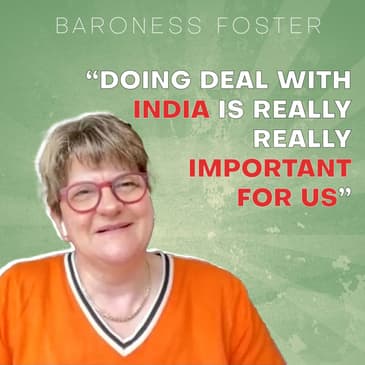
Free Trade Agreement between India and the UK has been in the works for some time. In this episode, we speak with Baroness Arlene Foster, who currently chairs Inter Trade UK and was the first female First Minister of Northern Ireland, about whether part of the delay comes from the colonial hangover that Britain still needs to shed completely. We also explore how the elections in both countries might impact the finalisation of the FTA.
Baroness Foster offers her unique perspective on these developments, especially at a time when post-Brexit Britain is seeking to carve its place in the world, and India has surged ahead economically, surpassing the UK to become the fifth-largest economy in the world.
In addition to her professional insights, Baroness Foster opens up about her personal journey, sharing what it was like to balance being a mother and serving as the First Minister. These beautiful moments give listeners a glimpse into the woman behind the political figure.
If you are a connoisseur of politics and eager to understand the inside story, and if you want to know more about the remarkable woman shaping these significant trade discussions, this podcast is for you.
FULL VIDEO
You Tube: www.youtube.com/@loveenatandonofficial
PODCAST SMART LINK :https://bingepods.com/podcast/podcast-rn7moe
SOCIAL MEDIA HANDLES
Baroness Foster
https://twitter.com/ArleneFosterUK
Loveena Tandon
LinkedIn: https://www.linkedin.com/in/loveenatandon/
Twitter/X: https://twitter.com/loveenatandon
Instagram : https://www.instagram.com/loveenatandonofficial/?igshid=OGQ5ZDc2ODk2ZA%3D%3D
https://www.instagram.com/tandonloveena/?igsh=MW5tOHdlc3cyMGJrOA%3D%3D&utm_source=qr
Tik Tok : https://www.tiktok.com/@loveenatandon?_t=8iEOX5p1s6C&_r=1
Learn more about your ad choices. Visit megaphone.fm/adchoices
[00:00:00] This is India a story in the making and I'm your host Loveena Tandon.
[00:00:05] Hello and welcome to India a story in the making. As the biggest democratic exercise
[00:00:11] of the world, the Indian elections are coming to an end. United Kingdom, Britain has announced
[00:00:17] its own elections. Britain known as the land of mother of democracy now is in its
[00:00:24] election fervour. Now elections change the government sometimes at least but how do they
[00:00:31] impact the working of the countries or the trades between the country that is quite impacted as well.
[00:00:41] In the light of this pre-trade agreement between India and UK that has been hanging for a very
[00:00:48] long time how will that be impacted or will it be at all and why hasn't it not been through the line
[00:00:57] despite being spoken about for a very long time. These are many questions that we explore
[00:01:03] with Baroness Foster who now takes the position of chair of inter-uk trade but there is something
[00:01:10] more to her as well very interesting she was the first female to be the first minister
[00:01:16] of Northern Ireland and I want to explore with her what is it to be a woman in politics
[00:01:23] in the United Kingdom and also the first minister at that and what can women bring
[00:01:30] to politics that men cannot so an interesting discussion indeed stay tuned on India a story
[00:01:36] in the making. This is Baroness Foster. Hello and welcome to India a story in the making.
[00:01:42] Usually I do this in person but Baroness Arlene Foster who is with me and joining from Northern
[00:01:48] Ireland just left and the elections were announced so I had to get her somehow so here we are
[00:01:55] doing it virtually. Thank you very much Baroness Foster for making time despite the
[00:02:02] elections having been called in the UK and thank you very very much indeed.
[00:02:07] Well it's lovely to see you again Navina and actually it must be about a year and a half since
[00:02:13] we have a chat so it's good good to catch up again. Yeah indeed absolutely and what an amazing
[00:02:19] time the mother of the biggest democratic exercise in India is coming to an end and
[00:02:27] the mother of democracy has announced its election so should I just begin by asking
[00:02:34] you about India. You have been to India, you know India, you are in the thick of the trade
[00:02:40] Indo-UK relations and we'll get into that but tell me how do you look at these
[00:02:45] elections the biggest democratic exercise 969 million people having to vote and a bowling
[00:02:53] booth for one person being 10 people a team of 10 taking a bowling booth for one person.
[00:03:00] How do you see this whole election from sitting here? Well isn't that wonderful to hear that
[00:03:06] story that people are actually coming together just to allow one person to vote because
[00:03:11] democracy is about the power of one it's about individuals expressing their opinion as to what
[00:03:16] they want to see and the scale of what is happening in India is just very difficult for
[00:03:22] us in the UK to understand because it's such a huge exercise in democracy and now that the
[00:03:29] election has been called here as well obviously our minds turn to what is going to happen here
[00:03:36] in the UK but I suppose the biggest impact that the calling of the election here in the UK has
[00:03:43] had as regards India is the fact that there was to be a British delegation go out to New
[00:03:50] Delhi this week to try and sort out the last remaining knotty problems in the trade deal
[00:03:58] and of course because of our rules here in the UK pre-election rules that visit's now not going
[00:04:05] to take place and that's disappointing of course disappointing I'm sure for both sides who have
[00:04:11] been working hard to try and bring this to a conclusion but the prize is still there
[00:04:17] and I think once the elections are over and we have a new government in place
[00:04:22] that should certainly be one of the priorities for the next government
[00:04:29] and I think you are the chairperson for inter trade UK and FDA the free trade agreement
[00:04:36] between India and the UK and been going on forever we have been listening about it since
[00:04:40] Boris Johnson was there. Do elections in any shape or form change the way or what government
[00:04:49] comes in each place does that change the dynamics of FDA in any way? Well I hope it doesn't I hope
[00:04:58] it's a continuation I mean the officials the civil servants will remain the same but obviously
[00:05:02] they will have different ministers in charge it will be interesting to see if there's any
[00:05:07] slight nuances and changes and what's important for those ministers obviously if it goes against
[00:05:15] all the polls and it's a Tory government again then it will definitely be a continuation but I
[00:05:19] think most people expect to have a Labour government here in the UK after the 4th of July
[00:05:26] and you know this is the biggest deal that we will do after Brexit and therefore we really
[00:05:33] need to concentrate on that the scale of the deal that has been talked about I think
[00:05:39] is really important and therefore I hope that the next government whatever shade or colour it is
[00:05:45] will prioritise certainly in the trade department the trade deal with India.
[00:05:52] What about the Indian counterpart does that change the dynamics as to who comes
[00:05:58] or who would one want or desire if there is any? Well yeah well I think from what I
[00:06:05] understand we expect a BJP government again in India and if that is the case then there'll be
[00:06:13] a continuation of the issues that we've been dealing with up until now. I mean India and
[00:06:19] ourselves have got a long relationship sometimes good sometimes not so good but I think at the
[00:06:24] moment we are in a really good place in relationships between India and ourselves. India
[00:06:31] invests a lot in the UK I think it's the second largest investor in the UK. We of course
[00:06:38] likewise invest in India and there's this really good relationship that goes on between India
[00:06:44] and the UK and of course in the person of our Prime Minister it's been wonderful to see
[00:06:49] a British Indian Prime Minister come to the fore in the way that he has and I think that
[00:06:53] underlies the relationship between India and the UK.
[00:06:59] How does the how will how significant let us say is this FTA agreement in terms of
[00:07:09] from when it started to where India is now it has moved leaps and bounds.
[00:07:14] Indian market is quite lucrative it is seen as the next big thing happening or it's already
[00:07:20] in the making. Where does the FTA stand vis-a-vis that what are the significant things that it'll move?
[00:07:31] Well I think it's a very good point because when I started to go to India as a trade minister
[00:07:35] here in Northern Ireland back in about I suppose 2010 2011 probably was my first
[00:07:42] visit to India and of course then it was a huge market for us a small region of the United
[00:07:48] Kingdom and we started to try and work with different regions of India but even since then
[00:07:55] the growth and the change in terms of technology that has been occurring in India I think has
[00:08:01] been really striking and I was reading somewhere that you know whereas the 19th century was
[00:08:09] the UK's century and the USA's century was the 20th century, the 21st century is absolutely
[00:08:15] India's century and because of its scale and because of its technology driving ahead
[00:08:22] I think that that's probably right and therefore its leadership in terms of the
[00:08:27] global south is really really important to the world so it is this global superpower
[00:08:34] that we really need to harness and I think for us in the UK if we want to be global Britain
[00:08:40] as we describe ourselves then doing a deal with India is really really important for us and
[00:08:46] as I say I hope it is a priority for the next government whatever shade that is.
[00:08:54] In the time that we are talking Britain has had Brexit and has become smaller in the sense
[00:09:02] of a market and India has grown do you think this FTA is quite important for Britain to
[00:09:09] have struck in terms of where it is now and it is in a way redefining and rediscovering itself
[00:09:20] and making its place? I think there has been a shift certainly and not enough of a shift
[00:09:26] if I'm honest you know from my perspective when we left the European Union the idea was
[00:09:32] that we as an independent nation would be able to do deals with other countries across the
[00:09:38] world and there have been some moves in that respect to see the southern trade deal that we
[00:09:46] recently did with the specific nations I think has been important but I also think that we can
[00:09:53] do more and it has been disappointing that we haven't been able to get the trade deal over
[00:10:00] the line with India. It has taken and I know it's very complicated and I know there's a lot of
[00:10:06] little parts that cause problems and that's what usually holds up.
[00:10:11] You could be 85% of the way there but the 15% that is left is really
[00:10:17] problematical so the question is do you agree the 85% that you have and then put the
[00:10:24] other 15% to the side? That may or may not be acceptable to India and if it isn't then you
[00:10:30] have to try and strive to deal with the other difficulties that are there. So I think Brexit
[00:10:35] has given the UK an opportunity to do this. I hope we can move that on ahead now with the
[00:10:42] next government and don't get bogged down in the ever-increasing circles of should we go back
[00:10:49] into Europe again because I don't think that's what the UK people are. I think we want to
[00:10:53] just get on, talk about global Britain and do the deals with places like India which
[00:11:00] are forging ahead in the world and it would be wonderful to be a part of that.
[00:11:07] Would you reveal some of the niggly bits and what are the niggly bits really?
[00:11:15] I think people have been talking about when I say niggly bits they are quite big
[00:11:20] so obviously work phases are an issue and I think recognition of professional standards
[00:11:32] across India and the UK are important too but I don't think these are insurmountable. It's a bit
[00:11:38] like when we're talking to the United States of America as a global piece as well there are
[00:11:45] difficulties sometimes there because different states have different levels of regulation and
[00:11:51] what have you and that sometimes it's easier to do deals with different states like there is a
[00:11:57] cooperation understanding with Texas for example but it would be really good if we could move
[00:12:03] ahead with India. I think given our history, given our common understanding, our value system
[00:12:10] which I really strongly believe that we share, I think there is an opportunity to do a deal that
[00:12:16] would make a difference to us yes in the UK but also in India as well and I think that's
[00:12:21] what's important that we both benefit from it. I know these deals are so much dependent
[00:12:27] on the civil servants more than the politicians, the politicians have the intent. Do you think
[00:12:34] somewhere India having shifted the way it is in the world, the space that it takes in the world,
[00:12:43] the stature that it has and Britain or the people working around it have not really
[00:12:51] readjusted their minds to it and find it hard to see India in a position where it is now
[00:12:58] that holds them back to finalise or formalise the deal? Has this culture in play?
[00:13:06] It's a very interesting point actually. Sometimes I get frustrated with the Foreign
[00:13:10] Commonwealth Office and indeed with some of our civil servants that they haven't,
[00:13:14] you know they're sort of playing the game with the rules and the tools to deal with it
[00:13:21] from the 90s or from the 2000s you know and things change, things change and I think there
[00:13:28] has to be an acknowledgement of how India has changed. Like rapidly over quite a short period
[00:13:33] of time particularly in terms of opening up and scaling back on regulation doesn't mean that
[00:13:40] there isn't still issues that we need to talk about and you know how we understand each other
[00:13:46] in terms of culture and what have you but I think our values are very much shared and therefore
[00:13:53] I think it is a good point and I hope that whoever the politicians are who are leading
[00:13:58] on this in the future can bring some of that to the civil servants as well. I mean I'm not
[00:14:04] dismissing civil servants, don't understand that would be the wrong thing to say but I do
[00:14:08] think you need to understand that anything that you do has to be flexible. So if we are to
[00:14:14] have a trade deal it has to be able to move and it has to be able to flex and not just be set in
[00:14:22] stone at the moment it's signed and to be able to do that requires good negotiation skills I
[00:14:30] think. Yeah I know and talking to each other rather than talking at each other I think that's
[00:14:35] yeah sometimes I hear that kind of talking at India we just have to look across at each other
[00:14:44] as equal partners. Yeah oh most definitely when you see the what has been happening in India there is
[00:14:50] no doubt about that I mean I think the days of the UK talking at people should be gone,
[00:14:59] should not be in anybody's psyche you know anymore and I think what we should be doing
[00:15:05] is trying to find a relationship space, a trade deal that respects each other,
[00:15:13] respects each other's strengths and also where there are challenges and weaknesses and how we
[00:15:18] can get around those but if there is that genuine respect for each other and we're not
[00:15:22] talking at each other but we're actually talking with each other and trying to find a deal
[00:15:27] that is good for both countries not just for one or the other. Sometimes I get frustrated
[00:15:31] maybe it's the female politician in me is supposed to be you know this is not about just getting a
[00:15:37] win for one side it's about actually getting a win for both sides so that we can both benefit.
[00:15:42] Indeed. I really think that. Yes thank you and you've been so open and upfront about it
[00:15:48] thank you for that really we need more people like you in there.
[00:15:54] Baroness Foster you said you went to India in 2010 and then you went in 2016
[00:16:00] and do you yourself also feel that it's moved or because I go like you like any other person
[00:16:09] now. What is the change that you feel that needs to be taken note of? Well I mean I
[00:16:18] feel that it has changed and has become more open in terms of business, in terms of doing
[00:16:24] business. I haven't been back since I think it was 2016 I had been a couple of times before that
[00:16:30] to Bangalore, I've been to New Delhi, I've been to Mumbai. I mean the thing when you visit India
[00:16:39] it's just lovely to think about actually it's an assault on all your senses.
[00:16:44] I just love it. You go and it's just oh my goodness this is wonderful and the noise and
[00:16:50] the smells and the colour and the culture it's a wonderful place to visit and I do hope to be back
[00:16:57] in the near future if I can at all. What do you love about India?
[00:17:04] It was mostly about meeting businesses that were interested in coming to Northern Ireland
[00:17:08] or maybe we had some businesses with us from Northern Ireland wanting to do trade
[00:17:12] in India so it was very much centered around that but I did have a bit of an opportunity to
[00:17:18] get out and about around Mumbai and at the time I was in Bangalore actually they were building a new
[00:17:25] rail system in the city and it was just wonderful to see the speed and the expertise
[00:17:32] and building infrastructure that was going on at that time. So yeah I'm really looking forward
[00:17:38] to going back to India if I can. You would have gone had the elections not been gold.
[00:17:44] Hopefully yeah but look I mean as you know elections are taking place in so many places
[00:17:50] this year. I think it's dubbed the year of elections because I think about half the
[00:17:55] community of the world are going to elections which is good because it is good that people
[00:18:01] you know everybody has the same power on election day. I have the same power as
[00:18:05] you because we only have one vote each and therefore doesn't matter how much money you
[00:18:10] have doesn't matter what your standing is in society you have the same power as the person
[00:18:15] next to you in the polling booth and to me that's the wonderful thing about democracy.
[00:18:20] We have one vote we use it and I get frustrated when I hear people say no I'm not voting.
[00:18:26] I agree. I might not agree with your politics but you should vote because if you don't vote
[00:18:33] then your voice isn't heard and I think that's really frustrating.
[00:18:36] Yeah you have to speak whatever it is. That's absolutely right. Moving to the UK elections now
[00:18:45] we have these few weeks to get it all set and done. How are you
[00:18:52] playing it out? What's happening do you think? Some insight in you.
[00:18:57] Well it's certainly shorter than the Indian elections
[00:19:01] but I mean I was in Westminster when the Prime Minister called elections last Wednesday.
[00:19:07] It was a shock it was genuinely a shock particularly for people in the Conservative
[00:19:13] Party. So on the Wednesday morning the buzz started that something was happening.
[00:19:19] I actually thought there was going to be a reshuffle of his ministers.
[00:19:23] I went in actually to Prime Minister's question time because I have a bit of time I'm going
[00:19:27] to go in and see what's been said here. He said in response to the SNP leader's question
[00:19:34] about the timing of the elections it will be in the second half of this year
[00:19:39] and I don't think anybody expected that to be July. So it has been a shock for a lot
[00:19:46] of people and you've seen the number of people that have decided they're not running
[00:19:50] for elections. The biggest I think ever. It's a record in the Tory party and the Conservative
[00:19:55] party in particular. A huge number of people deciding not to run again which leaves a real
[00:20:03] problem because constituency associations have to find candidates within a very very short
[00:20:08] period of time. They don't have time to vet them, they don't have time to get to know
[00:20:13] their new candidates and then they're supposed to go out and canvas for them and ask people
[00:20:17] for their votes. So it's a difficult time for a lot of individual politicians in terms of the
[00:20:23] macro picture, the bigger picture. I think most people, most commentators polling are saying that
[00:20:31] it's going to be a Labour government that we will have after July the 4th. I think the big
[00:20:37] question is not will we have a Labour government but how big will the majority be? I think
[00:20:42] that's a really interesting question because Labour has to win big in Scotland if they're
[00:20:49] going to have any sort of a workable majority and I think the way things are looking at
[00:20:56] the moment they will probably get that. Yeah it looks like that, it looks like that indeed.
[00:21:02] But I'll go through another question but before that was there another, why would he call it in
[00:21:09] July? I mean in June or now was there something brewing or there was too many
[00:21:15] factions within the party and he just, and he didn't think that the economy is going to
[00:21:20] go any further than the inflation coming to normal? Yeah I think that inflation coming down
[00:21:26] as low as it did was the trigger for him and I think he felt because inflation's at this level
[00:21:32] now and going to go to a country. I certainly thought he was going to wait to November,
[00:21:37] I thought that he would wait to that time because then maybe the issue around immigration,
[00:21:44] illegal immigration would have settled, there would have been flights out to Rwanda
[00:21:50] and things would have moved on but he obviously thought you know what I'm taking such a battery,
[00:21:56] is it better to go now? You know it's going to get worse if I keep staying in office for
[00:22:02] this time and so it was a balancing act for him and I think he just came down on the side
[00:22:07] of right I'm going to go now in the summer. It's easier for candidates to be out in the
[00:22:12] summer, there's no doubt about that. A November election and I fought a November election
[00:22:18] can be miserable because you're going to see those doors in sleet and heel, they don't want
[00:22:25] to open the doors, they don't want to see you and you're feeling miserable because you're out
[00:22:30] in the weather so I think July from the candidates point of view of getting out and
[00:22:35] about is probably better but it was a shock. Yeah indeed it was. Now
[00:22:43] how do you think Labour government, if it does which it looks like coming at the helm will
[00:22:51] change if anything the relationship if at all with India because it's not been in good waters
[00:22:57] late especially with the diaspora with Jeremy Corbyn's Kashmir comment. So overall what do
[00:23:06] you think? Well I think as you know there are many British Indians who support the Labour Party
[00:23:13] and they will want to make their voices heard within the Labour Party. I think they will want
[00:23:18] to set out their stall and I think the Shadow Chancellor is doing that today on the economy.
[00:23:24] They want to send out a message that they can be trusted with the economy, that they're not
[00:23:28] going to trash the economy but they're playing a very interesting balancing act because on the
[00:23:35] one hand you had Keir Starmer out yesterday talking about he was a socialist, he believed in
[00:23:40] socialism and then today we have Rachel Reeves out talking about the economy and how the Labour
[00:23:46] Party is going to grow the economy. So it's a balancing act for them at the minute they need
[00:23:50] to keep their core vote content because as you know there's been a little bit of
[00:23:57] turbulence there over Gaza and Israel and they've lost some of the Muslim vote has gone
[00:24:05] to independence instead so that's something I think to watch in some of those seats
[00:24:10] where there is a significant minority there of Muslim voters but I think that they will want
[00:24:16] to say to people we are serious about the economy and therefore I am hopeful that they
[00:24:21] will pick up the trade deal again. It would be a disaster if they didn't do that. I think
[00:24:26] it would send out a very bad message if they didn't pick that up after the election.
[00:24:33] I'm sure they would and because Britain needs it in fact. Coming to you
[00:24:41] Baroness, you've been the First Minister of Northern Britain twice, am I right?
[00:24:48] Yes twice that's right. 2016 and then during that awful period of Covid in 2020-2021
[00:24:58] which is difficult to think back on actually. It's almost like a nasty dream that we all had
[00:25:06] back in 2020-2021 but yes that's the time I was First Minister. Sometimes I can't believe when
[00:25:12] I go out that there was not a soul on the road. It was a very strange time. I live off the
[00:25:24] main Belfast Road in Northern Ireland and cars up and down it all the time and I could stand on
[00:25:31] that road in the middle of the road for minutes without a car coming during that first lockdown
[00:25:37] which of course was the most intense period when everybody was really afraid and it was
[00:25:43] a horrendous time. Yes indeed. You sailed through it and you're the only woman who has
[00:25:50] been in Northern Ireland as the First Minister. What is it like to be
[00:25:57] a woman in politics and completely leading it from the front? So I was the first female
[00:26:04] First Minister but now there's a First and Deputy First Minister female in Northern Ireland
[00:26:09] now as well so pleased about that and see that continuing. I consider myself to be probably
[00:26:16] in the transition generation transitioning from all male politicians and I was looking at a
[00:26:22] photograph of the opening of a road in the 1970s just yesterday and all of the people in
[00:26:27] the photograph were men. Not one single woman was in that photograph and now I'm pleased to say
[00:26:34] that there are a number of very high-profile women in Northern Ireland politics and there's
[00:26:39] more young women coming forward as well so that's really good to see and I think that's
[00:26:43] been a change in society here and you see it across the UK you see more women coming
[00:26:49] to the fore which is really good but I mean in my lifetime when I was growing up in the 70s
[00:26:56] men were the politicians and as I say for me to get involved in politics and to become
[00:27:02] the First Minister of Northern Ireland was quite something and I'll always be incredibly
[00:27:08] proud of the fact that I was the first female to hold that job and it was a wonderful
[00:27:12] privilege to do it as well. You know I saw your Twitter Baroness Froster and you have the first
[00:27:18] thing you have mother of three yeah and you did this all the way through I mean seriously and
[00:27:24] and if I was to just describe myself the first thing that comes in my mind is mother.
[00:27:32] How was it like being a mother and the First Minister to the nation as well?
[00:27:37] Well you know it's interesting you say that because my children have been such a blessing as
[00:27:44] they are I mean obviously we all have our moments totally with our children but they've been
[00:27:48] such a blessing because they really grind you in who you are don't they because
[00:27:53] you're always going to be their mum you know you're not always going to be the First
[00:27:57] Minister, you're not always going to be a politician, you're not always going to be
[00:28:00] whatever you're doing as a job at that particular point in time but you're always
[00:28:03] going to be a mum yeah and that's why it's important for me even when I was First Minister
[00:28:09] myself always knew that if my children rang and they needed me I would take the call regardless
[00:28:15] of who I was meeting at that time because they would have been important.
[00:28:19] Please give spill some beans has it happened where you were being let's say a Prime Minister
[00:28:25] President and then your child wins? I do remember my middle child he's now 22
[00:28:32] I was on a visit to South Africa and we were moving about between meetings and I get a call
[00:28:38] from George and I said oh my goodness what's wrong and I answered the call and the question
[00:28:42] was where is my rugby kit mum I can't find my rugby kits where is it? I go George I'm in South
[00:28:49] Africa it was funny but I said ask your father. Would the father know?
[00:28:57] Yeah well that's a good point probably not but hopefully he would know where to look
[00:29:02] yeah no the kids have been wonderful I think all women who work, all women who are high
[00:29:08] profile have a part of them feels guilt because they feel you know am I not spending enough
[00:29:17] time with my children am I not I'm away from them but you know they've had such
[00:29:21] wonderful opportunities as a result of me being First Minister they've met politicians from all
[00:29:27] over the place as young children and I'm really thankful that they're three pretty sensible
[00:29:35] pretty down-to-earth kids and I'm really grateful for that. So you know when I sometimes
[00:29:42] I've had to take my children for interviews including when I interviewed David Cameron
[00:29:47] actually my children were sitting outside on the side yeah very young do they recognize this or
[00:29:54] this or they see this as what I mean was do they recognize this as an opportunity that they had
[00:30:01] had to meet these politicians or they just feel oh mum was just lugging us around yeah
[00:30:08] I think at the time they don't really realize but now I know when they look back and look
[00:30:13] photographs and my daughter with Boris Johnson or you know just whatever that they will realize
[00:30:19] as they get older that it was pretty significant the mum brought me into a meeting and Nancy
[00:30:25] Pelosi was there and she said hi you know and I mean things like that you know now yes
[00:30:30] now I went later on when they're growing up but at the time they were probably going
[00:30:34] I could be at home watching tv or on my xbox or whatever. How have you shaped them? Do you think they have
[00:30:42] shaped them differently in any way and I'm just sitting seeing hope because my children
[00:30:47] are still growing up and going out with me now. Yeah no I think it has obviously you don't have
[00:30:55] that sliding door moment where mum wasn't a politician and she wasn't a first minister
[00:31:00] or whatever but I'm really we worked hard at first of all keeping them out of the public eye
[00:31:06] and having them a very normal childhood apart from the times when they went with mum to different
[00:31:12] places and I think that was important because they need to understand that mum's job is a job
[00:31:19] and they need to go to school and they need to have a life and play rugby and do all of the
[00:31:24] ordinary things so my husband has been a wonderful support as well and I think that's
[00:31:29] always important that your partner's there to help in these times. So important, so important
[00:31:35] indeed. What does a woman's energy bring to a post like the one that you were on or Margaret
[00:31:44] Thatcher was? What does that energy do the world because often we hear that we need more
[00:31:52] feminine energy to bring this world together that is falling apart almost. Do you agree?
[00:31:58] Well I do think that we do multitasking better, I mean there is no doubt about that.
[00:32:10] One of my favourite photographs of Margaret Thatcher is her in the kitchen
[00:32:14] cooking a meal for her two children actually when she's prime minister so I mean you know
[00:32:20] we do all the ordinary things but we also do the things that we have to do at the same time
[00:32:24] and I think that grounds you, I think it makes you realise yes you're holding down this powerful
[00:32:31] job but you're also in touch with all of the things that everybody else has to do so
[00:32:35] when people used to say to me child care is a real problem I'd say yeah I know that because
[00:32:41] I have to balance and make sure that I have child care in place if I'm late
[00:32:47] my dear late mother-in-law goodness what would I have done without her was always there for me
[00:32:53] you know always lifted the kids if I was going to be late or I had a circle of really strong
[00:32:58] friends who could step in as well and I think because of that women have to think ahead what
[00:33:04] if I'm going to be late what if x happens so you're thinking ahead all of the time and I
[00:33:11] think that is a good skill to have. Oh brilliant so thinking ahead now actually
[00:33:19] you would have a section called high five India and I would be giving you a high five in the end
[00:33:26] and that would be a reward. It's five rapid fire questions I'll ask quickly because the time is
[00:33:33] running out so are you ready? Yes I think so. Okay India for you in one word? Colour. Okay
[00:33:51] What is it about India that the world doesn't get?
[00:33:56] I think they don't get how dynamic it is and how you can see photographs of India and that's
[00:34:04] what you think India is but then you could see something that completely is different and
[00:34:10] that is also India so India is such a breadth of experience I think. Okay what is it that
[00:34:19] a woman politician brings to the table that a man cannot? I think the multitasking piece I think
[00:34:26] that is something that we bring to the table because we do it every day and we don't think
[00:34:31] about it but then when it comes to politics it becomes really useful tool when you're thinking
[00:34:36] about different things at different times. Okay if you could meet any historical figure
[00:34:43] or take the place of any historical figure you can choose who would it be and why?
[00:34:51] I always say that Margaret Thatcher had a huge influence in my life because she became prime
[00:34:56] minister when I was just eight years old and she was there right throughout my teenage years
[00:35:02] and therefore had an impact on me as a woman could be prime minister but I never got to meet
[00:35:10] her and I really regret that and I would have loved to have met her and to just have a
[00:35:14] conversation with her. If you wouldn't have been a politician what would you be?
[00:35:20] Well I started life as a lawyer so probably would have stayed
[00:35:24] at being a lawyer if I hadn't been. I did want to be a police officer but my father said no.
[00:35:30] That was a wonderful high five. Thank you thank you. Thank you so very much
[00:35:38] Baroness Foster. It's been an absolute pleasure speaking to you every time it is when I speak
[00:35:44] to you and thank you so very much for being on India a story in the making. Thank you,
[00:35:50] look forward to speaking again. Thank you. It's such a privilege to bring these conversations
[00:35:56] to you on India a story in the making a show that is consistently doing well and can do
[00:36:02] even better if you can like follow and subscribe the YouTube channel Lavina Tandon official for
[00:36:09] the videos and for podcasts it is any platform that you get your podcast from Apple, Spotify,
[00:36:16] Audible wherever please do follow and subscribe this helps us generate more such content
[00:36:25] for you and I'm also there on social media on Twitter and LinkedIn. I'm as
[00:36:30] Lavina Tandon on Instagram. I am there as Tandon, Lavina or Lavina Tandon official so
[00:36:36] anything please do follow and send your feedback that is absolutely mine of gold for us.
[00:36:42] Thank you take care and God bless. Listen to my podcast audio on Apple,
[00:36:48] Spotify, Binchbots or wherever you get your podcasts from and watch the video of the podcast
[00:36:56] on my YouTube channel Lavina Tandon. New episodes are out every Sunday.