
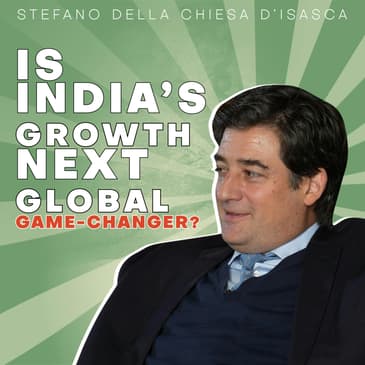
While India is striving to become a $5 trillion economy soon, the question looms: Is the infrastructure ready for it?
While the GDP has increased, the concentration of wealth, particularly in the hands of a few families remains a significant concern or is it a concern for those looking to invest in India?
While India wants to pose itself as a huge investment opportunity, does its internal politics make foreign investors vary?
Stefano, an investment banker with expertise in the structured credit market and deep knowledge of emerging markets, shares what factors weigh on his mind as he considers India as an investment option.
If you are thinking of engaging or investing in India or understanding an investor's mindset, this episode is for you.
Connect with Loveena -
Linkedin - http://linkedin.com/in/loveenatandon
Twitter - www.twitter.com/loveenatandon5ZDc2ODk2ZA==
Instagram - https://instagram.com/loveenatandonofficial?igshid=OGQ5ZDc2ODk2ZA==
Youtube - https://youtube.com/@loveenatandon1460
Bingepods: https://bingepods.com/podcast/podcast-rn7moe
Learn more about your ad choices. Visit megaphone.fm/adchoices
[00:00:00] I explore the opinions of people across sectors, across professions and across the globe to find out what makes them curious about the India story.
[00:00:12] This is India a story in making and I am your host, Loveena Tandon.
[00:00:17] Welcome to India the story in making. There is a buzz about India.
[00:00:24] The World Bank sees it as a global player now and Morgan and Stanley have projected that India could be the third largest economy of the world by the end of this decade.
[00:00:36] Welcome to India a story in making where I delve into the practical side of these numbers.
[00:00:44] I speak to the decision makers, the change makers, the investors and all the people who are interested in investing in India are all engaging with India.
[00:00:58] I want to find out what is it that they think of when they are engaging with India.
[00:01:12] My guest today is a man who has a knack of riding on waves. May it be the rolling waves of the sea as a surfer or a sailor or the financial waves where he has already clocked 25 years as an investment banker or the wave of opportunity in the growth story of India.
[00:01:35] I am going to attempt his name, Stefano De La Quisa Disasca.
[00:01:40] Thank you very much. I did it.
[00:01:42] Wonderful introduction.
[00:01:44] Thank you. Did I pronounce the name right?
[00:01:48] Perfect introduction.
[00:01:49] So you are Stefano of the church of...
[00:01:52] Of Disasca which is a village in the north of Italy.
[00:01:56] So you in Italy do you name your names after the village and...
[00:02:02] Family names come from the place you come from or from the job you do so historically.
[00:02:09] Oh that's really interesting.
[00:02:12] The church thing is that there are no very old families at the time they were kind of either knights of the church or knights of the church of that village.
[00:02:23] Then the names stick.
[00:02:25] Pavilas but do you allow me to call you Stefano?
[00:02:29] Yes, absolutely.
[00:02:30] You don't have to say that anymore.
[00:02:33] Not anymore.
[00:02:34] Thank you, thank you for coming.
[00:02:36] So since you have a knack for riding waves...
[00:02:40] I hope you get time for that now being an investment banker but tell me what brought you to the financial market considering your brilliant background of your grandmother being an actor as well.
[00:02:55] And then to the growth market of India, the wave of India.
[00:02:59] How did you turn around on that?
[00:03:01] Well came to London after my university in Rome.
[00:03:05] More opportunity was back in the 90s.
[00:03:07] Investment banking was growing so I joined and then the UK...
[00:03:13] What we call the Coulbert Agnier.
[00:03:15] It was very hospitable for many foreigners, Italian, French, German.
[00:03:20] So then end up staying here, marrying here, having my family here.
[00:03:24] Yeah, and basically keep working in the city of London.
[00:03:28] And India is part of my job.
[00:03:31] My kind of daily activity, especially recently, is look after investment, also in emerging markets.
[00:03:39] So I have to know what's going on in India, what's going on in China...
[00:03:43] You know, either developed market or emerging markets.
[00:03:47] One thing I wanted to say when I talked about India is that I put myself in the
[00:03:51] shoot of European, you know, American, British investor.
[00:03:55] And when they go to India, they find a friendly business language.
[00:04:00] Because India is a mix between civil law and commot law.
[00:04:05] Let's say the business language is commot law so it's very similar to Australia,
[00:04:11] to the UK, to the United States.
[00:04:14] Whether country that have civil law and ultimately the civil law come from the Roman Empire law
[00:04:20] and then it was modified, become the church law, the pop law, so the canonical law
[00:04:25] and then it became the code Napoleon which is basically a set of code where
[00:04:30] the law is codified and everything needs to tie up whatever you do needs to die up to the law.
[00:04:36] So other matter here, everything becomes from a business perspective.
[00:04:39] It becomes lower, more bureaucratic with more requirements and checks.
[00:04:45] So when you say British investor, American investor go to my country, need a lien invest.
[00:04:51] They like Italy, they like the class by always, oh my god what's going to happen then.
[00:04:54] You know, we need to check this, we need to check that.
[00:04:57] But not because Italians are bad or French are bad etc but because of the civil law.
[00:05:02] Commot law in a way, it's easy.
[00:05:04] In the UK you can set up a company, you know.
[00:05:06] One day close a company in another day, you need a German,
[00:05:10] ages, trade unions, whatever.
[00:05:13] So when you're going abroad in emerging markets,
[00:05:17] you're going to China, civil law, you're going to Russia, civil law.
[00:05:20] You go to India somehow is something very close to what you use to.
[00:05:25] It's different because it's another country, it's development country etc but
[00:05:31] it's got this peculiarity of the common law.
[00:05:34] That's the first thing.
[00:05:36] All these started basically back in 1993 after the fall of the Soviet Union
[00:05:41] where finally you have this new silk road from China to Europe to Central Asia
[00:05:46] and all this market development.
[00:05:49] Now this time is passed and at the G20 summit in Delhi what they announced was the IMAC,
[00:05:56] India, Middle East, European corridor.
[00:05:58] So instead of going China, centralised Russia, Ukraine and Turkey,
[00:06:04] we move out also because there is a war in the north
[00:06:08] and because there is a tension with China in the economy.
[00:06:15] China also is not doing very well at the moment, unemployment,
[00:06:18] debt, circulation, huge problem, real estate etc.
[00:06:23] So all of a sudden you turn around and you see a country
[00:06:26] just passing a number of populations.
[00:06:28] They pass China, they have more people than China.
[00:06:31] They landed on the south side of the moon.
[00:06:34] 75 years from independence from England, so much to celebration.
[00:06:40] The Ambani family throwing in their yard party
[00:06:44] in Mumbai back in every.
[00:06:46] So many events, India is always on the spotlight.
[00:06:49] And so more people than China,
[00:06:53] not the same level of capital control.
[00:06:56] Business friendly because they are common law and then this corridor you finally got from India,
[00:07:03] you go up to Middle East, Saudi Arabia, Israel, the Emirates, South and Europe.
[00:07:11] So finally you can actually with this IMAC let's say there is all a set of countries
[00:07:17] which is, for example just to give an example,
[00:07:20] Saudi Arabia net trade commerce with United States was 80 billion 10 years ago,
[00:07:27] 926.
[00:07:30] The same number with China at the moment is 86.
[00:07:34] So even in Saudi Arabia is switching to India and many companies in Saudi Arabia
[00:07:40] in South Korea, yes compared to China because there is all these political tensions with China.
[00:07:46] So everyone also is looking at the shift to India.
[00:07:50] So all of a sudden you have, the United States potentially have some allies,
[00:07:55] you know Israel always been in line, Saudi Arabia always been in line.
[00:08:00] And then you have these new countries which is big emerging markets doing so well,
[00:08:05] which is India, which can actually be kind of in the middle to create more stability in the region
[00:08:11] versus the power of China versus the other Middle Eastern country.
[00:08:16] So that's this two big factor, the IMAC that was announced and the fact that
[00:08:23] you know you can actually do business in India.
[00:08:25] In India the chip making company for artificial intelligence.
[00:08:31] Last week they signed an agreement with the reliance which is the Ambani conglomerate
[00:08:39] to develop you know artificial intelligence program in India and some other,
[00:08:46] there's another company that produce iPhones and even Apple they're moving from China out of China
[00:08:52] into India. China is punishing them for that.
[00:08:55] Yeah and in India I can not go to China because basically the risk is that they can use artificial
[00:09:00] intelligence to develop unconventional weapons. You know there's all these, there is geopolitical
[00:09:05] factor. So these two factors I think are helping India to develop. Then if we go to the numbers
[00:09:12] in the economic then we find what's what's instead is little bit going wrong and still need to fix.
[00:09:19] So that fixing will definitely come to end the challenges that they face but I want to
[00:09:24] pick up on something quite important that you said that I heard a lot of trust when you felt
[00:09:30] you know balancing China with India and that corridor and the ease of work doing
[00:09:38] the business with India. Where does this trust come from?
[00:09:42] I think it's trust from this geopolitical reasoning and you can see that
[00:09:49] more I think it was the first and only India Prime Minister was invited twice in the United
[00:09:55] States. Back in 2005 the United States basically kind of revoked the visa to Modi to come
[00:10:04] to the States because of the famous you know history of his past when he wasn't the Prime Minister
[00:10:10] he was in the region of India, Karamat and Gujarat. Yeah and all the issue there but then he was
[00:10:15] invited twice to the United States to talk to the Congress and he was the first one to do that.
[00:10:22] He came was invited in the UK. So I think Modi what he brought is kind of a national sense of
[00:10:31] pride of India and you know for the first time to make India great nation etc all concert that
[00:10:41] from the outside I mean locally I don't want to talk about politics people can see this as to be
[00:10:47] right-wing populism etc but as an investor we start seeing some you know they walk the talk
[00:10:56] they say you know they say do they walk the talk yes they do and that's what Modi it looks like
[00:11:02] is doing you know that this for example this huge plan PM was Gadi Shakti which is the plan
[00:11:10] for the government for infrastructure to invest 1.8 trillion in infrastructure, 1.2 in manufacturing
[00:11:18] basically all the different department of the Indian government they're going to have access
[00:11:23] to this huge portal and this huge portal will tell them if they want if they have a planned submission
[00:11:30] plan to build a road to build a port to build a train station they have all the other crossing
[00:11:37] you know legal barriers and this cannot be done if you go through this through this city will cost
[00:11:42] you too much money it's a kind of optimization all the infrastructure planning so you have
[00:11:49] someone a government to talk to as an investor which actually is responsive and okay it may be
[00:11:56] a government you like less you like more investors don't care that much until there is a civil war
[00:12:02] and things are really screw up as an investor you say okay I put the money there do have certainty
[00:12:09] do if you give me collateral against it do have access to my collateral how we working in a region
[00:12:15] where the law is such that if you default then I'm a creditor you and I can recall you know
[00:12:22] do the things works if they work I'll put the money to work there right I'm not a politician
[00:12:28] you know I'm not going there to judge more it's not up to me it would be the history it was be
[00:12:32] its people the voters you know it's not it's not a job of an investor that much we look at it
[00:12:38] as a thermometer or what can go wrong for an investment but it's not our job to kind of think
[00:12:45] politically I know so I let that be on his own okay so you feel that as long as there is a stable
[00:12:53] political climate and the promises can be carried out an investor would look at India
[00:13:00] and that's why you're looking at India yes yes as a strong emerging market exactly and there are
[00:13:05] few signs other big signs for example J.B Morgan announced that they have intention to add
[00:13:14] India in their indices you know like if you are an investor in asset management you have all
[00:13:20] this benchmark indices so you invest in a bond market and you need to say okay you give me your
[00:13:27] money I invest and you say seven of the bond market made 10% you should make 11 you know because
[00:13:34] you should be better than the market so this indices represent a benchmark and the big benchmark
[00:13:39] provider are J.B Morgan and Bartley's J.B Morgan said well we're going to put the India into the
[00:13:45] emerging market indices and Bartley said well no yet because this government bond needs to be
[00:13:52] like settle like you look here would do the rating of India needs to go up it's too low it's
[00:13:58] it would be minus etc so but if this happens then it means that foreign investors can actually treat
[00:14:06] India like a liquid market and a lot of money we come in for example another sign S&P
[00:14:13] they say 20% of GDP of India it goes into the corporate world it goes to the company
[00:14:21] and in the next five years that would reach 60% now GDP of India just to also for the audience
[00:14:29] United States 25 trillion dollar China leave it or take it 1718
[00:14:38] with with the hand not on the fire just a joke then you go to Germany Japan for trillion then
[00:14:47] you go to India 50 economy in the world 3.3 okay they say India is growing at 7% a year let's assume
[00:14:55] they go 10% a year that means 300 400 billion a year so the big talk its India would be 5 trillion by
[00:15:04] 20 20 2025 that imply two more trillion dollars and that would mean at least 8 trillion dollars of
[00:15:14] foreign investment in India and it's a lot of money and Kenya does ingest the infrastructure
[00:15:23] to handle that to under all this inflow of money because for example all the big
[00:15:29] money is going to the big company so you go adani and bani what's the other there's another
[00:15:35] honey family beerla meter these are the people who gets all the the money because they have some
[00:15:44] many company they have you know educated professional and and then for for the people of India
[00:15:52] the small company is difficult to access to credit access to funding you know there are like
[00:15:59] small company struggling and also the money that the government put to work is where the government
[00:16:03] decides so agriculture infrastructure and the rest is still you know it's a big challenge
[00:16:13] for yeah okay I no no I totally agree so I had this thought in the mind but yes it's going from
[00:16:20] 3.5 to 5 trillion and it'll take and your work is in focus on debt and assets and how would you
[00:16:28] and absolutely write that it will be hard to it must be a sticking point or at least a question mark
[00:16:35] or what do you ask yourself when you see India is going from 3.5 to 5 into 8
[00:16:43] what are you taking in consideration as far as debt it can this concern in 1 2 3 what is
[00:16:49] positive and what is challenging I'm looking out the corporate access to the markets to
[00:16:56] funding is big corporate mid corporate small corporate the credit level in the banking system
[00:17:04] because so far all this GDP grow is sustained is domestic demand is domestic spending
[00:17:13] by the government there are big companies coming like CAPTUMI 9 60 thousand job these are the
[00:17:21] company from Taiwan they make iPhone you know they're going to come to India another 40 thousand
[00:17:26] job I mean there are all different names private egg with this we are rich 60 billion a year of
[00:17:33] activity in India venture capital is the growing startup especially in the 80 and the farmer sector
[00:17:40] but these are all like you know small cherry in a big garden which still many things are not working
[00:17:48] in terms of infrastructure so like this sign will put the India government in the index
[00:17:55] when this happens it means that the ground it looks finally solid and that's the sticking point
[00:18:02] that's the edge when India passed this so you have basically the public market with going up very
[00:18:08] high speed you know the government money basically and the private side which is lagging because
[00:18:14] no everyone has got access to the same credit there was another article which I came across about
[00:18:21] the audit firm you know the usual the big four PNC PWC the Lloyd etc. and I think the Lloyd
[00:18:29] is a market leader but you can't have a four-row leader you need 50 auditor you know it's so it's like
[00:18:36] there's a lot to be done you know but it's going fast it's going very fast and and you also notice
[00:18:44] that when things are happening you have big family on the news like for example in Italy when
[00:18:51] it was the boom Italian boom in the 60 when we made the auto-straded solidarity one the motorway
[00:18:58] from Napoli to Milano to Milano to Napoli everyone was like the big infrastructure project and
[00:19:05] then you had the Agnieli, the Ferrero, the Pesenti all the big family of the country because it's
[00:19:14] a family country you know it's not the markets are not developed too much so who moves the money
[00:19:20] is the biggest you know how do you see that as someone who's sitting outside I mean you have
[00:19:27] you have kind of you hail from Italy you're married a Greek yeah so you know you deal with
[00:19:34] American and European institutions you work in the city of London you have a completely
[00:19:40] global worldview how do you see this when you look at India? And they see they are at that stage
[00:19:50] when all these big family are on the news every day it means that we are at a turning point
[00:19:56] because after them there is the markets there are the investor so there is more small corporate
[00:20:03] which have can issue bonds it's more corporate that can issue share and invest to the buy share so
[00:20:09] at some point you start to talk less like like in the United States genius per part Morgan
[00:20:15] JP Morgan he was the guy who built all the railways at the beginning of the century in the United
[00:20:20] States so then he became JP Morgan and bank you know and it was probably yeah you wouldn't talk
[00:20:26] about the family anymore so now that's why you talk about Adani and Bani and all these families
[00:20:31] because these are the huge conglomerate when this conglomerate becomes you know the economy becomes
[00:20:37] more solid than a smaller player coming in more corporate bond market you you know develop capital
[00:20:43] markets and because of the 18th of structure in India and the mentality they can actually happen
[00:20:50] very very quickly that's what people don't realize is not there's no social you know religious
[00:20:59] you don't have like a religion that want to tell people how to live you don't have like a
[00:21:04] civil law central government or socially strong communists and you have a country which is pretty much
[00:21:10] business friendly where it's democracy you know to the point that Modi wants to change the name
[00:21:17] Bart the mother of the how do you see that let's call it indistan does it make you does it
[00:21:25] do you worry about that no does it factor in in anything but you do it's marketing you know
[00:21:30] oh it's marketing okay how is it marketing it's fire Bart I mean fire ready to be and you're okay
[00:21:38] with that it doesn't make a difference yes because it means we want to grow we want to be the best
[00:21:42] we want to build this we want to zero pollution when I have the best train we want to build a corridor
[00:21:48] from North India to South of India from the east to the west etc so you looked into this whole
[00:21:53] India yes because I follow the politics and what they say and you know he said Bart the mother
[00:21:59] of the mother it's changed the name why not call it indistan I think we'll stick to
[00:22:08] Bharat yeah we'll see to Bharat and you're okay with that so that's fine yes because the only
[00:22:15] political issue that is talked in India is distinct are too much Hindu for Muslim because of
[00:22:21] Modi blah blah but it's a little thing does it worry you do you factor that in your when you look
[00:22:27] into market no because it's so tiny in terms of discussion you know it's like two brothers
[00:22:35] Modi and Gandhi fighting each other it's not it doesn't look serious it doesn't look that's
[00:22:40] going to lead to violence is not a little revolution to see with war or anything it's just the
[00:22:47] local politics that they're going to develop themselves into something better and better you know
[00:22:51] every polity are just politics you know you need politics so in a way if I could say that while
[00:22:58] you're looking at the emerging market by looking at investing in India you're not factoring it does
[00:23:03] it's not you're having an eye on it but you're not well not I'm not factoring and I don't see any
[00:23:08] any backstop anything that can actually stop this growing the the only thing it's you know
[00:23:17] that the government has some point collapse and no one is doing the reform that needs to be done
[00:23:22] for the small businesses for the youth unemployment etc but on the other end
[00:23:30] there are these like the low dependency factor that there is so young people you know India is like
[00:23:37] the one of the country with the lowest dependence yeah in the demographic yeah the demographic it's
[00:23:46] advantageous huge huge help so I doubt that all these smart young Indian kids working in Chennai
[00:23:54] you know they want stop you know yeah no new things developing new company as for funding and you
[00:24:07] know stay there and improving so that's why everyone also got man's access said that India will be
[00:24:13] by 2050 GDP will be I don't know 50 trillion with China will be the second or even the first
[00:24:19] largest economy in the world yeah so I mean I want to hold on to that young population
[00:24:26] and the talent bit but I want to go quickly go back a little bit on the family thing that you
[00:24:31] had mentioned so because there's a huge conversation that happens in India about you know wealth
[00:24:36] being concentrated in the hands of a few families and you very interesting
[00:24:41] comparison you made between Italy as well as other countries even to US who at one point had this
[00:24:51] family thing and then that your calling is a turning point yes correct am I right to understand that
[00:24:58] because there is enough wealth accumulated to build something which are at some point you know
[00:25:04] there is like in the world of happiness if you want there is a point that you cannot be
[00:25:12] too selfish because the people next to you needs to be happy as well otherwise
[00:25:21] you won't work it doesn't work you don't make any more money so you that it has to be more
[00:25:26] democratized yes in a way organically in order for you to fill out your creation of wealth into
[00:25:32] this conglomerate and this family that at some point they need to reverse this wealth in the country
[00:25:38] in the and that's where you see a turning point in the you know in becoming a developed economy
[00:25:44] very interesting so this comes there comes a point when families do become in focal points
[00:25:51] but then there is diversion as well because that is an organic moment of development in a country
[00:25:58] I didn't do a study about that but if you think about the represident in Italy United States
[00:26:04] surely in England as well where yeah this happens and it doesn't bother you as an investor when
[00:26:10] you look at it no I don't think so I don't think so I think it's a way did the Adani issue bother you
[00:26:14] I mean the hidden work what they said about how did you know just me the whole market
[00:26:22] the the report came out in January and then Adani had a massive response and they got three billion
[00:26:29] from wealth funds they go into this Australian private equity stepping in they allow the creditors
[00:26:38] the bond holder to come and visit to have all access to operations I mean they've been very
[00:26:43] transparent there's no single thing that was done what is not you know prompt reaction to what
[00:26:51] happened then there is this supreme court going on so that would be you know the supreme court of
[00:26:58] India which is called this report that came out to read the investigation then there was recently
[00:27:05] last week another report that was done known by them by group journalists that was shared with
[00:27:11] the F.D. and the Guardian yeah the moment it's not a bother point or a sticking point for you I
[00:27:17] don't know because I think that unfortunately when you have such an accumulation wealth in one
[00:27:24] family I'm like it up and for Adani the next one can be Ambani or can be Birla can be another family
[00:27:31] the key point is that they control too many things it's huge you know it's huge activity
[00:27:36] and but this huge activity normal is the turning point when this morning is to go somewhere
[00:27:41] and normally they go domestically and they improve the economy of a country that's the
[00:27:46] ultimately what happened you know that's interesting now coming back to your talent point so
[00:27:51] off late we have seen so many Fortune 500 companies having Indian origin CEOs
[00:28:01] and they're increasing is there a correlation of this fact to the growth story of what is happening
[00:28:10] it's it's that cultural I think it's the cultural heritage I was talking about the common law
[00:28:16] and the education like the business school and you know even the oriented study when they are
[00:28:22] school and then they go to university same university in I mean I'm assuming that the university
[00:28:29] in Indian Bangalore etc are you know similar in a way to the UK to the US from a business perspective
[00:28:36] no history medicine whatever and that of course facilitate then to have this young talent working
[00:28:44] in international companies like if you're going to the city of London financial services
[00:28:49] you know like there was a lot of Italians talent desk you know in American banks and then
[00:28:56] you had a lot of Indian community like a some point Dutch bank was run by the Indian basically
[00:29:01] and very successfully have to say so it's that kind of you know mentality and approach to study
[00:29:10] and you know there's always a huge community in the UK is heritage make India assets very close
[00:29:17] to the UK and ends very close to the United States so for them also it's not just for us when we
[00:29:24] go and invest them but from them when they come here and they go to the States because of the
[00:29:28] commonwealth and the mentality they don't find something that different you know interesting if
[00:29:35] they come to Italy at university and they have to study you know ancient Roman law what is this
[00:29:42] but I go to the state of Georgetown and I will study something similar like in Bangalore
[00:29:50] so like I think this is common ground match Indian like very similar to this side of the world
[00:29:58] and there's a reason why the financial center are in London and in New York and they're not
[00:30:03] in Napoli and in Madrid there's a common law thing that works for you yes it's a business
[00:30:09] the English made a common law out of being protestants out of Calvino and they were great merchant
[00:30:16] and they exported the system of common law and you know adjust the law and the controversy any
[00:30:22] dispute to whatever it's happening in the world every day and they sported that to the United
[00:30:28] States and they sported that to any colony there that won the commonwealth and that's a huge
[00:30:33] difference we in the south we are Catholic meaning canonical Roman law meaning codenable
[00:30:40] leon means central state civil law and similar is the russian because the russian law comes from as
[00:30:45] well eruditege of Germany and it's a totally different way of thinking and you know to business also
[00:30:53] you have this idea of the you know it was God then was emperor then was the king then the pope
[00:31:00] then the central state goes down is hierarchy is pyramid so you do business and everything but
[00:31:09] there are other things which are as well important whether in the commonwealth and the common law
[00:31:15] business pretty much prevail on all aspects of life so quickly turning around a little bit
[00:31:22] though you have touched upon the common law between india and china but how do you compare
[00:31:28] the growth story from here on because in fairness china has this far ahead of india at this point in
[00:31:37] time but is that a part yeah there are huge parts the problem of china is the debt they have
[00:31:47] 21% debt to GDP so if the GDP is 18 3.6 is debt the central government but then if you look at
[00:31:56] the local government what they've done like in india is doing this huge infrastructure pipeline with
[00:32:04] god is Shakti national master plan yes that's the correct name China what they did is they allowed
[00:32:15] each province to set up this special company vehicle which would be roads and you know infrastructure
[00:32:25] and hospital whatever to be used by the people and this company would make profit out of this
[00:32:34] and they will issue debt that the local government would buy and then at some point up and with
[00:32:41] the real estate crisis that this debt was massive compared to the revenue that this company made
[00:32:48] so the local government said okay I issue public bond so chinese bond and with the money I get
[00:32:55] I repay this debt so the money like the debt of the province of shandong is not used just to make
[00:33:08] new things it's to pay off other debt so if you look at the debt of the government then you
[00:33:14] add the debt to the local authority then you add the debt to this vehicle the overall debt is 100%
[00:33:19] to GDP meaning 17 trillion dollar so everyone talks about this 10 trillion dollars
[00:33:29] even debt of the province of China and who's going to bail out that either the central government
[00:33:37] of the national banking champion so i agree that you know China development bank commercial
[00:33:45] industrial bank of china the huge one and they are the one who actually sustain the real estate
[00:33:51] business so they lower the mortgage rate they love the lending standard to sustain the property
[00:33:58] developer all these property developers are default in ever grand you know country guardance
[00:34:06] is the fault thing so we got to a point that because of the capital control and the central government
[00:34:13] all these organic growth sign it wasn't that very organic also because of the capital control
[00:34:19] so if you want invests of china in reality the soul like a complex chain of connection between
[00:34:26] local company in china there's a company in Hong Kong there's a company in the kai man there's
[00:34:30] a lot like different boxes of interconnected to have investment in mainland china if you want
[00:34:38] european or foreign firm based locally in china they have the famous onshore offshore so they
[00:34:47] need to raise money locally if you want to send money from abroad there is all the sort of
[00:34:52] application permission sometimes it's forbidden according to so all of these in a way it's the recipe
[00:35:01] for a disaster if you want you know in the sense that i don't see this in india i don't
[00:35:07] that in india there are no discoverer control there are everywhere control but not the same as china
[00:35:12] so china it's an animal per se if they government designed to fix all decision to open up they
[00:35:19] have a vision they can do very quickly very powerful country don't get me wrong very rich etc
[00:35:26] but that's the way they manage their business so for an investor it became too complicated
[00:35:33] and now that you got the neighbor across the road literally and you finally find you know
[00:35:41] easy ground easy government to deal with and everyone is switching on the other side
[00:35:48] is it easier i mean because there was a ease of doing business was always a question mark
[00:35:53] is it easier in terms of dealing yes it's always been easy it's the security of the law so
[00:35:59] if you wanted to invest in india 10 years ago you know all these big family conglomerate kind of
[00:36:06] create a sort of economic stability for the investor you know it's it took a while
[00:36:13] it's like a building solid ground so now it looks safer oh before it was too much of a
[00:36:20] emergency market in india and china was okay up to what can you do you know the the
[00:36:28] point where you cannot do more you cannot step into the local market so the local market is for
[00:36:34] the chinese from the chinese government the chinese bank you can't compete with them
[00:36:39] no one opened mark so you see a surety in terms of regulation and law which encourages
[00:36:45] you to engage with india yes i think india is all the the the the cards to create
[00:36:52] and business environment where foreign direct investment can just come and do business
[00:36:59] very easily and you see this happening because you will see so many firms start opening activity
[00:37:07] in india setup subsidiary in india outsourcing activity in india because they realize that the
[00:37:17] actual employment law corporate governance law whatever is there it works it's working it's
[00:37:26] better of course it's not developed like if you were in england the u.s but it's going to
[00:37:30] the right direction you want to be on the front end you want to arrive there before the other
[00:37:36] now establish as a market leader in that country because that's a huge market and and and you're
[00:37:43] able to do that because you have trust now in the stability or the law in the regulation of the
[00:37:50] country i guess and the more you put the money anymore you're going to go there you're going
[00:37:53] to go to the birlaf family i'm done a dhani and you're gonna say yes you're doing you're doing well
[00:37:59] but if you want more money i want you to fix this so the guy needs to go to the government said look
[00:38:05] there is this huge part there is huge huge airport there's this with a building with these
[00:38:10] funds and these are the fund they said we need this great it all it's it's but it's on the road
[00:38:17] yeah it's on the road so let me then ask in the few concluding questions as to
[00:38:23] what still there is a long way for the foreign direct investment to go and there is huge
[00:38:29] that's coming more to go what are the first top three things that need to happen
[00:38:35] to facilitate this further it's acts i think it's access to credit for the corporate so it's actually
[00:38:43] credit markets so meaning funding access to funding making developing markets or corporate bond
[00:38:51] market equity market you know capital markets which will allow more companies in India to grow
[00:38:59] to you know have access to funding and to develop business and then on the other side you need
[00:39:05] more auditors more controller more regulation so let's say all that the government is doing
[00:39:13] in terms of green energy zero net emission infrastructure spending we're gonna
[00:39:22] they need to shift on the private side of the economy that will make India pass you know
[00:39:29] the edge and the thing is if the government's not doing that the big conglomerate would push for
[00:39:35] that because they if they don't do that they won't survive if i am the the ambani reliance
[00:39:45] gene wifi business telecommunication i need to make sure that the government helps me with you
[00:39:52] know repetitive tower with uh you know rights for customer to complain because otherwise i won't
[00:39:59] make anymore business and i will lose the international money that comes from america and
[00:40:05] australian private equity into my business because i'm not doing the right thing so in a way it's
[00:40:12] not just a political choice there would be a lot of pressure by the markets let's call it
[00:40:18] which many people think you know it's like some weird organization but it's actually dynamics
[00:40:24] of people doing business you know i want to protect my business so i would like this
[00:40:29] otherwise the guys are not gonna give me the money so every Indian like official in the government
[00:40:35] we'll have these things on the years every day every day so they will have to do something
[00:40:41] they have to do so okay India was in the growth radar radar of the world but it quite didn't materialize
[00:40:50] what is it that is different now that is attractive and that will be sustainable and possibly we
[00:40:58] will see all the projections coming through i think that it's mainly the geopolitical reason
[00:41:05] because how the world was at the time really the emerging market started in 93 after the collapse
[00:41:12] of the Soviet Union so everyone is measuring the bricks which he was a name invented by Goldman
[00:41:19] economies yes this concept of the emerging market is like it didn't exist like forever it's like
[00:41:27] it's from 93 really you know so in the collapse foreign investment are more allowed
[00:41:33] you know we have access to Asia before it was just Japan and you know Taiwan some specific places
[00:41:41] now it became a massive pro and the first thing the first thing was the i think was China and
[00:41:48] WTO in 98 97 I don't know what exactly here and that was under the Clinton administration
[00:41:56] open up to China and that allowed you know the China dream everyone and you know there's
[00:42:04] oh we got a new Japan remember in the 80s they say Japanese common copies everything and we do
[00:42:09] it better so all happened with China and I think it didn't happen with India because there was
[00:42:15] over geographically there was all the central x Soviet Union kind of in the middle of this
[00:42:22] development and then I have to say that from 2014 it was really the the BGP party of Modi
[00:42:34] I think yet 80 seats now it's got 55% of the seats I think this guy managed to
[00:42:41] bring this concept of you know grow India as a nation nationalistic grow India identity and so on
[00:42:49] and so forth which he wasn't there historically for for many reason but I assume that the difference
[00:42:58] from 2000 now is really the geopolitical evolution and also the growth the market you know we had to
[00:43:05] 2008 was the global financial crisis we didn't have all this regulation now when we go around
[00:43:11] and exchange bond and corporate bond and equity and share the regulator developed so many different
[00:43:19] rules which keep evolving and improving which are initially maybe they were too strict because
[00:43:25] we're scared to have another disaster and then they say okay maybe they're too strict this
[00:43:29] should be better so there's a lot of been regulator activity to fine-cune and create a market which
[00:43:35] is fair which means no market abuse which means that the prices are am's length that you pay
[00:43:41] what is correct so all these legacy of regulation that can easily sport it in a market for example like India
[00:43:48] say you know that's how we do bond market in the states the you know the settlement that's how
[00:43:56] we do it here in Sedell in Europe that's our collateral works that's how you know Chinese wall
[00:44:03] works between one department and all these kind of things and because the Indian people are
[00:44:10] listening because they have the same mentality and there's not like central government with the
[00:44:16] civil law or the religion say no this is how we do it we do it our way so they're listening and
[00:44:21] evolving yeah listening and evolving so and there is a hope of further exactly so that's why
[00:44:28] everyone thinks okay where is the obstacle whereby a country with 1.5 billion people like Europe
[00:44:36] 300 million US 300 million so double European US together with people who are smart or young
[00:44:44] listening open with the same common world mentality where is the catch why is not going to work
[00:44:53] and that way you see Morgan Stalin Goldman Sachs saying India's going to be 50 trillion by
[00:44:58] 2017 it's going to be the largest economic power because I think no one really sees a why not no
[00:45:05] one sees what's the problem he's going to come like always happen in history but it's difficult
[00:45:10] to identify something that we stop investor to look at India like an opportunity because it's
[00:45:18] a huge market and he looks like a democracy we have a short little like a rapid fire high five
[00:45:24] India section and I'm going to ask Tiffano about the five questions and then you want so first one
[00:45:31] Tiffano what is when you think of India what's the one word that comes in your mind
[00:45:38] like like me what's the name of the god
[00:45:42] Lakshmi Lakshmi you see India's going to have Lakshmi
[00:45:50] morning biggest market in the world one five billion people democracy the mother of all democracy
[00:45:57] okay what sector of the Indian economy excites you the most for future investment opportunities
[00:46:07] IT and infrastructure
[00:46:09] IT and infrastructure okay if India's growth were a wave
[00:46:15] everything about you is a wave would you describe it as steady surging or unpredictable
[00:46:22] steady steady what is the one thing the world can learn from India or is there anything
[00:46:31] I think the kindness there's a lot of kindness in the you know in the population if you think about
[00:46:40] how big is India how many Indian people there are I mean of course there's been violence
[00:46:46] has been war etc but it would be way lot worse than it is and I think that because of the
[00:46:54] you know it's the religion the Buddha the Hindu is about there is like a lot of kindness in that
[00:47:01] so your top piece of advice for international investors looking to write the Indian growth wave
[00:47:09] due diligence and due diligence yeah know what you're doing because you know it's still an
[00:47:15] emerging market so you need to look at the details okay we have done our high-fide you did well
[00:47:25] but before I end is it the most promising emerging markets as of the level I think so
[00:47:32] and your reason because it's the largest and there's no and it's growing and you know
[00:47:39] you long term there may be short-term shock but long term is I think the best investment
[00:47:45] brilliant thank you very good note to end on actually yes a little bit of kindness is required even
[00:47:52] in aggression in the business world as we move and forge forward so well India a story in the making
[00:48:00] indeed Stefano della crisi di Saska I did it thank you very very much Stefano and as India has been
[00:48:11] predicted as the office of the world the consumer of the world and the factory of the world and
[00:48:18] as Stefano said he has high hopes for India as well of course there are sticking points but then as long
[00:48:26] as the the country is listening the government is evolving and making it better and better and
[00:48:35] there is stability there is a lot of hope another time with another guest talking about what is
[00:48:41] behind the numbers that everyone is talking about India thank you take care and God bless
[00:48:49] I must take this opportunity to thank the sponsor of this episode of India Story in the Making
[00:48:56] the fine dining restaurant in the South Ryselip area of London called the earth it is not only
[00:49:03] impressive for the service and the hospitality and the food but I particularly love the unique
[00:49:10] gavour that they make not available in many other parts possibly and also the fusion some of
[00:49:18] the fusion starters are great so if you fancy things like this and dishes like this the earth
[00:49:25] is the place for you also can I take this opportunity again do thank you for listening and also
[00:49:34] request to follow and subscribe to our podcast wherever you get your podcast from please do
[00:49:43] subscribe this allows us to get more of you and more of your feedback and give you great content
[00:49:50] which is what I want you to do so please do subscribe and I hope to hear from you as well what kind
[00:49:58] of guests would you like me to have what kind of topics would you like me to pick up so please
[00:50:04] let's keep in conversation with each other thank you take care and God bless