
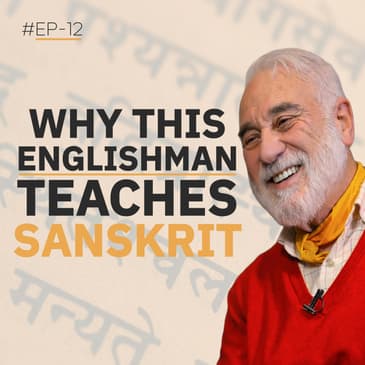
This is the story of David Stollar.
David lives in London and it has always been his home. He dropped out of A levels, and yet defied the odds to become a teacher… and then something even rarer: the Englishman who helped shape how Sanskrit is taught in the UK, writing course books, and contributing to the GCSE syllabus. David has never set foot in India. And still, Sanskrit became his unexpected connection to something ancient, beautiful, and profoundly human. There was a time when David fell into deep depression and sometimes felt suicidal. What helped him hold on and slowly rebuild was study, discipline, and the guiding light of his life: the Bhagavad Gita.
David's captivating journey unfolds in India: A Story in the Making. It’s a story that reminds us geographies don’t define destinies. Meaning can be found. Purpose can return. And even in the most modern world, an ancient language can still change a life. If you’re looking for quiet inspiration, this episode is for you.
To learn Sanskrit from David Stollar please email email address: davidstollar@btinternet.com
SMART LINK OF THE PODCAST:
https://bingepods.com/podcast/podcast...
Full Video of the episode please follow: https://youtube.com/@loveenatandon146...
Other social media handles:
Twitter / X www.twitter.com/loveenatandon
LinkedIn 5ZDc2ODk2ZA== / loveenatandon
Instagram https://instagram.com/loveenatandonof...
Tik Tok https://www.tiktok.com/@loveenatandon...
India: Kindly Subscribe to help me bring more such stories :)
Learn more about your ad choices. Visit megaphone.fm/adchoices
[00:00:00] This was a person who dropped out of A levels and lit in a time where he got into deep depression
[00:00:07] and at some times felt suicidal as well.
[00:00:11] So where are you in your studies now?
[00:00:14] Well I particularly revere the Bhagavad Gita I've already mentioned at once.
[00:00:21] There were once Sanskrit Shlok that really what I want to discuss with him today. David Stoller. Yes, an Englishman who's interested in Sanskrit. Why? That's what I want to know and much more from him as you will
[00:01:42] discover when we speak together and I am to get them in the morning and clean each one of them. And you have gone a level ahead and made it colour coordinated. Why? Well, I am an artist by temperament or character and I just don't like being surrounded by
[00:03:00] mess and the average bookshelf is a mess. What a fascinating story, David, for someone who drops out of A level. Yes, I would, if you had told me when I was a boy that I'd become a teacher, I wouldn't have believed you. It would have been an incredible idea. Tell me your story and why the depression, what was happening in the times you said you were in
[00:04:21] the 60s? Yes. And it just didn't make any sense to me. And I got more and more depressed. Luckily I had a friend who recommended me to a philosophy course, an evening class, and he said, come
[00:05:40] along to the beginning of term lecture with me, each week it gets better and better. So how does this connect to you learning Sanskrit and then teaching it?
[00:07:02] Right. Well, this school of philosophy, which was following the Shankara Charia of the North, which is a very high position in the in the Hindu in Hindu society a little like the Pope anyway we went along and we met this man and we
[00:08:22] compared notes with him and we found that he's
[00:08:27] he was a very wise man and we started taking I soon began to gain positions in the Sunscript faculty that we set up, and eventually came to teach in the day schools that we set up for our children, and I volunteered to write a Sunscript course for the children,
[00:09:41] which was ideal for me because adults that had met for many, many years and
[00:11:00] was looking, as they would have phrased it, they were looking for the truth.
[00:11:04] The truth, okay. And that's why...
[00:11:05] At first, they were looking for the truth about economics and it was called the School Sanskrit is the original language and that may well be true but science tends to think that it's a language which is there is a word I've got what school at that stage was that most people are, as it were, asleep. They're not aware of their own faculties, and most of the time they're not even aware
[00:13:40] that they're alive because they're locked in thoughts in our head and the stability that or the calm you felt when you entered to say you can get rid of this clutter is what hooked you am I right yes I'm not sure you can get rid of it it at that time. And we wanted... We weren't satisfied with the state education because it was too limited. We wanted a better education for our children,
[00:16:20] so we decided, quite an adventurous thing to do,
[00:16:25] to set up our own school, The school was already up and running. They had interest in running ancient languages and you said you ran Sanskrit. Yes. How would you get the children who were so young and parents who were not connected to India or Sanskrit in any way to get them interested into?
[00:17:43] Oh well it's 700 verses, and we go through every verse in Sanskrit.
[00:19:00] Now first of all I have to the Bhawan in North Kensington and I got friendly with Nanda. I think he's still there, but maybe... Nanda Kumarji runs the Bhawan culture hub and he's doing a brilliant job of it. That's right. In London, in High Street, near High Street, Kensington or West Kensington?
[00:20:21] Yes, West Kensington most notable points in my education in Sanskrit was doing, the particular grammar book we were studying from the 15th century, I think it clarity, it means grace. It's a beautiful word. Is that the word that the full meaning. It loses the power. It's the language that's why people join together in groups to support each other. And that's quite important.
[00:27:00] It's very difficult to do it on your own.
[00:27:03] But if you do it together and if you've got somebody who's more experienced, who can teach great point for, it's a great hard work for parents to maneuver technology to work for them. Actually at the moment sometimes I feel we are working for the technology. Yeah had to deal with it face on. I have families that I know very well, often they're homeschooling, and they don't allow their children to have say no. I think you have to you have I mean parents have always known you you can't always be in Sanskrit if they've got what's her name Taylor Swift you know if they've got a choice and it's up to them
[00:32:22] and they're sitting in the train on the way home what are they going to look at What has these many years of learning Sanskrit done to your life? Well, it's given me a firm background that I can rely on, and which can lift my sights, so that I'm aware, when I want is the way of things. Of course, which is the way of things. What do you feel religion-wise? Religion-wise, I am a very strange person because I am very religious, but I don't go to any church or synagogue or temple.
[00:35:02] I once got baptized into Christianity anything I try to live in a way
[00:36:25] that's worthy it. Okay. What is it in Gita that most appeals to you and has worked for you practically in your life? Well, I'll give you an example. In the 16th chapter of the Gita, there are a list. It starts off with generosity? How am I doing with restraint? With lack of ego? This lovely list of divine treasures are a guide to life. And there are many other parts of the Gita which I find equally valuable. It's very practical.
[00:39:02] How do you do this checklist in daily life? the results of action. That is a very important teaching in the Gita. It calls them the fruits of action. So you're not looking towards what you can get out of everything, you're looking towards what you can put into it and how well you can perform the action and how you can
[00:40:20] help other people with it. But still, whether it's success greatest advancements, so that I might have wanted a young lady to marry me and she might have refused. But then the next one around became my lifelong wife that I've never regretted. elements that I'd rather be without. But I have a purpose in life. I know where I'm going, I know what I'm fighting for and I may fight badly one day and well in another day, but it has meaning for me. And that's where I started without
[00:43:04] any meaning.
[00:43:07] Would you want to share that with us. So people who want to learn from you, how can they? How do they reach you David? Well I'm always ready which I ask you five questions, quick ones. Oh, right. And then you can give answers if you want to, if you can. And then you do a high five in the end.
[00:45:42] Well, that's nice, right.
[00:45:43] That is the only reward, so get ready.
[00:45:45] So is that a left hand, or you're using your left hand? And why, you worry? Because of this way that the modern world has encroached on every traditional value. I think it's very frightening. I don't think people realise how dangerous that is. If Sanskrit were a superhero, what would be its special power?
[00:48:06] No, you're quite right in what you just said secondly that no translation does justice to it
[00:48:09] Although even the translations are full of wisdom
[00:48:16] But no it learning it in the Sun script and it's no end to I'm still teaching it
[00:48:19] Every week Guitar and I discover new things every week and how one verse connects with another this sort of thing
[00:49:26] Okay. If Sanskrit was lost to the world, what will the world lose? Well, it would lose this connection. There are other great books. In the Chinese, there's the Tao Te Ching.
[00:49:35] In the Greek and European, there's the New Testament, high five. Oh right. That was a, no. Yes, that's it. We did it. Brilliant. David, do you want to leave us. Actually it is us and beyond and if one was to connect it with this truth, I think people