
Hopes and deals aside, the US–Iran crisis continues and so does the global reshuffling of alliances.
In a fragmented world, where rivals compete but still depend on each other, countries are having to rethink where they stand.
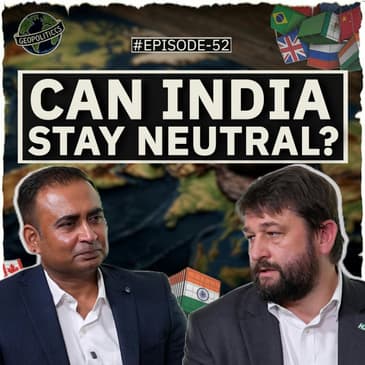
India has chosen its own path from non-alignment to multi-alignment. But can it continue to balance competing powers while protecting its own interests?
On India: A Story in the Making, we explore the new world order with two perspectives:
Dr John Hemmings, looking from the outside in, as a geopolitical and security expert.
And Azad Singh Rathore author and politician from Rajasthan, bringing a view from within India.
Can India stay neutral in a world asking everyone to choose?
EPISODE 52 – CAN INDIA STAY NEUTRAL? NOW LIVE ON:
📺 YouTube: https://www.youtube.com/@loveenatandonproductions
🎙️ Podcast – Smart Link: https://bingepods.com/podcast/podcast-rn7moe
💬 Join Our Discord Community: https://discord.gg/p2UYt9uV5d
We thank Bridge India for facilitating this conversation in their Ideas for India event in London
Learn more about your ad choices. Visit megaphone.fm/adchoices
[00:00:00] I wouldn't want to see a Chinese century, but I wouldn't mind seeing an Indian century. 25,000 Chinese troops on the left. They are building infrastructure, consolidate that power. What would Gandhi do today? The list of friends and foes are changing very rapidly. The United States has gone to war with two Chinese allies in the last three months. China only has two Kriya allies, North Korea and Pakistan. We kept ours as non-alignment. You may not be interested in alignment, but alignment is interested in you. We are not Vishwur, we are Vishwamitra for everyone. The world doesn't really understand in alignment.
[00:00:30] Can India remain neutral in this fragmented world? This is India A Story in the Making and I'm your host, Loveena Tandon. The world powers are playing a double game. While America has an angst with China, yet it depends on it for manufacturing in all its factories. Russia has sanctions from the West, but it's doing business all across with other countries.
[00:01:00] Can India remain neutral in this fragmented world? And to unravel this, I have two very wonderful guests with me. One from India, straight from Rajasthan, an author and a politician, Azad Singhji. Dr. John Tellings. So thank you both of you for being on India's Story in the Making. Thank you for having me. And we are at the IDEAS 2026 Bridge India Conference.
[00:01:29] That's why you see the big battle behind me. And this is a bridging conversation. The world is not making bridges. Imagine you are bird's eye view of the world. What movements, what patterns are you seeing? The world always has been multipolar. Keeping ourselves in this multipolar world has always been a challenge. But non-alignment is our basic of our foreign policy.
[00:01:52] First, our successful doctrine introduced by Mr. Nehru, we kept ourselves non-aligned in whatever the situations are. And we should keep ourselves non-aligned. I deeply respect Mr. Nehru's guiding philosophy. But you have to be careful that, you know, you may not be interested in alignment, but alignment is interested in you. What do I mean by that? I mean that you can have a policy of non-alignment.
[00:02:21] But if a state continues to threaten the media, you have to make sure that non-alignment doesn't mean that you become a pushover. And that you don't ignore your own national interests. One of the ways that states deal with pressure from another state is by aligning with other states. So even though I agree with the broader principles of Mr. Nehru's philosophy, which I think is very spiritually sound, there's 25,000 Chinese troops on the lake. They are building infrastructure to consolidate that power.
[00:02:51] They're continually pushing in the Indian Ocean to have access, to ensure that they have continual access to Middle East oil and gas. But they'll have to do what they're already doing, which is building relationships that keep the Chinese guessing. Non-alignment doesn't mean you are a lonely penguin. We do have a multipolar system in the sense that there are a greater number of poles. What do we mean by poles?
[00:03:16] We mean great powers that have a key amount of power in their region at the top system. During the Cold War, it was just the Soviet Union really and the United States that had the accumulation of what we would argue to be the world share of manufacturing, economic, nuclear, and military power condensed at the top. But now that's sort of distributed. And in that system, what we've seen is a liberal trade system breaking down.
[00:03:46] A China that is growing out its manufacturing base. It now makes 52% of all ships in the world, commercial vessels, LNG vessels. It is growing as a fourth industrial revolution power. So we may have an AI stack from Silicon Valley. We're seeing Chinese supply chains really penetrate the world on all those technologies. So all of that's happening as the liberal systems plodes over the issues of culture and identity.
[00:04:16] We've seen the rise of populists. Donald Trump in the United Kingdom. We have Nigel Farage of Reform UK. The migrant issue has risen in the West as an issue. It's a fascinating time. The West has sort of destabilized. Have we allowed, or the West or the US, allowed China to take over the manufacturing of the world because they just didn't want to do the dirty work? Do you think that? No.
[00:04:42] What I think, and this is a dangerous question because I'm finishing research on this, there was to some extent a grand bargain in which that we would rise up the value chain and that they would do some of the dirty work. But what we didn't anticipate was that this would also be done strategically and that the Chinese would focus on strategic sectors. Yes. That they would then dominate the forever supply chain and they'd also take over design. So the grand bargain is already breaking down. We were a little patronizing.
[00:05:11] We said, you know, you build, we'll design. Yeah. But actually they're going to design as well. Of course. And they've used state strategies and huge subsidies and state direction in key areas. So they installed 300,000 robotic industrial robots in 2024, more than the entire rest of the world combined. And they also began to outperform Germany in terms of exports of machine tools. Yeah.
[00:05:35] So the world is actually competing and cooperating at the same time and we cannot escape that reality today. You've been to Quads. What have you learned and heard from Quads? The various foreign ministers met, you know, Jaishankar, Rubio, Penny Wong, including Japan. And so you have the Quad Four country group has actually made three really big decisions that are quite important.
[00:06:01] And I think even though India remains non-aligned, it sort of hits exactly the lines that we were discussing that India is making strategic choices. Number one, they've created a maritime surveillance mechanism for the four in the Indian Ocean, which basically means that the United States and Japan will probably provide India with satellite data intelligence.
[00:06:24] Very, very, very sensitive intelligence to track vessels in the Indian Ocean that are of Chinese origin, probably. Secondly, they've created a major fund for critical minerals. China controls 90% of all critical mineral processing. Critical minerals are everything that goes into our phones. It goes into airplanes. It goes into these cameras. Which is why we have lovely Venezuela and lovely Iran in trouble. Yeah. And you mentioned how the dirty industry was given to China.
[00:06:53] China, they don't have any environmental regulations. And so they could process. So that's why the processing of lithium happens there. But we depend on batteries from there as well. Yes. The third one is that they are building infrastructure in a different country. They're building in Fiji, a port. And so India is showing the South dialogue. Hey, we can get money from the Americans, the Japanese and Australians, and we can bring it to you to build alternative infrastructure to what the Chinese are offering.
[00:07:22] Normally everyone gets one deal. You want Guadur? Come to China. You want Hanban Hatota? Come to China. And so giving the world, the developing, the South, alternative providers without the heavy loan conditions, I think that could be a very important role for India. In the context of India, Quad is important to us. But not only Quad, but SARC is as much as important to us. BRICS is as important to us.
[00:07:50] We have our own guiding principles. We have our own stance. We have our own challenges. We can't change our neighbors. SARC, BRICS and Quad. India is common among all these three groups. We should remain like this and we should look forward towards our challenges first. We should make the policies which are in our interest. We have to think it in a larger perspective, in a broader context.
[00:08:20] Yes, at a man's pull up. You got me to break, said we have India and China sitting together there. But more interestingly recently, they want to have their own currency. I don't know if it can happen. The Chinese have been trying to get the RMB internationalized in the Belt and Road initiative. The problem with currency is the Americans right now are going through an experience where Donald Trump is trying to control the Federal Reserve Chairman.
[00:08:50] He wants him to be politically controlled. The reason the US dollar has been so powerful in many ways is that the US has been careful not to control it too much. So can you get a controlled major currency? Who controls it? We saw the Euro was a very dangerous thing during the Greek financial crisis. Essentially, the Germans had to bail out the Greeks. So common currencies are a whole other different thing.
[00:09:19] Russia and China would love to replace the dollar in bricks. Go for it. Try your best. I really don't see it happening. If anything, we've seen the Shanghai index falling. It's the one area where the West state remains predominant. Everything else, they're doing very well. I agree. 100% manufacturing, semiconductors. Financial. China has lost financial power. No one's buying the RMB.
[00:09:42] Yes, some South countries have to borrow in order to get infrastructure from China, but that's very different from willingly buying bonds from China. In terms of a common currency, really? No. Do you have South Africa? A very, very challenging economic profile country. India is looking great. Russia, not so good. So you've got China and India looking like the stars. And then you have two guys are actually dragging it down. So it won't work because it doesn't allow that stability.
[00:10:10] For a common currency, we all have SWIFT, Visa, credit card systems. Yeah, they tried to do this 10 years ago. Do you use any Russian or Chinese credit systems? No. You still use Visa. You still use American Express. Why? Because they're controlled by the Belgians. The Belgians control SWIFT. Yes.
[00:10:28] So in a sense, I think the Americans have managed to share out and distribute the power of the dollar between London and New York in a way that the Shanghai financial crowd have not been able to share out. Unestable China is not in favour of India. And obviously, a very strong China is obviously not in our favour. We are sharing the same geographical location.
[00:10:55] If the conflict intensifies tomorrow, because we are all cooperating and competing with each other, where, who is standing in this world? Unless we are already, are we in Cold War? Are we having Cold War? I think so. The United States and China are in a Cold War, but they've decided for different reasons not to call it that. So how would you define a Cold War?
[00:11:20] Cold War is when you cannot have a hot war, but you're competing at multiple levels, cultural, ideology, sports, and even some proxy conflict. The United States has gone to war with two Chinese allies in the last three months and sort of deconstructed an alternative energy system that the Chinese were building through their two allies.
[00:11:44] Both Maduro with Venezuela and now Iran, both were supplying heavy amounts of fuel and LNG and crude oil to China for the strategic reserves. So I think the US and China have the big battle in their minds, whether or not India and Europe will take sides. I think you're absolutely right. They don't need to take sides at the moment.
[00:12:08] But you did mention in the beginning that you might be non-aligned with, people might be wanting to align with you. And I think there's a point, and you may disagree with us, but there's 25,000 troops on your border. They're not Americans. So who's putting more pressure on you? Yes, you have to deal with that. No, you don't have to get involved in the US-China dilemma, but you can harness the Americans to play off the chains. This is applicable for all countries. The list of friends and foes are changing very rapidly.
[00:12:40] So the world, as I mentioned, world always has been multipolar, but... That's what my question is, who's standing with whom? China's allies with Pakistan, let's not forget. Who's Pakistan for India? You forget, like, their defense industry is very close. They are treaty allies. China only has two treaty allies, North Korea and Pakistan. We need to watch it very carefully. We have to take our steps very carefully.
[00:13:08] And we should not come to a conclusion very early. But we should not miss the train as well. Yes. I agree with that. I actually think we're very agreeable. We're agreeing. Yeah, we agree. That's wonderful. Give me a short reply. Can India remain neutral in this fragmented world? So on December 7th, 1941, when Japan attacked the United States at Pearl Harbor, the United States was not aligned. Yeah.
[00:13:37] You shouldn't make the principle serve the principle. The principle needs to serve the nation at any given time. When the United States was attacked, it was isolated. They had no allies. Of course, the British have been trying to woo us. Churchill been trying to woo us. And so we did some defense industrial building for them. But, you know, Roosevelt had been very non-aligned. So I think you just, yes, I respect Nauru's decision. I respect India still has that freedom to choose. Brilliant.
[00:14:05] But you should always be adaptable to the global situation. And if you are attacked, then I'm sure India will make a decision then. Do you think what India is doing now geopolitically serves itself? I think for the moment, yeah. As I say, we agree with each other in many ways. I think you must live with your neighbor as well. I think I'm watching the trend lines and I see a China that views India as a potential challenge to its own interests. You don't view China that way, but they view you that way.
[00:14:35] Why do I say so? Because they provoke challenges on the border to reek in your contact with northern states. They also are very close to Pakistan and built into their port infrastructure as a maritime base. And that they're trying to gain greater access and control of the Indian Ocean so they can make sure that their oil supply is uninterrupted. You're in the way. It's not personal. The Americans are far, far away from all of that. So even though we're not your neighbors, we also don't challenge any of your real interests.
[00:15:04] So in that sense, I view it purely through the lens of Mackinder, the geopolitics British thinker who is from the London School of Economics. Speculatively, if there was an absolute crisis from Cold War to Hard War, where do you think the world is landing? Where would India be standing? It depends on the conflict. The ISIS is unlikely to attack India in any way. Is China likely to attack India in any way or challenge you militarily? Well, they already have done so repeatedly over the last 15 years.
[00:15:34] It was very difficult for almost each and every country. We witnessed the Cold War and we witnessed the collapse of the USSR. When the whole world was facing that economic crisis, India was standing not only in a pink of its economy, but we saw the vast economic reforms in particular that period. So India is doing well now as well?
[00:16:03] India has to follow our basic principles and basic fundamentals. Then we can go to the desired or desired place. Okay, perfect. He stays non-aligned. That's very good. In the end. Okay, high five India. You could be sitting in the position of Trump today. Who is the first phone call you'll make to? Elon Musk.
[00:16:33] Yeah. I'm saying what? I need more money for the next campaign. Can he stand again? No, but it could be JD Vance's campaign. Oh, okay. I will call Nathan. Nathan. Matt done for the day. Let's take some rest. We'll speak later. Okay, perfect. If you could listen to a phone call between two world leaders, who would you want to listen to? Margaret Thatcher and Indira Gandhi.
[00:17:02] Oh, okay. Interesting. Interesting. That's quite a good one. I once saw Indira Gandhi in Tunisia. She drove by on a roundabout and we had Indian flags and we waved them at her, even though we're in a different country. I think I would like to see Modi and Trump. I think they get on very well. And I agree you shouldn't decide a foreign policy because they're very different men in many ways, very different backgrounds. And yet they have incredibly similar views about the nation and the vision of their nation. Have you been to India? I lived in India.
[00:17:32] Oh, how long? Four years? Delhi, two years in Kapha, one as a child. And then I think I've visited two or three times since then. Oh, fantastic. I must ask your favorite Indian food. Korma, of course. The Indian korma, right? Of course. But a chicken. Naan. India for you in one word. Great. Yeah, I agree with that. Great. Yeah, in what way? Why? You didn't ask him why. I cannot tell you. On fair rules.
[00:18:04] Power. Great culture. I'm allowed on fair rules. Yeah, it's, it's, I like it because you are, I think you're a good person. I think India is becoming a great power. And I do think it's going to change the alignment rules a little bit, but we can see. It's a historical question that we don't have the answer to. Great power, great culture. Now you can't knock an American tech company without finding an Indian CEO.
[00:18:30] You know, India is incredibly intellectual and it is helping build the future. And I'd like to see India. I wouldn't want to see a Chinese century, but I wouldn't mind seeing an Indian century. Okay. You can answer if you want. Why great? Why India is great? Like India has everything. We are the best geographically located country. We have the great Indian Ocean, great Himalayas, desert of Thar, then Ganges Basin,
[00:18:56] then so much other formations which are, you can't see in other part of the world. Then we are culturally rich. Then we have our own history. Then we gave yoga to the world. We gave mathematics to the world. We are the soft mama. So that's why I'm speaking not only as a citizen, but as a citizen of a global world. Impartial world. I'm completely inspired. He's trying his best. It just so happens.
[00:19:25] He's really trying his best. He's really trying his best. Just from a scientific perspective, it is the best country in the world. What is it about India that the world doesn't get? I hate to say this, but I think non-alignment. Shoot. I hate to say it, but it's true. Like the world doesn't really understand non-alignment because the world isn't non-aligned.
[00:19:47] Understanding the strategic posture of countries has always been about alliances or enemies or bandwagoning or hedging. As I told you that being, being, being, being, like having a non-alignment policy. Don't defend that non-alignment. We can agree to disagree. Okay. Just tell me what the world doesn't understand about India. Sorry. I touched a match to India. God, again.
[00:20:12] Like few of the organizations or the agencies want to portray India as a Vishwamitra, but we are not Vishwamitra. We are Vishwamitra for everyone. And India is the only country who can be Vishwamitra to each and every country in the world. So this is something very unique for India. I think we're sort of aligned. No, you're not. Can we be aligned? You're not. You're trying your very best. It's not happening, John. No, I only said it from a different perspective. I think you're misreading me. No. I'll tell you why.
[00:20:40] I was saying that the world doesn't understand it, but he's not disagreeing. He's saying that the world doesn't understand great power versus friends with all. And I think we're sort of agreeing. Yes, we are sort of very mend. Non-aligned countries. Vietnam has the same issue. Vietnam is multi-aligned, they call it. Multi-directional. And so one of the hardest things, you remember when you were at school, you had your friend group. Yeah. You had the enemies. But that's how humans are. And sometimes you have the people that dance between all of them. We all had them. In fact, I was one of them.
[00:21:09] I was friends with everyone. And so understanding those people, it always takes time to demonstrate your posture to people. So I think India should grow its foreign policy machine to explain non-alignment and explain its strategic views to the world. It's harder to understand because human nature is often reduced to binary black and white. Yeah. And you were saying, we like grey. In fact, we don't call it grey. We call it silver. Fine. You like silver. All right. You smashed my next question.
[00:21:39] If I was to say India's foreign policy in one word, you've already said silver. Silver. Silver lining. Great. Silver lining as well. I like it. That's a good one to end on. But I have to ask the last question because you took my last one away. How many last questions does she have? No, this is the first one. Do you know that? I have to have the five number. If you could meet a leader from the world, who would it be and what would you ask? Anyone from history? Yes, sir Arafat.
[00:22:09] And ask? That how you manage yourself between so many other countries and kept your interests, keep yourself moving between these all countries who are against you. How you did that? And he was quite successful in a certain time. Yes, sir Arafat's diplomacy.
[00:22:36] Quite interesting times actually, because India recognized Palestine. Yes, go. Actually, my stepfather was a liaison with the PLO. Oh. So he knew him personally. Oh, wow. I hate to say it because it's probably because I'm surrounded by discussions of India, but I do love Gandhi. There is an American story with non-violence and political change, which I deeply respect. What are you asking him?
[00:23:04] How do we manage great power, geopolitics with non-violence? You know, how do we, is it human nature to continually struggle with each other with violence? What would Gandhi do today? He'd say, when is lunch? No. He'd say, let's go for Amaran Anshat. Yeah, yeah. No lunch. Well, that's true. Anyway, go on then. Thank you. Okay. Thank you very much. This was an absolutely amazing discussion.
[00:23:31] Of course, discussions can be debates and as long as they remain friendly, that's fantastic. How did you like this? Do write to us on India A Story in the Making. Thank you. Take care and God bless. Thank you. This video is created for educational, informational, and entertainment purposes only. The views and opinions expressed in this video are personal and may include commentary on geopolitics and global affairs. We are shared for general awareness, discussion, and understanding and are not intended to offend, harm, or misrepresent any individual, community, organization, country, or religion.
[00:24:00] The information presented in this video is based on publicly available sources as well as material provided by our guests. All visuals and content used in this video have been included with the consent of our guests, while efforts are made to ensure accuracy. Viewers are encouraged to do their own research and form their own opinions before drawing any conclusions.