
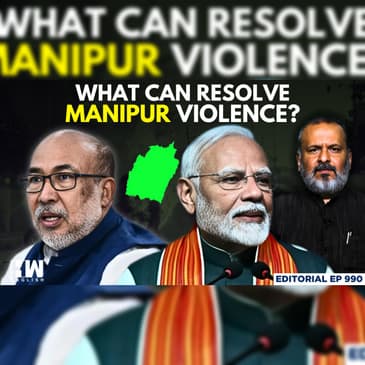
In this episode of The Editorial, Mr. Sujit Nair discusses the ongoing unrest in the northeastern state of Manipur. He delves into the geography, demographics, and history of the region, providing crucial context. The episode also includes a brief discussion on the origins of the unrest in Manipur. Additionally, Mr. Nair references PM Modi’s 2017 speech in Imphal. Through this episode, Mr. Nair explores potential steps to resolve the Manipur issue.
Learn more about your ad choices. Visit megaphone.fm/adchoices
[00:00:01] Namaskar! Welcome to another episode of Editorial. Manipur Violence Continues. Until such time that Manipur Violence continues, I am going to talk about Manipur. Let's get right into the show and first let's try and understand Manipur and then possibly we'll understand the cause of violence better. Let's get right into the show.
[00:00:28] First, let's talk about the geography of Manipur. Then let's talk about the population of Manipur. Then let's talk about the history and the problems of Manipur. And then let us spend five minutes trying to talk about a possible solution to the Manipur problem.
[00:00:56] This is my tutorial today and let's start with the geography of Manipur. Manipur, 90% of Manipur are hills, 90% and 10% is the valley. The valley we all know Imphal which is the capital of Manipur where most of the development infrastructure everything happens and hills are yet underdeveloped yet the infrastructure has not reached the hills.
[00:01:26] This is how Manipur is geographically. Now let's come to the population. More than 50% population of Manipur are the Maithis. The balance 50 are various other tribes. Various other tribes.
[00:01:44] Now let's talk about Maithis.
[00:01:48] Maithis. Maithis is basically Maithis is not a religion. Maithis are not Hindus. That's a wrong notion. While predominantly most of the Maithis are Hindus but Maithis are not Hindus. Maithis 83% are Hindus. 8.4% are Muslims. 1% are Christians. Now this is how broadly Maithis are divided.
[00:02:14] When it comes to Maithis. When it comes to Maithis. When it comes to Maithis are the Nagas, the Kukizo community so on and so forth. That's the others. That is the other 50%.
[00:02:25] Now most of Maithis. Most of Maithis stay in the valley. So almost 50% of the population, 50% plus of the population stays in 10% of Manipur's land.
[00:02:44] And the balance 50% occupies the rest. Now let me just give you some figures. You see the Imphal valley is around 1864.44 square kilometers. That is the Imphal valley. Maithis stays there.
[00:03:04] The rest 50% stays in 10 districts across Manipur and all hills. Like I told you again, I repeat myself. Imphal is the most developed place of Manipur. The rest, the development has not yet reached them. This is the status.
[00:03:23] Now Maithis have been constantly fighting for the status of scheduled tribe. Now why do they need the status of scheduled tribe?
[00:03:35] The fact is, while Kukizo communities and other tribes can come down to Imphal, Maithis cannot go and buy residences or set up their homes in the hill areas because that is reserved for scheduled tribe.
[00:03:54] So Maithis have been fighting for the status of scheduled tribe because they say that, listen, we are 50% but we only occupy 10% of the land mass.
[00:04:06] So we need to be present in the other 90%. We also should have the freedom to go and settle into the other 90% of the hills.
[00:04:18] Now, the tribes, the scheduled tribes, they say no, this is our land. First of all, we don't have the infrastructure. Secondly, whatever little infrastructure, we are growing, we are planting, we are doing our agriculture and we are trying to survive.
[00:04:36] If that also is captured by people from the city, then what is left for us?
[00:04:42] Then we will have nothing. How do we feed our families? This is the zoo cookies and other tribes, their problem. This is the status.
[00:04:53] Now in middle of all this, there has been a lot of cases of poppy cultivation, drug cultivation in the hillsides.
[00:05:05] So the government has been coming down very heavily on the drug mafia. At least that is what the government has professed.
[00:05:14] That is what the government says, that they have been coming down very heavily on the drug mafias.
[00:05:19] And those are the hill population because drugs are grown, poppy plants are grown in the hills.
[00:05:26] So that too.
[00:05:27] Now let's talk briefly about the history of Manipur.
[00:05:32] Now Manipur is situated in a very strategic position.
[00:05:38] Manipur is sandwiched between Bangladesh, China and Myanmar.
[00:05:44] It is sandwiched and the fact that a lot of tribal groups in Manipur has been quite upset with New Delhi.
[00:05:55] In 1970, there was an armed rebellion against India's rule.
[00:06:01] They believed, as in the rebels in Manipur believed that India, that is New Delhi, was not giving enough attention to Manipur.
[00:06:10] This was the reason.
[00:06:12] So there was an armed struggle against India which continued off and on.
[00:06:16] In fact, till 2010 from 1970, they almost lost about 10,000 people in this struggle, in this armed struggle.
[00:06:29] 2015 actually saw the last of the armed violence between the rebel and our forces where again 20 soldiers were killed.
[00:06:40] After 2015, incidentally, things were calm.
[00:06:46] Things were calm.
[00:06:48] Now, the current upsurge, whatever is happening, has bought about the old demand from the Zoukukis to have a separate Zoukuki administration in India.
[00:07:03] Which, of course, the Methis do not agree.
[00:07:05] Now, let us understand how the current problem started.
[00:07:08] Let us understand the current problem.
[00:07:11] The Methis, like I told you, always wanted, always had this demand of having the scheduled tribe status.
[00:07:22] Scheduled tribe status would help the Methis go anywhere in Manipur and settle.
[00:07:28] Which means, they could also go to the hills and settle if they wanted to.
[00:07:33] Now, this scheduled tribe status was not given to the Methis.
[00:07:39] Finally, it reached the high court, the Manipur high court and on March 27, 2023, there was a judgment delivered by the Manipur high court.
[00:07:51] Which said that the state government shall consider the case of the petitioner, which is the Methi community, for inclusion of Methi community in the scheduled tribe list expeditiously, preferably within a period of four weeks.
[00:08:06] Ah!
[00:08:07] Now, this created the problem.
[00:08:10] The Methis wanted to be scheduled tribe, but the Zoukukis, they said, no.
[00:08:16] No, this land, like I told you, they said, is ours.
[00:08:20] We have no infrastructure like what they have in Imphal.
[00:08:24] We have very limited infrastructure.
[00:08:26] We grow our, we do our agriculture here.
[00:08:29] And if it is infested by people from Imphal, from the town, then where do we go?
[00:08:35] How do we live?
[00:08:36] So, this was the conflict.
[00:08:37] So, the scheduled tribe status would give Methis a chance to go to the hills, which the Zoukukis didn't want.
[00:08:45] This was the start of the problem.
[00:08:48] This was the start of the problem.
[00:08:50] Now, mind you, this particular, this particular status, this particular judgment was actually criticized by a lot of people who understood law and was also not seen so favorably by the then Chief Justice, Justice D.Y. Chandra Chud.
[00:09:12] In fact, D.Y. Chandra Chud said that I will tell you, he was talking to the lawyers, I will tell you one thing that the High Court order was incorrect.
[00:09:21] He is talking about the order that I referred to.
[00:09:24] He said the High Court order was incorrect.
[00:09:26] I think we have to stay the order of the High Court.
[00:09:30] The High Court order is absolutely wrong.
[00:09:34] This is what the Supreme Court had to say.
[00:09:37] And incidentally, in 2024, the High Court order was stayed.
[00:09:42] In fact, not only stayed, it was reversed.
[00:09:44] That is, the status currently.
[00:09:47] But the violence continued.
[00:09:49] And the violence continues.
[00:09:53] Now, the violence has taken a different tone.
[00:09:57] It has taken a tone of, to some section of the people, media and the world,
[00:10:06] it has taken a tone of communal violence, which is basically Christian cookie zoo versus Hindu methis.
[00:10:12] It has taken that shape.
[00:10:14] Some people say that, no, it is not a communal violence.
[00:10:17] It is not at all about communal violence.
[00:10:19] It is about methis versus zoo because zoo cookies do not want methis to be coming and taking over their hills.
[00:10:27] And methis wants to kind of expand because their population is growing.
[00:10:31] They need more land.
[00:10:32] So, this is where it stands.
[00:10:34] Now, the problem is, a lot of cookie zoo community, people feel that the state government is helping the methis.
[00:10:46] Why?
[00:10:46] Because they believe that Bharatiya Janatyaparti government is helping the methis because methis are predominantly Hindu community.
[00:10:54] This is what a lot of zoo cookie community feels.
[00:10:57] A lot of zoo cookie community, therefore, feels that administration, security forces, etc. are helping the methis.
[00:11:07] This, they are not very comfortable with.
[00:11:10] The methis, on the other hand, says that, no, we are not perpetrating violence.
[00:11:15] Violence is being perpetrated on us.
[00:11:17] We are trying to kind of ensure that we build peaceful atmosphere.
[00:11:23] This is what a lot of maithis say.
[00:11:25] So, then where is the violence coming from?
[00:11:29] The fact remains that there are evidences of absolutely lack of action taken by the police in Manipur riots.
[00:11:40] Women were abducted.
[00:11:42] Women were raped.
[00:11:43] Women were killed.
[00:11:45] We have given to understand that in some of the cases, even a fire was not registered.
[00:11:52] This is the status.
[00:11:54] Regardless of whatever community these women come from, zoo or kook maithis, I don't want to get into it because a lot of y'all write to me as to why don't I talk about the community.
[00:12:03] My objective is not to talk about communities.
[00:12:06] My objective is to talk about that woman who was raped.
[00:12:09] And for me, my blood boils because that woman was raped.
[00:12:13] A woman was killed.
[00:12:14] A child was killed.
[00:12:15] An innocent was killed.
[00:12:17] Regardless of whatever community that person, he, she or the child comes from.
[00:12:22] Doesn't really matter.
[00:12:25] Now, the point is, without taking sides, let me tell you that there were instances, glaring instances, where a lot of us thought that the administration was not taking enough steps.
[00:12:37] The administration was not taking corrective steps because FIRs were not registered.
[00:12:41] People were abducted.
[00:12:43] People were missing.
[00:12:43] FIRs were not registered.
[00:12:47] The court intervened and the court said that they will set up a panel to investigate, so on and so forth.
[00:12:53] But that too, I don't know what happened to it and what happened after, as always, you know, our good Mr. Chandrachood, who used to go out and give fantastic statements.
[00:13:04] And after that, nothing really actually happened.
[00:13:06] At least to my mind, I saw nothing happening.
[00:13:12] This was the status of the administration.
[00:13:17] Now, what is needed to be done?
[00:13:21] Manipur needs to be healed.
[00:13:25] You need to take steps to ensure that the Zoh Kuki community, the Maithis and the other tribes are bought together.
[00:13:34] There is an amount of harmony that is created in Manipur.
[00:13:41] You need harmony.
[00:13:43] You need love to be spread in Manipur.
[00:13:45] What is currently being spread is hate.
[00:13:49] And till such time that the administration, which is seen as incompetent and as an administration that is not actually taking steps, if that is how the people see it, even if the government believes, even if the government believes that they have the best administration in Manipur, I think the government, so that people are satisfied, people feel more safe.
[00:14:11] They should be sacking the chief minister and getting somebody else who is seen as somebody who can bring back normalcy to Manipur.
[00:14:21] This is, is it too much to ask for?
[00:14:23] You see, it's not just me.
[00:14:29] Even RSS, RSS had condemned fresh violence.
[00:14:35] Even RSS had condemned fresh violence.
[00:14:37] In fact, RSS made a statement saying that it is unfortunate that 19 months old violence in Manipur is starting from 3rd May 2023 has remained unresolved.
[00:14:46] Due to ongoing violence, innocent people have immensely suffered.
[00:14:49] Rastra Swayamsevak Sang Manipur strongly condemns inhuman, brutal and merciless act of killing of women children after taking them in captivity.
[00:14:57] The act is cowardly and it is against the principle of humanity and coexistence.
[00:15:01] This is what RSS is also saying.
[00:15:03] That how can you not contain violence?
[00:15:07] RSS is also saying the same thing.
[00:15:09] Technically, they are also asking the government that, bhai, it is more than 19 months.
[00:15:14] Why are you not able to contain the violence?
[00:15:17] Why can't you contain the violence?
[00:15:19] RSS is asking the same thing.
[00:15:20] Now, not only has Bharatiya Janata Party MLAs showed concern on the Berenceng management,
[00:15:27] even their allies, that is NPP chief Condit Sangma, this is what Condit Sangma had to say,
[00:15:34] they are their allies, they are allies of Bharatiya Janata Party.
[00:15:37] He said, we strongly feel that Manipur state government under the leadership of Sri Berenceng
[00:15:42] has completely failed to resolve the crisis and restore normalcy.
[00:15:46] Keeping the current situation in mind, the National People's Party has decided to withdraw its support
[00:15:51] to the Berenceng-led government in the state of Manipur with immediate effect.
[00:15:57] It is not just me, it is not just a lot of media, it is not just a lot of experts,
[00:16:02] it is not just the opposition, it is also their own MLAs, their own allies saying that
[00:16:09] Berenceng is not able to handle the situation.
[00:16:12] So, this is the glaring problem, this is the problem, this needs to be resolved.
[00:16:18] You resolve this and the situation will get resolved.
[00:16:20] I too am asking the same thing.
[00:16:22] The solution to this problem is to ensure that there is new administration put into place,
[00:16:28] there is a new chief minister put into place.
[00:16:29] A chief minister who people believes can solve the problem,
[00:16:32] a chief minister who government believes can solve the problem,
[00:16:34] a chief minister who the prime minister actually believes can solve the problem,
[00:16:38] that chief minister should be put into place.
[00:16:40] My point is, solutions normally happen when management changes.
[00:16:47] In corporate world, when there is a lack in administration,
[00:16:53] when a brand is not doing well, when a company is not doing well,
[00:16:58] when the institution is not doing well,
[00:17:01] normally the first thing that happens is you change the CEO,
[00:17:04] you change the managing director.
[00:17:07] And when a new managing director arrives in the scene,
[00:17:11] especially a managing director handpicked,
[00:17:14] person who is seasoned,
[00:17:16] a person who knows to handle such situation,
[00:17:19] a person who is experienced in handling the situation,
[00:17:23] and a person who the people trusts in,
[00:17:26] the people trusts in.
[00:17:27] If such a CM is bought and placed in Manipur,
[00:17:34] there is a huge chance,
[00:17:36] there is a huge chance that things can turn around.
[00:17:39] There is a huge chance that this new person will look things in a new perspective,
[00:17:45] with a new lens,
[00:17:48] and therefore things may change,
[00:17:50] things could change,
[00:17:51] things will change.
[00:17:54] You require a new management,
[00:17:57] you require a new CM.
[00:17:58] That's the step one,
[00:18:00] to resolve this violence,
[00:18:03] that's happening in Manipur.
[00:18:04] That's the point I make today,
[00:18:06] like I have been making for the past three days,
[00:18:08] I continue to make that point,
[00:18:09] and I will continue to talk about Manipur,
[00:18:12] till such time,
[00:18:13] that we see some kind of resolution,
[00:18:15] in Manipur violence in front of us.
[00:18:17] Till I see you next time,
[00:18:18] that's tomorrow at 10.
[00:18:19] Namaskar.
[00:18:21] Stay ahead with our cutting-edge news app.
[00:18:24] Instantly access the latest shots in just one minute,
[00:18:27] and breaking news in just 50 words.
[00:18:29] Download now for a smarter, faster news experience.