
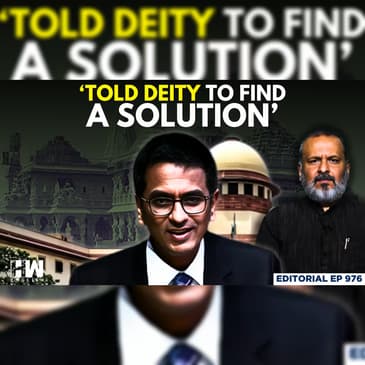

In this episode of The Editorial, Mr. Sujit Nair discusses a recent statement made by the Chief Justice of India, DY Chandrachud. While speaking in his hometown of Pune, CJI Chandrachud noted that he sat before the deity and told him he needs to find a solution to the Ayodhya dispute.
Learn more about your ad choices. Visit megaphone.fm/adchoices
[00:00:01] Namaskar, welcome to another episode of Editorial. I sat before my deity and told him he needs to find me a solution. This is what Justice Chandrachud, Chief Justice of India said when he was speaking in a seminar in Puna.
[00:00:24] This he was talking in context to the Ayodhya judgment. Let's talk about it. Let's get right to the issue.
[00:00:37] So, the Chief Justice of India, Justice DY Chandrachud was speaking in his hometown in Pune.
[00:00:48] Where he said that you see very often we have cases to adjudicate but we don't arrive at a solution.
[00:00:55] Something similar happened during Ayodhya, that is Ram Janma Bhumi and Babri Masjid Dispute which was in front of me for three months.
[00:01:03] Three months and I sat before the deity and told him he needs to find a solution. He said boss, Ayodhya I just couldn't find a solution.
[00:01:14] I didn't know what was right, what was wrong. So I sat before the deity and told God Almighty that please you need to find a solution for this.
[00:01:23] This is what he said. Now, he also went on to say actually that believe me if you have faith God will always find a way.
[00:01:34] I completely agree to this. See by the way before I start this entire editorial let me tell you I myself am a God fearing person.
[00:01:42] But you know I see a problem here. I see a problem here when a Chief Justice says that I found a solution to a problem or I gave my judgment to a problem after discussing with God.
[00:01:58] I have a problem here. I will tell you what I mean by that. You see, imagine, imagine, you go to a doctor, you go to a surgeon and you say listen I don't know what the problem is, what do I do?
[00:02:14] The doctor checks you up and says, you know what I really can't find the problem to your disease. I don't know what is your problem.
[00:02:23] But wait, wait, wait, wait, wait, wait, wait, wait, wait. I will just go to the nearest temple. I will sit in front of my deity and I will tell him please find solution to your problem and I will come back and I will treat you.
[00:02:34] The doctor tells you this. And he goes and he comes back and he says, okay, we are going to operate your heart. Is that convincing? Would you be convinced?
[00:02:47] Would you say that how he checked with the deity now everything perfect? He is a trained doctor. He knows his job. I said he doesn't know his job. He is a trained doctor and he has also checked with his deity.
[00:02:59] Now it is perfect. Now you operate. Are you going to say that? Isn't this quite similar to even the court of law? A judge who is going to judge the fate of this country? Okay.
[00:03:12] Now I want to ask you another question. I want to ask you another question. Say something goes wrong with the patient. Say something goes wrong with the patient and there is a medical legal case where the patient's family goes to the court, goes to the same judge and says that your honor, this man, this doctor did not treat my patient properly, did not treat my family member properly because of his wrong decisions.
[00:03:39] My family member passed away. If he says that. And the judge asks, what happened? And the doctor comes and says, judge, listen, your honor, listen. You know what? I went and checked with my deity. I went and checked with my deity. I told my deity I need solutions.
[00:03:58] And my deity. This is the solution he gave and I operated. So I am in the clear. I checked with my deity. Will the same judge, will the same honorable D.Y. Chandrasud, Chief Justice of India, will he say, okay, you are acquitted? Why? Because you checked with your deity, you know? Then you are acquitted. Will he do that?
[00:04:23] If not? If not, then is it really, is it really important or is it really right to go out in an open forum, the Chief Justice of India saying that one of the most important decisions taken in this century in the court of law of India is something that he depended on his deity to show him the way.
[00:04:51] Again, I tell you, I am a believer. I am a very God-fearing person. I completely believe that if you have faith, you know, most of your life, most of your solutions comes in front of you.
[00:05:05] But by saying all this, by believing all this, do you think I can go up to my editorial team tomorrow and say that, listen, editorial team, I think you need to do this particular article, Baba.
[00:05:18] You know why? Because my deity told me so. Will they believe me? Should I be saying it?
[00:05:26] Third factor is our constitution itself, scientific temperament.
[00:05:30] We need to build scientific temper into our people. This is what the constitution says.
[00:05:35] Where it is not questioning faith. It is not questioning your belief in God.
[00:05:41] But what it says is, there are certain places where you should purely work on logic, science, technology and philosophy.
[00:05:50] You can't work on, I sat in dhyan and I was enlightened and I am doing this. You can't do that.
[00:06:01] That's against the concept of scientific temper.
[00:06:05] Which means, that's against our constitution, isn't it?
[00:06:08] That's against our constitution.
[00:06:11] That's against our constitution.
[00:06:11] Okay.
[00:06:13] That's point number one.
[00:06:14] The point is, you see, he must have done it.
[00:06:17] He must have gone to his deity, spoken about it.
[00:06:19] He must have done what he does.
[00:06:20] That's his private affair.
[00:06:22] But going and speaking in front of the public gives an impression that most of the decision, he will go, listen to everything, go to the temple, pray and then come back and give the decision.
[00:06:33] That's the impression that this particular incident gives.
[00:06:38] This particular statement of his gifts, which I don't think is right.
[00:06:41] Which I don't think is right for the chief justice of this country.
[00:06:45] This is my opinion.
[00:06:48] Okay.
[00:06:49] Point number two.
[00:06:51] You see, it is not that our justice system is working immaculately.
[00:06:58] It is not that our justice system, everything is good.
[00:07:01] In fact, to the contrary.
[00:07:04] There is one judge in Karnataka High Court who says, no problem.
[00:07:09] You can go and say Jai Shri Ram in a mosque.
[00:07:12] So what?
[00:07:13] So what?
[00:07:13] They are all living in religious harmony.
[00:07:16] So what happened if we go and say Jai Shri Ram in a mosque?
[00:07:19] He said it.
[00:07:21] There was another judge who Justice Chandrachood himself spoke about.
[00:07:25] There was another judge in Karnataka High Court who said that, what of it?
[00:07:30] You know, people who in that particular area, because there are assuming a lot of Muslims,
[00:07:35] people in that particular area, in the Pakistani area that is, because there are a lot of Muslims.
[00:07:40] That also happened.
[00:07:41] This is happening in our courts.
[00:07:44] This is happening in our courts.
[00:07:45] There is a judge in our court who, before becoming a judge, had gone out and said that there is white terrorism,
[00:07:53] there is green terrorism and all of that.
[00:07:55] There are judges like that.
[00:07:56] There are judges who wear tika and all of that in the court.
[00:08:00] And they come to the court.
[00:08:02] Now you would ask, Kare, why?
[00:08:03] The judge can't wear it.
[00:08:05] See, technically, a police, I have not seen police wear tika and go to office, go to duty.
[00:08:11] I have not seen an army man wear tika and go to office.
[00:08:14] Why?
[00:08:14] If an army man cannot do that, a police cannot do that.
[00:08:18] A judge is supposed to be the most fairest of persons sitting in front of me.
[00:08:23] Because I go to him with my life.
[00:08:25] He takes decisions on my life.
[00:08:27] He can hang me if he so decides.
[00:08:31] And he can wear tika and everything and then come and pass a judgment.
[00:08:37] Would we be okay if a judge comes in a skullcap and sits in front of us and then takes a decision?
[00:08:42] Would we be okay?
[00:08:44] If that's not okay, then how come wearing a tika is okay?
[00:08:50] The point that I am trying to make is, you see, these are small issues.
[00:08:54] These are small issues and a lot of you may say that why are we exaggerating these issues?
[00:08:58] Why are we making this issue larger than life?
[00:09:00] But no.
[00:09:02] These issues needs to be addressed now.
[00:09:05] So that it doesn't grow to a level where you can't control it.
[00:09:10] These issues needs to be addressed now.
[00:09:12] The country should say that we understand that such things are happening around us.
[00:09:17] It's important.
[00:09:20] It's important because, like I told you, our judiciary is our last frontier.
[00:09:28] Judiciary is the last place we can hope, pray for justice.
[00:09:34] Judiciary is the last frontier to ensure that our constitution is kept intact.
[00:09:42] The way it was and the way it should be.
[00:09:46] Judiciary is the last frontier.
[00:09:49] And if judiciary starts shaking, judiciary starts taking sides, judiciary starts saffronizing,
[00:09:56] judiciary starts, you know, becoming a majoritarian kind of a setup, you know, where the judge,
[00:10:05] this didn't happen.
[00:10:06] I'm just giving an example.
[00:10:08] This didn't happen.
[00:10:08] I'm again telling you, just giving an example.
[00:10:11] Where the judge tomorrow, you may have a judge who will say, Jai Shri Ram and sit in his chair
[00:10:16] and say, now, come on, aage aajau, batau, problem ke hai.
[00:10:21] This could happen tomorrow.
[00:10:24] This could happen tomorrow.
[00:10:25] And like, like now, we could sit here and do editorals.
[00:10:28] And like now, a lot of people will write about it.
[00:10:30] But then this could happen tomorrow.
[00:10:33] It should be nipped in the bud and it should start with the chief justice of India.
[00:10:38] He should be the first person.
[00:10:41] Whatever your personal preference, your religion, your faith is.
[00:10:45] I mean, he should be advising us here.
[00:10:47] It is not an advice, but this is what I think.
[00:10:50] These things, especially when you are wearing a black robe, these things should be very private and kept to yourself.
[00:10:58] And it should not be, you know, put up in the public.
[00:11:01] Because tomorrow, if I talk about my deity, if I talk about my Ram, if I talk about my Hanuman, if I talk about my Shiv.
[00:11:11] Imagine if I am a judge and if somebody, a Muslim is standing in front of me.
[00:11:15] With what faith is he standing and looking at my face saying that I will give him justice.
[00:11:20] I will be just to him.
[00:11:23] What confidence am I giving him?
[00:11:26] Like I say, justice is not just done.
[00:11:29] It should be seen as it's done.
[00:11:32] The person who comes in front of me, before he comes in front of me, he will assume that he will give me justice.
[00:11:41] So this is the point I wanted to make.
[00:11:44] Think about it.
[00:11:46] I want you to kindly write down your comments.
[00:11:50] I want to know what you feel about what I just said, what I intend to say.
[00:11:56] And give me your comments and let me know what you feel.
[00:12:00] Till I see you next time.
[00:12:01] That's tomorrow at 10.
[00:12:03] Namaskar.