
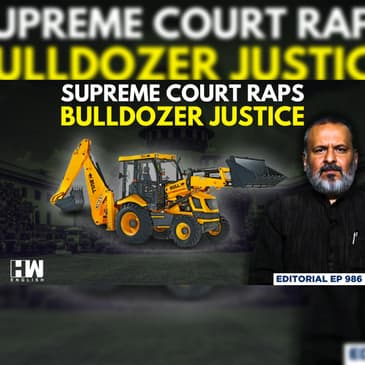

In this episode of The Editorial, Mr. Sujit Nair discusses the Supreme Court's judgment on 'bulldozer justice.' The apex court has strongly criticized this practice, stating that the executive cannot demolish the properties of individuals solely because they are accused or convicted in a criminal case. Furthermore, the court has established pan-India guidelines for property demolitions.
Learn more about your ad choices. Visit megaphone.fm/adchoices
[00:00:00] Namaskar! Welcome to another episode of Editorial. You see the picture in front of you? This picture is of a bulldozer. Supreme Court says, Bulldozer reminds of lawlessness. A bulldozer in India today reminds of lawlessness. How correct they are. Let's talk about it. Let's get right into the show.
[00:00:30] Vigilantism or instant justice gets you popularity. It's a very popular way of managing a society. Instant justice. A lot of people will say, oh, you know what? That rapist was shot by that commissioner. That commissioner becomes God because he went and shot that rapist.
[00:00:55] But we normally do not stop to think that does that commissioner have the powers to just remove his gun from his holster and shoot accused? Does he have the power?
[00:01:10] Do we wait to think that what happens if every second police officer gets the power to remove his gun and shoot the accused? The accused, mind you, not even a convict, accused. What happens?
[00:01:29] We saw it in Hyderabad. We saw it in Badlapur recently in Maharashtra. Where the rapist, accused rapist was shot. Shot dead. And a lot of people took credit for it. A lot of politicians took credit for it.
[00:01:43] A lot of people, people like you and me, we were singing glory about the person saying that, look, see how powerful he is. Look, see how the decision, how fast the decision he took. Instant justice was delivered. We, a lot of us spoke about it. Think about it for a minute.
[00:02:07] What if that accused. What if that accused was innocent? What if that accused has not committed the crime? What if there are a lot, many people, a lot more people behind that accused, powerful people behind that accused who has actually perpetrated the crime and you shoot the accused, accused over the big people behind the accused, saved. Think of the situation.
[00:02:37] What happens then? That is why civilized society like ours has something called as a judiciary. A court where we go, we put up the case. There is a prosecutor. There is a defense lawyer. They argue the case. A judge reviews the case, views the entire argument and gives and finally gives a judgment.
[00:03:02] And that judgment is executed by the executive, which is your police and jailers, etc. There is a process to it. But somewhere down the line, we find it very, very satisfying when, you know, a rapist is shot.
[00:03:21] And it's to some extent one can understand because all of us, all of our blood boils. When you see a rapist, all of our blood boils, but some rapist get shot and some rapist gets furloughed. That also happens. Some convicted rapist gets furloughed and some are shot.
[00:03:44] My second question is, how do you make difference between that convicted rapist and the rapist who got shot? How is Ram Rahim different to that rapist who got shot in Badlapur? Both of them committed the same crime. How are they different?
[00:04:00] So the point is, law somehow takes a backseat. In fact, it goes topsy-turvy when such decisions are taken and such decisions are perpetrated or are initiated by politicians purely to show how they deliver justice.
[00:04:16] It is not the work of a politician to deliver justice. It is work of the judiciary. And that's exactly what judiciary said today.
[00:04:24] Let's come to the topic at hand.
[00:04:26] Bulldozer reminds of lawlessness is what the judiciary said.
[00:04:31] The judiciary said that, you know, the executive has no power to go and deliver judgments or go and deliver justice.
[00:04:41] It is not the job of an executive.
[00:04:44] The executive cannot do it.
[00:04:46] That is why we have judiciary.
[00:04:48] That is what the judiciary said.
[00:04:49] You have us because we are the ones who are supposed to give judgment, not the executive.
[00:04:55] And the fact is, executive using bulldozer because possibly they are being told by their masters, their political masters, on a particular group, on a particular community, on a particular or an accused who is accused of rioting or accused of throwing stones or whatever the person or the group is accused of.
[00:05:19] Bulldozing their houses.
[00:05:22] Are you only punishing that accused?
[00:05:26] What gives the executive or the state in this matter?
[00:05:30] Because, like I said, most of these judgments come from the politicians.
[00:05:35] At least the credit goes to the politicians.
[00:05:37] We have bulldozer, babas and all of that in our country.
[00:05:40] The credit goes to the politician.
[00:05:42] What gives the right to that politician to punish with the accused?
[00:05:47] His father, his mother, his children, his wife, his brother, his sister.
[00:05:53] What kind of justice is this?
[00:05:57] What kind of justice is this?
[00:05:59] In fact, the court says that the executive cannot become a judge and decide that a person accused is guilty and therefore punish him by demolishing his residence or commercial properties or whatever.
[00:06:13] Such an act of an executive would be transgressing its limits.
[00:06:17] The chilling sight of a bulldozer demolishing a building when authorities have failed to follow the basic principle of natural justice have acted without adhering to the principle of due process reminds one of a lawless state of affair.
[00:06:33] Might is right.
[00:06:35] And in this case, whose might?
[00:06:37] The government's might.
[00:06:38] The government of that particular city, the government of that particular state and the government of the country.
[00:06:46] Their might.
[00:06:47] Their might is right.
[00:06:48] The court went on to say that in our constitution which rests on the foundation of the rule of law, such high-handed and arbitrary actions have no place.
[00:06:59] Such excess of hands of executive will have to be dealt with heavy hands of law.
[00:07:05] Our constitutional ethos and values would not permit such abuse of power and such misadventures cannot be tolerated by the court of law.
[00:07:16] They went on to say that officials taking part in such illegal demolition will be held accountable.
[00:07:24] So just because your dear minister told you go bulldoze, if you go bulldoze, you are going to be held responsible.
[00:07:32] What I have not seen here is why is the ministers, why are the ministers paid?
[00:07:38] Why are the ministers not held accountable?
[00:07:41] The minister who commands the executive to go and do it, why are they not held responsible?
[00:07:47] Anyway, directions are laid down by court now.
[00:07:51] Now, just for all our information, now a bulldozer cannot go and demolish a person's house just because the minister wants it or the government wants it or the particular executive wants it.
[00:08:06] They cannot do that.
[00:08:08] There are laws.
[00:08:08] Because the court says that even after the order of demolition are passed, the affected party need be given some time so that they can challenge the order of demolition before an appropriate forum.
[00:08:22] An appropriate forum, I would assume, be the court.
[00:08:26] Even in a case of a person who do not wish to contest the demolition order, sufficient time needs to be given to vacate.
[00:08:34] And one statement the court made, which was very heartfelt, was,
[00:08:40] It is not a happy sight.
[00:08:43] I repeat, it is not a happy sight to see women, children, and aged person dragged to the streets overnight.
[00:08:53] Heavens will not fall on the authorities if they hold their hands for some period.
[00:08:58] This is what really happens.
[00:09:00] I don't know how many of you have seen bulldozers coming and demolishing houses.
[00:09:06] I have seen it.
[00:09:07] When old men, women, children are dragged out of their house and they see their house which they built for the last 50, 60, 70 years,
[00:09:18] which they stayed everything in that house, everything in that house they have bought and they built.
[00:09:24] When that house is demolished, think how that father of the accused feels.
[00:09:29] He has done nothing.
[00:09:31] The mother of the accused feels.
[00:09:33] She has done nothing.
[00:09:34] The child of the accused.
[00:09:36] The child has done nothing.
[00:09:38] Nothing whatsoever.
[00:09:40] But all of them are punished.
[00:09:43] You know, this reminds me of North Korea.
[00:09:46] In North Korea, if you are accused, your three generations are punished, which means your children are punished and your parents are punished.
[00:09:55] So three generations are punished if they find you accused, if the person is convicted.
[00:10:04] How is this different?
[00:10:06] It's almost the same.
[00:10:07] Because normally Indians live in a joint family.
[00:10:12] A lot of us stay with our parents.
[00:10:14] A lot of us have our children.
[00:10:15] So when a house is demolished, three generations are punished for one man who is accused.
[00:10:25] Not convicted.
[00:10:26] Not convicted.
[00:10:27] Accused.
[00:10:28] The politicians and the executive decides that the person whose house is demolished is accused.
[00:10:36] They decide.
[00:10:36] Not the court.
[00:10:39] This is the point I wanted to make.
[00:10:41] And next time when we celebrate encounter or next time when we speak about this great leader who can, who if he finds something going wrong, bulldozes the house.
[00:10:59] Think about it.
[00:11:00] Today, it's somebody else's house.
[00:11:03] Tomorrow, it could be yours.
[00:11:06] Because today, they are the enemy.
[00:11:09] Tomorrow, you could be one.
[00:11:11] Till I see you next time.
[00:11:12] That's tomorrow at 10.
[00:11:14] Namaskar.