
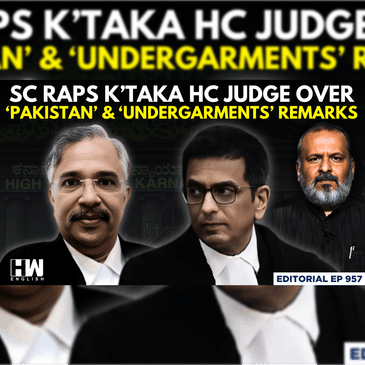

In this episode of Editorial, Mr. Sujit Nair discusses the controversial remarks made by Karnataka High Court judge, Justice Srishananda. During hearings, Justice Srishananda referred to a Muslim-majority locality in Bengaluru as 'Pakistan' and, in a separate instance, made a derogatory remark about a female lawyer. Additionally, Mr. Nair addresses other courtroom cases to examine the broader responsibilities of the judiciary.
Learn more about your ad choices. Visit megaphone.fm/adchoices
[00:00:00] Namaskar! Welcome to another episode of Editorial.
[00:00:07] Today I think I have one of the most important topics to talk to you,
[00:00:14] one of the most important topic that I have ever taken up in my editorial.
[00:00:19] Today I want to talk to you about justice.
[00:00:22] Today I want to talk to you about court.
[00:00:25] Today I want to talk to you about judges.
[00:00:28] And today I want to talk to you about how confused I am about justice in India.
[00:00:39] Let's get right to the show.
[00:00:44] You know there is a justice in Karnataka High Court called Shri Sananda.
[00:00:51] Shri Sananda while referring to a Muslim dominated area,
[00:00:57] he was passing his judgement sitting in his judge's chair,
[00:01:02] he was passing his judgement while talking about a Muslim dominated area.
[00:01:05] He said that Pakistan, Pakistan why because there are a lot of Muslims,
[00:01:09] a judge sitting in a high court.
[00:01:13] This is what he said.
[00:01:17] You know the same, the same judge,
[00:01:19] the same judge while addressing a lady advocate,
[00:01:26] the judge said wait Amma why are you telling?
[00:01:30] You know everything about him.
[00:01:32] Tomorrow morning you will tell which colour undergarments he wears.
[00:01:37] But I found that to be cheap.
[00:01:41] I found that disgusting.
[00:01:44] I found that absolutely misogynistic.
[00:01:50] And this judge Shri Sananda decides people's life, decides people's fate.
[00:02:01] He judges others.
[00:02:05] I don't know where his moral compass stands but he judges others.
[00:02:12] And in case my case goes in front of him,
[00:02:15] I have no choice but to fold my hands in front of him,
[00:02:18] call him your honour and take whatever he gives me.
[00:02:21] And they all tell me I live in a democracy.
[00:02:27] They all tell me I have the freedom to decide my own fate.
[00:02:32] And they all tell me that my founding fathers fought for hundreds of years,
[00:02:38] hundreds and thousands of them gave their lives to get me that freedom
[00:02:42] that they say I enjoy today.
[00:02:49] Okay, let's get into another story.
[00:02:52] In another story,
[00:02:56] Bharatiya Janata Party MLA, again in Karnataka,
[00:03:02] called a minister, congress minister,
[00:03:07] Mr. Dinesh Gundurao's wife who incidentally happens to be a Muslim,
[00:03:13] called her a Pakistani.
[00:03:15] Called her a Pakistani.
[00:03:18] And there the justice was different.
[00:03:22] The judge on the hearing this petition,
[00:03:25] the petition by the way was filed by the MLA
[00:03:29] to quash the case because obviously the minister Gundurao filed a case against him
[00:03:35] saying that listen filed an FIR against him saying that listen he calls my wife,
[00:03:38] Pakistani, my wife and it went in front of a judge, Nagaprasanna.
[00:03:45] Justice Nagaprasanna while hearing this particular case,
[00:03:49] a case that the MLA, BJP MLA had put up to quash this entire FIR,
[00:03:55] the judge said no what is this?
[00:03:58] Just because he is married to a Muslim,
[00:04:01] you can call him half Pakistani.
[00:04:04] Why do you have to say this?
[00:04:06] Why do you say whatever comes in your mind?
[00:04:09] You can't dub a particular community to be that.
[00:04:11] Then live here the judge said.
[00:04:15] He was very livid, said what nonsense are you talking about?
[00:04:18] Rightly so.
[00:04:24] There is one judge who because the population in that particular area
[00:04:31] there are more Muslims calls that entire area Pakistan judge.
[00:04:35] Same Karnataka High Court.
[00:04:38] There is a larger judge same Karnataka High Court
[00:04:41] where a case came in front of him where MLA called
[00:04:46] a minister's wife Muslim wife incidentally
[00:04:51] Pakistani, he said what nonsense are you talking about?
[00:04:55] Do you know what you are talking about?
[00:04:57] Two judges, two different attitudes.
[00:05:02] My question tonight is am I going to a court
[00:05:05] or am I going to the session of a judge
[00:05:10] who decides my fate?
[00:05:12] Who decides what is law?
[00:05:14] Does a judge sitting in that chair decides what is law
[00:05:16] or does the court decides what is law?
[00:05:18] Now my question to you.
[00:05:21] Supposing the judges were interchanged
[00:05:25] and this judge Justice Srisananda
[00:05:28] what to hear the Gundurao case
[00:05:32] that is where Mr. Gundurao's wife was called Pakistani
[00:05:37] if he had to hear that case
[00:05:39] what would that judgment be?
[00:05:42] Would that judgment be different to what Justice Nagaprasna said?
[00:05:47] Would that judgment be different?
[00:05:49] And why should I not believe that the judgment will be different?
[00:05:53] Because that judge calls an area which is dominated by Muslim Pakistani
[00:05:57] he did it.
[00:05:59] So if some similar case comes to a friend of him
[00:06:01] he could say that, okay, what happened?
[00:06:04] What have it? He could have said that.
[00:06:06] Which means that what is IPC, CRPC and all
[00:06:11] what is all of that?
[00:06:13] It is what the judge feels.
[00:06:16] If the judge feels that Muslim area should be termed as
[00:06:24] Pakistani or Pakistan
[00:06:26] he can also say that if a Muslim woman should be called a Pakistani
[00:06:29] he could say that. I am not saying he will say that
[00:06:32] but he could say that, wouldn't he?
[00:06:34] So then what is this justice system all about?
[00:06:39] I am wondering, I do not know
[00:06:43] when I go to a court what should I expect?
[00:06:46] What should I pray?
[00:06:47] Pray to my Almighty saying that listen the judge who comes
[00:06:51] no he has to be in favor of this particular ideology
[00:06:54] or in favor of that particular ideology
[00:06:56] or that's what I should be praying.
[00:07:00] It is not that I trust my legal system
[00:07:03] it is I hope I get a good judge.
[00:07:08] Where is our justice system going with this?
[00:07:12] Where is our justice system going with this?
[00:07:14] You see the Supreme Court has taken cognizance.
[00:07:16] Let me also tell you the Supreme Court has taken cognizance
[00:07:19] to it, a five-judge bench
[00:07:21] led by Chief Justice D. Y. Chandrachud.
[00:07:25] Chief Justice D. Y. Chandrachud who had recently
[00:07:27] invited the Prime Minister of India to his house
[00:07:31] for Ganesh Puja, D. Y. Chandrachud along with
[00:07:34] Justice S. Khanna, B. R. Gawai, S. Kanth and H. Roy
[00:07:38] expressed the need of establishing clear guidelines
[00:07:41] for constitutional court judges regarding their remark in court.
[00:07:46] Attention has to be drawn to media reports
[00:07:48] of the comments made by judges of Karnataka High Court
[00:07:52] during the court proceedings.
[00:07:54] We request Karnataka High Court to submit a report
[00:07:56] after seeking instruction from Chief Justice of the High Court.
[00:08:00] Chief Justice Chandrachud said,
[00:08:02] we may lay down some basic guidelines.
[00:08:05] You see my worry or my problem with this is
[00:08:11] while yes good at least they took so much of cognizance
[00:08:15] thank you that was great fabulous
[00:08:16] but the fact is it is not a process initiated
[00:08:21] to ensure that people with such bigoted thought
[00:08:25] is not made a judge.
[00:08:28] People with such ideologies are not made judges.
[00:08:33] Ideologies where if there are Muslims then it is Pakistan.
[00:08:37] Such people are ensured systems created to ensure
[00:08:41] such people do not become judges.
[00:08:43] That's not what the discussion is.
[00:08:45] The discussion is Baba kodakandak banata
[00:08:47] ta kaya liye social media dek raya
[00:08:49] how are you going to make the how can that make such statements
[00:08:52] that's the problem.
[00:08:54] It is not what the judge feels or the judges made up of.
[00:08:58] It is what the judge could say in front of the social media
[00:09:01] that we are all debating.
[00:09:03] We are debating the symptoms.
[00:09:04] We are not bothered about the disease.
[00:09:07] Imagine what the judge is thinking if he calls an area
[00:09:12] where there are Indian Muslims staying
[00:09:14] if he calls that area Pakistan
[00:09:16] imagine what the judge is thinking.
[00:09:19] If the judge can look at a woman and say that you know
[00:09:22] you seem to be knowing the undergarments that your client is wearing
[00:09:26] look at what the judge is thinking.
[00:09:28] I am surprised why we are not talking about what the judge is thinking.
[00:09:33] We are rather talking about what the judge should be saying in front of social media.
[00:09:40] That's what we are thinking.
[00:09:42] And you know what there is another notice from the Karnataka High Court
[00:09:45] that I want to take you through.
[00:09:47] The notice from the Karnataka High Court says
[00:09:49] that no person or entity including print electronic media
[00:09:53] and social media others
[00:09:55] than an authorized person or entity shall record, share
[00:10:00] or disseminate live stream proceedings or archival data.
[00:10:05] They say that the use of unauthorized recording
[00:10:08] in the original form may be permitted by the court
[00:10:12] interlia to disseminate news and for training
[00:10:15] and academic and educational purposes
[00:10:17] authorized recordings handed over for the effort side
[00:10:20] purposes shall not be further edited or processed.
[00:10:24] Such recordings will not be used for commercial
[00:10:27] promotional purposes or advertising in any form.
[00:10:32] Any unauthorized use of live stream will be punishable
[00:10:35] as an offense under the Indian Copyright Act 1957
[00:10:39] Information Act 2000 and the provision of law including
[00:10:43] Law of Contempt.
[00:10:47] The Supreme Court took cognizance of it
[00:10:50] good and said that listen,
[00:10:53] not that you know we should ensure that we hire better judges.
[00:10:58] Better judges who can judge better, who can deliver judgment,
[00:11:03] who can be fair, who can deliver fair judgment
[00:11:06] that's not what they were discussing.
[00:11:07] They were discussing in what the judges should be speaking
[00:11:10] in the court because there is social media.
[00:11:13] This is what the Supreme Court talks about.
[00:11:14] What the Karnataka High Court says is you next time
[00:11:17] take our proceedings and you air it,
[00:11:21] we will put you behind bars,
[00:11:23] that will be contempt of court.
[00:11:26] We will punish you.
[00:11:29] So it is not about correcting,
[00:11:33] it is about killing the messenger.
[00:11:35] As far as Karnataka court is concerned
[00:11:37] and as far as Supreme Court is concerned unfortunately
[00:11:42] the way I see it, it is about
[00:11:45] ensuring that the symptoms are taken care of.
[00:11:49] Bolo Matya Rai Sa, court may.
[00:11:52] This is what my first point is.
[00:11:55] My second point is there is another court rebukes CBI
[00:11:59] for claiming West Bengal courts are hostiles
[00:12:02] and wants of contempt action.
[00:12:04] In a stinking rebuked to the Central Bureau of Investigation
[00:12:07] the Supreme Court on Friday castigated the agency
[00:12:10] for filing petition to transfer cases out of West Bengal.
[00:12:14] You see, the court earlier on called the CBI
[00:12:18] a case parrot. We spoke about that.
[00:12:20] Today they rebuked the CBI for castigating courts
[00:12:24] and saying, hey, West Bengal court is not fair,
[00:12:27] we want to take the case out of West Bengal and all that.
[00:12:30] It is all fair, fine. No questions for that.
[00:12:35] But my question is,
[00:12:38] what exactly is the responsibility of the judiciary?
[00:12:43] Is the responsibility of the judiciary
[00:12:45] is just to like I say I use this word quite often
[00:12:48] in this particular editorial,
[00:12:50] just to see the symptom and treat the symptom
[00:12:53] or is the responsibility of the judiciary
[00:12:56] to see, to understand the problem
[00:12:59] and see how judiciary can correct it.
[00:13:04] What I mean by that is like I asked last time
[00:13:07] when you call CBI a caged parrot
[00:13:11] who caged the parrot in the first place?
[00:13:14] Did the court ask that?
[00:13:17] Did the court call the Home Minister, the Home Ministry,
[00:13:21] the Home Department and say
[00:13:23] that this CBI report should you know,
[00:13:26] why are they caged parrot?
[00:13:28] What have you done to ensure that they are caged parrot?
[00:13:31] Why do they report to you?
[00:13:33] Why do they work the way you want them to work?
[00:13:35] Why is that happening?
[00:13:37] Did the court ask?
[00:13:39] Did the court summon the Home Minister
[00:13:41] and say come here, stand here and tell me why?
[00:13:46] Possibly had the court done that,
[00:13:48] then the court is getting into the disease
[00:13:51] rather than just handling the symptoms.
[00:13:54] And the case is similar here.
[00:13:57] They want to get it out of West Bengal
[00:13:59] is what the CBI says,
[00:14:01] court says why you are castigating every court
[00:14:03] is what the court asks.
[00:14:07] It is what the court is asking.
[00:14:10] Did the court bother to ask
[00:14:12] the central Bureau of Investigation
[00:14:13] is there any pressure on you
[00:14:16] from any tough forces
[00:14:19] to ensure that you ask for the case
[00:14:22] that has to be taken out of West Bengal?
[00:14:25] Is the court asking that?
[00:14:28] If there is a pressure then let us know
[00:14:30] what that pressure is
[00:14:31] or let us investigate who that pressure is.
[00:14:34] Who is asking you to take this outside of West Bengal
[00:14:36] and possibly take it to another state,
[00:14:38] possibly an Assam,
[00:14:40] possibly heaven.
[00:14:43] Who is asking you?
[00:14:45] And if somebody is asking you
[00:14:46] then what is the political advantage of that person
[00:14:48] asking you to take it out of West Bengal
[00:14:50] and take it to another state
[00:14:53] if at all there is a political advantage.
[00:14:57] Shouldn't the court be bothered about that too?
[00:15:01] Because end of the day, yes the court is absolutely right
[00:15:04] it is contempt.
[00:15:05] Every second investigating agency says that
[00:15:08] it happened in Maharashtra so I want to take it to Gujarat
[00:15:10] it happened in Gujarat so I want to take it to Rajasthan
[00:15:12] it happened in Rajasthan so I want to take it to Delhi.
[00:15:18] This court is not fair.
[00:15:19] This government will not support us.
[00:15:21] This government is not the government that we report to
[00:15:23] so we will not want to work in the jurisdiction
[00:15:26] of this particular government
[00:15:28] can we take it to another government jurisdiction.
[00:15:30] Is that how we are going to work as a federal system?
[00:15:35] Why is the court not addressing it?
[00:15:37] Because this is going to blow into a bigger problem.
[00:15:41] If a Pidlu journalist like me
[00:15:44] can understand it
[00:15:46] can't these learned judges understand?
[00:15:49] Can't our system understand?
[00:15:51] That it is time that they try
[00:15:56] in their own way to ensure that these constitutional bodies
[00:16:00] these investigative bodies are taken out of these political games
[00:16:06] these politicians
[00:16:08] Chengul as they call it or whatever
[00:16:10] these politicians control and make them independent
[00:16:13] don't these judges, don't these courts need to play a role?
[00:16:19] Is that too much to ask?
[00:16:23] That's the point I wanted to make today.
[00:16:26] Like I said, I believe this is one of the most important editorials
[00:16:30] that I have presented to my viewers
[00:16:36] because end of the day
[00:16:38] it's time we change
[00:16:41] it's time we get reforms in our system
[00:16:44] it's time we get reforms in our politics
[00:16:48] in our administration in our judiciary
[00:16:51] it's time we get reforms
[00:16:53] it's time we start thinking for the people
[00:16:58] that's the point I wanted to make
[00:17:01] till I see you next time
[00:17:04] Namaskar