
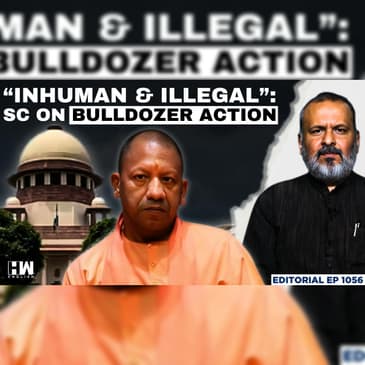

In this episode of Editorial, Mr. Sujit Nair discusses three different cases to examine how we, as humans, often remain oblivious to our surroundings and the current happenings in the country. The three cases include: the Supreme Court slamming officials for the way they carried out a demolition in UP’s Prayagraj, the arrest of a journalist in Assam while covering a story, and the case involving Kunal Kamra and Eknath Shinde.
Learn more about your ad choices. Visit megaphone.fm/adchoices
[00:00:00] Namaskar, welcome to another episode of editorial. I have got three stories for you. All these stories are linked and we will discuss how they are linked in the last part.
[00:00:15] My story number one is about Prayagraj. 2021, the Prayagraj administration had bulldozed residences in Prayagraj, calling it unofficial. The Supreme Court slammed them. We will talk about that.
[00:00:34] The second story is about a journalist in Assam who was put behind bars under the SCST laws. The court slammed Assam government saying that you are misusing SCST laws. Let's talk about that.
[00:00:51] The third topic that I want to talk to you about is about Kunal Kamra. Kunal Kamra says that you know what? The government is killing creativity and killing artists. Let's talk about these three topics. Let's get right to the show.
[00:01:10] Before I get into my stories. My interest is not to sit here and give you my opinion. Because you don't need my opinion. You have an opinion. You know how things are. You know what things are happening around you.
[00:01:25] My interest here is to ensure that you are. Let me know what your opinion is. And it is very important for our society to understand and then react. It is very very important for our society. And my effort is to ensure that whatever in whatever small way I can get that change happening.
[00:01:52] You see. I will give you an example of a frog. Not the frog in the well. No no no no. You see if you take a frog and put the frog into cold ice cold water in minutes the frog its body will adjust to the temperature. And the frog will be absolutely comfortable in that cold water.
[00:02:17] If you take a frog in the well. And the frog will be comfortable in that cold water till the cold water boils. And boils all the internal organs of the frog and the frog dies.
[00:02:47] The frog will never understand nor notice the temperature of the water getting high. You see somewhere down the line I feel as a society we are like that frog. We kind of are oblivious of what is happening around us.
[00:03:09] Because we are oblivious of what is happening around us or we don't want to react on what is happening around us. We are that frog. We are comfortable in whatever environment we are put in. Today it is cold. Tomorrow it will be boiling hot.
[00:03:26] The point is the society that we are not. The point is the society that we know ourselves to be. That society should not be destroyed because our inability to react. Our inability to participate. Our inability to be conscious of whatever is happening around us.
[00:03:45] That's the reason why these editorials and that's the reason I plead you. I humbly ask you to react to whatever the story I'm going to put in front of you. So let's get to the story. The first story is from Uttar Pradesh.
[00:04:02] You see there was a demolition in Prayagraj. This happened in 2021. It went to court. The high court kind of said it was okay because there is nothing illegal about it. The supreme court reacted very differently.
[00:04:19] The supreme court said that the demolition of some houses by the local authorities in Uttar Pradesh's Prayagraj in 2021 was inhuman and illegal. The supreme court said that high handed manner in which this was done shocks our conscience. The supreme court said that the case shocks our conscience.
[00:04:45] The supreme court directed Prayagraj development authority to pay 10 lakhs each to those affected. While talking about this, the judge said that the case shocks our conscience. Resiliential premises of the appellants have been high handedly demolished. Carrying out demolition in such a manner shows insensitivity on the part of the statutory development authority.
[00:05:10] The authorities and especially the development authority must remember that the right to shelter is also integral part of article 21 of the constitution of India. This is what they said. They said that the way the houses were demolished were absolutely high handed. You are not demolishing the house because this is my inference. You are not. Why would some authority be high handed? Because they were doing it with a vengeance.
[00:05:39] They were doing it to harm somebody. That is why you take a high handed decision. Let me tell you the story of this entire background. I will give you a background of the story. You see the plot's name which these bulldozers came and started disrupting the house, started breaking the house. This plot name was called Nazul. It was a government land for public purposes. Now the government had leased this land in 1906.
[00:06:07] And this land was leased to a person called Shakir Hussain. Like I said, March 19th 1906. This was done by the then Allahabad district collector. The lease was 30 years initially and was renewable for two successive periods, which means it was a 90 years lease. So first 30 years, then again 30 years, then again 30 years. It was leasable.
[00:06:35] It was, it could be leased for two successive years after the 30 years. Subject to an aggregate of 90 years, which is what I told you. So 90 years they could lease. Now, according to the petitioner, Sakir Hussain transferred the land rights to Kulsum Begum, Mehbooba Begum, Kanaz Fatima in 1960.
[00:07:00] With the district magistrates permission later, Kulsum Begum and Kanaz Fatima transferred the right to Hazi Firoz Ahmed, the father of the gangster turned politician Atik Hamar. And this gangster turned politician was gunned down in April 2023. While the third lady Mehbooba Begum sold her properties elsewhere.
[00:07:27] So the property in which this bulldoze action happened then belonged to this gangster turned politician Kalati Kaya Madh. That is why maybe the authorities acted a little high handed. The fact remains that the land, nobody, no court has commented on the, on the veracity of the action. In fact, now the Supreme Court also is not commenting on the land rights.
[00:07:54] The Supreme Court is not saying that the land belonged to these people. Why did you bulldoze? No, that is not what the Supreme Court is saying. But the Supreme Court is, the question is the way it was done. And that's the question even I want to ask today. You are a government authority. You are doing your job maybe.
[00:08:19] But there is a way you enforce that action of yours. If that action is enforced in a civil and a legal fashion, then one understands. But when the action is enforced as if you are doing it to teach somebody a lesson, then is that actually a legal action? Is that how a government should perform?
[00:08:44] What were you doing here when you use high handed methods to destroy an entire residence or whatever, entire group of residents? Because possibly it belonged to a gunda. Yeah, it was unofficial, possibly that also true. So that's the point number one. You know, while talking about this, the High Court also pointed out on this particular video that you see in front of you.
[00:09:13] This didn't happen in this particular Nazul plot. It didn't happen here. It happened in U.P's Ambedkar Nagar. That too was an administrative action which was kind of clearing the residentials. And the court said, in court words, they said, there is a recent video in which small huts were being demolished by bulldozers. There's a small girl running away from the demolished hut with a clutch of books in her hand. It has shocked everyone.
[00:09:43] A small girl like you see in the video running with a clutch of books in her hand. Is this a democracy? Is this the country we want to hand it over to our next generation? Somewhere down the line, a politician only takes action when he knows that his voters appreciate this action. A politician acts the way his voters want him to act.
[00:10:10] So are we therefore saying that as a society, we like to see others misery? We like to see when somebody's house is demolished, we enjoy it in some form. Is that what we are? Is that the society that we are? That's the question I wanted to ask yourself today. Do we enjoy? Is there a sadistic pleasure that we derive when somebody's house is knocked off? When you see that child running? Is there a sadistic pleasure that we derive as a society?
[00:10:38] Because if it wasn't that, then a politician wouldn't have dare, dare, done this kind of act. And the problem is this bulldozer technique now is spreading all over the country. Because somewhere down the line, every politician started thinking that the moment there is a bulldozer strategy, a bulldozer law that happens, the crowd feels very good. The crowd feels that the judgment is instant.
[00:11:09] This is what I remember used to happen in Mumbai during the encounter days. All of us used to say, and then we saw encounter specialists becoming bigger gangsters than the gangsters themselves. Some of them, some of the encounter specialists. I won't say all. What Bombay had to face those days, Bombay, not Mumbai.
[00:11:39] What Bombay had to face those days. Let me come to the next story. This journalist from Assam. Now, Dilwar Hussein Mazumdar, a Gawati court pulled up Assam police saying that the Schedule Cast and Schedule Tribe Prevention of Atrocity Act is not intended to use and make arbitrary arrest.
[00:12:04] You want to arrest a person, Dilwar Hussein Mazumdar, so you use the Atrocity Act, the SCA Atrocity Act and arrest him? Could you be? I am not saying this, the court is saying this. The court is asking. You see, last week they say, Mazumdar was arrested twice and got bailed in both the cases.
[00:12:24] In the first case, he was accused of violating SCST Prevention Atrocity Act for allegedly making offensive remark against a security guard at a bank where he was covering protest earlier on in the week. And the court of the Chief Judicial Magistrate, Kamrup Metropolitan, granted the journalist bail in the first case on March 26th.
[00:12:43] Majumdar, a reporter of Assam based digital portal, the Cross Current, known for his investigative reportage on the state government, has been arrested March 25th after he went to cover a protest against Assam cooperative Apex Bank. Assam Chief Minister Hemantab Biswasarma is the director of ACAB and the BJP MLA Biswajit Pukhan is the chairman.
[00:13:07] The grounds of his arrest presented by the police was allegedly that the security guard statement clearly established that the accused used verbally abuse the complainant using offensive derogatory remarks involving the guards cast and it was intended to demean and insult the complainant. In the bail order, the court observed that he has not stated anything incriminating to the accused. This is the story.
[00:13:36] This man, this journalist was covering a bank which incidentally the Chief Minister of Assam is a director, a Bharatiya Janata Party leader is a chairperson and he was not writing kind words about the bank. There was a protest, he went to cover the protest, the guard and the journalist had a tiff and the guard went and complained he abused me on my caste.
[00:14:05] And the court says there is nothing that he has said that should be seen as offence or the SCST atrocity act be implemented. Now the reason I am talking to you about this story is A, this is the fate of a journalist in India. You don't tow the government lines, you are made to tow the government lines.
[00:14:30] Now mind you, I am not just talking about the Bharatiya Janata Party government per se by the way. This is now spreading everywhere like I told you about the bulldozing case also. It is spreading to every state. This time of course, it is Assam which is a Bharatiya Janata Party government and one let me also tell you Bharatiya Janata Party government cases are much more normally than another political party run government.
[00:14:58] But like I said, there are cases with Trinamul Congress also who have done the same. So I am not going to talk about one particular political party but that being said, the case I am talking about is about Bharatiya Janata Party. This journalist was arrested that too under SCST case, SCST atrocity case. The court said something is wrong. You see, there are two things you are doing.
[00:15:23] A is you are weakening this schedule caste, schedule tribe atrocity case, atrocity prevention case. You are weakening that case because if you use it for every other purpose to ensure that you put the person you want behind bars, if you use that or to please your political masters, if the police starts using it, it will harm the schedule caste, it will harm the schedule tribe, it will harm their interest.
[00:15:50] Because if their laws are misused when the real case happens, the court will not see it seriously. Obviously, the boy who cries wolf story. Every day you cry wolf and one day a real wolf come, nobody is going to bother to look at you. And secondly, is this our law? I again, it's not me saying this. I am not passing a judgment. It is the court who said that there is. Let me read it again.
[00:16:20] He has not stated anything incriminating against the accused. He has neither mentioned any word of abuse used by the accused or anything to suggest that they were criminally intimidated by him. This is what the bail order said. This is what the bail order observed. The court said it here. You know, you just used the case. The court said you are misusing the law.
[00:16:50] You are misusing the law possibly for a political reason. You are misusing the law possibly, possibly because of a political master. A political master doesn't like you. Police will find a way to put you in. This is the way it looks. Otherwise, why would you misuse the law? You see, Kunal Kamra got his third summons.
[00:17:18] He cracked a joke on the deputy CM of Maharashtra. Like I told you last time, as a citizen, I never took that seriously because that was a comedian and that is his job. He was cracking a joke. He cracked a joke. Nobody took it seriously till such time that Shivasanics went and ransacked that place, damaged that entire auditorium.
[00:17:43] Mind you, Shivasana is the government in Maharashtra. One of the part of the government in Maharashtra. There are three parts. One of them, Shivasana. They ransacked the government. People who are in the government ransacked. Took law and order in their own hands, ransacked the hall. Did the leaders say anything against it? Did Maharashtra government come crashing down on them?
[00:18:11] Did the police come crashing down on them? They were arrested. I am not denying that. But end of the day, Kutal Kamara is the one that the entire system is gunning after. You see, like I showed you last time, comedians crack jokes. I will give you a very interesting example.
[00:18:40] And I will end this editorial with this. You see, RK Lakshman used to draw a lot of cartoons on Indira Gandhi. Lot of them. He used to make fun of Indira Gandhi. One fine day somebody came and told him that, Arrey listen, hello. Mr. Lakshman you have been given Padma Bhushan. You have been given Padma Bhushan and you know who recommended you? Mrs. Gandhi recommended you. Lakshman said it eh. That's not possible.
[00:19:10] That's not possible. How will she give me Padma Bhushan? I have been making fun of her every day. But actually, you know what? Mrs. Gandhi recommended him for Padma Bhushan. And he got it. He was awarded the Padma Bhushan. The point that I am trying to make is not start writing saying that I am promoting Mrs. Gandhi. And all that is not the point I am trying to make.
[00:19:34] I am trying, the point I am trying to make is this is how the relation between a critic, a cartoonist, a comedian, a politician should be. You see, every time a mimic goes on stage and does a mimicry of a star, the star feels very good. He is mimicked. Why is he mimicked? Because he is relevant.
[00:19:57] I know of film stars, super stars who have gone and begged of mimics to go and do their mimicry on the stage. Every time that mimicry artist goes and does a mimicry of a star on the stage, that star gets relevant, the star gets attention. Likewise, it is good if you have comedians talking about you. You stay relevant. People don't go by what the comedian says or people comedians don't create your image.
[00:20:27] People do. The work that you do amongst the people in the society creates the image that you want. A comedian neither can build it nor damage it. But what a comedian or a cartoonist or a journalist can do is to ensure that you and your name stays relevant, which is very important to any person who is a celebrity or whatever you call it. A person who deals with public, who has a public life.
[00:20:58] It's important. What Kunal Kamra did for Mr. Eknash Shinde is actually good for Mr. Eknash Shinde. It's actually good for Mr. Eknash Shinde. What Eknash Shinde is doing back to Kunal Kamra is what is harming Mr. Eknash Shinde's image. Mr. Eknash Shinde was not seen as a person who is revengeful, was not seen as a person who would go back and you know, he was not seen as a person.
[00:21:25] I come from Thane. I know Eknash Shinde the way he would, I know his political career, I have seen his political career very closely. This was not what Eknash Shinde is. The way things are being handled? I think Eknash Shinde himself should think whether he wants all this happening around this case and whether he wants to wreck up this case the way it's being wrecked up.
[00:21:55] Kunal Kamra is a comedian. Let him be that. That's the point I wanted to make and I wanted to review these three cases, what I just said. I want you to figure out as to what do you think is happening in our society. I want you to react. I want you to let me know what your point of view is. Maybe reading your point of view, maybe some politicians will realize how their voters are thinking.
[00:22:25] That's the objective of this editorial. Till I see you next time. That's tomorrow at 10. Namaskar.