
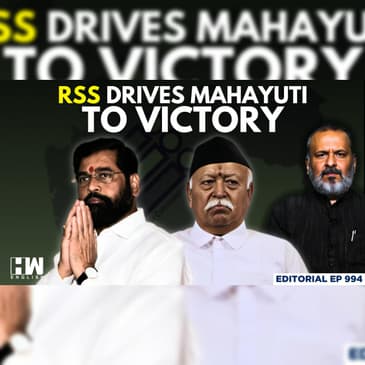
In this episode of The Editorial, Mr. Sujit Nair discusses the RSS’s role in the BJP’s victory in the Maharashtra assembly elections. Following the Lok Sabha results, the RSS actively campaigned for the BJP in Maharashtra. Ahead of the polls, it launched initiatives to shape public opinion in favor of the BJP. RSS swayamsevaks reached every nook and corner of the state, persuading voters to support the party.
Learn more about your ad choices. Visit megaphone.fm/adchoices
[00:00:00] Namaskar! Welcome to another episode of Editorial. You see there is something called as expectations, there is something called as superseding expectations. That's what happened in Maharashtra. You see the contest between Mahavika Zaghadi and Mahayuti was tough, was quite tough. But Mahayuti doing the numbers it did absolutely super surprised.
[00:00:29] Let's talk about it, let's get right into the show. You see as a political commentator, one has friends in all the parties. While we may be talking about a particular ideology, we have friends in all the parties and a lot of them talk to us privately, socially we meet, a lot of discussions happen.
[00:00:59] A lot of things that is spoken privately, we do not talk about it in front of our audience because that is not fair that those are private discussions. But yeah, so therefore you normally get a sense of what these political parties are thinking.
[00:01:18] Now most often than not what really happens is, a political party normally thinks the best case scenario for themselves. The best case scenario. It may not be what they profess, they may profess the best best best case scenario for themselves but within also they have, they believe that things could go right for them. That is what normally they believe otherwise they will not be able to fight the election. I hope I have communicated my point.
[00:01:47] But yet, there is some amount of reality in what they believe in and it can't be drastically different to what they believe in. So that's how it is. If they say we are going to get 10, they may get 15 and they may get even 7, they may get even 8. So that's okay. That leeway, we give it to the politicians but broadly they are very sure about what they are seeing is going to be.
[00:02:17] 2024 was a surprise. 2024 was an absolute surprise. You see, 90% of politicians, 90% of Bharatiya Janata Party politicians believed that they would sweep the Lok Sabha. 90% of them.
[00:02:34] While a lot of people could come here and told me about 40 out of 48 we will get and so on and so forth but still internally they were very sure that they will get 30 plus in Lok Sabha.
[00:02:48] Bharatiya Janata Party merely got 9 in the Lok Sabha.
[00:02:52] Now that was something that was absolutely unexpected. Genuinely, people in Bharatiya Janata Party didn't expect it and believe me you, a lot of sophologists may have told you that, oh we knew it before, nobody knew it before.
[00:03:05] Everybody thought that, you know, it is going to be 28, 27 so on and so forth. You know, that kind of numbers.
[00:03:11] Nobody knew that they would get below 10. So that was the first thing.
[00:03:16] That was 2024 Lok Sabha. 2024 Lok Sabha threw up a lot of factors.
[00:03:25] One of the factors was the clear divide between the Rashtra Swayam Sevaksang and the Bharatiya Janata Party.
[00:03:33] The understanding that Rashtra Swayam Sevaksang, we needed them when we were aksham but today we are saksham so maybe we don't need Rashtra Swayam Sevaksang.
[00:03:48] The statement made by the then BJP or even now BJP President J.P. Nadda that resonated and that showed in Maharashtra, that showed in Uttar Pradesh.
[00:04:02] They were reduced to 9, 9 and that is below sub 10 and even Uttar Pradesh, they were something like 32.
[00:04:15] So, I think right after June, August 31st to September 2nd, the Rashtra Swayam Sevaksang and the Bharatiya Janata Party met in Palakkad.
[00:04:34] You know a lot of statements that were made between June 4th and August 31st.
[00:04:43] A lot of statements were made, especially made by the Sarasanga Chalak, Dr. Mohan Bhagwat.
[00:04:49] A lot of statements were made.
[00:04:51] He made statements on the immortal factor and he made on the heavenly factor and all of that.
[00:04:58] You know, we all know what statements he made.
[00:05:01] So, I am not going to repeat those statements.
[00:05:03] But a lot of statements were made where he made it very clear that he is not happy the way democracy or the way Bharatiya Janata Party is being running this country.
[00:05:14] And one single person, one single person has been, is seen as Bharatiya Janata Party itself.
[00:05:23] He said he is not very happy.
[00:05:25] He made it very clear.
[00:05:27] Bharatiya Janata Party realized that was Saksham, Aksham and all.
[00:05:33] That was all figment of their imagination.
[00:05:35] If they need to survive in India, if they need to still dominate India, they cannot do it without RSS.
[00:05:44] So, they went down and I believe they surrendered to RSS.
[00:05:48] And told RSS,
[00:05:52] So, let us start ahead.
[00:05:56] Let us have a fresh start.
[00:06:00] After that, I think the first thing that we saw that RSS did in Maharashtra is they regrouped.
[00:06:09] They regrouped in Maharashtra.
[00:06:12] They regrouped in Maharashtra.
[00:06:14] They got their entire team into place and they started campaigning for the Bharatiya Janata Party.
[00:06:26] For starters, the first thing they did is they initiated a campaign called Sajagraho.
[00:06:36] Now, Sajagraho was not that popular as much as what yogi's campaign which Sajagraho aligned to.
[00:06:44] That is, Batenge to Katenge became.
[00:06:46] So, Batenge to Katenge became their campaign.
[00:06:49] That became their slogan.
[00:06:51] Now, while Batenge to Katenge was happening in one end,
[00:06:56] on ground, this campaign was absolutely percolating to every nook and corner of Maharashtra.
[00:07:05] So, RSS made small groups.
[00:07:09] RSS made small groups and they had close to 60,000 odd group meetings, meetings across Maharashtra.
[00:07:21] So, small groups went and met small group of voters and they had close to 60,000 such meetings in Maharashtra.
[00:07:31] If you remember, your channel too had reported this to you a few months back.
[00:07:38] This was the kind of percolation that they were trying to get into Maharashtra.
[00:07:46] Now, another very important factor that RSS created was a counter-opposition group.
[00:07:55] 13 counter-opposition group.
[00:08:00] Groups purely meant to counter the opposition.
[00:08:04] Groups purely meant to understand what the opposition is saying,
[00:08:08] to imbibe what the opposition is saying,
[00:08:11] to counter what the opposition is saying.
[00:08:14] You see, the constitution of the opposition in 2024 Lok Sabha election was not countered on ground.
[00:08:24] Was not countered on ground and this time around,
[00:08:28] RSS did not allow one statement of the opposition that went uncounted or whatever that's called.
[00:08:35] One statement which was not countered against.
[00:08:39] Every statement, every statement made by the opposition, whether in social media, whether in rallies, whether through advertising,
[00:08:48] every statement of opposition was countered by the RSS, by this 13 member group of RSS.
[00:08:56] And one out of that 13 member group, one group was completely analyzing the growth or the spread of the opposition.
[00:09:09] They were monitoring areas where opposition were spreading or opposition was becoming more popular than the Mahayuti partners.
[00:09:18] That too was kept a close eye on.
[00:09:22] So that was this 13 member group, which I am told that RSS created for this purpose alone.
[00:09:28] Now, another very important factor that the RSS did for Bharatiya Janata Party and the Mahayuti was two factions were not so pro them.
[00:09:45] One was the Maratha factor, which was definitely not pro them.
[00:09:48] And the second was the tribal factor, which needed to be converted.
[00:09:53] The RSS used their Vanuvasi Kalyan Ashram.
[00:10:00] Vanuvasi Kalyan Ashram purely is a sung branch and purely works with the tribals.
[00:10:07] Vanuvasi Kalyan Ashram worked with the tribals and converted the tribals to BJP voters.
[00:10:15] So that is what the Vanuvasi Kalyan Ashram did.
[00:10:18] And there were groups that were set amongst Marathas to try and convert Marathas back to Bharatiya Janata Party.
[00:10:27] The hatred they had against Bharatiya Janata Party, the kind of conceptions they had about Bharatiya Janata Party, this particular group tried and changed it.
[00:10:38] And somewhere down the line, Jarangay Patil's indecisiveness and Jarangay Patil's whims and fancies, Jarangay Patil's sometimes blowing hot, blowing cold, all this completely dismantled that movement.
[00:10:51] And Bharatiya Janata Party got the advantage and thanks to RSS.
[00:10:57] Because RSS was there to convert those Marathas who later on at some point started getting confused with where Jarangay Patil was leading them.
[00:11:08] That those Marathas were converted to Bharatiya Janata Party.
[00:11:13] It was a beautiful step that they took.
[00:11:16] So, Marathas got converted, tribal got converted.
[00:11:20] And last but not the least, RSS personally reached out to social media influencers.
[00:11:31] Social media influencers, YouTube content creators, they personally reached out and they personally started spreading the narrative of what Mahayuti government did.
[00:11:40] This is what strategically RSS did for Bharatiya Janata Party.
[00:11:49] And RSS proved that it is finally them, it is finally the Sangh that can make Bharatiya Janata Party win or lose an election.
[00:12:01] It was very clear.
[00:12:03] It was very clear.
[00:12:03] You see, in 2014, with all the Modi wave, Modi layer, Bharatiya Janata Party won 122 seats.
[00:12:14] In 2019, again with a lot of Modi wave, they won 105 seats.
[00:12:21] But believe me you, in 2024, with no Modi wave, no Modi wave whatsoever, they won 132, which is kind of a record of sorts.
[00:12:34] One 32 by one particular political party in the recent past is kind of a record of sorts.
[00:12:40] Because let me take you through some figures.
[00:12:42] In 2004, the number one party then in 2004 was the Nationalist Congress Party, that is Sharath Pawar's Nationalist Congress Party.
[00:12:50] They had 71 seats and 18.7% shares.
[00:12:53] In 2004, the Nationalist Congress had 69 seats and Shivasena 62 seats, BJP 54 seats.
[00:13:01] This was 2004.
[00:13:02] In 2009, the Nationalist Congress had 82 seats, NCP 62 seats, BJP 46 seats.
[00:13:10] In 2014, like I told you, BJP 122 seats, peak of Narendra Modi, the Narendra Modi wave, 122 seats.
[00:13:18] Shivasena 63 seats, Internationalist Congress 42 seats.
[00:13:22] 2019, again peak of Narendra Modi wave, 105 BJP, Shivasena 56.
[00:13:28] And now 132 BJP 57, Shivasena, now headed by Shinde.
[00:13:34] And 41 NCP, now headed by Ajit Pawar.
[00:13:38] So, this is kind of a record.
[00:13:40] No Modi, no wave, but Bharatiya Janata Party swept the polls.
[00:13:45] This time, the credit of that particular achievement, 132 achievement, goes to none other than the RSS.
[00:13:54] And the way they strategized and they executed their plan on ground, there is no doubt.
[00:14:00] That being said, before I end my story, let me also talk about Eknash Shinde.
[00:14:07] You see, Eknash Shinde, when he came in, I don't think anybody took him seriously.
[00:14:17] Nobody took him seriously.
[00:14:18] He kept on saying, Mala, what happened to you?
[00:14:21] Don't take me lightly.
[00:14:23] He kept on saying that, but nobody took him seriously.
[00:14:27] But what he did on ground and the popularity that he earned on ground was fabulous.
[00:14:38] Fabulous.
[00:14:40] People genuinely liked the man.
[00:14:43] He was not seen as a progress man or as an infrastructure.
[00:14:47] All that he was not seen like a lot of people talk about.
[00:14:50] But he was seen as somebody who the people of Maharashtra liked.
[00:14:55] And some research says that they wanted him to come back.
[00:15:00] They want him to come back as chief minister.
[00:15:02] He was the most popular chief minister among the three.
[00:15:05] First was him, second was Uddhav Thakraya and third was Devendra Fartnavesh.
[00:15:09] So people of Maharashtra liked Eknash Shinde, loved Eknash Shinde and were not very aversive
[00:15:15] of having him back.
[00:15:17] So Eknash Shinde's contribution to this entire mix cannot be ruled out because his contribution
[00:15:25] was very effective.
[00:15:27] Now the chances are that Larki Bhain was not his idea.
[00:15:30] Larki Bhain was Bharatya Janata Party idea which was just kind of control C, control V in
[00:15:36] Maharashtra which is cut and paste in Maharashtra from Madhya Pradesh.
[00:15:40] All that factually correct.
[00:15:42] But the way he took those ideas to the people, the way he reacted to the people, the way he
[00:15:47] went out to the people, I think that was fabulous.
[00:15:51] It was a fantastic approach and people liked him.
[00:15:58] So end of the day, this particular results goes to the RSS.
[00:16:02] And there is one man called Eknash Shinde who by sheer, sheer hard work, sheer hard work,
[00:16:11] sheer hard work that he put on ground and his connect that he had with people.
[00:16:18] I think he did the rest.
[00:16:19] So that's the point I wanted to make.
[00:16:22] We will talk about what went wrong with Mahavika Zagadi in maybe another episode.
[00:16:27] But this episode, I think let us dedicate it to Mahayuti who came from the back and just
[00:16:34] zoomed off and took off and decimated their opposition and the clear, clear government
[00:16:44] of Maharashtra for the next five years.
[00:16:47] That's what I wanted to talk to you about.
[00:16:49] Till I see you next time.
[00:16:50] That's tomorrow at 10.
[00:16:52] Namaskar.