
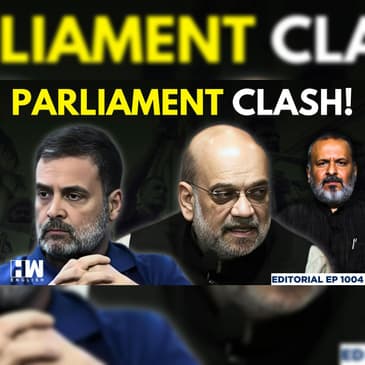

In this episode of Editorial, Mr. Sujit Nair questions whether we truly follow and respect Dr. B.R. Ambedkar, or if we merely pretend to do so. This discussion arises amid the confrontation outside the Parliament complex, where both the BJP and Congress accused each other's MPs of ""assault"" during protests over Home Minister Amit Shah's remarks on Dr. B.R. Ambedkar.
Learn more about your ad choices. Visit megaphone.fm/adchoices
[00:00:01] Namaskar, Welcome to another episode of Editorial. Our Home Minister Mr. Ramesh Shah made a statement on Dr. Babasai Bambedkar. This particular statement he made created a ruckus in the parliament. Ruckus!
[00:00:21] In fact, Bharatiya Janata Party MP Mr. Pratap Chandra Sarangi said that Rahul Gandhi pushed an MP and that MP fell on him and he is injured. He said I am critically injured because Rahul Gandhi pushed an MP and that MP fell on him and so on and so forth.
[00:00:41] Karge also said that somebody pushed him and he is also injured. So everybody seems to be injured. Why? Because of that statement. We will go through that statement.
[00:00:51] Karge also said that I had a statement. But before that, what I want to ask tonight is not about that statement. What I want to ask tonight is do we actually respect, follow Dr. Babasai Bambedkar like the way we pretend to do?
[00:01:09] Karge also said that Mr. Ramesh Shah said this.
[00:01:25] Hear this out.
[00:01:26] I can't give this, hear this out.
[00:01:26] I believe there is a passion.
[00:01:29] Now there is a passion.
[00:01:31] Ambedkar, Ambedkar, Ambedkar, Ambedkar, Ambedkar, Ambedkar, Ambedkar.
[00:01:35] If you take such a name to God, the universe will get the same life to that.
[00:01:40] It's a good thing.
[00:01:43] No, no, do not listen, do not listen.
[00:01:47] Do not listen to me?
[00:02:03] He said it has become a fashion to say Ambedkar, Ambedkar, Ambedkar, Ambedkar, Ambedkar, Ambedkar.
[00:02:09] If they took God's name so many times, they would have got a place in heaven.
[00:02:15] Take his name hundred times more.
[00:02:18] But I want to say what your sentiments about him.
[00:02:21] What he said.
[00:02:23] And of course, Congress and other opposition.
[00:02:26] It was a ruckus in the parliament.
[00:02:29] The point, my question is not about the statement.
[00:02:31] My question is not even about the ruckus.
[00:02:35] I'm kind of used to it now in the parliament.
[00:02:38] So I'm not even going to talk about the ruckus.
[00:02:39] What I'm going to talk about is do we really follow, respect Dr. Baba Sahab Ambedkar?
[00:02:49] Or are all these just pretending?
[00:02:53] It is just being pretentious.
[00:02:55] Do we really care about what Baba Sahab Ambedkar said?
[00:02:59] What Baba Sahab Ambedkar's vision was?
[00:03:01] And what Baba Sahab Ambedkar envisaged for our country?
[00:03:04] Do we really care?
[00:03:05] That's the question I want to ask you tonight.
[00:03:07] And I told you I'm going to tell you a story.
[00:03:10] The story is that 92%, 92% of sanitation workers are from SC, ST and OBC.
[00:03:23] 92% workers.
[00:03:25] According to a research, according to data provided by the government of India, what research?
[00:03:31] According to a data provided by the government of India, two thirds of the sewer and septic tank
[00:03:41] workers that is SSWs in urban bodies across India, two thirds are from schedule caste community.
[00:03:52] Two thirds.
[00:03:55] And almost 92%, like I told you, almost 92% of people, SSWs comes from schedule caste, schedule tribe and other backward class.
[00:04:08] 92%.
[00:04:09] 8% are from the balance.
[00:04:35] 9% are from the balance.
[00:04:42] Anti-error.
[00:04:44] If you've got the job.
[00:04:44] 1% of the rights of schedule caste, schedule tribe and OBCs, what exactly have they delivered to the people?
[00:04:53] If you juxtapose that to say doctors, what is the percentage of SC, ST and OBCs in doctors?
[00:05:02] What is the percentage of SC, ST, OBCs in top IIS positions?
[00:05:09] What is the percentage of SC, ST, OBCs in top IPS positions?
[00:05:15] What is the percentage of SCs, STs and OBCs in top business community of India?
[00:05:24] What is the percentage?
[00:05:28] Those percentages are decimal and the bulk is still SSW, septic and sewer workers.
[00:05:40] This is the state of India.
[00:05:45] This is the state of Schedule Cast, Schedule Tribe and OBCs in India.
[00:05:50] You see the point is not political alone.
[00:05:55] The point is our administrative flaws.
[00:05:59] The point is that we have flawed in our solution that we engineered to ensure that SCs, STs and OBCs were uplifted,
[00:06:11] were alleviated from the position they were.
[00:06:15] We created a creamy layer where a percentage of the SCs and STs and OBCs got the opportunity
[00:06:23] through possibly reservation or other methods.
[00:06:26] And that family, that creamy layer went on getting the privileges and they went on becoming big.
[00:06:32] But the large part under that creamy layer, which is the bulk of the audience, the people,
[00:06:44] they got nothing.
[00:06:47] They got nothing.
[00:06:49] And that's the point I wanted to make tonight.
[00:06:58] You see, what has parties, parties which claim to be dedicated to the upliftment of the Schedule Cast,
[00:07:09] Schedule Tribe and OBCs, what have these parties achieved for you?
[00:07:15] How has these parties helped the Schedule Cast, Schedule Tribe except for helping themselves
[00:07:22] to become ministers and union ministers and sitting in the cabinet and enjoying power?
[00:07:27] Other than they themselves enjoying power, how have they actually helped?
[00:07:32] Isn't it time that India stands up and realizes the fact that, listen, hello?
[00:07:37] No.
[00:07:39] You see, STs are where they were.
[00:07:43] 92% of sewer and septic tank workers, but not 92% of doctors, not 92% of IAS officers,
[00:07:53] not 92% of top businessmen, not 92% of top politicians.
[00:07:59] That's not the case.
[00:08:01] 92% of SSW workers.
[00:08:05] Do you see the problem?
[00:08:09] Why a lot of people talk about reservations and how reservation is unfair for others?
[00:08:19] To that some extent, I agree.
[00:08:22] But the fact is, has that reservation helped?
[00:08:24] The question is not whether reservation should be there or should not be there.
[00:08:29] The question is whether that reservation has helped.
[00:08:32] And if it has not, then who exactly is that reservation helping?
[00:08:36] Reservation to hora.
[00:08:36] Let us talk for a minute about solution.
[00:08:42] What exactly is the solution?
[00:08:44] Is reservation the ultimate solution?
[00:08:47] Is caste census the ultimate solution?
[00:08:52] Are these solutions?
[00:08:54] Or are they just political benefits that different political parties are trying to reap?
[00:09:03] My question is, by just doing census or by just giving reservation which we saw,
[00:09:13] are we going to solve the community's problem?
[00:09:15] The problem can be solved, A.
[00:09:20] Like I said, if we go beyond the creamy layer and start elevating people from beyond the creamy layer,
[00:09:29] underneath the creamy layer, go deep dive and try to alleviate people.
[00:09:35] That is the first thing that India needs to figure out.
[00:09:38] And the way you can figure that out is by ensuring that our infrastructure, schools, colleges,
[00:09:49] opportunities, reaches the last common denominator in our country.
[00:09:58] Reaches a nomadic tribe.
[00:10:01] Reaches a Adiwasi community.
[00:10:06] If our infrastructure, if these infrastructure like school, hospitals and opportunities can reach them,
[00:10:14] that is the way you alleviate them, you get them into mainstream, give them opportunities
[00:10:20] and therefore they perform, therefore they get their opportunity and they grow.
[00:10:26] That is a natural form of doing it.
[00:10:30] That is the best form of doing it.
[00:10:32] But like I always tell you, no politician is going to tell you this.
[00:10:36] No politician is going to tell you this is because
[00:10:40] the reason is that a lot of politicians knows that they will not be able to achieve it.
[00:10:46] Difficult hai.
[00:10:46] It's difficult.
[00:10:48] It is difficult.
[00:10:49] It is difficult to execute what I just told you.
[00:10:53] You see, countries much smaller than us.
[00:10:57] Countries much smaller than us.
[00:10:58] Countries like Mongolia have created opportunities for reindeer hunters, reindeer growers who stay
[00:11:08] in communities which are way, way out of human civilization.
[00:11:14] Small communities, communities of five people, six people, they stay in that community.
[00:11:19] A country like Mongolia has created opportunities where those people are bought into the mainstream.
[00:11:26] Those children are forced to go to a proper education process.
[00:11:32] They are inducted in schools.
[00:11:35] Their mothers are given accommodation in the schools so that the children can come and study.
[00:11:40] They get the children into mainstream.
[00:11:43] The child then moves out, goes to cities, goes to bigger cities, makes a career.
[00:11:51] That is how you integrate a society.
[00:11:53] That is how you integrate a community in a society.
[00:11:56] This has happened in countries much, much smaller than us.
[00:12:01] We still stick to caste census and reservations.
[00:12:06] I am not saying caste census is wrong.
[00:12:08] Neither am I saying reservation is wrong.
[00:12:11] I am saying, are they being used well?
[00:12:14] Are they really helping our people?
[00:12:16] Are they really uplifting our schedule caste and schedule tribe?
[00:12:22] That's the question I asked tonight.
[00:12:24] Till I see you next time.
[00:12:26] That's tomorrow at 10.
[00:12:27] Namaskar.