
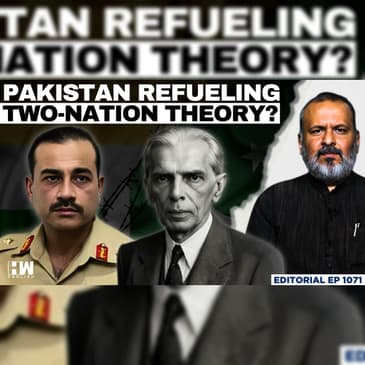
In this episode of Editorial, Mr. Sujit Nair discusses the Two-Nation Theory by exploring the lesser-known history of the pre-independence era. He examines how Muhammad Ali Jinnah and the Muslim League developed the theory between 1937 and 1946. After a significant defeat in the 1937 provincial elections, Jinnah began advocating the Two-Nation Theory through divisive politics. Mr. Nair raises the question: is Pakistan now attempting to revive the Two-Nation Theory?
Learn more about your ad choices. Visit megaphone.fm/adchoices
[00:00:00] Namaskar! Welcome to another episode of Editorial. Now this editorial of mine is going to be slightly A longish B, I am going to propose a theory to you. I want you to interact with this theory. I want you to give me your opinion about this theory. I want you to tell me whether you agree to me or you don't agree to me. Both ways is fine.
[00:00:30] And I want to talk about the concept of Two-Nation Theory. Two-Nation Theory of Pakistan and the fact that Pakistan is trying to desperately relaunch Two-Nation Theory in its own country. That's the topic of discussion today. And the fact that will we be helping them in some way to relaunch this Two-Nation Theory?
[00:01:01] That would also be a point that we will discuss today. Let's get right into the show. This concept of Pakistan trying to launch the Two-Nation Theory came to my mind with this particular speech made by an Army General, Aasim Munir. You hear this speech and then we talk about it.
[00:01:29] This speech is about the fact that you have to tell your children. So that they don't forget the story of Pakistan's story. We are different from the Hindus in every possible aspect of life. Our religion is different. Our customs are different. Our traditions are different. Our thoughts are different. Our ambitions are different. That was the foundation of the Two-Nation Theory that was laid there. That we are two nations. We are not one nation.
[00:01:56] Now why would a general want to talk about two nations? The foundation of Pakistan as he puts it which happened 75 years ago. What is a general talking about it? He was speaking with more passion than a historian. What was general talking about? Hindu, Muslim, we are different. Muslims are different. Hindus are different. What is he talking about? Is this what a military man talks? Is it concerning a military man? Does it concern?
[00:02:26] The military? And talking communal divide and all from a politician? I can understand. I can understand. From a religious whatever heads? I can understand. A military man in uniform sitting and talking about Hindu and Muslim? A religious man talking about history and say teacher children history and geography and all? I mean how does it make sense?
[00:02:51] It makes sense. But then when you deep dive? You realize that yes, it makes sense. He is talking about the Two-Nation Theory for his survival. For his survival. For his survival. His military survival. Because if he does not reestablish Two-Nation Theory in Pakistan, his military and he will have a problem.
[00:03:16] Let me try and explain this concept of Two-Nation Theory and why I say what I say. Now let us go back, zoom to 1937.
[00:03:31] 1936-37. Let us talk about 1936-37. This is pre-independence. You see, 1937, the British more or less knew that it was time to grant independence to India.
[00:03:46] 1937-37. The British more or less knew. They knew their time is ending. So in 1937, they announced the provincial elections. 1937. Now provincial elections, there were two major players. Congress and the Muslim League. Two major players. And you know what happened. 7 out of 7 provincial elections, they announced the provincial elections.
[00:04:14] Congress just swept the provincial elections. Congress got seven provinces. Seven provinces. Muslim League got zero. Muslim League could not form the government in one single province.
[00:04:34] 1937-37 India. Such was the state of Muslim League that imagine in 1937, in a place like Punjab, which went on to divide into Pakistan and India. In a place like Punjab, they just won one seat. They didn't form the government. Congress formed. But in that province, they just won one seat. And mind you, this was the same state.
[00:04:58] This was the same state that went on to divide into India and Pakistan. To be a manifestation of the two nation theory. Now, let me ask you a question. 1937 India, if Congress could form government in seven provinces and Muslim League couldn't form government even in one province, what does that mean? That technically means that there was no two nation theory. There was no Hindu-Muslim divide.
[00:05:28] That's why Muslims gave vote to Congress. Lock, stock and barrel. So, Congress formed the government. Had there been a two nation theory coming from the people of this country, coming from the people of then United India, then the Muslims would have voted for Muslim League Congress, Hindus would have voted for Congress. That would have happened. It didn't happen in 1937, mind you.
[00:05:53] So, the fact is, the fundamental basis of two nation theory was somehow in question. Now, where did this two nation theory then come from? You see, in 1937 ke baad, 1937 ke baad, people like Jinnah, they said, this is going to cause us problems. We will never be able to be in power. Congress will be in power.
[00:06:22] Because Muslims are also voting for Congress. There is no divide. So, after 1937 is when this concept of two nation theory was devised and propagated. And you know, it was devised and propagated not just by Jinnah, but it was promoted and propagated with the help of Alam Iqbal. Alam Iqbal was a poet and activist and politician and everything. He was all rolled in one.
[00:06:48] Alam Iqbal was one person who was hoping to be Rabindranath Tagore one day. But he realized, he couldn't be Rabindranath Tagore. He will never be Rabindranath Tagore if it was unified India. So, Alam Iqbal, Muhammad Ali Jinnah, both these people, both these gentlemen were predominantly and basically and fundamentally very secular people. Very secular people. Muhammad Ali Jinnah was almost a foreigner. He was almost like a Westerner.
[00:07:17] He followed the Western culture. He wore a suit, he had a drink and he was quite a Western man. Now this man who was almost following the Western culture, all of a sudden realized that there should be a divide between the Hindu and the Muslim.
[00:07:36] And Alam Iqbal, also similar person, who was a secular person till then, after 1937, said, thought that if we have to gain power, if we have to be in power, then there has to be this infusion of two nation theory, this divisive politics that we need to play, that will divide this country, the United India then. concept of two nation theory started in 1937.
[00:08:01] Now, let me read some articles for you from some historic books, which are very, very relevant and very, very well articulated. You see, Devendra Panigrahi has written this book called India's Partition, the story of imperialism in retreat.
[00:08:20] Very interesting book. Okay, in this book, he very beautifully narrates how two nation theory concept was seeded into Indian minds, into the minds of Muslims, especially. You see, he says that peers, revered both by Hindus and Muslims were roped in by the Muslim League to propagate the cause of Pakistan.
[00:08:49] Influential peers, you know peers, you know peers, these are seers, these are religious people. Peers like peer of Man ki Sharif, Jamaat Ali Shah, Khwaja Nizamuddin of Taunsa and Muktun Raji Shah of Multan were co-opted by the Muslim League to rally the cause of Pakistan.
[00:09:11] The peers conferred the title of peer and Sajada Nasheen, caretaker, successor of a peer on members of Muslim League. Prominent members like Shawkat Hayat Khan, Firoz Khan Noon and Iftikhan Hussain Mamdut were given semi-divine status by the peers to make them popular among the Muslims.
[00:09:36] And you all of a sudden had this concept of two nation theory taking off, taking off and percolating in this country. Who benefited? Muslim League benefited. Muslim League benefited. The overtly dangerous and Islamist approach of the Muslim League in the run up to the election was also shared by the then governor of Punjab,
[00:10:04] Bertrand Glacey said in August 16th 1945, he said that here is a very serious danger of the election being fought. So far as Muslims are concerned, on an entirely false issue, crude Pakistan may quite illogical, undefinable and ruinous to India and in particular to Muslims.
[00:10:34] But this does not detract from its potency as a political slogan. The uninformed Muslim will be told that the question he is called on to answer at the polls is, Are you a true believer or an infidel or a traitor? Against this slogan, the unionist have no spectacular battle cry.
[00:10:59] Very clearly, what the then governor of Punjab, Bertrand Glacey said that, and I quote him because, I would want to believe that this would be an unbiased and clear view without any prejudice. What he said is, listen, average Muslim for the first time in India is called on and said that, Are you a Muslim or are you an infidel?
[00:11:24] If you are a true Muslim, religious Muslim, then you have to be supporting the Pakistan theory. You have to be supporting Muslim league. And if you are not, then you support others. So a Muslim's faith was questioned. A Muslim was asked to vote on his faith. This happened from 1936 to 1946.
[00:11:52] Now the result of all this, the result of all this is in 1946, matters changed. In 1946, 91% of non-Muslims voted for the Congress and it captured 57 out of the 102 seats in the Central Assembly. But you know what happened?
[00:12:16] This time around, 86.6% of Muslims who had previously voted for Congress in 1936, In 10 years, after this two nation theory was created, percolated, propagated, advertised, 86% of Muslims voted and Muslim league captured 30 reserved seats in Central Assembly. Story changed, you are? The story changed.
[00:12:44] So, Muslim league came into existence because of the concept of two nation theory. Two nation theory came into existence by sheerly asking a Muslim that are you religious? If you are religious, you believe in two nation theory. If you are not religious, then you are with the infidels. A Muslim was put into that dilemma. And finally, a Muslim league was born.
[00:13:13] A Muslim league could win seats. And finally, that paved way for the Pakistan today. Also mind you, this 1946 election was considered as a referendum for the creation of Pakistan. That is when Jinnah and his Alame Iqbal went out and said that, listen, you know what, Dego? Muslims are with Pakistan. And that paved the way, like I told you, for Pakistan. Now you got the drift?
[00:13:42] Now let me connect all of this. Let me connect all of this. You see, Pakistan was formed with a concept which actually never existed on ground. In advertising, we call it false insight. Which actually didn't exist on ground. Because had it existed on ground, was that need really there? Was that concept really there? Then we would have seen it in 1936. We didn't.
[00:14:12] After this entire exercise was created, after this entire campaign was made, after this entire campaign was percolated, you saw the concept of two nation theory taking its shape. You saw Muslims saying that we are different, we will not vote for the Congress, we will vote for Muslim parties. And we may need another state. You saw that. Now, today, today, I want to go back to Asim Munir's speech.
[00:14:43] Today, why is he talking about two nation theory like I started my entire editorial with? He is talking about two nations theory today, is because 60% of Pakistan is below 30. 60% of Pakistan has no idea about what happened with Alame Iqbal and what happened with Muhammad Ali Jinnah. All that they are not aware of. They are not aware of there was a provincial election and you know, all that they are not aware of.
[00:15:11] Today, they also wonder why did we, why do we have Pakistan and what was the concept of Pakistan? What is the concept of Pakistan? Now, if Pakistan has to survive, A and B, this military has to be, you know, seen as Demi God, then the concept of this divide, that they are different. There, look at what he said. I will try and put that word once again. Just look at what he said.
[00:15:38] Well, our forefathers thought that we are different from the Hindus in every possible aspect of life. Our religion is different. Our customs are different. Our traditions are different. Our thoughts are different. Our ambitions are different. That was the foundation of the two nation theory that was laid there. That we are two nations. We are not one nation. The divide that he is talking about. They are different. Their thoughts are different. Their ways are different. That is necessary.
[00:16:06] That is necessary for the existence of Pakistan today. Because the youth of Pakistan is questioning the existence of Pakistan. The youth of Pakistan is talking about development. The youth of Pakistan is pointing towards India and say, Look, where are they? Where are they? Where are we? Where are we? And that's what is going to be dangerous for Pakistan.
[00:16:29] Especially dangerous for the army power of Pakistan. And that is why from nowhere, this general with his uniform and all that comes and talks about history and comes and begs people, Papa, Papa, please ensure that people believe in two nation theory. Please ensure that the theory is percolated. Because that is the reason for his existence and that is the reason for Pakistan's existence.
[00:16:52] More importantly, the army, his existence. And this is the concept that I wanted to make clear to you. Now to my next topic. Why do I say that could we be helping Pakistan in some way? Would we be helping Pakistan in some way to establish this two nation theory once again, especially in their country?
[00:17:19] Yes. Yes. Yes. And I'll tell you what I mean by that. You see, every Indian, every Indian Muslim who stood by us, who are by us and who is staying today in India, were those people, those 14-15% people who said that no, who are given a choice.
[00:17:38] Baba, if you are a Muslim, you are religious Muslim, then you vote for Pakistan or you are with the infidels. They chose to be the infidels. That is us. They chose us. They chose us over a threat. There are people. They decided with their own free will. They chose us. Nobody put a gun on their head. They decided to go against their community. They decided to go against the majority in their community.
[00:18:07] They possibly decided to go against a lot of cultural backlash which they would face. They decided, in spite of all that, they decided to be with India. They are us. We are them. We are one. The fact is, the day we start, consider them to be different. No? We are helping Pakistan relaunch the Two Nation Theory.
[00:18:35] We were told. We had told them. You see, that's precisely what I am trying to communicate through this editorial. Let us please not help Pakistan to relaunch their concept of two-nation theory by saying that Hindus are different, Muslims are different, they think differently, their ambition is different, our ambition. Let's not get into that.
[00:19:04] Because end of the day, every Indian thinks one. Every Indian's ambition is to see India possibly develop into a superpower. Every Indian wants it. Every Indian wants India to be prosperous, India to be prosperous economically, India to be prosperous military-wise, India to be prosperous overall. Every Indian wants to see that because it not only helps India, it helps his family too.
[00:19:30] So the fact remains that cowards, terrorists coming in and asking people to read Kalma and then shooting them down is a very deliberate act to create divisiveness in our society so that they can survive, so that Pakistan can survive.
[00:19:50] Finally to conclude, when you question an Indian Muslim's patriotism, please understand this is the second time he has been questioned. The first time his own community questioned him. His own community called him a traitor, called him an outcast and called him an infidel because he was supporting us. He wanted to stay with us.
[00:20:18] That was the first time he was questioned. His patriotism was questioned and he chose us. If you question him, this would be the second time. And when we question patriotism of our Indian Muslims, we are not helping us. We are not helping India. We are not helping Hindus either. We are helping those two nation theorists, that army officer who stands there and says
[00:20:47] that Hindus are different and we are different. And the second point I need to make before I conclude is, you see, I am not claiming that India has been very fair to our minorities. We have been great. We have been perfect. We have been good. I am not saying all that. We had our problems. We still have our problems.
[00:21:10] But the fact remains that our strength even today, even today, our strength lies in our unity. The unity that we have in our diversity. That strength nobody can take away from us. And that is the strength that most of our enemies are trying to break. That's the point I wanted to make till I see you next time.
[00:21:39] That's day after tomorrow with a very important topic on farmers and farmer distressed in Maharashtra. Take care. Namaskar.