
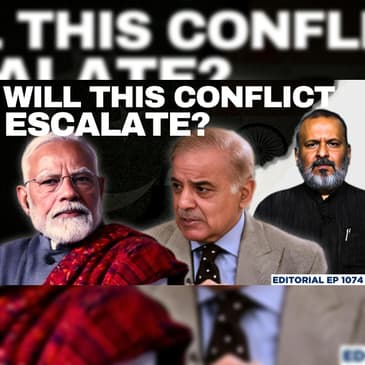
In this episode of Editorial, Sujit Nair discusses Operation Sindoor—a strike carried out by the Indian armed forces on terror camps across Pakistan and Pakistan-occupied Kashmir (PoK). The Indian Army neutralized terrorists across nine targeted locations. Mr. Nair commends the Indian government’s decision and also shares his thoughts on the possibility of further escalation with Pakistan.
Learn more about your ad choices. Visit megaphone.fm/adchoices
[00:00:00] Namaskar! Welcome to another episode of Editorial. Today morning at 1-5, the Indian Armed Force launched Operation Sindoor. Operation Sindoor lasted for 25 minutes. In 25 minutes, we gave our reply to those terrorists of Pahalkam. We gave our reply to the sponsors.
[00:00:29] Let's talk about Operation Sindoor. Let's get right to the show.
[00:00:38] Operation Sindoor. Possibly one of the most effective and well-strategized operations that Indian government ever launched against Pakistan or for that matter of fact, against any country. We only had war with Pakistan and China. So, yeah, one of the best strategic action that India has ever taken.
[00:01:06] Operation Sindoor is now on the 22nd of April. Let me explain the reason why. Let me start with the name Operation Sindoor.
[00:01:34] And you know, after shooting their husband, point blank, these terrorists had gone and told these women, you go tell your Modi. They did tell their Modi. And today at 1-5 in the morning, Modi answered these terrorists. And Modi answered brilliantly.
[00:01:56] The brand name Operation Sindoor itself was so well thought of. Because Operation Sindoor, the operation that our Indian Armed Forces carried out at 1-5 this morning, were dedicated to those women who are widows today.
[00:02:15] 26 of those women who are widows today because of those cowardly terrorist act who killed their husbands in front of them, killed their fathers, young children, fathers in front of them. So, today's operation, Narendra Modi himself named the operation and called it Operation Sindoor. And today's Operation Sindoor is dedicated to those 26 of them.
[00:02:38] To Hemanshi Narwal, to Hemanshi Narwal, to Sohini Adhikari, to Sheetal Kalatya, to Pragati Jagadale, to Sangeeta Ganbhote, to Sujata Bhushan, to Sheetal Ramchandran and 19 more. It's dedicated to Herodotra, to Sheetal Ramchandran and 19 more. It's dedicated to these young daughters of India, these virows who lost their husband.
[00:03:01] And today, India assured them, reassured them that India is there to protect them. If somebody tries to harm them, India is there to protect them. So, that makes Operation Sindoor so powerful, so close to an Indian's heart. So, that's one.
[00:03:22] Second, strategically, like I told you, it was beautifully planned and phenomenally executed is because the face of Operation Sindoor are two women. Colonel Sophia Khureshi and Wing Commander Vyomika Singh. Two young women from the Indian Armed Force. A Muslim and a Hindu.
[00:03:45] These two women are the face to India's response to those terrorists. These two women are the face. These two women are representing India to the world, talking about Operation Sindoor. And I thought, strategically, optically, it was one of the best steps that the government of India took. It re-emphasized the concept of Operation Sindoor.
[00:04:07] It also, very emphatically spoke about the fact that India is a secular country. We are a secular democracy. I quote these officers, where they say that our actions have been focused, measured and non-escalatory in nature. India has demonstrated considerable restraint in the selection of our targets and the method of execution.
[00:04:32] Pakistan, very, very rightly said, nine targets were identified, nine targets were attacked and we achieved what we wanted to. Pakistan responded by shelling, by bombing along the lines of LOC.
[00:04:51] Pakistan responded and we were expecting it because, according to sources, we also evacuated people from the LOC and we got them to bunkers to a safer place. India achieved its target. India achieved its target. India today killed almost ten relatives of Azar Masood.
[00:05:15] Azar Masood, one of India's most wanted terrorists, Azar Masood, who has been the brain behind so many operations in India. Let me give you a brief profile of this guy called Azar Masood. Azar Masood runs an organization called Jayshay Mohamad. Azar Masood had entered India with a fake Portuguese passport in 1994.
[00:05:41] He was arrested on 11th of February 1994 in Anand Nag. So he entered India and very soon he was arrested. Azar Masood was held and put in Tihar jail. But unfortunately, in 1999, Azar Masood was one of those prisoners we had to exchange with those hijackers in Kandahar.
[00:06:08] So he escaped us because of the Kandahar hijacking. And after that, what he did to us was unbelievable. Like I said, he founded Jayshay Mohamad in 2000. And Jayshay Mohamad's first major attack was suicide bombing on Jammu and Kashmir's legislative assembly in October 2001, killing 38 people.
[00:06:37] 2001 Indian parliament attack, December 13, 2001 in collaboration with Lasker-e-Tayyabha, nearly triggering a war between India and Pakistan. This, what we see today could have happened in 2001. Because he, with Lasker-e-Tayyabha, that is, that other fellow called Hafiz Sayeed had caused the parliament attack. So this was in 2001. Pathan Khot airbase attack.
[00:07:04] January 2 to 6, 2016, they killed nearly 7 Indian security personnel. 2019, Fulwama attack. February 14th, 2019, suicide bombing that killed 40 CRPF personnel. Multiple attacks in Kashmir, Jayshay Mohamad had conducted numerous strikes on Indian forces and civilians in Jammu and Kashmir, often using Fidain's, that is, suicide squads.
[00:07:28] And of course, Azhar Masood was famously known for his friendship with Hafiz Sayeed, who is again our number one enemy. Azhar Masood, 10 of his family members were killed, 4 of his aides were killed in yesterday's attack. 25 minutes. There are two things we need to understand about this particular operation and this particular escalation that happened in the border.
[00:07:59] One is the fact that yes, while a lot of us believe that war is never a solution and there is no winner in a war. But one should also understand that there is a level to tolerance. There is a level to what you can take and if you don't push back, you will end up being bullied all your life.
[00:08:21] There is at some point we have to say stop because at some point our ideology, our belief of non-violence cannot be taken as our weakness. So while one understood what this war could actually mean, one understood that this war, like I said, would help nobody, including India.
[00:08:47] We knew that, but at some point in time, an answer, a retaliation was necessary, more than necessary, which India did. What I am very happy today is the way India did it. India was almost picture perfect. Everything we did was right.
[00:09:06] Everything we almost tick marked every box that a matured responsible nation would do and a matured responsible nation was expected to do. When our cabinet sat in that meeting, the cabinet sat in the backdrop of Mahatma Gandhi. The message we sent to this world is that, listen, we believe in our principle of non-violence.
[00:09:35] We believe in that no matter which political party is sitting in the chair. We believe in the concept of non-violence. But push us no more. We will push back. I thought that message was beautifully communicated and like I said, we today showed the world that, listen, you know what? Our internal problems are our internal problems. That we will solve. But you know, there is no Hindu Muslim as far as India is concerned.
[00:10:06] When we talk, we talk as one voice. And that is what Colonel Sophia and Colonel Wing Commander Viomita showed the world today. My last point. You see, I personally speaking, personally speaking, I think this war will not escalate. This is my personal view. Our country, India, we are responsible. We do not believe in war.
[00:10:35] We are not war mongers. You hurt us, we hurt you back. And today, very surprisingly, the Pakistan defense minister released a statement which was quite surprising to me, where he said that this has been initiated by India. If India is ready to back down, they have taken the initiative. We have just responded.
[00:10:59] We have been saying all along for the last fortnight that we will never initiate anything hostile against India. But if we are attacked, we will respond. He said in his closing statement that if India backs down, we will definitely wrap up these things. If India backs out now, we will wrap up these things. India has almost achieved what it set sail for.
[00:11:29] We hit those terrorist areas. We killed those terrorists. Some of them still exist. Azhar Masood is still alive. Hafiz Said is still alive. But yeah, we almost achieved what we set sail for. I don't think that India is going to go for all out war and that is not what we are.
[00:11:57] Like I said, as a nation, we don't believe in that. Whatever, whichever the political party is, as a nation, we don't believe in win war. So to my mind, looking at statements that I see from Pakistan and the fact that I know India, I think this war will not escalate. But then this is my personal view. Till I see you next time. That's tomorrow at 10. Namaskar.