
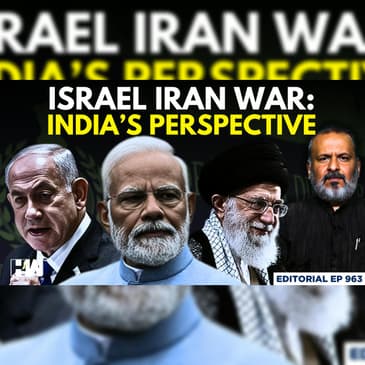
In this episode of Editorial, Mr. Sujit Nair discusses India's ties with Israel and Palestine, and how it has evolved over years. India and Israel have historically had a strange relationship, while India has always supported the Palestinian cause. Mr. Nair also examines how the ongoing conflict in West Asia could impact India's trade and oil prices.
Learn more about your ad choices. Visit megaphone.fm/adchoices
[00:00:00] Namaskar! Welcome to another episode of Editorial. Since yesterday night we were following up with the Israel-Iran conflict, the chances of this conflict becoming a Middle East regional conflict and growing is now becoming very high.
[00:00:20] Let's talk about our relationship with Israel. Let's talk about the Indian perspective in this entire conflict. Let's get right to the show.
[00:00:35] You know the reason I wanted to talk to you about Israel and India is because Israel and India, we share a very strange relationship.
[00:00:49] We were never the best of friends, but we were always in some form or another very close to each other. Both the countries helped each other when they needed help most.
[00:01:06] And yet we were, we always kept a one-armed distance from Israel. I'll tell you what I mean by that.
[00:01:12] You see Mahatma Gandhi and Nehru was never for Israel. They were never for separate Israel, that is partitioning Palestine to create Israel.
[00:01:22] So India therefore voted against the UN resolution 181 in November 1948. We didn't vote for partition of Palestine.
[00:01:34] Israel happened in May 14th of 1948. The Jews were okay with the partition, the Arabs were not. And Israel happened like I said on May 14th 1948. But India was not for it.
[00:01:50] But we didn't remain against it for long. Because September 1950, India recognized Israel and we started trade office in India. Israel started the trade office in India.
[00:02:05] There is no hidden fact that the right wing, even in 1947 and even in 1950 and even today shares a very warm equation or has a lot of regard for Israel.
[00:02:21] And the government of India has been very neutral. This is what it is. So we've come to 1950 when we started, when we recognized Israel and we got the, we got the trade office in India.
[00:02:36] In the 1950s we recognized, but you know our passport said that not valid in Israel. So we couldn't send our citizens to Israel.
[00:02:48] Because our passport was not valid in Israel. Our passport incidentally got valid in Israel in 1992 or we started sending citizens in 1992.
[00:03:02] So 1992 saw the current relationship that we have with Israel where there were embassies, consulates, passport valid and all of that.
[00:03:15] This is the point number one that I wanted to make. The point number two is one country which has helped India in the hour of crisis that has been Israel.
[00:03:30] That also is true. In 1971, during the India-Pakistan war, Israel helped us with arms for that war.
[00:03:40] Kargil war, Israel gave Indian Air Force targeted bombs and arms and ammunition.
[00:03:47] So Israel has constantly been supportive of India and India also under the radar has always been supportive of Israel.
[00:04:01] And whenever there has been right-wing government, especially Atal Vyar Iwaj Pai government and now Modi government, you have seen the peak in Indo-Israel relationship.
[00:04:10] In fact, Modi was the first prime minister, Indian prime minister to have visited Israel.
[00:04:15] But that being said, be it right-wing or be it left-wing, as far as India is concerned, we have always kept, we have always been in the center.
[00:04:24] We have not taken sides with Israel against Palestine nor have we taken Palestine's side against Israel.
[00:04:33] Both have not done.
[00:04:34] We have never been part of the Arab group to support the Arab and Palestine cause nor have we supported Israel overtly.
[00:04:42] To go and support Israel for everything they have done.
[00:04:48] In fact, let me give you some interesting facts.
[00:04:50] October 7, 2023, in the immediate wake of Hamas attacks, India abstained from a United Nations General Assembly resolution calling for a ceasefire.
[00:05:02] However, two months later, with the death toll of Gaza causing 20,000 then, India voted in favor of United Nations General Assembly resolution condemning Israeli settlements in Palestine.
[00:05:18] So, we, as late as 2023, voted against Israel and Israel settlement in Palestine.
[00:05:30] So, somewhere down the line, we have genuinely been in the center.
[00:05:36] Also, we need to understand that we do not recognize Hamas as a terrorist organization.
[00:05:42] Neither do we recognize them.
[00:05:44] I mean, we don't recognize Hamas at all.
[00:05:46] We don't call them a terrorist organization.
[00:05:48] Neither do we call them any proper resistance or something.
[00:05:52] We do not recognize them at all, as far as India is concerned.
[00:05:56] But, Israel recognizes Lashkar-e-Tayyaba as a terrorist organization.
[00:06:03] And, mind you, India was campaigning for Lashkar-e-Tayyaba to be recognized as a terror organization.
[00:06:10] Israel obliged.
[00:06:14] Now, this is the typical relationship between India and Israel.
[00:06:18] As far as India is concerned, Israel has always been friendly and always been a good partner.
[00:06:29] Good trade partner.
[00:06:31] Good partner as far as our defense is concerned.
[00:06:35] But, as far as India is concerned, we also need to understand that India has a large percentage of Muslims.
[00:06:42] The Indian Muslims has a soft corner for the Arabs, for the Palestine.
[00:06:50] Also, from a moral perspective, India's stance has been very clear.
[00:06:57] You see, while India understands that the Jews went through hell during Holocaust,
[00:07:04] but that had nothing to do with Palestine.
[00:07:07] That had nothing to do with the Palestinians.
[00:07:09] So, finally, the result of the Holocaust and people, the Jews wanting their own land,
[00:07:17] actually affected the Palestinians more than anybody else.
[00:07:20] It didn't affect Germany.
[00:07:21] It affected the Palestinians.
[00:07:23] This is what has been the question that India has been raising since 1948.
[00:07:28] So, India recognizes the rights of Palestinians.
[00:07:34] That has always been there.
[00:07:36] So, this defines the core of India's relationship with Israel.
[00:07:41] So, that's where we stand.
[00:07:43] As far as India is concerned, India has a fairly decent relationship with Iran.
[00:07:49] India has a fairly good relationship with most of the Arab countries.
[00:07:53] In fact, with almost all Arab countries.
[00:07:55] So, that's where we stand.
[00:07:58] This war is going to spread.
[00:08:01] This war may involve a lot more countries in the near future.
[00:08:08] And if that happens, then India's trade position, India's economic position will be hampered.
[00:08:18] Because it's going to have impact on India's trade.
[00:08:21] It is going to have negative impact on India's trade.
[00:08:24] Number one.
[00:08:25] Number two.
[00:08:27] It is also going to affect the oil price.
[00:08:33] And that also is going to affect a common Indian.
[00:08:37] Here, we were just coming out of Ukraine-Russia war.
[00:08:42] And now, here we are in something which is larger in size and possibly something which is more closer to India and the Indian economic lifeline.
[00:08:55] So, that's point number two.
[00:08:57] The last point I want to make.
[00:08:59] The last point I want to make is not about India but about United States.
[00:09:04] You see, like I said that India is very cautious and very does a tightrope walk when it comes to relationship with Israel.
[00:09:14] Because India has a large Muslim population.
[00:09:18] Likewise, United States also is very cautious when it comes to their relationship with Israel.
[00:09:25] In this case, because they have a large Jewish population.
[00:09:29] And a very influential Jewish population in United States.
[00:09:36] So, United States will always stand with Israel.
[00:09:40] And which we have seen.
[00:09:42] US has given an unconditional support to Israel yesterday.
[00:09:45] And they will help them with arms.
[00:09:48] They will help them with ammunitions.
[00:09:49] They will help them with even military.
[00:09:52] Now, as far as Israel is concerned,
[00:09:57] It is said that a Benjamin Netanyahu is more closer to a Trump than possibly to a Biden.
[00:10:08] Or to a Kamala Harris.
[00:10:11] But if there is a conflict.
[00:10:13] And in this conflict, you actually see the American soldiers in war.
[00:10:20] And if there are dead bodies coming back to United States.
[00:10:28] Then, that may have very, very severe impact on Kamala Harris's election run.
[00:10:35] That is for sure.
[00:10:37] So, somewhere down the line, a lot of things are going to be affected.
[00:10:42] A lot of things in a lot of places across the globe are going to be affected.
[00:10:46] And the last point I wanted to make.
[00:10:50] If you see, traditionally,
[00:10:53] Traditionally, whenever America has been involved in a particular conflict,
[00:10:58] Russia has always stood by the other side.
[00:11:02] Is Russia going to be therefore involved with the other side in this case?
[00:11:08] That is the Arabs.
[00:11:10] Is Russia going to support the Arabs?
[00:11:13] That is something that one needs to see.
[00:11:16] At the moment, Russia has not taken any stance.
[00:11:19] They have kept out of it.
[00:11:21] But future, you never know.
[00:11:23] So, these are factors that one should be looking out for.
[00:11:27] And these are factors that may directly or indirectly concern us as Indians.
[00:11:33] And that is why I thought I should get these points to your notice.
[00:11:37] Till I see you next time.
[00:11:39] That's tomorrow at 10.
[00:11:40] Namaskar.
[00:12:19] Now, as Maharashtra gets set for the 2024 Assembly elections,
[00:12:29] We believe that we have the infrastructure, we have the know-how,
[00:12:33] we have the experience of covering Maharashtra.
[00:12:35] We want to cover the Maharashtra elections.
[00:12:37] What are the issues on the minds of the voters?
[00:12:40] Can sitting Chief Minister Eknath Shinde defend his turf
[00:12:43] with the BJP and Ajit Pawar by his side?
[00:12:46] Or will the legacies of Thakres and Pawar prevail?
[00:12:50] What role will Manoj Jalange Patil face leading the Maratha agitation play?
[00:12:55] Now, for us to cover the Maharashtra elections, we need some funds.
[00:12:59] We need some money.
[00:13:00] We need around 5 to 6 lakh of rupees.
[00:13:03] I would urge our patrons.
[00:13:05] I would urge our viewers.
[00:13:07] Viewers who appreciate our work.
[00:13:11] Viewers who think we are worth that.
[00:13:14] I would urge you to contribute.
[00:13:16] I would urge you to contribute to this venture.
[00:13:21] Give us that 6 lakhs so that our journalists can go to nook and corner of Maharashtra.
[00:13:26] Find out exactly what the problem of Maharashtra is.
[00:13:29] Log on to our website hwnews.in.
[00:13:32] Click on the subscribe us button.
[00:13:34] Select an amount you wish to contribute.
[00:13:36] And support independent journalism.
[00:13:39] Stay ahead with our cutting edge news app.
[00:13:42] Instantly access the latest shots in just one minute
[00:13:45] and breaking news in just 50 words.
[00:13:47] Download now for a smarter, faster news experience.