
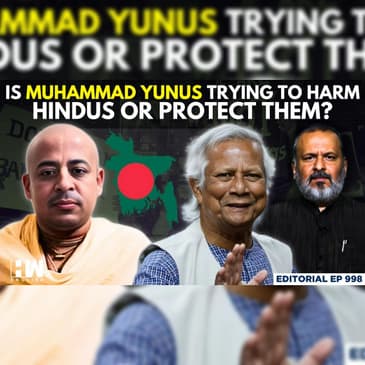
In this episode of The Editorial, Mr. Sujit Nair discusses the ongoing Bangladesh crisis and Chief Advisor Muhammad Yunus's failure to protect Hindus. The turmoil intensified after a Hindu monk was arrested for sedition, sparking nationwide protests. Hindus are under attack, and temples have been damaged by mobs. Mr. Nair examines the politics of Bangladesh and how the country reached this stage.
Learn more about your ad choices. Visit megaphone.fm/adchoices
[00:00:00] Namaskar. Welcome to another episode of Editorial. There has been 200 cases of violence against Hindus in Bangladesh. Yunus Muhammad who had taken over as in charge of Bangladesh failed the Hindus of Bangladesh.
[00:00:29] Let's talk about Bangladesh, let's talk about Yunus Muhammad, let's talk about these riots and let's talk about what could be the future of Bangladesh.
[00:00:41] Let's get right into the show. So, Sheikh Hasina from the Awami League party was thrown out from Bangladesh by the students of Bangladesh, the people of Bangladesh.
[00:01:01] Sheikh Hasina was thrown out because a lot of students believe that she killed the concept of democracy in Bangladesh, amongst a lot of other things.
[00:01:13] I have done a detailed editorial, I will kind of attach it with this particular one.
[00:01:19] But she was thrown out primarily saying that she killed the concept of democracy in Bangladesh. She is taking her political asylum in India. She is in India.
[00:01:35] And came in this gentleman called Yunus Muhammad. Yunus Muhammad is a Nobel Prize laureate. He is a very respected gentleman in the world. Yunus Muhammad came in and said that, listen, you know what?
[00:01:52] I will only be the advisor to the state if Hindus are protected. Hindus are protected.
[00:02:00] Hindus are protected. Because I am a secular person, this is a secular country. I want Hindus to be protected as much as a Muslim is in Bangladesh. This is what he said.
[00:02:11] The whole world including us, great, fantastic, what a man and good, good. This is the kind of leader that Bangladesh needs.
[00:02:23] So he came in. Now, some experts, especially people who have been dealing with Bangladesh, said that,
[00:02:34] Look, this gentleman will not be able to bring peace and may not bring peace to the region.
[00:02:46] Because there is a party called Jamat-e-Islami. This party is supporting this man and this man needs that party's support.
[00:02:55] And till such time that that party is there and that party flourishes and he allows that party to flourish, Hindus won't be safe.
[00:03:06] Some experts had said that even then. But Muhammad Yunus was very clear. He said, no, nothing doing.
[00:03:12] Hindus have to be safe. If Hindus are not safe, I will not take over. I will resign. I will go back.
[00:03:18] I will do this job. Okay. This was like I told you, August 2024.
[00:03:25] August passed, September passed, October passed, November passed, today we are in December.
[00:03:34] Now the story seems to have changed. You see, when Muhammad Yunus was asked that,
[00:03:42] that, by Al Jazeera, a very famous Middle East channel, was asked as to,
[00:03:47] you, bhai, theek hai, now you have taken over, you are the advisor to the state. Abhi, election ka bhi kara ho ga yaar.
[00:03:54] When are you gonna do the election? You said that, Sheikh Hasina represented absolute killing of democracy.
[00:04:04] She killed democracy. She represented anarchy. That is what you said. So, that is why you came in.
[00:04:11] That is what the students protest was all about. Now students protest ho ga yaa.
[00:04:15] Ultimately, the biggest sufferer of all this, after Sheikh Hasina or with Sheikh Hasina, were the Hindus of Bangladesh.
[00:04:21] Okay. So, all this happened now. When are you going to have a re-election? When are you going to have an election?
[00:04:27] And when are you going to set up a democratically elected government?
[00:04:33] Everybody, he was expecting him to say, in the next two months, in the next ten days, in the next three months.
[00:04:40] That is what one was expecting. But he said, no, no, no, no, no, no. He said in three to four years.
[00:04:45] What he said is, while the exact time frame of interim government tenure has not been determined, it should be under four years.
[00:04:53] It should be under four years. That's for sure. It may be lesser.
[00:05:00] The moment you hear words like this, no, you should realize that this is not going to happen soon.
[00:05:06] You know, that time frame has not been decided.
[00:05:09] Are you? Why?
[00:05:11] You wanted to get reforms.
[00:05:13] Why do you reform on life?
[00:05:15] This is how Idi Amin took over Uganda.
[00:05:18] That, you know, I want to get reforms. Once I get reform, no, I am going to conduct elections.
[00:05:23] And I am going to hand over charge to an elected president.
[00:05:25] This is what Idi Amin said.
[00:05:28] Every possible non-elected person, be it a dictator or I don't know what else can one call that kind of person, an anarchist, says that time frame, Baba is not decided.
[00:05:42] But, yeah, four years, I will try and hand over the government.
[00:05:49] What kind of reforms are you setting in?
[00:05:52] Killing of Hindus?
[00:05:55] Breaking down Hindu temples?
[00:05:59] From August to December, you couldn't control your crowd.
[00:06:05] You couldn't control the attack on Hindus, on minorities.
[00:06:12] And like we talk about our own country, whenever there is attack on minorities, we talk about every country.
[00:06:21] Wherever there is attack on minorities.
[00:06:26] Here, this is blatant attack on minorities.
[00:06:31] A lot of people in India try to make use of it and, you know, try to blow up situations and try to kind of make it larger than life and all that.
[00:06:40] Wo sab tha August, September, May.
[00:06:42] But now, things seem to be getting more and more real.
[00:06:46] Attack on minority has not stopped.
[00:06:49] It is not just figment of somebody's imagination.
[00:06:52] It is not just propaganda.
[00:06:54] There is a lot of reality into the entire story.
[00:06:58] Now, Bangladesh cannot go and tell the world that,
[00:07:06] Look, this is all propaganda against Bangladesh.
[00:07:10] It is all to defame Bangladesh.
[00:07:12] You can't no longer say that to the world.
[00:07:16] The world today started questioning you.
[00:07:19] The world today has realized that you are not able to take care of your Hindus.
[00:07:23] And that's not good news for you.
[00:07:28] You see, I used to have a very good image about Bangladesh.
[00:07:35] I always saw Bangladeshis as a very industrious lot.
[00:07:40] I am still saying most of the people may be good.
[00:07:43] I mean, I am not again saying that people of Bangladesh are bad.
[00:07:46] It could be some section of people.
[00:07:48] But I am still saying as a country they were doing well.
[00:07:51] Their economy was doing well.
[00:07:55] Their business was doing well.
[00:07:56] Their textiles, they were dominating the world.
[00:08:00] They were getting frustrated.
[00:08:00] Where did you get frustrated?
[00:08:02] What have you got yourself into?
[00:08:06] What have you got yourself into?
[00:08:08] You see, this entire, the core of the problem,
[00:08:14] the core of the problem here is this party like I told you called Jamaat-e-Islami.
[00:08:21] Now, before I get into Jamaat-e-Islami and all that, let me tell you,
[00:08:24] there are three major parties.
[00:08:25] Let me actually, one second.
[00:08:27] Let me give you a background about Bangladesh first.
[00:08:31] You see, Bangladesh, like Pakistan, has been a country which had constant military interventions.
[00:08:40] Constant military interventions, constantly their democracy was crushed.
[00:08:45] Constantly.
[00:08:45] In fact, they had close to 29 military coups between 1975 to December 2011.
[00:08:55] 29 military coups, 29 military coups.
[00:08:59] They had 1975, 1977, 1980, 1982, so on and so forth.
[00:09:04] 29 military coups.
[00:09:06] So, it was a country which was, which didn't care much about democracy, number one.
[00:09:14] Now, lately, Bangladesh started focusing on their economy.
[00:09:21] In fact, their economy was doing fairly good.
[00:09:24] The development was almost on track and all of a sudden the world stood up and started taking notice of Bangladesh.
[00:09:33] A lot of us spoke about Bangladesh and spoke about how well Bangladesh is doing in terms of their economy and in terms of their trade and in terms of their alleviating their poverty, empowering their women.
[00:09:46] What do you mean?
[00:09:47] They were doing well.
[00:09:50] Now, in Bangladesh, there are three major parties like I was telling you.
[00:09:55] So, I told you about coups.
[00:09:56] There are three major parties in Bangladesh.
[00:09:58] One is this party called Bangladeshi Nationalist Party, BNP.
[00:10:02] Bangladesh Nationalist Party is headed by none other than Begum Khalidazia.
[00:10:08] Khalidazia served as the Prime Minister of Bangladesh from March 1991 to March 1996.
[00:10:14] And again from June 2001 to June 2006.
[00:10:19] She was the first female Prime Minister of Bangladesh.
[00:10:23] After the military coup in 1982, led by the Army General Hussain Mohamed Irshad, Zia helped lead the movement of democracy until the fall of Irshad in 1990.
[00:10:39] So, this is one of their parties which is the Bangladesh Nationalist Party.
[00:10:46] Bangladesh Nationalist Party fought vehemently for the democracy.
[00:10:51] Begum Khalidazia fought vehemently for democracy against General Irshad.
[00:10:57] So, that is BNP.
[00:11:01] Now, let's talk about Avami League.
[00:11:04] Avami League is Sheikh Hasina's party who was just thrown out of Bangladesh.
[00:11:09] Avami League, I said Sheikh Hasina was the daughter of Mujibur Rahman, the first president of Bangladesh.
[00:11:15] Now, Sheikh Hasina also has one more record.
[00:11:20] She has ruled Bangladesh for over 20 years.
[00:11:24] In fact, her rule was from June 96 to July 2001, from Jan 2009 to August 2024.
[00:11:35] She has ruled Bangladesh for over 20 years.
[00:11:39] This is Sheikh Hasina.
[00:11:41] This is party 2.
[00:11:43] Sheikh Hasina was seen as a very secular person.
[00:11:48] Sheikh Hasina was seen as a friend of India.
[00:11:50] She always wanted good relations with India and also, to some extent,
[00:11:56] Sheikh Hasina was seen as somebody who was very progressive in terms of economy.
[00:12:04] She really developed the economy of Bangladesh.
[00:12:07] Now, so it was not that Sheikh Hasina was the best governor and the best government and all of that.
[00:12:14] Sheikh Hasina also had her own set of problems.
[00:12:18] A lot of people believed that she was very autocratic.
[00:12:20] Her decisions were very autocratic.
[00:12:21] A lot of people believed that some of the elections conducted under her regime were not fair.
[00:12:27] That too.
[00:12:28] She put a lot of opposition in jail.
[00:12:31] That too.
[00:12:32] All this happened.
[00:12:33] The biggest problem though was the quota issue.
[00:12:36] You see, her father, Mujibur Rahman, had given quota for the freedom fighters.
[00:12:40] And that quota was continued to the freedom fighters' children.
[00:12:43] Now, that was not something that the youth of today's Bangladesh accepted.
[00:12:48] So, they had a problem.
[00:12:50] The court didn't accept that.
[00:12:52] They had a problem.
[00:12:53] But, Sheikh Hasina insisted that it should continue.
[00:12:57] Possibly, it was an ego issue for her.
[00:12:59] And it got continued.
[00:13:01] But then, later on, I think in 2018, she succumbed and she stopped everything.
[00:13:07] But then, she stopped the entire quota system.
[00:13:10] The students were asking for reforms in quota.
[00:13:13] Wherein she stopped all the quota.
[00:13:15] She said, if freedom fighters won't get one, who won't get one?
[00:13:18] Now, the story didn't get over here.
[00:13:19] The story didn't get over here.
[00:13:21] So, she banned all quotas.
[00:13:22] Like I told you, she said, if one is not getting, nobody will get it.
[00:13:25] Now, 2021, a group of petitioners went to the High Court and they said, no, this quota for freedom fighters should continue.
[00:13:35] 30% quota for freedom fighters should continue.
[00:13:38] And, July 1st, 2024, the court ordered that the quota for freedom fighters' children has to be reinstated.
[00:13:51] This sparked the violence.
[00:13:55] This made the entire thing worse.
[00:13:57] So, this is Sheikh Hasina.
[00:14:00] I have given you in a nutshell.
[00:14:01] Like I told you, I have done a very elaborate editorial on that.
[00:14:05] Please do have a look at it.
[00:14:07] And that's as far as Sheikh Hasina is concerned.
[00:14:09] So, I have spoken to you about the Bangladesh National Party and Begum Khalidazia.
[00:14:14] I have spoken to you about the Avami League and Sheikh Hasina.
[00:14:19] Now, let me speak to you about this party in question.
[00:14:22] That is, Bangladeshi Jamaat-e-Islami.
[00:14:27] Now, Bangladeshi Jamaat-e-Islami is a radical Islamist party.
[00:14:34] For starters, this party didn't want Bangladesh to split at all.
[00:14:39] They didn't want Bangladesh to happen.
[00:14:42] They were very happy with Pakistan.
[00:14:45] They wanted to remain with Pakistan.
[00:14:47] They wanted a perfect Islamic country with Pakistan.
[00:14:52] So, that was this particular party.
[00:14:55] Now, in 2013, just to give you some pointers.
[00:14:59] In 2013, Bangladesh Supreme Court cancelled the registration of Jamaat-e-Islami.
[00:15:05] Ruling that the party is unfit to contest national election.
[00:15:09] It was fully banned by the government on 1st August 2024.
[00:15:14] Its preceder, the Jamaat-e-Islami Pakistan, which is what I told you.
[00:15:18] They were a Pakistani party and they wanted to remain in Pakistan.
[00:15:22] The Jamaat-e-Islami Pakistan strongly opposed the independence of Bangladesh and the breakup of Pakistan.
[00:15:27] Upon the independence of Bangladesh in 1971, the new government banned Jamaat-e-Islami, like I told you.
[00:15:33] They banned Jamaat-e-Islami and said,
[00:15:35] Yeh, Yeh, Bangladesh ka party hai ni.
[00:15:37] So, this party was banned.
[00:15:39] Long and short of it is,
[00:15:40] It is a hardcore, fundamentally radical Islamic party.
[00:15:47] A party that wants Bangladesh to be total Islamic.
[00:15:51] A party that do not want to see Hindus survive and thrive in Bangladesh.
[00:15:59] Now, the thing is, this particular party aligned with the BNP, the Bangladesh National Party of Begum Khalidazia.
[00:16:09] They aligned with Begum Khalidazia once they were in the mainstream politics after they were banned initially in 1971.
[00:16:18] So, this political party, they say, a lot of people say, instigated the violence, the students' violence to a very major extent.
[00:16:28] And this political party, a lot of experts say, is currently influencing Muhammad Yunus.
[00:16:36] Now, are you getting the picture?
[00:16:39] The picture is, Muhammad Yunus is not willing to hand over the government and conduct a free and fair election.
[00:16:47] He is not willing to do that.
[00:16:49] He is saying that he will take minimum four years, maybe less, but minimum four years.
[00:16:55] But again, he says, time frame, I am from allum niya amko.
[00:16:58] And the fact is, a lot of people believe that he has been guided.
[00:17:03] Jamaate Islami.
[00:17:04] Jamaate Islami wants Hindus out.
[00:17:08] Now, this said, there is a second theory.
[00:17:13] There is a second theory that is also making the rounds.
[00:17:19] You see, Sheikh Hasina had a lot of enemies.
[00:17:24] Sheikh Hasina had put almost all our opposition party members, all our opposition behind bars.
[00:17:31] So, Sheikh Hasina definitely had a lot of enemies.
[00:17:34] Including Khalidazia was put behind bars by Sheikh Hasina.
[00:17:39] Now, the thing is, chances are, if an election is conducted tomorrow, Khalidazia, that is her BNP, Bangladesh Nationalist Party, with Jamaate Islami may come to power.
[00:17:54] Jamaate Islami may dominate.
[00:17:57] So, chances are, Muhammad Yunus is trying to stop that from happening.
[00:18:04] Because, if Jamaate Islami comes to power, things are going to be worst for the minorities.
[00:18:11] Worst.
[00:18:13] So, there is a chance that, Muhammad Yunus understands this.
[00:18:19] Muhammad Yunus understands the reality on ground.
[00:18:22] And, Muhammad Yunus is trying to stop.
[00:18:25] And that is exactly why he says, I can't do an election.
[00:18:29] I can't call for an election now.
[00:18:33] I can't call for an election now.
[00:18:35] Possibly.
[00:18:36] The reason, like I said, is if the election happens, chances are, these guys may come to power.
[00:18:41] That is, BNP and Jamaate Islami.
[00:18:43] And things may be worse.
[00:18:44] Because, Avami League, at the moment, is hit rock bottom.
[00:18:50] Avami League, chances of Sheikh Hasina winning an election, is almost next to impossible.
[00:18:56] At the moment.
[00:18:59] Maybe, some people say, maybe, Muhammad Yunus is buying time.
[00:19:08] Buying time, so that matters cool down.
[00:19:11] And, there is a proper pitch between Avami League, Bangladesh Nationalist Party, and maybe, the people can make the right choice.
[00:19:26] That, too, is a theory that has been circulating.
[00:19:32] And, that, too, is a theory that we should be considering.
[00:19:36] This is the point that I wanted to make.
[00:19:40] Till I see you next time.
[00:19:42] That's tomorrow at 10 PM.
[00:19:45] Namaskar.
[00:19:54] Namaskar.