
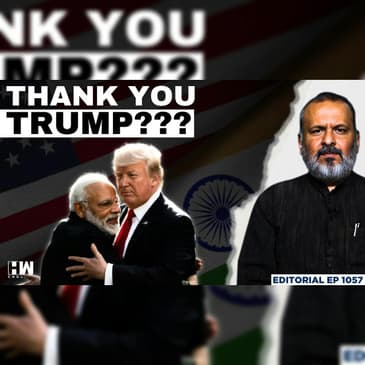
In this episode of Editorial, Mr. Sujit Nair discusses the tariffs imposed by U.S. President Donald Trump on countries worldwide. Specifically, Trump has imposed a 26% reciprocal tariff on India. Mr. Nair examines the case and its impact on India and Indian businesses. The discussion is structured around three perspectives: business, social, and political.
Learn more about your ad choices. Visit megaphone.fm/adchoices
[00:00:00] Namaskar! Welcome to another episode of Editorial. Donald Trump has imposed 26% reciprocal tariff on India. Now let us understand this 26% tariff from three perspectives. One is from a business perspective. Second, from a social perspective. Third, from a political perspective.
[00:00:30] Let's get right into the show. Okay, so firstly let's understand this concept of reciprocal tariff and why does Trump want to impose reciprocal tariff on the world? Let us understand that first. The man has some logic to it. Trump says that,
[00:01:03] you, that is the other countries, their producers come and market your product in my market. I charge you very little tariff. So what happens to your product? Your product in my market, you will get a price advantage. Because I charge you very less tariff. When my products come to your market, you charge me huge tariff.
[00:01:30] So what happens? My product is very expensive in your market. So I find less buyers. He says, How is this? I give you my market? I give you my market by ensuring that you pay less tariff and you are actually blocking me from covering your market because you impose more tariff on me. He says, I will increase your price. He says, I will increase your price.
[00:01:57] He says that I am going to have reciprocal tariff which means that you have two choices. Either you reduce my tariff or I will increase your tariff in my country. Two choices. Oh, Abhisam Balalo. If you say that you increase my tariff, I will sell at a competitive price yet. So fine. Fair enough. Do it. Or you increase your, you decrease your tariff for my products. I will decrease my tariff or keep the tariff same for your product. This is what he says.
[00:02:27] Now why is Trump saying this? You see, Trump says that listen, my manufacturers, my entrepreneurs, my businessmen, they produce and they too have to sell to the global market. But whenever my producers, my manufacturers come to your country and try to sell their product because of your tariff, they always are at a disadvantage. They always are at a disadvantage.
[00:02:54] When Harley Davidson, for instance, is sold in India, it is sold at a higher price because you are leaving so much tariff. Tesla couldn't sell in India because Tesla said, who will give such taxes? Who will give such taxes? So the US says that listen, it is not on. When my manufacturers come, we are at a disadvantage. Now what happens if that continues? If that continues, which means my manufacturers won't get your market.
[00:03:21] Therefore, my manufacturers won't have a chance to grow. And if my manufacturers don't have a chance to grow, which means I may not be able to, I may not be able to create that kind of employment in my, in my country. So that's a problem. So to create the employment in my country, I would want to support my manufacturers. And therefore, I am asking you, you reduce, reduce your tariff. Else, I will increase mine.
[00:03:48] Okay, okay. This is one logic and looking at from his perspective, it is fair. But then no, there is a reverse side to it. There is a reverse side to it. The reverse side is that while American manufacturers, they are one of the best, they have the best brands in the world.
[00:04:08] But a lot of these manufacturers depend on a lot of other countries to give spare parts, to give as ancillary units. So a lot of spares for a lot of produce of theirs, they depend on other countries to give them. For instance, Canada gives a lot of automobile spare parts to United States.
[00:04:35] In fact, that is one of the largest trades between Canada and United States. One of the largest trades. Gas, of course, being another. So the fact remains that when you increase the tariff, your producers will have to now pay more money for their spare parts, for their raw materials. They have to pay more money. Who pays finally?
[00:05:03] End of the day, American consumer will pay more. American consumer will end up paying more. For instance, Canada will say, If you have raw materials, you can't change the tariff, you can't change the price. Now, you can't overnight change vendors. It is not possible. It is not possible. It will take you another three to four years to change the vendors, find another alternative vendors, deal with them, ensure that they meet your quality standards, get the vendors, use it into your components and then sell it.
[00:05:33] It takes two to three years to four years at times. So, which means, end of the day, there is a very high chance that the price of a reciprocal tariff will be borne by the American consumers. As much as it affects the rest of the world. So, that's my point number one. Now, let us come to India, which is what really matters to us.
[00:06:03] You see, India, according to a report, Donald Trump says that India charges 52% tariff and, you know, therefore, we are going to only take half. That is, we are only going to charge half, which is 26% tariff to India back. So, this is what he says. And, according to some reports that I have, India on an average charges 12% tariff on US and US charges 3% tariff on India.
[00:06:33] The difference is, therefore, 9%. So, yes, I mean, broadly, the difference exists. There is a 9% difference. So, he says that, you see, I am going to charge India. I am going to charge less because he is my friend. In fact, he made a very, very important statement where Trump says, India, very, very tough, very, very tough. The Prime Minister just left. He is a great friend of mine.
[00:07:02] But I said, you are a friend of mine, but you are not treating us right. They charge us 52%. You have to understand, we charge them almost nothing for years and years and decades. So, this is what he said. So, while we have reduced tariffs on Harley-Davidson, which is kind of good news, we have reduced tariffs on bourbons, that is whiskey, the American whiskey as it's called. That's also good news. And we have reduced tariffs on Google Tax. That also is good news.
[00:07:31] So, we have reduced tariffs. We are succumbing. Now, the fact remains that here, I don't think there is point in putting too much pressure on Mr. Narendra Modi. I will tell you why. You see, United States of America is one of the world's largest importer. They are also one of the world's largest exporters.
[00:07:57] But as far as India is concerned, the trade deficit is in favor of India. We sell more to America, then we buy from them. So, when you are talking to your biggest customer, no? When you are dealing with your biggest customer, Mr. Modi or Mr. Rahul Gandhi or Mr. Rajiv Gandhi or Mr. Manmohan Singh or Mr. Vajpai, you know, no matter who the leader is, you have to give some leeway.
[00:08:26] Because the person you are talking to is your biggest client. Now, that leeway has to be given. So, while we can say, Mr. Modi is so best friend and all that, but all that is fine. All that is fine as far as political arena is concerned. But reality is that Mr. Narendra Modi doesn't have much leeway to negotiate. He has to suck up to some extent.
[00:08:58] Now, let us look at the political angle of this. See, the political angle is very interesting. You see, Mr. Narendra Modi is just getting pally with RSS. Like we all know, he went to RSS headquarters and all that. Now, this RSS has always been advocating Swadeshi Munch and Swadeshi products and make in India and all.
[00:09:25] If India is seen as succumbing to US pressures, chances are a section of RSS is going to object to that. Could be. Or RSS, they may just shut their eyes to that, which is what should be the ideal way. Because, you know, India doesn't have much of choice in this case. Like I told you, that too could happen. But there is a chance that RSS may create a UN cry if we actually succumb to the US pressure. So, that's a challenge that Mr. Narendra Modi has to handle.
[00:09:55] And also the challenge of handling Trump, the challenge of handling our trade deals. Because end of the day, the biggest sufferer of this 26% tariff hike would be the pharmaceutical, the auto and the IT industry in India. They will suffer a lot. They will suffer a lot. Now, this is as far as the political side is concerned.
[00:10:24] Now, the last point I wanted to make. Does increasing tariff make our businessmen more competitive, competing in the world market, reducing price, coming out with a competitive price? See, all this is theoretical. All this is theoretical.
[00:10:51] Business is not just about quality and manufacturing and manufacturing at a larger level and you know, one this innovative idea of manufacturing, zero inventory method. These are good things. Some of the companies, like even today practices it in India. But the fact is, what you need to understand is the cost of money. Cost of money plays a very important role for Indian manufacturers.
[00:11:20] While you say that, you know, now they have kept a gun on Indian manufacturers head, now they will perform and all that. You have said it okay, but it doesn't happen. practically it doesn't happen. Because the cost of money for an Indian manufacturer is far higher than the cost of money for an American, for a European. The cost of money for them is around 3%, 2%, 4%, maximum 4%. Cost of money for an Indian entrepreneur, if he is a small entrepreneur, it is 16%. And he is a big entrepreneur,
[00:11:50] it is 9%, 11%. You see, that cost of money itself increases his cost. So till such time that that is taken care of, and that, an individual manufacturer cannot take care of that. Or an industry put together cannot take care of that, and sit over the bank, and say, and sit in the, and over all financial institutions, and NBFCs, and say, interest come croo, interest come croo, interest come croo. It doesn't work that way. So the point is,
[00:12:19] while we have the advantage of, of cheaper labor, but we have a huge problem with our capital. Our capital is not cheap. So this concept of, what happened in 91 can happen again, because, you know, 91 when the international brands came into India, and therefore Indian brands had to soup up, and you know, shape up, and all of that. Yeah, yeah, all that happened. But that happened, with the cover of the tariff.
[00:12:49] Indian companies had to, change from a, rattly scooter, to a fantastic bike. That they did. But the fact remains that, they had a cover, of, of, of tariff even then. They could afford to make, that motorcycle, price it, at that particular price, and sell it in the marketplace. They could do that. But, now, with this kind of tariff, they won't get the kind of money, that possibly, a,
[00:13:20] American, a businessman would, or a, European businessman would, or most of the, the developed countries, businessmen would. Because for them, cost of money is far lesser. So, it will be unfair, to say that, you know, Trump has done us a favor, by, by, by increasing the tariff, to 26%. It won't be fair, while theoretically, it sounds right, but it is actually not fair. And, it is not fair, to even, compare, our businessmen, and the,
[00:13:49] their pricing, to, foreign companies, and foreign, businesses. Yes, it is very fair, to compare, our businessmen, their quality, and the quality, we get abroad. That, our businessmen, needs to learn, to ensure, that we focus on quality. There, there is no doubt about it. Which is what happened in 1991. Our businessmen, started focusing on quality. So, that's my take on this, this entire project. You know, before I, before I end,
[00:14:19] let me tell you, my team had done a lot of research. I didn't take even, take you through even half of it. Let me tell you, you know, while Trump wanted to, kind of, put his tariff, across the globe, he very unexpectedly, put tariff, levied tariff, on an uninhabited island, a volcanic island actually, near Antarctica, home to glaciers, and penguin. Only glaciers, and penguin stay there, but, Trump's tariff, was, was slapped there,
[00:14:49] and this, this particular place, this particular island, has been slapped, with a 10% tariff, on goods, along with, mainland Australia. So, with mainland Australia, this island, where only penguins, live, with glaciers, Trump said, ne uddar bhi 10%, penguin, you never know, so he put, 10% tariff. So, this is Trump, this is, the Trump government, and, yeah, this is the,
[00:15:18] story of, tariff, and, how it is going to impact India, till I see you next time, that's tomorrow at 10, Namaskar.