
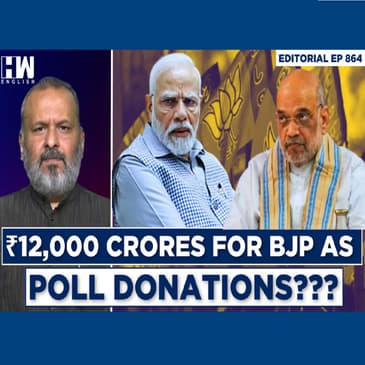
In this edition of "Editorial," Mr. Sujit Nair examines how the BJP has emerged as the primary beneficiary of political funding, including electoral bonds & electoral trusts. Out of the total of Rs 16,492 crore obtained through bonds, the BJP received Rs 8,252 crore, surpassing the funding received by over 20 other parties combined. Additionally, parties have garnered funds from electoral trusts, which have significant corporate donors. Combining funds from electoral bonds, trusts, and other donations declared in audit reports over a six-year period from 2018 to 2023, the BJP's total funding reached Rs 12,930 crore, solidifying its lead over other political parties.
Learn more about your ad choices. Visit megaphone.fm/adchoices
[00:00:00] Hello and welcome to HW Editorial with me Sujit Nair.
[00:00:07] Here you can listen to my views, my analysis.
[00:00:11] Follow this podcast to stay updated.
[00:00:13] At HW News they have been delivering news that matters to you.
[00:00:17] Our goal is to present you with information that stimulates conversations around topic
[00:00:22] of larger public importance.
[00:00:24] That often gets lost in prime time shows.
[00:00:41] Namaskar and welcome to another episode of Editorial.
[00:00:45] This Editorial 2 we are going to talk about Electoral Bonds and we are going to go beyond
[00:00:50] electoral bonds.
[00:00:52] We are going to talk about electoral bonds, we are going to talk about electoral trust,
[00:00:57] we are going to talk about other donations that political parties have received.
[00:01:03] And you will be surprised the kind of money that political parties especially Bharati
[00:01:08] Ajahnata party has received.
[00:01:11] Today night I want to question as to what do these political parties do with this kind
[00:01:17] of money and how would this kind of money harm our democracy.
[00:01:23] Let's get right to the show.
[00:01:28] So till now we have been talking about electoral bonds.
[00:01:32] We are going to continue to talk about electoral bonds, we are not going to stop at this
[00:01:37] we are going to continue to talk me and my colleagues, we are going to continuously
[00:01:40] get you reports as it comes about electoral bonds.
[00:01:44] But today we are going to not only talk about electoral bonds, we are going to go one step
[00:01:49] further.
[00:01:50] Now it is very interesting that electoral bonds, electoral trust and other donation put together
[00:01:59] Bharati Ajahnata party, one party Bharati Ajahnata party is estimated to have got around
[00:02:06] 12930 crore rupees.
[00:02:10] This is how the graph looks.
[00:02:12] To the left of you, you can see electoral bond graphs where Bharati Ajahnata party has
[00:02:18] got more than 50% of the total electoral bonds and to the right is like I told you electoral
[00:02:26] bonds, electoral trust and other donations put together.
[00:02:30] This is how the party has got other parties have also got money.
[00:02:33] I am not disputing that nor do I say that that is correct to this extent.
[00:02:39] This is how Bharati Ajahnata party has got at this editorial, let us focus on Bharati Ajahnata party.
[00:02:45] Okay now the thing is Bharati Ajahnata party like I told you before in electoral bonds
[00:02:52] it is calculated that Bharati Ajahnata party has roughly got around 8252 crores.
[00:02:58] But all these other electoral trust and other donations are put together, Bharati Ajahnata
[00:03:03] party has got 12930 crores.
[00:03:07] See let us start from there.
[00:03:11] 12930 crores why would a political party need 12930 crores?
[00:03:20] What can a political party do with 12000 crores with them?
[00:03:25] What all can they do with around 13000 crores, 12930 crores, 13000 crores of rupees with
[00:03:32] them?
[00:03:34] You see just to put things into perspective, Pepsi for instance, Pepsi spends around 600 crores.
[00:03:42] The ads that you see the marketing that you see Pepsi spends around 600 crores in India
[00:03:46] and co-op spends around 738 crores in India, 600 crores and 738 crores.
[00:03:53] That is the kind of money India's top advertising and marketaer spend.
[00:03:59] But a political party needs 16000 crores to run campaigns, to run political parties.
[00:04:05] Why would they need this kind of money?
[00:04:07] When you use this kind of money do you think it is only restricted to paying their basic
[00:04:14] administrative expenses and meeting their basic office rent rate and expenses and all that
[00:04:20] because that is a very small percentage.
[00:04:25] The political parties then empowered to use money to buy anything they want.
[00:04:32] I would assume, I would assume and this is assumption, I don't have anything to prove but
[00:04:37] I would assume that this money can be used to buy votes.
[00:04:41] This money can be used to buy MLS.
[00:04:44] I am not saying they are doing it.
[00:04:46] I am saying I am assuming it because you can use this money for anything.
[00:04:51] You can use this money to buy MLS.
[00:04:53] You can use this money to buy MPs.
[00:04:54] You can use this money to pull a government down.
[00:04:56] You can use this money to split a party.
[00:04:59] You can use this money for anything.
[00:05:00] That is the kind of money I have.
[00:05:02] I have excess funds.
[00:05:03] I can rule this country with that money.
[00:05:07] So if you are going to rule the country with this money then where is democracy?
[00:05:13] Then what is the value of our vote?
[00:05:15] Have you thought about it?
[00:05:16] In a democratic process, to maintain democracy, you are earning money.
[00:05:21] You amount of money and that you amount of money is going to be instrumental tool to ensure
[00:05:27] that the very democracy that you are trying to empower or you are trying to maintain,
[00:05:34] that very democracy can be ruined.
[00:05:37] Think about it.
[00:05:38] 23 crores roughly is what one MP which assuming if Bharatiya Janata party ensures that all
[00:05:46] the 545 seats they fight, one MP can get 23 crores as campaign expense with this kind
[00:05:53] of money.
[00:05:54] Roughly, roughly in for a small little constituency.
[00:05:59] 600 crores is what Pepsi spends in the entire country and here MLA can spend 23 crores
[00:06:06] in its total constituency.
[00:06:10] You see what kind of havoc that this money can create?
[00:06:16] And I talk about every party by the way but especially Bharatiya Janata party because in front
[00:06:22] of you in your screen look at the graph, look at where Bharatiya Janata party is as far
[00:06:27] as money is concerned and look at where other parties are, where money is concerned.
[00:06:31] Now, Bharatiya Janata party a lot of people say that what is in it?
[00:06:36] What is in it?
[00:06:37] Hey we handle the center, we handle so many states.
[00:06:40] Obviously, we get more money.
[00:06:43] We get more money, proportionally, proportionally, proportionally.
[00:06:48] So, it is wrong.
[00:06:49] This is what a lot of people from Bharatiya Janata party, people who support Bharatiya
[00:06:53] Janata party will talk and I am sure a lot of people must have written by now in the comment
[00:06:57] box also.
[00:06:58] Let me answer that question to you.
[00:07:00] Okay, are we running a political party?
[00:07:03] Are we running a democracy or are we running a business?
[00:07:05] You see, I can understand.
[00:07:07] I come from a marketing background, I come from a corporate background.
[00:07:10] I can understand.
[00:07:11] Look over here.
[00:07:12] I am having, I am dominating Maharashtra market so I get this revenue.
[00:07:15] I want to dominate Gujarat market so I can increase my revenue more.
[00:07:19] I want to dominate Mahamadhyaprata market because I can increase my revenue more.
[00:07:23] I dominate Tamil Nadu market because I increase my revenue more.
[00:07:27] I don't dominate Kerala market because I increase my revenue more.
[00:07:30] The concept is very clear.
[00:07:32] My agenda is very clear as corporate.
[00:07:34] I expand because I will get more revenue.
[00:07:37] This is the political party.
[00:07:39] Going to say the same or political parties in India going to say the same.
[00:07:43] Papa, I want to win Gujarat because I will get money.
[00:07:46] I want to earn more money.
[00:07:47] So I want to win Gujarat.
[00:07:49] I want to meet Himachal Pradesh.
[00:07:51] Then let us not comment say that oh, I am there to serve people.
[00:07:54] I am there for the benefit of people.
[00:07:56] I am there for the benefit of Hindus.
[00:07:58] I am there for the benefit of whoever I am there for the benefit of people.
[00:08:01] Let's not talk about all this.
[00:08:03] Let us be very clear.
[00:08:04] We either say Paisa Kamanik Le hai.
[00:08:06] We win elections to win money, to get money.
[00:08:09] Are we saying that if you are not saying this then this holds no justification?
[00:08:14] Let me also tell you.
[00:08:15] You know there are certain countries where the state funds,
[00:08:18] the state funds, the political party which is how the ideal situation should be.
[00:08:23] Our politician will never amend or get a law like that
[00:08:26] where the state funds political parties.
[00:08:28] They will never get a law like that because then the funding will be equal and deserving.
[00:08:33] You know countries like Germany for instance,
[00:08:37] the funding is based on the seeds, the number of seeds.
[00:08:43] So the more number of seeds you win, the more money the state funds you.
[00:08:48] So you have a larger party, you win more seeds and you get more money
[00:08:52] because it's you mean that you won more seeds.
[00:08:54] As far as countries like say France is concerned for instance.
[00:08:59] France goes by the votes here.
[00:09:02] So technically speaking, Barathe is anata party is one 38%.
[00:09:06] So Barathe is anata party's total donation in that respect.
[00:09:10] If you look at it from that perspective should be 38% of the total money.
[00:09:14] Not 50% and 50% and 60% 38% of the total money.
[00:09:19] The votes here is 38%.
[00:09:21] That is fair because that's how democracy should see funding.
[00:09:27] Not the way, okay market shares are more than revenue.
[00:09:31] Market share is small, revenue is small.
[00:09:33] I will increase my market share so that my revenue becomes big.
[00:09:36] That is corporate, danda business.
[00:09:40] This is politics, social work, welfare, difference
[00:09:44] and the argument is going to be mixed match.
[00:09:46] Then well you need to decide as political party whether you are into the business of politics
[00:09:50] or you're doing actual politics.
[00:09:53] That's my answer to that question.
[00:09:55] Now let me,
[00:09:57] let me iron and massage the future with you.
[00:10:02] Today 16,000 crores tomorrow, 1,000,000 crores.
[00:10:09] Yeah, after tomorrow, 2,000 crores.
[00:10:11] What really then will become important is the importance of a voter that is UNB
[00:10:18] in this entire democracy will reduce, will reduce exactly like it's reducing
[00:10:26] when it comes to our economy.
[00:10:28] The economy, the business, the opportunities are for the rich.
[00:10:33] Where is the opportunity for the poor?
[00:10:35] What is an MSME doing?
[00:10:37] Where is MSME getting haircut?
[00:10:39] If it doesn't pay the loan back, you know what happens to that MSME.
[00:10:44] But if the big man is the top businessman doesn't pay a haircut, he gets.
[00:10:48] Don't we see that this is going to happen in our personal life?
[00:10:53] Because the government will be taking donations.
[00:10:56] The government will be talking about 1 lacrore, 2 lacrore, 5 lacrore, 10 lacrore
[00:11:00] and we'll be looking at people to give that kind of money
[00:11:03] and obviously when that kind of money is given to the government,
[00:11:07] the government other than being for the people will be for the donors.
[00:11:14] And if the government is for the donors,
[00:11:16] the economy is for the rich.
[00:11:20] What happens to us?
[00:11:22] Where do we go?
[00:11:24] Will we go back into slavery?
[00:11:27] Is that where we are headed to?
[00:11:29] Because then only the rich will survive, isn't it?
[00:11:32] People who can fund the government,
[00:11:34] people who can fund political parties will survive.
[00:11:36] And normal person who can't fund himself,
[00:11:38] can't survive here.
[00:11:41] Where we are going to survive?
[00:11:42] How are we going to survive?
[00:11:45] That's the question I need you to think about it.
[00:11:49] I need you to think about it.
[00:11:51] And before I hand, I will end again with an electoral bond issue.
[00:11:57] Here this 2nd clip,
[00:11:59] 1 minute clip of Chief Justice Chandrachud and then I will get back to you.
[00:12:05] Suppose A purchase is the bond.
[00:12:07] A purchase is bonds worth X amount, 100 crores.
[00:12:10] He's only the person who's been put up to purchase the bond because
[00:12:13] such, A has a KYC, etc.
[00:12:15] A has to only physically hand over the bond to B.
[00:12:18] Who's in, or B gives it to C,
[00:12:20] will in turn give it to a political party.
[00:12:22] There is no control over the transaction between A and B.
[00:12:25] So B can trade on that bond for cash,
[00:12:27] also whatever other concerns he acquires that bond.
[00:12:30] He hands it over to a political party.
[00:12:32] Or B gives it to C and C,
[00:12:33] hands it over to a political party.
[00:12:35] The person who satisfied the requirement of the
[00:12:37] tundra didn't being through the normal banking channels,
[00:12:39] A, the purchase of the orcansable purchase of the bond.
[00:12:42] But this does not object the fact that the people who are behind it,
[00:12:46] that they have used authorized banking channels.
[00:12:48] All that they have to do is that the...
[00:12:50] That somebody's KYC is...
[00:12:51] The trading is prohibited.
[00:12:52] But there's no way you can prohibit trading the bond.
[00:12:54] Absolutely.
[00:12:55] He doesn't have to buy the bond from the A to official banking channels.
[00:12:58] Because there's no record of for any transaction in the bond.
[00:13:01] He just goes...
[00:13:02] If a next party goes to SBI by a electoral bond and gives it to a Y party,
[00:13:07] the Y party buys that bond from you from that particular X party
[00:13:10] and gives it to a political party,
[00:13:12] the political party actually receives it from me.
[00:13:14] But who is it on record?
[00:13:16] It is party A.
[00:13:17] Party A buys it, gives it to party B,
[00:13:19] party B gives to the political party.
[00:13:22] So who's giving it to the political party party B?
[00:13:24] Who is what the electoral bonds party A?
[00:13:27] Party B's name will never come into picture.
[00:13:29] This is what the Chief Justice says.
[00:13:31] The reason I interjected this particular topic
[00:13:33] into a topic which is actually technically
[00:13:35] you'll wonder what this is going to be.
[00:13:37] I'll tell you why I'm saying this.
[00:13:38] What I'm trying to say is look at the ways and means.
[00:13:43] Look at the ways and means.
[00:13:45] The political party has designed to ensure that they can get money
[00:13:51] and they can circumvent all monitoring system,
[00:13:59] all compliance.
[00:14:01] They can circumvent it.
[00:14:03] End of the day,
[00:14:05] you will never be able to possibly say who paid,
[00:14:08] who actually how much and what.
[00:14:11] Whatever the data is, whatever data comes,
[00:14:14] possibly you'll never be able to say.
[00:14:16] That's the point I wanted to make.
[00:14:18] The effort in which political parties have gone
[00:14:22] to ensure that because of Pisa,
[00:14:24] then a Pisa that is kept very safe and hidden
[00:14:27] and something that nobody other than them knows about it.
[00:14:32] Do you think you get that liberty?
[00:14:35] Try getting 1000 rupees from somewhere
[00:14:37] and you will be asked your source.
[00:14:40] That's the difference between being the ruler
[00:14:44] and being the ruled.
[00:14:47] That's what you are today.
[00:14:50] Till I see you next time, that's tomorrow at 10.
[00:14:53] I'm Ashkar.
[00:15:10] If you liked this episode, please rate us with five stars right now.
[00:15:31] HW News Podcast are available on binge spots
[00:15:36] and all other audio platforms.
[00:15:38] Also, don't miss to check out our news reports
[00:15:42] from the House of HW News Podcast.
[00:15:44] We are sure you will love it too.