
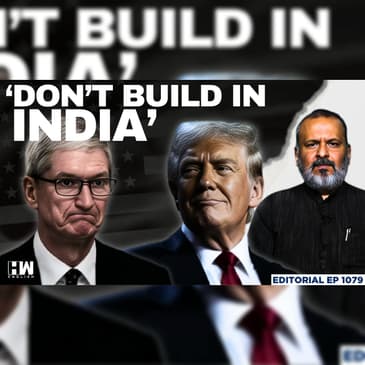
In this episode of Editorial, Mr. Sujit Nair discusses U.S. President Donald Trump telling Apple CEO Tim Cook to build Apple products in the U.S. instead of India. Mr. Nair sheds light on what Apple could do next.
Learn more about your ad choices. Visit megaphone.fm/adchoices
[00:00:00] Namaskar Welcome to another episode of editorial. Don't build in India. This is what Donald Trump, the United States President told Tim Cook, the CEO of Apple. He said why are you building in India? You build in US instead. India will take care of itself. Why is Trump so not happy with India?
[00:00:32] Especially in the second term. Somebody who said that you know, Narendra Bodhi was my best friend and all of that, howdy moody and all that. Why is he so unhappy with India in the second term? Let's talk about it. Let's get right into the show.
[00:00:47] Now, Trump told Tim Cook not to invest in India. Not to build in India. He says build in United States instead. We've been good to you, Yair. You better invest in United States. India will take care of itself.
[00:01:06] Now, let's analyze this entire situation. More importantly, there are two aspects to it. First, let's look at it from Apple's perspective. Let's talk a little about Apple. Very interesting company and very interesting relationship with India. Then let us talk about Donald Trump and the relationship with India and primarily the relationship with Modi. And then let's talk about Donald Trump.
[00:01:34] And his strategies, his international strategies. Okay. So let's divide this entire editorial in three. Okay. So first, let's talk about Apple. You know, Apple has a very interesting relationship with India. Steve Jobs was humongously, humongously inspired by a sage in India called Neem Karoli Baba.
[00:02:00] He was very inspired and most of his life lessons has been an inspiration of Neem Karoli Baba. Until he died, till he died, he was a devotee of Neem Karoli Baba. So he had a spiritual connect with India. He had a spiritual connect with an Indian sage.
[00:02:23] And Neem Karoli Baba, by the way, he has influenced a lot of celebrities across the globe. Huge names, including Julia Roberts and others. Lots of people. So that's Steve Jobs.
[00:02:40] But Steve Jobs, and I'm going to put it blunt. Steve Jobs always thought that Indians were not very discerning consumers. A lot of magazines have written about it, but they have sugarcoated all of that. But let me tell you, as a marketing person, let me tell you, Steve Jobs thought that India was not a discerning market.
[00:03:01] And 1999, you know, the Apple market in India was not even 1%. It was not even a single digit market. The reason why Steve Jobs thought that India was not a discerning market, therefore didn't focus much on India, is because he said, I believe in design.
[00:03:22] I believe in giving the best products, the best design, and I need a market that will pay me a premium for design and India is not that market. So therefore, he didn't focus on India. He said, India may not pay me just for my design, just for what I am. You know, a very famous statement he made that I will read out to you. He said, we don't aim to be the biggest. We aim to be the best. We don't look at the top line.
[00:03:54] 8% market share, 10% market share, 20% market share, 30% global market share, all that we don't look at. We want to be the best. I want to give the best design.
[00:04:03] I want to give the best. We want to give the best. We want to give the best.
[00:04:33] Domination. Tim Cook believed in selling more products and Tim Cook saw India as a huge market, a huge market. And Tim Cook said, I am going to make my product feature rich, where an Indian feels it is worth buying that product, not just for mere design because it's feature rich.
[00:04:59] So, there was a difference even in thought. There was a difference even in the way the product was positioned. Though they have not gone and admittedly said that, listen, you know what, Amlao Design and Bhadmai Ghabi, we are going to focus on features and all of that. It was not made very obvious, but you have seen the transition and the answer to that and the result of that rather is the fact that India today is around 2.05% of Apple market.
[00:05:27] 2.05% from almost not even 1% to 2.05%, which is quite a growth as far as sales is concerned. They are 2.05% of the revenue of Apple. That is what I meant by 2.05%. Now, India definitely is important and therefore, Tim Cook decided to invest in India and make India a manufacturing hub for Apple.
[00:05:56] Now, mind you, they had tried the same with China and they successfully tried it with China. Now, they wanted to focus on India. And 2024, they made around 14% to 15% of their produce. And there are companies like Foxconn, there are companies like Pegatron.
[00:06:20] Pegatron is in Tamil Nadu, Foxconn also incidentally is in Tamil Nadu, Vistron, which is in Calc, which is in Karnataka. So, these are the companies that produce for Apple and these companies produce 14% to 15% of total apples produced in the world. So, India was successfully becoming a production hub for Apple. That's when, now let me come to my next point. That's when, Donald Trump came and said that,
[00:06:50] Why are you spending so much money? Why are you investing in India? Why are you looking at India? Stop building India, dude. Build our own country. Build the country you used, that supported you. Build the country that you originated from. Build America. Why go to India and build India? Now, the question is, is that statement that plain and that simple? Why do you put it there? Is that statement that simple and plain? Let's understand the response of Apple.
[00:07:20] Tim Cook hasn't responded to the best of my knowledge. He hasn't responded as yet. But, the Apple executive, the Apple spokesperson of India responded. He is saying that there is no change in the investment plan in India. He told the government of India that we are going to invest as much as we promised we were going to invest. And, the commitment to India as a major manufacturing hub remains. He says we continue that. There is no change. Now, would I take it on the face value of it?
[00:07:50] The answer is no. I will not. And, I will tell you why I will not take it on the face value. I will not take it on the face value because India is 2.05% of their revenue. America is close to 44% of their revenue. American sales is close to 44% of their revenue. In fact, China too is quite big. China is 17.12% of their revenue.
[00:08:20] Now, a country, forget about a country of origin. Forget about it's an American company. Forget about all that. A country, a market that tells you, the market that has 44% of your revenue, where 44% of your revenue comes from, that market tells you, Baba, don't invest in another market. Do you think that an intelligent businessman or even non-intelligent businessman, a businessman will go and go against the whims and wishes of that country leader
[00:08:50] and go and start investing in the other countries? Will he do that? The leader of the country which gives him 44% of his revenue says that do not invest in India. Do you think, simple, that Tim Cook will still go and invest in India? Tim Cook will continue everything in India like he had originally envisaged. Do you think it is going to happen? I don't think it is going to happen. I don't think it is going to happen.
[00:09:19] End of the day, it is money, honey. And that's what it's all about. Money. Why would somebody risk 44% of their revenue? So the chances are, while all this is said, the chances are, Tim Cook may heed to what Trump said. And I can understand why Apple made this statement. It is very natural for Apple to make this statement. All these companies that I spoke to you about, Foxconn, Pegatron, Vistron,
[00:09:48] all these companies, they have invested. Invested because Apple asked them to invest. They have invested on manufacturing Apple products. Overnight, Apple coming and saying, that doesn't work that way, right? So obviously, Apple has to make that statement saying that, no, no, no, everything is as planned and all of that. So, yeah, but finally, finally things may change. This is what I believe. Now coming to the third point. Why is Trump doing this?
[00:10:17] My friend, my best friend, Mr. Manendra Modi, turning to Modi is also my friend. Pakistan is also my friend. How come this change? How come this man changed? Now, the first thing, if you remember, we had always told you that it is always better when a country has a relation with another country, not one leader with another leader.
[00:10:46] One leader with another leader, that relationship is always volatile. A country to a country, that relationship cannot be volatile. It will be very difficult for Donald Trump or Biden or anybody in the United States to go against or just take Britain lightly, United Kingdom lightly. They cannot. Because it's a country to country relationship. It's a country to country relationship. So normally,
[00:11:16] a country to country relationship is stronger. India and the United States at one point when the relationship peaked was Modi and Trump relationship. What peaked could always come down because it was two human beings at the end of the day. That's point number one. Point number two. Trump two. Trump two point oh
[00:11:45] was never quite favorable to Modi. Possibly, Trump thought that Modi didn't give Trump enough impetus when Trump lost. Modi didn't stand by Trump. Modi didn't visit Trump when he went to meet Biden or when he was in United States when there was a meeting arranged between Trump and Modi because possibly at that point at time Narendra Modi thought maybe Kamala Harris would come as the next president and meeting Trump at that point at time would not be very wise. This is possibly what he could have thought.
[00:12:15] But the point remains that the relationship Trump too was not very good. A. Modi was not invited for his swearing-in ceremony. Let me just add this. During swearing-in ceremony when he was not invited a lot of people said no no no it's not like that it's just that you know when we like to treat Modi separately when Mr. Modi comes to United States we will be treating him separately and you know of course Trump is looking forward and all that that also happened.
[00:12:45] Modi went to United States but this time there was no fanfare and all that. In fact it was very lukewarm. Trump didn't even go out to receive Mr. Modi like he would do that to other state heads. He didn't go out to receive Modi. So the response was quite lukewarm. One wondered why. While Trump was not rude to Modi like he was to Zelensky and all that but he
[00:13:15] was not you know those heaps of praises either. As a signal of good faith Prime Minister Modi recently announced the reductions to India's unfair very strong tariffs that limit US access into the Indian market very strongly and really it's a big problem I must say. So Modi's trip was not very very you know like normally the fanfare we didn't see this time around.
[00:13:45] Third was very clear the tariff the reciprocal tariff India was not spared India was not given any special treatment like other countries India was also one of the now they are going to completely remove the tariff for American products we'll have zero tariff that is what he says and he says as if he has won a war
[00:14:14] that's the way Trump is proclaiming it. So the point is India was not given any special treatment during their reciprocal tariff war against the world. The fourth most importantly is Trump played it absolutely neutral between India and Pakistan absolutely neutral. He went out and said that both are my friends. Of course he also said that India and Pakistan were warring for 1500 years which I didn't know that
[00:14:44] Pakistan existed 1500 years and but yeah of course Trump says that so 1500 years they were warring and you know both are my friends and I will talk to both of them never did he speak for India never did he speak for India very well knowing that Pakistan was aligned to China but he never spoke for India so the point is there too he was
[00:15:14] very neutral and the fact that he took entire credit of bringing about the ceasefire one sided he took the entire credit of bringing about the ceasefire so India to a large extent tried to say that no it was not Trump it was we who decided we wanted Pakistan came to us we decided that there would be a ceasefire so on and so forth Trump continued his claim to he
[00:15:44] and his administration brought about the ceasefire that too happened so at some point there is something that was not going right and finally here openly he says you know you don't build in India why are you building in India see when he says openly to Tim Cook he is sending message to 10,000 other investors
[00:16:13] investors who would want to be investing in India mind you so that's the importance of him telling Tim Cook and of course the fact that Tim Cook is investing in India and was going to invest much more than what he is currently already did so that's the point now I have done an editorial on what are the things that really went wrong between the Trump Modi relationship I will attach that
[00:16:43] the last point I wanted to also make is the geopolitical situation you see if you specifically look at this entire thing from a Apple point of view Apple invested humongously in China Apple made China a manufacturing hub like what they are intending to make India look where China is today any number of
[00:17:13] and made China as powerful almost as powerful as America they may not be as powerful as America but definitely they are the second most powerful country in the world a lot of it was thanks to American investment now Trump is very wary he doesn't want investment to go to China but neither does he want to have investments in India coming into India because he doesn't want India to be another China
[00:17:45] he knows his country made China what it is through their investment and he doesn't want his country to make India what China is today he doesn't want any more superpowers or at least contender for superpower he doesn't want that that's one
[00:18:15] and he didn't want India to be super powerful by helping India to be one he didn't want that he wanted that balance to be maintained China on one end India on the other Pakistan on the third and ultimately therefore America reigning so these were factors that can also be thought of if you talk about the reason why Trump 2.0 is
[00:18:45] absolutely different than what Trump 1.0 was and Trump 2.0 does not look very favourable to India this is the point I wanted to make until I see you next time that's tomorrow at 10 let's go