
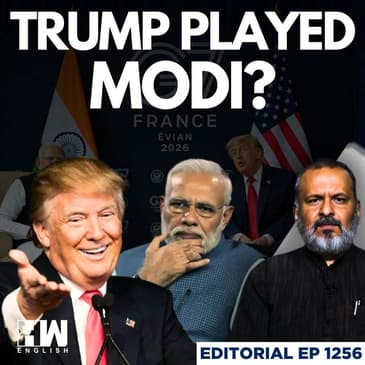
In this episode of Editorial, HW News Managing Editor Sujit Nair speaks on the highly-anticipated meeting between PM Modi and Donald Trump on the sidelines of the G7 Summit. Mr. Nair calls out Trump's bizarre answers in the press interaction. He also criticises Indian mainstream TV media's sensational coverage of the event.
Learn more about your ad choices. Visit megaphone.fm/adchoices
[00:00:00] I thought Trump was playing Modi and his supporters and Indians. What is Trump trying to do? Trump trying to campaign for Narendra Modi like Narendra Modi campaigned for him in Houston? I was expecting questions to be asked. I was expecting Modi to go and ask him what happened, why? Why was our three sailors killed? I was expecting that.
[00:00:23] We will kill him at home, right? This is what we say the new India is, right? What happens here? I mean, we were not bothered about data. We were bothered about drama. Namaskar. Welcome to another episode of Editorial.
[00:00:45] When I heard Trump speak yesterday, especially in context of Indo-American ties and when he was with Mr. Narendra Modi, I thought Trump was playing Modi and his supporters and Indians. He was playing because the words he used, the way he spoke about us, the way he spoke about everything, I think he was not even serious. He was not even serious.
[00:01:16] I thought he was just talking for applaud and making us feel good like we do it to a kid. Hear this. He's a very tough negotiator. One of the toughest. So you look at this man. I'll give you a lesson. He's the most beautiful looking man. He looks so nice. He's like an angel. But actually, he's as tough as he's a killer. I don't want to. He's that killer. He's as tough as they come. But he looks so good. So he gets you by surprise.
[00:01:45] I mean, isn't this something like, you know, talking to a kid? Calling a kid and saying, you're Superman, you're super strength, you can lift 10 elephants. Isn't this similar to that? Is this how a president talks to a prime minister? The president of the world's oldest democracy talking to the prime minister of the world's biggest democracy. Is this the conversation?
[00:02:15] Hear this out. I mean, I didn't understand the statement.
[00:02:45] I'll be there for India if Mr. Modi is the leader. I'm not sure if there is anybody new. First of all, Indian doesn't want American help. In fact, I thought he was crossing the line. We're a sovereign country. We don't want American help. And America in the history of independent India, in the history of India, America has never helped us. And I don't think America is ever going to help us in any of our conflict. I'm not so sure if they will add fuel to the fire on our conflicts.
[00:03:15] That I'm not very sure. But helping us? And the fact that what does he mean? That if the leader changes, then I don't know. If Mr. Modi is the leader, then maybe. What does he mean? Is he trying to interfere in our internal politics? Whether we choose Narendra Modi, we choose Rahul Gandhi or we choose Arvind Kejriwal. What has Donald Trump to do with that? What has he to do with that? I really didn't get it.
[00:03:46] What was he trying to say? Are we some kind of a pond in his hand? What is he talking about? Thirdly, hear this. Do you expect India to play any role in West Asia? Yeah, I do. I do. I think India plays a big role in everything. As long as he's the leader, India is going to play a big role. What is Trump trying to do?
[00:04:15] Trump trying to campaign for Narendra Modi? Like Narendra Modi campaigned for him in Houston? Is he trying to campaign for Modi? Is he trying to reiterate and trying to answer the opposition saying that, you know, this man is the man and I will be there for him and he is going to play an important role. He plays a very important role. Is this trying to answer what the oppositions are alleging that, you know, Modi tends to listen to Trump and Modi tends to do what Trump says.
[00:04:43] Is he trying to answer, counter that allegation? Because this is how it sounds. This is how it sounds. Now, I, a lot of you may reiterate that is how Trump is, you know, that's how. See, listen, end of the day, I am not talking about an individual called Trump. I am talking about the President of the United States who is addressing my country and when my Prime Minister is sitting next to him. That is what I am talking about. I am talking about protocol.
[00:05:12] This is not a back slapping personal party that happens in France. This is G7 summit where Mr. Narendra Modi is representing India and I am sure Mr. Trump is representing the United States of America. I was expecting questions to be asked. I was expecting Modi to go and ask him what happened, why? Why was our three sailors killed? I was expecting that. I was expecting a strong protest.
[00:05:39] I was expecting a statement to be made there in front of Trump. Three of our people were killed. This is what we say the new India is, right? What happens here? Is limited to people who can't really combat us? When it comes to the bullies, all that is over? Is that how it is? This is one point.
[00:06:09] You know, then I saw a lot of television anchors. And I want to make this point. I don't want to take any individual names, nor would I want to kind of talk about any individual anchors. That's not my intention. My intention is not to ridicule anybody. But my intention is to make a point very clear. There were anchors talking about, you know, how Mr. Modi walked.
[00:06:36] There was one anchor who said, you know, Mr. Modi gave his hand to Trump and he actually helped him climb the stairs. One anchor says that, you know, look at the kind of privilege, the kind of respect, the kind of power that Modi has. And he walks and he was standing in the front and he was standing in the side and one hand he raised and one smile. I don't know what were they describing? Top television anchors of mainline television channel,
[00:07:05] which is supposedly said to have crores of views. These anchors were not talking about a geopolitical event that was happening in France. I thought they were talking about a television episode of Shaktiman. I actually thought they were talking about a television episode of Shaktiman. He raised his hand and then he went there and he put four people, went on the side, four people came on. He was standing in the middle.
[00:07:29] Is this what commenting or analyzing geopolitical event like G7 is all about? Isn't that what the world is seeing about us? Isn't that the whole world who people who matters see about India and laugh at India? This is how we analyze a geopolitical event. He said I am boss but he said he is angel. Is that the big story?
[00:07:58] And if you do that, end of the day, what are you saying? People are going to question our understanding, our ability to understand a geopolitical event of this size. Our ability to analyze a geopolitical event of this size. Because end of the day, we have stopped doing that. We are judging an event based on body language, based on who stood there, who stood where, based on how many smiles he got, based on how many hands he shook,
[00:08:28] rather than what did we get in return? What was the actual results? What did India get out of all of this? What trade, what defense deal, what infrastructural agreements have we signed? Isn't that what we should be bothered about? Isn't that what analysis is? I mean, we were not bothered about data. We were bothered about drama. How would the world react to you? Possibly Trump reacted to you because
[00:08:55] he too thought that that is all our intelligent, intellectual capability is. That's where our intelligence stand. We get so much, we get so much, we get so much. Actually, Trump must have thought that, you know, he actually floored India by whatever he said. Because ultimately, this is what represents us globally, isn't it? I beg of media houses,
[00:09:26] media owners. I understand that there are reasons, economic reasons and political reasons and fear factors and all that, that you have to sing certain amount of praises about the government, certain amount of, you know, you have to, you have to kind of make everybody look good, the people who are in the government. I understand all that. But at least when you are talking about a geopolitical situation, when you are analyzing a geopolitical situation, at least have anchors who are intelligent,
[00:09:55] who understands the subject, who, because it's not just Indians, the world is watching us. The world will watch us to understand our perspective of the G7 summit, mind you. And when the world watches our perspective of the G7 summit, where we say, oh, he wore blue pants and he was wearing a white shirt and he shook hands first and he hugged more and he hugged less. If that's what we are going to discuss, that's what the world is going to think that we understand.
[00:10:23] That is what the world would believe that we understand. The world will judge us with that particular thing, what they see on the screen. And that's when we fall into this kind of situation. Think about it. Think about it. That's the point I wanted to make till I see you next time. That's tomorrow at 10. Namaskar.