
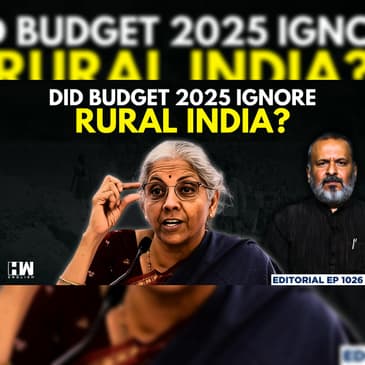
In this episode of Editorial, Mr. Sujit Nair discusses the Union Budget 2025-26, focusing on rural India. He explores the various funds allocated for the development and prosperity of rural areas. The data and analysis cited by Mr. Nair comes from an article in Mint newspaper. The analysis reveals that the overall rural development budget has remained unchanged at ₹2.6 trillion.
Learn more about your ad choices. Visit megaphone.fm/adchoices
[00:00:00] Namaskar! Welcome to another episode of Editorial. Yesterday we spoke about Budget and Middle Class. Today I speak about Budget and Rural India. Is this Budget helping Rural India? Will this Budget help the Farmers? That's the question I asked tonight. Let's get right into the show.
[00:00:21] The overall Rural Development Budget has not changed from Rs. 2.6 Trillion. It remains unchanged. So what are we to understand? We are to understand possibly the government believes that rural does not need more investment. Farmers do not need more investment. Possibly there is no farmer distress.
[00:00:52] Everything Changa see as far as rural India is concerned. Everything Changa see as far as farmers are concerned. Because Budget has been unchanged. Now a lot of the data that I am going to talk to you, we have got it from the Mint and I am specifically referring to an article written by Sayanthan Bera. A very good article and I am going to take a lot of data from there and then we talk about it.
[00:01:19] Now if you look at the graph, if you look at the graph, the Budget has not changed much except for PM Awaz Yojna where there has been a slight increase. But other than that, the Budget from 2023-24 to the Budget from 2024-25, it has not changed much. It has remained more or less the same.
[00:01:43] Like I told you, if at all something has changed, it is the PM Awaz Yojna which has been given a slight incrementally. So like I told you, I guess the government believes that you see everything is fine with rural India. Everything is fine with the farmers. We don't need to kind of invest anything more on them because it is not required. So that's number one.
[00:02:03] Number two is what has been offered in the Budget. The first thing that has been offered in the Budget is an improvement in crop productivity and credit access for 100 most underperforming district. Crop productivity and credit access. Now that is fine but there is no separate budget allocated for this.
[00:02:28] You see, so while the government has said that we are going to give impetus on credit access and crop productivity for this 100 district, this particular 100 district which is underperforming. But Baba, I have not kept any budget and all that. Budget which is what it is, it will have to be removed. That is number one. Number two is a host of national mission was announced on cotton, pulses, fruits, vegetables and high yielding seeds put together.
[00:02:56] Here they received a modest 2100 crores. So while they had announced a national mission for a host of crops like cotton, pulses etc. The amount that was given was 2100. Now let us see how this particular budget impacts the farmer.
[00:03:20] Now before I get into how this budget has affected the farmers, let us understand some statistics. You see, from 2019 to 2024, the farm employment has increased to 68 million people. 68 million people have been added more into farm agricultural employment.
[00:03:46] That is the first point. Now the second point is the industry has to therefore fend the 68 million people more that has been put into the employment, that is working in farms, that is working in agricultural industry. Okay? Now, to add to this, produce like soya bean, produce like ground nut, these produce had to be sold
[00:04:12] even lesser than the MSP. MSP is minimum support price as we all know. So the farmer had to sell his produce lesser, even lesser than the MSP. Now understand this, what I am trying to say. The farmers have increased, the farm laborers have increased, the farm workers have increased, people depending on farms and agriculture has increased. 68 million according to the figures from 2019 to 2024. But the income has decreased.
[00:04:41] Income is lesser. Some of the produce income is lesser even than the MSP. Now, the government under the national mission has earmarked 2 or 3 produce, where they are going to ensure that there is a support given to the produce price, the farm gate produce price. Now, these 3 products which they have earmarked, the budget earmarked is 500 crores.
[00:05:10] What are you going to achieve? Is 500 crores enough to ensure that you help these farmers to sell their produce at least in an MSP price? So that's the impact that has had on the farmers. Labor has increased, cost of production, the value of product produced has decreased. But the profits have decreased, income has decreased. This is point number 2.
[00:05:39] Now let us come to point number 3. See, point number 3 is non-agricultural income. This is something that I am sure a lot of my viewers will already be aware of. You see, I have always been saying that non-agricultural income is a must in an agricultural community, in the rural community. Why? Because if your farming doesn't do well, if your produce doesn't fetch you price, if your weather doesn't help you,
[00:06:09] then it becomes more imperative that you have an other alternative income for the family. And that is the non-forming income. And that is your Manarega. Now the point is, Manarega budgets have not been increased. So end of the day, there is nothing much that the farmer can look forward to in case his crop fails.
[00:06:33] There is nothing much that the farmers can look forward to in case his produce doesn't fetch the price that he wants. Some of the other factors, some of the salient points of this budget, Like I said, I am quoting from the Mint and Sayatan Bera's article, where they say that for Pradhan Mantri Gramsadak Yojana, funding is unchanged at 19,000 crores.
[00:06:59] The funds for rural housing were marginally increased, raised by 332 crores, with a budget of 54,832 crore in 2025-26. This is a decline after adjusting the inflation. For the rural drinking water mission, the allocation 25-26 is Rs. 67,000 crore,
[00:07:25] lower than the 70,000 crore in 2023-2024. So for rural drinking water mission, the budget has come down by 3,000 crores versus 23-2024. So overall budget of rural development schemes is unchanged, like I told you, at Rs. 2.6 trillion. So broadly, this is how your rural budget in one shot looks like.
[00:07:53] What I am trying to do and what I am trying to tell you is to simplify the way the budget has been laid out. And for you to understand that end of the day, yesterday, we spoke about how much of the middle class will benefit out of this budget. Today, we are trying to talk about how much rural India farmers will benefit out of this budget.
[00:08:21] Like I said, tax cuts will definitely ensure that at least 1 crore of middle class has some money in hand, which I still believe it is not something that will change their life or change their future or change their, make them wealthier. I still don't believe that. To continue from what I said yesterday, I still don't believe that particular savings in the tax will make much of a difference in their lives. But yeah, it does. It does.
[00:08:51] It will at least have get them some money in their hands, at least in some form or another. They will have a little more money to spend to upgrade their life. So that is as far as urban India is concerned for, but for rural India, But for rural India, I find no such respite. I do not find or I do not see the farmer earning more money.
[00:09:14] I do not see a rural citizen of India earning more money because he or she has to still depend on his farm. He or she has still no guarantee that his or her product will sell at a reasonable profit or even at a minimum support price. He or she is not confident of that. And I see no alternative income either, which as a country and as a government we have developed for them.
[00:09:42] So this is what the rural scenario looks like. Till I see you next time, that's tomorrow at 10. Namaskar. I see you next time, that's tomorrow at 10.