
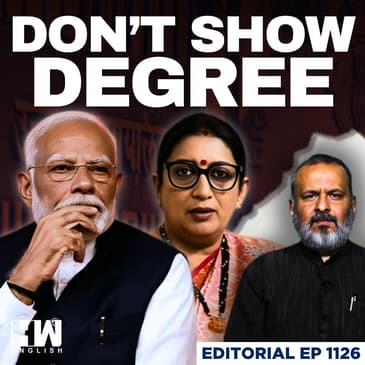
In this episode of Editorial, HW News' Managing Editor Mr. Sujit Nair discusses the remarks made by the Hon. Delhi HC regarding the public disclosure of PM Narendra Modi & former Minister Smriti Irani's educational credentials, including degrees and marks. Mr. Nair opines that voters should give emphasis to educational qualifications before choosing their public representative.
Learn more about your ad choices. Visit megaphone.fm/adchoices
[00:00:00] Namaskar! Welcome to another episode of editorial. The Delhi High Court passed a judgment wherein the Delhi High Court says that you can't ask the Prime Minister Smiti Rani etc. for their educational qualification because those are personal information. So you can't write in an RTI and demand that I need to know how qualified my Prime Minister is. This is what Delhi High Court said and
[00:00:30] let's talk about that. Let's get right into the show.
[00:00:35] So like I said, the Delhi High Court on Monday ruled that information pertaining to an individual's educational qualification including degree and marks is personal information exempted from disclosure under the Right to Information Act. They said that thus it is unambiguously clear that the marks obtained, grades and answer sheets etc are in the nature of personal information and are protected under the right.
[00:01:03] under section B1J of the RTI Act subjected to an assessment of overriding public interest. You see, I am not going to really sit here and talk about Narendra Modi and Smiti Rani. That is not my intention. My intention is to dwell on a larger issue.
[00:01:26] You see, I remember a decade and a half back if I am not wrong, Lintas had done an ad. We made an ad and this is what the ad looked like. Just have a look at it. This is for Tatati. This is what the ad looked like. I am not going to say that. Namaskar. I have your vote. I have not asked. No, not sir. Sit here. Ramuka. Sir, also a tea tea.
[00:01:55] Okay, sir. I mean, you... Bhamar Lal. Bhandari. And qualification? Qualification? Let's go. Tell your work experience. 25 years. Sir, sir. Work experience means construction, waterworks, engineering. What a great job. You are taking our interview. Sir, you applied for such big jobs. Which job? Which job? The job of killing the country. Come on, come on, come on. Come on, come on. Every morning, don't get up.
[00:02:24] The point that the ad was trying to make is, you see, you interview an intern, an intern, a fresh intern who just out of college comes and joins your company, you interview that intern. You ask that intern for his or her qualification. You verify his or her qualification. And then you appoint an intern.
[00:02:51] And here you have our law kind of saying that, listen, you know what? A common man through an RTI cannot ask what is his Pradhan Sevak, Prime Minister's or his minister's qualification. You see that intern just joined the company. He or she may not necessarily be responsible for making or breaking the company, at least at the stage where she has joined in.
[00:03:21] But the Prime Minister, who the court claims that an average Indian cannot ask for his or her education qualification. The minister, where an average Indian cannot ask for his or her education qualification. This Prime Minister or this minister could be able to make or break our country. Able to make or break our lives, our careers, our family, our entire life around us.
[00:03:48] I go to a doctor and I don't have the right to ask the doctor whether are you qualified to handle my case. If I have a heart problem, do I have the right to ask him that are you a qualified cardiologist? Is he duty bound to show me, prove to me that he is a qualified cardiologist and how is the Prime Minister different? Is it that the Prime Minister is about law?
[00:04:16] Pradhan Sevak is what you ask us to call him. Pradhan Sevak. Pradhan Sevak. And you can't ask him for his qualification. You see the problem is that qualification seems to be taking backseat. Our Prime Minister has been kind of constantly saying that it is not Harvard that is important, it is hard work. Sorry! Sorry!
[00:04:46] Harvard is equally important as hard work. A Prime Minister or a minister or a public servant or whoever is guiding her life needs to be qualified along with a lot of hard work and 24 hours by day and 365 days a year and all working. All that is one side but that person needs to be qualified too. That needs, person needs to understand basically what is happening in and around him.
[00:05:17] Because finally he takes responsibility of our lives. So no, mere hard work will not help. It is time we understand this. Hard work is good but with Harvard, hard work will make more sense and will be more effective for the country. Let us understand this very clearly.
[00:05:40] And I think, I humbly beg to differ with the Honourable High Court when the High Court says that you know RTI, you can't, I as a common Indian, as a citizen of this country cannot know how qualified my Prime Minister is or my Minister is. What marks they achieved, got in their exams. I am not supposed to know that. While I am appointing them as my Prime Minister, I appoint them as my Minister through my votes.
[00:06:09] At least that is what I think whether that actually happens or not. That too now is a question mark. You see, this problem is not limited to just a Prime Minister and one Minister who used to be a Minister, now no more a Minister. But you know it doesn't limit itself to this.
[00:06:31] Businessman Ramdev had once stated, Donald Trump supports Sanatana values and has deep affinity for India. His America first ideology reflects a global shift towards prioritizing national interest, a perspective that we share in India. This marks a new era of nationalism. We celebrate Trump's victory as a triumph of his ideology.
[00:07:01] I am optimistic about a new beginning in Indo-US relationship with Trump at the helm. Pramod Krishnam made a statement wherein he said Trump's victory is Sanatana's victory because when atrocities were committed against Hindus in Bangladesh, it was only Trump who spoke about it. Because a person who is not a Hindu but is speaking for Hindus is true Sanatana.
[00:07:30] Trump won the hearts of Sanatanis and all Sanatanis supported him in America. And even this credit has to go to Narendra Modi. These are some, these are Babas or you know these are Yog Gurus or that other gentleman, I don't know what he does for a living. I don't know who these people are but definitely they are not geo-politicians. And they go out in this country and they talk geo-politics.
[00:07:59] They claim that Trump is better because for Sanatan Dharma then other leaders, so they hope that Trump should be the President of the United States. What's going on? What's going on? What's going on? And DK everybody has the right to say what they have to say. But the point is the unfortunate part is lakhs and crores of people watch them, follow them.
[00:08:27] If you follow them for their yoga, great, good, they are good at it. But if you follow them and listen to them and make them your ideal and they start dictating geo-politics for you, they start dictating local politics for you, they start dictating economics for you and fiscal policies and rupee versus dollars and all for you. If that's what they start explaining to this country, do you know where they are taking this country to?
[00:08:54] And worst, like I said lakhs and crores of people follow them. Do you know what, who and what are we idolizing? Look at the people, at least in my younger days, the people I used to idolize. I used to idolize a Shivaji. I used to idolize a Dr. Bhavasai Bambedkar. I used to idolize Mohandas Karam Jan Gandhi. I used to idolize Nehru.
[00:09:24] I used to idolize Sardar Vallabhbhai Patel. These were the people I used to idolize. In fact, I can't often tell my team in my office. Jyoti Bha Pule, Savitri Bha Pule. These are people who really created, who really crafted this country. We are what we are because of these people and look at the structure of these people. Look at where these people are. Look at what these people have done.
[00:09:51] Look at what level of intelligence, of foresight these people had. These were the people that India was idolizing at one point in time. Now, I don't want to, I don't want to tell you this. You decide, you think, who are we idolizing today? Who are we idolizing today? Who are our children idolizing today?
[00:10:22] Compared to the people you were idolizing when you were young. Your answer is right in front of you. If you use, lose the value of education. If you lose the value of how much marks have you got? If you lose the value of education equals some amount of efficiency in the work you do. If you lose that sheer value and you talk about hard work versus how hard and hard work is all and how hard is nothing.
[00:10:49] Then, believe me you, are you going ahead? Are you progressing as a nation or are you regressing as a nation? If people like what I just showed you becomes our national ideal for everything, they are good at what they do. I am not denying that. They are good at what they do. Let them continue to do what they do.
[00:11:11] But when they are being seen as poster boys for geopolitics and economics, that's when I have a problem. Because possibly we don't have a good geopoliticians or economists. Now, today, who has the support, who has the backing, who the government promotes to come in front of our people and talk about actual politics, actual geopolitics, and actual economics, and so on and so forth. Because it's all about hard work, no? End of the day.
[00:11:41] Harvard doesn't work. The point I want to conclude with is our country has to change. Our country has to change and if we don't, we are headed the wrong way. We are headed backwards. It is time that we like in that ad, ask our public representative, We will have to get an interview. What is your qualification? What subjects did you specialize in?
[00:12:10] What marks did you get? And I am talking about any and every political party, any and every politician. I am not going to like I said. My intention is not to stick to this particular prime minister and whatever that former minister's story. That's not my intention. My intention is to go beyond it. I think there has to be a process where we interview our public representative.
[00:12:38] We interview our public representative, whether we do it as a community, whether we do it individually, whether we do it as a cooperative society. When they come into your cooperative society asking you for words, interview them, talk to them, make them answer. Qualification should be part of that question that you ask them. Because if that is lost, if education is lost, let me assure you our progress is lost.
[00:13:08] Let me assure you the country that we were and the country that we are, that won't be the country that we could be in the future. If this is the direction we are headed to. That's the point I wanted to make till I see you next time. That's tomorrow at 10. Namaskar.