
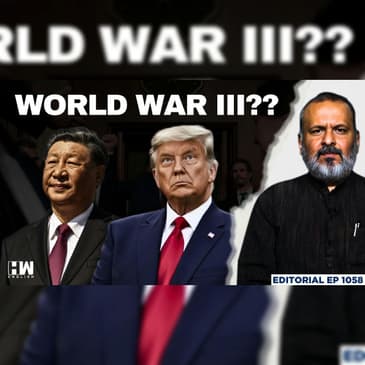
In this episode of Editorial, Mr. Sujit Nair delves into the rising tensions sparked by US President Donald Trump’s ‘reciprocal tariffs war’. As economic battles heat up, Mr. Nair questions whether this ‘trade war’ is a ticking time bomb that could spiral into a global conflict. Drawing parallels to the era of the 1929 Great Depression, he warns of the haunting echoes from history that we may be ignoring.
Learn more about your ad choices. Visit megaphone.fm/adchoices
[00:00:00] Namaskar! Welcome to another episode of Editorial. World Wars, or for that matter of fact any wars happen because of certain stupid decisions that the country head takes, the leaders take. Stupid decisions. Nothing to do with the people.
[00:00:23] Now, these stupid decisions end up not only harming their country, their enemy country, but possibly at one point the entire world. Especially when the country you are talking about is the United States of America.
[00:00:40] Now, a lot of experts including the Singaporean Prime Minister feels that would this tariff war actually blow up into a world war? There is a possibility. Let's discuss that possibility. Let's get right into the show and understand this entire issue in a very simple format. Let's get right into the show.
[00:01:05] So, our good friend, our Prime Minister's good friend, Mr. Donald Trump, the President of the United States, he is trying his strategies to make America great once again.
[00:01:26] One of the strategies that he tried, like we all know and now this is old news, that he said, listen, reciprocal tariff. I have done a whole editorial on that. I am sure all of you all know what reciprocal tariff is all about. Now, what is this intention? This intention is to get America back great again, make American economy super, give more jobs, make the economy vibrant, get more millionaires, get more billionaires, help more billionaires and millionaires to become billionaires and billionaires to become trillionaires.
[00:01:55] This is what the whole idea of Donald Trump is. Okay? Okay. Good. Now, you know, that's one end of the story. Let's keep that aside for a minute. Now, let me tell you, you know why we learn history in school? We learn history in school for two reasons. A, because history inspires us, great people inspire us.
[00:02:19] The second is, history is a teacher. Because they say history repeats itself. History is a teacher is because we should learn from what happened in our earlier times. Because most of the thing that happens now must have happened sometime in our country, in our historic cycle. It must have happened sometimes.
[00:02:45] So the idea is to learn from that. What am I saying? You see, 1920s was called as the Roaring Twenties in United States of America. The Roaring Twenties. Now, the kind of money that Americans earned, the kind of money that was available in America, the kind of wealth that was created in America was unbelievable.
[00:03:15] And every single American, almost every single American was rich. Every single American had personal disposable income. Every single American had money in their pockets. The Roaring Twenties. Now, when you have money in the pocket, what do you do? At times, most of the times they say, you tend to make stupid decisions.
[00:03:45] You tend to want more of what you already have. So, New York Stock Exchange, they all looked at New York Stock Exchange and thought, why not invest in the Wall Street? Why not make money? Why not double, triple, quadruple R money?
[00:04:06] Why not money? And everybody, they say, right from billionaires to a janitor, to a driver, to everybody, those entire social, socioeconomic classification, everybody. They started investing in shares. When you had that kind of investment in shares, what is going to happen? The share price shot up.
[00:04:32] Now, you know the right way and the wrong way. The right way for a share price to shoot up for a particular company would be when the company is performing well. When the company's balance sheet is good. When the company has done something substantial, earning very good, earning more profits, giving more dividends, then the share price goes up. Understood. Understandable.
[00:04:58] When you have a lot of money, you know, you start playing in the stock exchange. You create a fictitious demand. Therefore, you create fictitious increase of the stock price. See, anything that is fictitious, anything that goes up in this way, in this manner, will come down and that is the norm. This price went up fictitiously.
[00:05:28] It crashed. It crashed in 1929. Why? It crashed in 1929 is because, well, stock price and all were going up. But there was no production. The companies were not producing. There were no jobs in the marketplace. There was no jobs in the marketplace. So, somewhere down the line, when the actual economy had faced lack of demand, lack of value,
[00:05:55] lack of jobs, lack of investment, lack of production. Kaput! Paisa gaya! Now, what happened after that? Let me tell you. On October 24th, 1929, there was en masse selling and a record of 12.9 million shares were traded that day. It was called the Black Thursday. This was on 24th October 1929.
[00:06:22] Five days later, five days later on 29th October 1929, on Black Tuesday, some 16 million shares were traded after another wave of panic swept in the Wall Street. Millions of shares ended up worthless. 2,000 rupiah, 3,000 rupiah, 2 rupiah, 50 paissa, worthless, not even worth anything, not even worth toilet paper. That was the status. We have seen it too. Not to this scale. But we have seen it too during the Aarshat Mehta time.
[00:06:52] We have seen it too. But this scale was next level. This scale was next level. So, the story started in 1920s, went up, 1929 crashed and now let me take you to scene 2. 1930, America said we will bounce back. Exactly like what Trump is saying.
[00:07:18] Of course, America is not in this bad shape now but all the same, exactly what Trump is saying. We will make America great again. The president then was a gentleman called Herbert Hoover and there were two senators, Reed Smoot of Utah and Willis Hawley of Oregon. There were two senators who proposed this act called the Smoot-Hawley Tarif Act. What was the Smoot-Hawley Tarif Act?
[00:07:48] The Smoot-Hawley Tarif Act was a proposal to raise the tariff on import goods, at least 20,000 different products to protect American farmers and businesses. Something very, very similar. Not in this scale too. 20,000 products they identified and they said we will raise the tariff. And this will protect the farmers and American business.
[00:08:17] Now mind you, Hoover came into the White House by championing, by being a champion of farmers. So he was always about protection of farmers, better life for farmers, better income for farmers, better infrastructure for agriculture, so on and so forth. So he always was about farmers. So it also matched his narrative. 20,000 products. Now interesting is they were close to 1,000 economists.
[00:08:47] 1,000 economists who signed a document and gave it to Hoover and said, Baba, please veto this. Don't increase tariff. Don't increase tariff. Because if you are going to increase tariff, we will have a problem. 1930. Because it's going to harm us more than it harms the rest. And lo behold, that's exactly what happened.
[00:09:13] Now, this 20,000 products that they had identified and they had increased the tariff, this started a trade war like we are going to have now. So not that it was improving the stock market or it did anything good for the economy. It only made things worse.
[00:09:39] Now, major countries, major partners, like I told you before, Canada, Europe, these are major partners of America. Canada supplies a lot of raw material supplies a lot of ancillary stuff to United States of America. So does Europe. So as I know, thank you, you know, you do trade all alone, or you can be isolated in the world and you can do trading. No indigenous trading, no import, no export.
[00:10:05] It happens in some cultural organizations mind, but it doesn't really happen in this world. There's not a single person in the world who could make this pencil. Remarkable statement? Not at all. The wood from which it's made, for all I know, comes from a tree that was cut down in the state of Washington. To cut down that tree, it took a saw. To make the saw, it took steel. To make the steel, it took iron ore.
[00:10:33] This black center, we call it lead, but it's really graphite, compressed graphite. I'm not sure where it comes from, but I think it comes from some mines in South America. This red top up here, the eraser, bit of rubber, probably comes from Malaya, where the rubber tree isn't even native. It was imported from South America by some businessmen with the help of the British government.
[00:10:58] This brass ferrule, I haven't the slightest idea where it came from, or the yellow paint, or the paint that made the black lines, or the glue that holds it together. Literally thousands of people cooperated to make this pencil. People who don't speak the same language, who practice different religions, who might hate one another if they ever met.
[00:11:21] When you go down to the store and buy this pencil, you are in effect trading a few minutes of your time for a few seconds of the time of all those thousands of people. What brought them together and induced them to cooperate to make this pencil? There was no commissar sending out orders from some central office. It was the magic of the price system.
[00:11:45] The impersonal operation of prices that brought them together and got them to cooperate to make this pencil so that you could have it for a trifling sum. That is why the operation of the free market is so essential. Not only to promote productive efficiency, but even more to foster harmony and peace among the peoples of the world.
[00:12:10] You can only survive if you have a trade with others. If you promote trade with others, buy the best from wherever you get the cheapest, sell it to wherever you get the best price. This is how business thrives. This is how economy thrives. So what really happened is Canada, Europe, like I said, a lot of countries got peeved off and they boycotted quotas.
[00:12:39] They boycotted quotas and their own tariff on American goods, they increased. The American export to retaliating nations fell by 28 to 32%. The act jeopardized recovery efforts of the country trying to emerge from the impact of World War I and the Great Depression. So the countries retaliated. So the countries retaliated. The countries retaliated. America retaliated back like what Trump is saying. And in this retaliation game, no?
[00:13:09] 28 to 32% sales went down. Trading went down. 32 to 28%. 28 to 32%. Now think about it. Think about it. The world war one was done. The other thing, you had the entire problem of your Great Depression on your head. Your economy was almost in doldrums. Everything was going wrong. And the decision you took.
[00:13:40] And the decision you took. The decision of implementing the SMOOT-Hawle Tarif Act. This implement went wrong. Kapoor. It boomeranged. And it destroyed the country. It destroyed the country. Why am I talking about this? Why am I talking about this? Because this is the point I was trying to make. That listen, you know what? One should learn from our mistakes.
[00:14:10] One should learn from history. That is what a wise leader would want to do. Learn from what happened in the past. Something similar has happened in the past. You see, the biggest problem, a lot of leaders, and I see this not only political leaders, but even corporate leaders, take that tabi ki baad tabi thi ab nahi ho ga. Ab mai ho na. I will handle it.
[00:14:35] This ego or this whatever you call it, whole idea of I will handle it better, puts everything on the docks. This is something that I have seen even in corporates. Even in corporates. Okay. Now, you know why we are so concerned? We are concerned because it is not just United States of America. 19 lakh crores is what got wiped out in our stock exchange.
[00:15:05] 19 lakh crores amid all this tariff game. Our decision was his suffering. We are doing. Can India retaliate? India cannot. They are our biggest customers. You cannot retaliate like I told last time. There has to be a compromise. We have to compromise. There is no, there is no way we can retaliate and I don't blame any government or any leader of India.
[00:15:33] If he or she doesn't retaliate and in this case, Mr. Narendra Modi doesn't retaliate. He cannot retaliate. He has to look at the future. If you retaliate, you are going to suffer more 19 lakh crores just on announcement. Imagine what will happen when it is completely implemented. And if at all, we get the raw end of the stick. Now the point is as on today, we are still better off than most of the other countries. We are still better off.
[00:16:02] To that extent, one should agree to the fact that Modi relation has got us something. It is the Trump-Modi relation that has at least ensured that we don't have the raw end of the stick. But yet, are things good for us? Absolutely not. Will we compromise? Definitely yes. Will we be made to force to compromise? Definitely yes. There is no question about it. And we will have to do it regardless of whoever the leader is in the center.
[00:16:32] This is the state of India. Now, why are markets falling? Markets are falling. You see, now let me try and give you the connect. Like I told you earlier on, Europe, Canada in 1930s, where they all retaliated and it devastated the market. It devastated the market. Now China is retaliating. Now there is a global growth here. Analyst says that forget about other countries.
[00:16:59] There could be a massive inflation in the US itself. And that inflation will weaken the demand and increasing recession risks. This is not in other countries, in his own country, in Mr. Trump's own country. That's the worry. You see, foreign investors, FIIs will sell out. You think FIIs going to remain where there is recession, there is uncertainty, there is trade war. You think an FI will invest? Would you invest? So FIIs will pull out.
[00:17:28] So major, now let me tell you, let me give you Chinese deal with the United States. Last time my team was very upset. I didn't share a lot of data. This time I will share every data that I have been given. So let me come to Chinese deal. Now, while China says it's unfazed with Trump's 50% tariff. Let me tell you.
[00:17:50] In fact, according to the latest data, the total trade estimated between US and China is around $582.4 billion in 2024. US goods export to China in 2024 has been $143.5 billion, which is actually down by 2.9%. And US goods import from China in 2024 has been around $438.9 billion.
[00:18:20] Now, obviously the import that US does with China like they do with India is more than their exports, but it doesn't work that way. You see, China provides a lot of cheap spare parts, cheap parts, cheap raw materials to United States of America, which helps their manufacturer to compete in the global market.
[00:18:46] So, don't think that we have more imports, our exports are less than our exports, so nothing will happen, it will only happen to that country. It doesn't happen. You see, when you don't get like I told you in my last editorial, you see, vendor management is a huge process. It is a very effective process. It is not that you can change vendor overnight. Certain manufacturing companies in the United States have been working with these Chinese vendors for decades.
[00:19:15] And those Chinese vendors have been providing them raw material, stroke, whatever, parts, spare parts, whatever. You know, on a regular basis, there's a perfect synchronization understanding between these two, these two corporates, these two companies. Now, what happens is overnight you tell them, you can't import from them, then what happens? Or they increase the price of their, or their raw material of their spare parts. What happens? Who has to pay? American consumer will have to pay. American consumer will end up paying this.
[00:19:44] Finally, who suffers? Well, definitely China may suffer, but so will Americans. Because no country, no other country possibly can give the price or quote the price that China quotes in international market, in global market. Believe me, you. Nobody can compete China's price. So the point is, that's going to be a major problem. That is a major problem.
[00:20:12] So that's where it comes from. Now, before I end, I want you to see this clip. I'm sorry, this is a slightly longish editorial, but let's look at it from a holistic perspective. So I want you to see this clip. This clip is around four minutes. This is the Prime Minister of Singapore speaking. Have a look and then I'll get back.
[00:20:36] My fellow Singaporeans, I've said before that the world is changing in ways that will disadvantage small open economies like Singapore. Some had previously questioned this assessment. But the recent Liberation Day announcement by the US leaves no room for doubt. It marks a seismic change in the global order.
[00:21:02] The era of rules-based globalization and free trade is over. We are entering a new phase. One that is more arbitrary, protectionist and dangerous. For decades, the US was the bedrock for the free market economies of the world. It championed free trade and led efforts to build a multilateral trading system,
[00:21:30] anchored by clear rules and norms where countries could achieve win-win benefits through trade. This WTO system brought unprecedented stability and prosperity to the world and to the US itself. To be clear, the system is not perfect. Singapore and many others have long called for reform to update the rules and to make the system better.
[00:21:57] But what the US is doing now is not reform. It is abandoning the entire system it had created. Its new approach of reciprocal tariffs, country by country, is a complete rejection of the WTO framework. The US has placed Singapore in the lowest base tier with a tariff of 10%. So the direct impact on us may be limited for now.
[00:22:25] But there are wider and more profound consequences. If other countries adopt the same approach as the US, abandoning the WTO and trading only on their own preferred terms country by country, it will spell trouble for all nations, especially small ones like Singapore. We risk being squeezed out, marginalised and left behind.
[00:22:52] We can also expect a strong global response to America's tariffs. Singapore has decided not to impose retaliatory tariffs. But other countries may not exercise the same restraint. The likelihood of a full-blown global trade war is growing. The impact of the higher tariffs plus the uncertainty of what other countries may do next world weigh heavily on the global economy.
[00:23:22] International trade and investments will suffer, and global growth will slow. Singapore will take a bigger hit than others because of our heavy reliance on trade. The last time the world experienced something like this was in the 1930s. Trade wars escalated into armed conflict and eventually the Second World War.
[00:23:48] No one can say how the current situation will unfold in the coming months or years. But we must be clear-eyed about the dangers that are building up in the world. Global institutions are getting weaker. International norms are eroding. More and more countries will act based on narrow self-interest and use force or pressure to get their way.
[00:24:17] This is the harsh reality of our world today. We will stay vigilant. We will build up our capabilities. We will strengthen our network of partnerships with like-minded countries. We are more ready than many other countries with our reserves, our cohesion and our resolve. But we must brace ourselves for more shocks to come.
[00:24:45] The global calm and stability we once knew will not return anytime soon. We cannot expect that the rules which protected small states will still hold. I am sharing this with you so that we can all be mentally prepared. So that we will not be caught off guard. Let us not be lulled into complacency. The risks are real and the stakes are high.
[00:25:15] The road ahead will be harder. But if we stay resolute and united, Singapore will continue to hold its own in this troubled world. The reason I wanted you to hear this clip is because first of all let me try and tell you what WTO agreement is.
[00:25:34] WTO framework which refers to multilateral trading system established under the World Trade Organization to promote free trade based on agreed rules and norms. You see WTO agreement is a multilateral trade agreement. It is a framework where we can trade globally. There are certain sets of rules and regulations that they have formulated. And everybody follows that rules and regulations. And you know who championed it? It was championed.
[00:26:04] It was led by United States of America. They were the ones who were championing that. And that was a good thing they did for the globe. The fact is now America is breaking this particular WTO rules. America is the richest country in the world. America is the most powerful economy in the world. America is the most powerful country in the world.
[00:26:28] And it is the most powerful country that ensures that the trade is guarded. Global trade is guarded. That responsibility falls on the leader. It is the leader that ensures that there are certain rules, there are certain norms that is followed.
[00:26:49] The world that ensures that weak countries, economically deprived countries, countries which doesn't have the wherewithal, doesn't have infrastructure. Those countries are protected. Those countries are alleviated from where they are. It is the duty, it is the responsibility of these great economies, these huge economies to do it.
[00:27:18] So America was championing this WTO rules and regulations. And that WTO rules and regulations said that countries like America will have higher tariffs when they go to smaller countries. So that the smaller manufacturers, countries that have their own manufacturing, those small manufacturers with limited resources, their interest can be protected in that market. And giants won't come and just wipe them out. Now it is not just a humanitarian act.
[00:27:48] No, no, no, no, no, no. It is not just a humanitarian act. You see, like any economy, if globally, every country is rich, every country does well, every country produces, what really happens is the demand grows. Demand, global demand grows, global demand grows, who benefits the most countries like United States, because they can produce the maximum. They can market the maximum products across the globe because there is demand. People will buy more Tesla cars. People will buy more Harley Davidson because there is demand.
[00:28:18] Who will benefit America will benefit. So they are not doing a favor. They just ensuring that economies are pulled up economies are alleviated for their own benefit. So this is the point I wanted to make. And yeah, let me know your views on today's editorial. Write down your comment in the comment box below. Let me let me let me know what your views are. And till I see you next time. That's tomorrow at 10. Namaskar.