
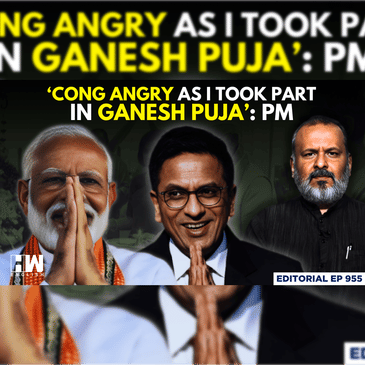
In this episode of Editorial, Mr. Sujit Nair discusses two topics. The primary focus is on a report by the 'Economic Advisory Council to the PM', which lists the top 5 richest states in India. Surprisingly, despite contributing the largest share to the country's GDP, Maharashtra does not feature in the list. Mr. Nair raises questions about this anomaly. Additionally, the episode covers PM Modi's defense of his visit to the CJI's residence for Ganesh Puja.
Learn more about your ad choices. Visit megaphone.fm/adchoices
[00:00:00] Namaskar! Welcome to another episode of Editorial.
[00:00:06] Today, the Prime Minister's Economic Advisory Council released a report and this report spoke about the top 5 richest states of this country.
[00:00:18] Now, the top 5 richest states when I was going through, I did not see my Maharashtra in that top 5 richest state.
[00:00:27] Now, okay, let me give a rider before I get into this editorial.
[00:00:32] You see, I am born and brought up in Maharashtra. I consider myself to be a Maharashtra.
[00:00:38] Now, I may sound a little biased towards my state and I am going to talk for my state today.
[00:00:47] And I talk for my state today because I think a lot of my political leaders in the state are not talking about my state.
[00:00:56] Therefore, I am going to talk for my state.
[00:01:00] So if you find my editorial slightly biased towards Maharashtra, I would seek your forgiveness.
[00:01:09] Let's get right to the show.
[00:01:13] So, let me come to the topic at hand.
[00:01:16] The topic at hand like I told you 5 richest state in the country, Delhi number 1,
[00:01:22] Telangana number 2, Karnataka number 3, Haryana number 4 and Tamil Nadu number 5.
[00:01:30] That's how the top 5 is placed.
[00:01:34] And how did they manage on what parameters are these states called the richest state?
[00:01:39] The parameters which they have used to brand it the richest state is the per capita income,
[00:01:45] which means people there are rich.
[00:01:47] Now, if you go by figures in 2023-24, my apologies, 23-24, Delhi has a 250.8% more than the average per capita income in the country.
[00:02:08] Which means Delhi IIT earns 250.8% more per capita income than rest of the country.
[00:02:19] Likewise, Telangana 193.6% more.
[00:02:23] Telangana is a new state very good, very happy for them.
[00:02:26] Telangana 193.6%, Karnataka 180.7%, Haryana 176.8% and Tamil Nadu is 171.1%.
[00:02:40] So, Tamil Nadu like I told you earns 171.1% more than an average Indian per capita income.
[00:02:52] Okay, so now this is the picture.
[00:02:55] My Maharashtra is not here.
[00:02:56] My Maharashtra does not figure in the first five.
[00:03:01] Now, let me show you another figure.
[00:03:04] You see as far as GDP contribution to the country is concerned, as far as the share of GDP to the country is concerned,
[00:03:14] Maharashtra tops at 13.3%.
[00:03:19] West Bengal 8.9%, Tamil Nadu 5.6%.
[00:03:24] Maharashtra tops as far as contributing to the GDP is concerned at 13.3%.
[00:03:30] A state that contributes the maximum to the GDP.
[00:03:34] In fact, Maharashtra has come down.
[00:03:36] Maharashtra used to be 15%.
[00:03:38] It has come down to 13.3% which also we will discuss.
[00:03:41] But the fact remains that a state that is contributing the maximum to the country,
[00:03:47] our per capita income doesn't figure in the top five.
[00:03:53] I wonder why?
[00:03:55] I wonder how fair is that?
[00:03:58] And I will tell you why I am raising this topic.
[00:04:03] The reason is because the money we spend, the money we contribute to the country
[00:04:08] and the money that we get for our infrastructure,
[00:04:11] the money that we get to ensure that we develop our economy,
[00:04:16] we develop our local economy, we develop more jobs in our economy,
[00:04:21] we get more jobs in our economy, we get more FDIs in our economy,
[00:04:25] we get more companies to come in and invest in our economy.
[00:04:27] When I say our economy, I mean Maharashtra economy is less.
[00:04:33] It is not justifying the kind of contribution we are giving.
[00:04:37] You see the story is here.
[00:04:39] Maharashtra for every one rupee that Maharashtra gives the center,
[00:04:43] Maharashtra gets 0.08 paisa back for every rupee that Maharashtra gives.
[00:04:48] 0.08 paisa back Maharashtra gets for every one rupee that Maharashtra contributes to the country.
[00:04:56] In fact, a state like BR gets 7.06 paisa per rupee they contribute to the center.
[00:05:05] Maharashtra gets 0.08 paisa for a rupee that Maharashtra contributes
[00:05:10] and BR gets 7.06 paisa for a rupee that BR contributes.
[00:05:16] Now, I am not against federal system.
[00:05:18] I am not even questioning that whether BR should be funded,
[00:05:22] Thilingana should be funded, Andhra Pradesh all that is fine.
[00:05:25] I am not asking those questions.
[00:05:28] We are a federal system.
[00:05:30] We are all part of our country.
[00:05:31] We are one country. All that is fine. But what about Maharashtra?
[00:05:35] The question is what about Maharashtra? Are we being fair to Maharashtra?
[00:05:40] Are we being fair to Maharashtra?
[00:05:42] You are taking money from Maharashtra,
[00:05:45] but you are not giving money to Maharashtra to develop the infrastructure,
[00:05:48] to develop investments in Maharashtra,
[00:05:51] to ensure that there is more employment in Maharashtra,
[00:05:53] to ensure that every Maharashtra is employed and he earns money,
[00:05:56] to ensure that there is demand created in the market.
[00:05:59] We are not spending on Maharashtra. How fair is that?
[00:06:05] How fair is that?
[00:06:07] The contributor is not the richest state.
[00:06:09] I am contributing the maximum, but I am not the richest state in the country.
[00:06:14] Think about it. Is it fair?
[00:06:16] Is it fair? I am asking you as a lay person, as a layman, the way I understand.
[00:06:20] Brother, I contribute the most in my house.
[00:06:24] But the lowest salary in my farm is money.
[00:06:26] How fair is that?
[00:06:27] In my brother's or in my uncle's or in my uncle's, there is a lot of money.
[00:06:32] All my family members have a lot of money.
[00:06:34] I contribute the maximum in the house, but my purse has the least money.
[00:06:39] How fair is that? This is how it is, isn't it?
[00:06:41] A very simple layman.
[00:06:45] And even this budget,
[00:06:48] even I raised that point when I was talking about the budget,
[00:06:51] even this budget,
[00:06:52] we are talking about how much investment in BBR,
[00:06:55] huge package to Andhra Pradesh, all that is good. Please give.
[00:06:59] But what about Maharashtra?
[00:07:01] What about us?
[00:07:02] And it's unfortunate, it's unfortunate that a political commentator like me has to speak
[00:07:08] because our leaders are not bothered.
[00:07:12] No leaders are talking about it.
[00:07:14] No leaders are talking about it.
[00:07:16] No leader is sitting there and demanding money for Maharashtra
[00:07:19] for my people who are here for them to get a job.
[00:07:23] For my farmers not to commit suicide.
[00:07:27] The maximum farmer suicide happens in Maharashtra,
[00:07:30] the state that contributes the largest to the GDP.
[00:07:34] How fair is that?
[00:07:36] How fair is that?
[00:07:38] And how long is this going to continue?
[00:07:41] This is the point I wanted to make in my editorial today.
[00:07:45] I have a short topic which I want to discuss with you.
[00:07:51] That's my next one.
[00:07:55] You see, the Prime Minister was invited by the Chief Justice of India for Ganesh Utsav.
[00:08:04] A lot of us spoke about it including me.
[00:08:07] You know, we all thought it was not right.
[00:08:10] It was not correct the right word to use.
[00:08:13] It was not correct for the Chief Justice to invite the Prime Minister.
[00:08:19] Now more than the Prime Minister, one would put the blame on the Chief Justice
[00:08:26] for inviting the Prime Minister.
[00:08:28] The Prime Minister accepted the invitation.
[00:08:30] That is different.
[00:08:31] But the blame I think at least to my mind I would put it on the Chief Justice of India.
[00:08:38] Now the Prime Minister responded to these various comments that people had made.
[00:08:44] The Prime Minister said Ganesh Utsav is not just a festival of faith for our country.
[00:08:50] It played a very important role for the freedom movement.
[00:08:53] I presume he is talking about Lokman Nathriyak who made the Sarvajani Ganesh Utsav
[00:08:59] which is where we had the entire community celebrating Ganesh Utsav to get people together.
[00:09:04] That is what he meant.
[00:09:05] So, important role in the freedom movement.
[00:09:07] Even at that time the British who followed the policy of divide and rule used to hate Ganesh Utsav.
[00:09:15] Even today power-hungly people are busy in dividing and breaking society
[00:09:20] are having problems with Ganesh Puja.
[00:09:23] You must have seen the people of Congress and its ecosystem are rattled
[00:09:29] because I participated in a Ganesh Puja.
[00:09:32] Now a lot of us I guess already understands.
[00:09:35] But for those who may have questions still, see the question is not about
[00:09:42] first of all this entire topic was not on the Prime Minister.
[00:09:46] I think a lot of us were questioning the Chief Justice of India
[00:09:50] and the question is not about Ganesh Puja or Durga Puja
[00:09:54] or Puja per se to say that divide and rule and take it to a next level.
[00:10:00] I think that was absolutely unnecessary and this is not what people spoke about.
[00:10:07] You see very simply what happens is Chief Justice of India
[00:10:12] is the ultimate as far as the judiciary is concerned at least figuratively
[00:10:19] at least as far as constitution is concerned.
[00:10:22] He is first amongst equals technically speaking in the Supreme Court
[00:10:26] but constitutionally he is the topmost judiciary in the country.
[00:10:33] Now the government is the biggest litigant as far as the courts are concerned
[00:10:37] especially the Supreme Court.
[00:10:40] Maximum courts, maximum litigations are government litigations
[00:10:45] either against them for them, by them with them so on and so forth.
[00:10:50] A lot of decisions that the judge takes especially the Chief Justice takes
[00:10:58] may have direct ramification on the government stroke the Prime Minister.
[00:11:04] Direct ramification, electoral bonds you remember
[00:11:09] didn't it have direct ramification on the Prime Minister and the government?
[00:11:15] Didn't it cause a lot of ruffle during the elections?
[00:11:22] Likewise decisions they take has direct ramification.
[00:11:27] Now the point is the concept of a judge, a concept of judiciary is to be a loop
[00:11:34] from the society if I am seeing socializing with the person
[00:11:39] whose judgment I have to pronounce that evening if I socialize with him
[00:11:45] how do you think people will view the judge and his judgment?
[00:11:51] Like I always say justice is not just done it has to be seen as being done.
[00:11:57] Will the people at last see it as it being done?
[00:12:01] Are the judges friend of Prime Minister of India very close friends they socialize
[00:12:06] they meet for pujas and others so they are good friends
[00:12:11] is what a layman would understand and that is the message you are sending to a layman
[00:12:16] look at the photograph in your screen, look at this in your screen it is a quadri-relationship
[00:12:23] between who, between a person who is possibly going to judge the other person
[00:12:27] at some point in time or the person's judgment will have some ramification
[00:12:31] on the other person at some point in time that is the person who is socially
[00:12:35] co-audibly celebrating the function with this judge is that fair?
[00:12:40] Isn't that what you call conflict of interest?
[00:12:45] Why you are going to judge this person or your judgment may have some ramification on this particular person
[00:12:51] and you are socializing with him isn't that conflict of judgment?
[00:12:56] I will conclude my editorial by a very simple question
[00:13:00] you see when money is involved we all are very cautious we all are very about how can that happen
[00:13:08] how can this happen press conference are taken how did Madhavi Buche take money from rent and take money from ICI
[00:13:16] all that money is exchanged but breach of moral conduct we are okay I guess
[00:13:23] we are okay as a nation moral will be okay, care for a quarter times
[00:13:28] you see that's how it's all happening isn't it?
[00:13:32] because inviting a litigant a possible litigant or the government head to achieve justice in this house
[00:13:43] is I think conflict of interest and I think it's breach of moral conduct
[00:13:48] it has got nothing to do with religion it has got nothing to do with Ganesh Utsav
[00:13:53] it has got nothing to do with anything but just that one point
[00:13:58] and that's the point that people are talking about and people are questioning
[00:14:02] and actually people are questioning more people are questioning the chief justice more than people are questioning the prime minister
[00:14:10] and this response of prime minister I thought I should get to your notice
[00:14:13] I think either he missed the point or he wants us to miss the point
[00:14:24] that's the point I wanted to make till I see you next time that's tomorrow at 10
[00:14:28] noshkar