
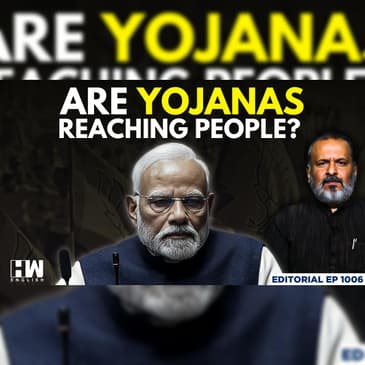
In this episode of Editorial, Mr. Sujit Nair discusses the failure of government schemes. He examines how these schemes, despite being well-designed, fail to benefit the public due to fraud. Mr. Nair also questions why we still struggle to meet the basic necessities of ‘Roti, Kapda, Makaan.’
Learn more about your ad choices. Visit megaphone.fm/adchoices
[00:00:00] Namaskar! Welcome to another episode of Editorial. Today's Editorial is going to be different. Today's Editorial I want it to be a dialogue in some format which means I want you to write your opinion. I am not going to make major opinions but I am going to ask a lot of questions. I want you to give me your opinion. I want you to give me your thoughts.
[00:00:30] And most importantly I want you to think what we are talking about.
[00:00:35] So my subject today is, you see we have been talking about progress, we have been talking about fighting corruption, we have been talking about India progressing, we have been talking about all that.
[00:00:50] But the question is, have we really progressed when it comes to health? Have we really progressed when it comes to housing? Have we really progressed when it comes to starvation food? Have we really progressed?
[00:01:04] Which means how and where and who is progressing? So where is this progress, all of this progress happening? That's the question I intend to ask tonight. And let's get right into the show. And let's talk about it.
[00:01:28] For starters, let's start the topic.
[00:01:57] You know, there is this concept called roti kapda or makaan. You know, it's very ironic. It's very ironic that in 1947 when we got independence, we spoke about roti kapda and makaan.
[00:02:13] Shortage of roti kapda and makaan. And even today in 2024, our biggest issue is hunger index. Our biggest issue is Pradhan Mantri Awa Jyoshna which is housing. And our biggest issue is, can we alleviate people from poverty? This issue has been consistent.
[00:02:33] It's not something that we have been consistent. It is not that we were 224th in hunger index and now we are, you know, we are the most well-fed nation or we are among the top 10 well-fed nation.
[00:02:47] We are still almost where we were. This is where we roam around in that category. This is as far as bhook, hunger is concerned. Roti is concerned.
[00:03:03] Even today, there are Awa Jyoshna, Pradhan Mantri Awa Jyoshna where he is saying that, listen, I know a lot of you all know house. Sorry, I am going to give you houses.
[00:03:14] But still, a lot of us have no houses. Are you getting it? The point that I am trying to make is, if we are saying that we are progressing, where are we progressing? How are we progressing and most importantly, who amongst us is progressing?
[00:03:33] That's important, na? One person progressed, one person bought a car, that doesn't mean the entire city is driving in a car, is it?
[00:03:41] That one person bought a car. Anyway, let me go directly to the topic. Now, like I said, I want you to start writing now. I want you to start telling me as to what are the ways that we have progressed.
[00:04:01] Okay, now let me get into my topic. Let me get into some facts and figures. You see, 3.42 lakh fraud cases detected under the Ayushman Bharat.
[00:04:12] That is Pradhan Mantri Jan Arogya Yojana. This is a headline that we saw recently.
[00:04:20] So, the point is, the government says that I am launching Pradhan Mantri Jan Arogya Yojana for you and somewhere down the line, by the time it percolates down to you, 3.42 lakh fraud happens.
[00:04:36] So, now, this was the case even before. There is that famous saying of Rajiv Gandhi that, you know, if I send 1 rupee, not even 20 percent reaches the ground.
[00:04:51] So, 1 rupee from the center, 20 percent reaches the ground. Has things been different?
[00:04:55] If things have not been different, then other than having a great launch, how are we saying that now things have percolated and it is going to the people?
[00:05:06] And possibly, isn't that the reason why we still are talking about housing? We still are talking about roti kapda and makan.
[00:05:15] While projects are happening in the center, has it actually percolated? Has it actually gone to the person? That is the question I ask.
[00:05:24] Four hospitals in Gujarat faces action from PMJAY discrepancies. That is Pradhan Mantri Jan Arogya Yojana.
[00:05:33] I will read some more headlines. Around 300 officials in Nellor housing department involved in 120 crore scam. This is Pradhan Mantri Awaz Yojana.
[00:05:44] So, here you are. 50 Tamil Nadu officers booked for Pradhan Mantri Awaz Yojana housing scam. This is May 2024.
[00:05:53] India today exposes corrupt agents using PM housing schemes for massive fraud in Delhi. This is 2024.
[00:05:59] One in every four Ujula Yojana beneficiaries took zero or one LPG refills in the last year despite of Rs. 200 subsidy.
[00:06:11] This is what an RTI report says.
[00:06:13] In MP, 4.5 lakh swatch toilets disappear in a 540 crore scam.
[00:06:25] So, all this when it comes to Awaz Yojana, when it comes to Swachh Bharat Yojana, when it comes to medical Pradhan Mantri Jan Arogya Yojana.
[00:06:36] Yojanas all happen. Yojanas all happen and happen beautifully with a fantastic brand name.
[00:06:44] It is branded well. The photographs are right. Everything is right.
[00:06:47] But does it actually percolate to the common man?
[00:06:50] If it doesn't, how has India changed before 2014, in 2010, in 2009, in 2002, in 2000 or in 1999 to what India is in 2024?
[00:07:00] What has changed?
[00:07:03] Because if it is changed, it is moving forward. It is progress.
[00:07:07] Are we saying that now we can brand our schemes well?
[00:07:11] And we can sell that branded schemes well? Is that what we are saying?
[00:07:15] Because finally, every scheme still seems to have problems.
[00:07:19] And this is, mind you, a very restrictive media that is reporting it.
[00:07:26] We, in our channel, had reported about toilets in Uttar Pradesh, if you remember.
[00:07:32] The point that I am asking you, the point that I am trying to make is,
[00:07:38] how have we changed except for the way we have changed our branding?
[00:07:43] The Ladki Bahin Yojana that Maharashtra won.
[00:07:47] Bharatiya Janata Party, Mahayuti, won the election with Ladki Bahin Yojana.
[00:07:53] Now, how much of this Ladki Bahin Yojana do you actually think?
[00:07:57] This is where I want your opinion.
[00:07:58] Like I said, how much do you think, how much of this Ladki Bahin Yojana do you actually think
[00:08:03] is going to percolate down to the last common denominator,
[00:08:06] to that Ladki Bahin who really needs this money and is going to benefit her and her family.
[00:08:12] How much of this is going to do?
[00:08:16] If it is not, then except for the politician benefiting from these Yojanas,
[00:08:23] these well-branded Yojanas, which they create and they launch and then kaput,
[00:08:29] does the people benefit?
[00:08:32] The second question then is, if the people is not benefiting is,
[00:08:35] then our core problem is still roti kapana and makhan.
[00:08:39] How have things changed for us?
[00:08:43] How has life changed for us?
[00:08:47] We still, where we started?
[00:08:49] And if this is how it is going to be,
[00:08:56] then what are the steps that we really need to take to ensure that India develops?
[00:09:02] If our answer is that a lot of schemes that are floated does not actually reach ground
[00:09:12] or does not succeed or does not actually benefit the last common denominator,
[00:09:16] then what is the solution?
[00:09:20] Wouldn't the solution then be that we as voters vote on behalf of the schemes that was put up,
[00:09:29] that was executed and we benefited out of it,
[00:09:32] then schemes that is shown to us to be something that's going to be launched if my government comes in.
[00:09:40] Which means, are we not supposed to judge a government or a political party
[00:09:46] based on what they delivered rather than what they promised?
[00:09:50] We are falling for promises.
[00:09:53] And in future we are going to fall for promises and I do this editorial today for one single reason.
[00:10:00] Because this new animal called freebieism has cropped into our politics.
[00:10:05] And I have been talking about this for a long, long time.
[00:10:09] Freebieism is nothing but branded offers.
[00:10:14] Branded, good branded offers.
[00:10:17] Most of the freebieism is not even going to last.
[00:10:22] We are going to vote purely based on freebieism.
[00:10:26] And we vote, if we vote based on freebieism,
[00:10:31] the government that has been formed on the basis of that freebieism
[00:10:35] is not a government that is actually going to ensure that you develop or things work for you.
[00:10:42] Because that government doesn't have a plan.
[00:10:46] That government has an idea.
[00:10:48] An idea sounds good.
[00:10:50] A plan works for you.
[00:10:54] So the point that I am trying to make is,
[00:10:58] huge number of policies are formed,
[00:11:01] huge number of policies are launched,
[00:11:04] but somewhere down the line,
[00:11:06] you decide, write down,
[00:11:09] how many of those policies has helped you and your family.
[00:11:13] And if you find it difficult to think of a policy that has actually helped you
[00:11:17] and punch it down,
[00:11:19] then the chances are none of these have helped you.
[00:11:22] And if none of these policies has helped you,
[00:11:25] then what are we talking about?
[00:11:26] What progress are we talking about?
[00:11:29] That's the point today.
[00:11:31] Till I see you next time.
[00:11:32] That's tomorrow at 10.
[00:11:35] Namaskar.