
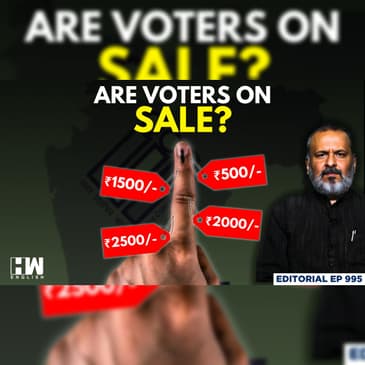
In this episode of The Editorial, Mr. Sujit Nair discusses two interconnected topics related to voters. He delves into corporate donations to political parties, election spending by political parties, and the flow of cash during elections. The second topic focuses on the growing freebie culture in India and its rapid spread.
Learn more about your ad choices. Visit megaphone.fm/adchoices
[00:00:00] Namaskar! You know as we progress everything about our society everything about our society is getting divided. I'll tell you what I mean by that. There is a huge division between the rich and the poor. We have discussed that many a times. We have discussed the Oxfam report and all of that. Huge wide between the rich and the poor.
[00:00:29] Now there is a huge difference of law and order between the political, the powerful and the normal. There is a huge difference. The amount of money spent on elections are atrocious and according to some reports June last year which is general elections there was an increase of money spent of 22%
[00:00:59] Let's talk about the money spent on election and let's talk about how it's going to affect our life and affect badly. Let's get right to the show.
[00:01:12] You see according to a report incremental currency in circulation since the election commission announced election date in March that was I'm talking about Lok Sabha election till the last phase of election was at Rs. 89,080 crores as of June 7th and was 22% higher than 72,680 crores.
[00:01:43] In the same period in 2019. 2019 the money spent or the cash in circulation was 72,680 crores which increased to 89,080 crores in 2024 in June.
[00:01:59] Now think about it. Year on year elections on elections the cash the currency in circulation is getting higher and we are talking about 89,090 crores.
[00:02:16] You see when you go to a cobbler you are encouraged to pay through Paytm. You go to a vendor you are encouraged to pay through Paytm and the situation is such that if the vendor doesn't have an ATM whatever Paytm that card whatever it is that vendor doesn't get business.
[00:02:36] Because people don't pay.
[00:02:40] Because people don't pay. People pay digitally. Paytm. So lot of people, lot of unorganized sectors, lot of informal economy has gone out of business. Why?
[00:02:54] Because we said cash distribute noo ayega baba. Aaj ke baad cash distribute noo ayega. Cash bandh.
[00:03:01] Digital cash chalu. For whom? For common people.
[00:03:07] But for politicians from 2019 72,680 crores cash being distributed, being circulated to 89,080 cash circulation. This is as far as economic times report.
[00:03:24] The politicians ko chalega baba. Politicians ko chalega. This is the point I was trying to make. Like we see difference between the rich and the poor. Huge difference in India between the 1% of the rich and the 99% of the poor in India. You also see difference between the powerful and the powerless in India.
[00:03:46] We are the powerless. And for us Paytm. Leke gumu. For the rich, cash comes. Where do these people get the cash from? Where does the cash generate? We take 1000, 2000 rupees also has been discontinued. Why? Because cash ne dena chihye baba.
[00:04:07] Then where do these people, where do these politicians get the cash? See it is not that I am talking out of thin air. We saw something recently also isn't it? Cash being just shown on your screen I am sure you are seeing it.
[00:04:22] And I am not, believe me you, I am not talking about one particular political party or one particular political dispensation. I am not talking about that. I am talking about every political party.
[00:04:31] One particular political party has excess of cash. So it displays excess of cash. Other political party may not have that kind of wherewithal. So it doesn't. Tomorrow that party has the wherewithal. That political party is also going to display excess of cash.
[00:04:45] So it is no one political party that I am targeting at. Neither am I having any reference to the recent Vidana Sabha election of Maratra. I am not having no reference to that.
[00:04:56] I am just asking you a question. What happens if our country depends or completely if our elections, if our democracy is dependent on cash?
[00:05:09] Let us go to some other data. According to some reports, according to a report in India today actually, nearly 1.35 lakh crores were spent in 2024. We are talking about general election again, Lok Sabha election again.
[00:05:22] 1.35 lakh crores were spent. What I am trying to say is if this is the future of India, if this is the future of India and if this is the kind of money that is going to be circulated in India and this kind of money is needed to win elections, which means money will buy you elections.
[00:05:42] Which also means that people who have money, companies who have money can win you elections.
[00:05:52] Which means that our democracy could one day, not today, maybe tomorrow, not tomorrow, maybe day after.
[00:06:00] But our democracy, if the way we are going ahead, if this is the route we are catching, then our democracy one day could be bought by one single corporate.
[00:06:10] If one single corporate decides to put in 2 lakh crores into our democracy, into our election, chances are that particular corporate could dominate the political party that runs our country and therefore that particular corporate could dominate our country itself.
[00:06:31] We are seeing corporates dominate our culture, corporate dominate our sports, corporate dominate our favourite games.
[00:06:39] We have seen all that.
[00:06:41] What if tomorrow you have a corporate dominating your country, your life, your democracy?
[00:06:51] You see, and the fault here, not of the political party alone, the fault here is of the voter and I would say the fault here is more of the voter.
[00:07:03] Because today, the voter is willing to take money and cast his vote or her vote.
[00:07:12] And this, somewhere down the line, is going to prove very dangerous for us, very dangerous for our democracy.
[00:07:21] In fact, this is going to seize us to be a democracy.
[00:07:27] And these are the figures that I showed you.
[00:07:30] I will show you one more figure before I go into my next subtopic.
[00:07:36] The figure that I want to show you is the rising cost of democracy.
[00:07:40] Around 20% growth was seen in electoral expenditures since financial year 2023.
[00:07:46] So, in 2013-14 versus 2022-23, the price of democracy as you see in your screen has been going up.
[00:07:59] The cost has been going up.
[00:08:02] The point, therefore, that I want to make is, A.
[00:08:08] If it's only money that will pursue us to give our votes to a particular political party,
[00:08:16] if it is only going to be money, then we will seize to have a democratically elected government.
[00:08:24] That government will be a farce.
[00:08:26] The second problem.
[00:08:28] The second point is freebie.
[00:08:30] You see, freebie culture is spreading as much as the communal caste culture in our country.
[00:08:40] Once upon a time, we used to say that,
[00:08:42] Arrey, it is not, we don't cast our vote, we vote our caste.
[00:08:45] That was one thing that used to happen in our country.
[00:08:48] Then, it became communal.
[00:08:50] Hindutva.
[00:08:52] You see, now, it is freebie.
[00:08:55] It is this freebie culture.
[00:08:58] The problem was, see, for a Hindutva, there was an alternative.
[00:09:02] There was an alternative group of people who, or group of political parties,
[00:09:07] who were talking secularism.
[00:09:09] So, you had a Hindutva platform, you had a secularism platform.
[00:09:13] At least, there was some kind of an option, some kind of a competition, some kind of a resistance.
[00:09:20] Freebie culture seems to be something that is universal in India now.
[00:09:25] Every political party breeds on freebie.
[00:09:30] I will give Rs. 1500.
[00:09:32] The second party says, I will give Rs. 3000.
[00:09:36] The first party says, okay, I will increase it from Rs. 1500 to Rs. 2500.
[00:09:41] This is going to go on and where is it going to end?
[00:09:46] You know what freebie is going to do to you?
[00:09:49] A figure puts freebies that Maharashtra would have to pay for the freebies at 46,000 crores.
[00:09:56] Total number of freebies to almost 96,000 crores.
[00:09:59] That is what one figure says.
[00:10:01] You know where is it going to end?
[00:10:02] It is going to end when your health is compromised.
[00:10:08] Your health is compromised.
[00:10:10] I have done a complete editorial on that.
[00:10:13] Your health is compromised.
[00:10:14] Your education is compromised.
[00:10:16] Most importantly, Manrega.
[00:10:18] Projects like Manrega is compromised.
[00:10:20] Where the lowest common denominator of this country gets that opportunity to earn his or her two square meal.
[00:10:27] Not donation.
[00:10:29] Not donation.
[00:10:30] Not khairat.
[00:10:30] Not bheek.
[00:10:31] But to earn the two square meals with pride.
[00:10:34] That projects like Manrega suffers.
[00:10:40] And that's what worries me the most.
[00:10:43] You see, two aspects in our democracy.
[00:10:48] This concept of spending money for votes.
[00:10:51] And therefore, the chances of large corporates coming and dominating our political scenario.
[00:10:58] This is a huge risk that is looming large on us.
[00:11:03] And the second is this freebie culture that every political party seems to be going through.
[00:11:09] And when I talk about this, believe me you, again and again, let me repeat.
[00:11:14] I am not keeping any single political party in mind.
[00:11:18] Because every political party indulges in using money.
[00:11:24] Some may be doing it more.
[00:11:26] Some may be doing it less.
[00:11:27] That is purely because that particular party gets more money and the other party gets less.
[00:11:32] If this party gets as much money as the other party, I am sure this party will do the same kind of spending.
[00:11:37] So, it is not about a political party.
[00:11:40] It is about the way our politics has turned out to be.
[00:11:44] And the second point that I wanted to say is about freebies.
[00:11:48] Freebies.
[00:11:49] Don't vote for a political party based on freebies.
[00:11:52] Because finally, you are going to pay for that freebies.
[00:11:55] And finally, the compromises, all the compromises that are going to be made,
[00:11:59] are going to be made on your benefits, your privileges, your health, your education.
[00:12:05] So, think twice before you accept freebies.
[00:12:08] Ask your politicians as to where is he getting these freebies from.
[00:12:13] Because obviously, it is not coming from his bank account or his party's bank account.
[00:12:18] Be wary of freebies.
[00:12:21] The next time you see a political party splurging money, splurging money for vote,
[00:12:28] think about the fact that some, some corporate or a group of corporates are funding them to splurge that money.
[00:12:37] And also think that if you cast votes based on the money they splurge,
[00:12:44] imagine the havoc those corporates can play with your life in the future.
[00:12:49] Think about it.
[00:12:50] Till I see you next time.
[00:12:52] That's tomorrow at 10.
[00:12:53] Namaskar.
[00:12:55] Stay ahead with our cutting-edge news app.
[00:12:58] Instantly access the latest shots in just one minute and breaking news in just 50 words.
[00:13:03] Download now for a smarter, faster news experience.