
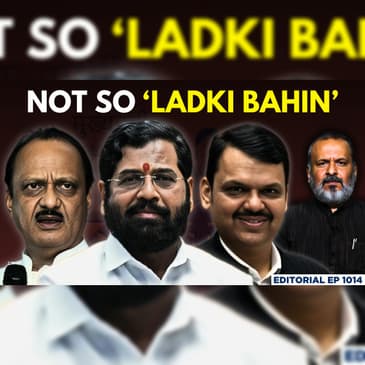
In this episode of Editorial, Mr. Sujit Nair discusses the Maharashtra government's recent decision. The government is likely to remove the names of 60 lakh beneficiaries from the Majhi Ladki Bahin Yojna. Mr. Nair examines the concept of ‘freebies’ and highlights the risks they pose to the state's financial health.
Learn more about your ad choices. Visit megaphone.fm/adchoices
[00:00:00] Namaskar! Welcome to another episode of Editorial. Around 60 lakh women are no longer Ladki for the Maharashtra government. They are no longer Ladki Bahin. Their name could likely be removed from the Ladki Bahin list.
[00:00:20] The question is, if they were not eligible for the money, then why were they paid? Why were they paid before the elections and after the election the eligibility was checked and they could likely be removed? Why? Let's ask that question tonight. Let's get right into the show.
[00:00:41] On the 1st of July 2024, the Mahayuti government then headed by Ekanat Shinde, now it is headed by Devendra Phatnavis, then headed by Ekanat Shinde, launched a scheme called the Mukya Mantri Maji Ladki Bahin Scheme.
[00:01:01] Very similar on the lines of Madhya Pratnavis, Mary Ladli Bahin which incidentally brought BJP to power again in Madhya Pratnavis.
[00:01:13] Then Maharashtra government which is also the government currently, the Mahayuti government launched the Maji Ladli Bahin scheme where they said that we will pay 1500 rupees to our dear sisters in Maharashtra.
[00:01:25] Those women whose household income was lesser than 20000 rupees. Incidentally, according to a report 21600 crores has already been paid.
[00:01:36] Now, Mahayuti came in with a resounding victory, resounding victory. They won, they sweeped the Maharashtra polls, sweeped up.
[00:01:49] They have to pay no? They have to pay those Ladli Bahin's. Now the Maharashtra government says, no, no, no, no, no problem.
[00:01:58] You see, they could likely remove 60 lakh of Ladli Bahin's from the Ladli Bahin scheme list. 60 lakh gone. 25% almost.
[00:02:10] Why? Because there is a lot of burden on the Maharashtra state government to pay this kind of money. Through this action, the government could remove at least 25% of the 2.46 beneficiaries of this particular scheme, which would in turn save around 900 crores out of the 3690 crores which they are spending per month.
[00:02:32] Now, the government says that the government will sift out those beneficiaries who also are receiving benefits from schemes like Sanjay Gandhi, Niradar Yojana scheme under which 25 lakh women were given 1500 pounds.
[00:02:48] The Namo Sethkari Samman Yojana, the PM Kisan Samadhan Nidi Yojana, all these other Yojanas which they are getting, they are going to kind of cut their names off.
[00:02:58] Because you are already getting it, is what they are saying currently.
[00:03:02] They are also going to check now to see whether, you know, whatever is signed and given in the affidavit, that our household income is lesser than 2 lakhs, that also they are going to see whether it is actually true.
[00:03:13] Question is, when you were given, like I told you, 21,600 crores when you gave from July 1st, 2024 to today, which is January 7th, 2024, you didn't think of all this.
[00:03:34] You didn't think that, you see, some people may be giving, getting other schemes, so we should not give them.
[00:03:39] Some people may be giving false affidavit, we should not give them.
[00:03:43] Some people may be benefiting some other pension schemes, you should not give them.
[00:03:47] Didn't you think of it then?
[00:03:49] If you didn't think of it and paid these people randomly, what were you doing and why did you do that?
[00:03:57] If I were to say that this was done purely for votes, this was done purely to ensure that the voters are enticed by giving money, taxpayers money, not private money from the political party.
[00:04:12] That too is wrong.
[00:04:12] But taxpayers money given to these people to get votes and once you get votes, you say that no, no, no, no, no, no, no, no, no, no, no, this is wrong.
[00:04:22] Now you have to delete the names.
[00:04:24] Why?
[00:04:24] Because you are part of other schemes.
[00:04:28] Why?
[00:04:28] Because you gave us wrong affidavits.
[00:04:31] Why?
[00:04:31] Because you already are getting other pensions.
[00:04:35] Is it fair?
[00:04:37] Is it fair?
[00:04:38] You see, the reason I am saying this is because this is not the first time it's happening.
[00:04:45] You see, if you remember Mary Ladli Behna Yojana that happened in Madhya Pradesh, which actually bought back the Bharatiya Janata Party as government in Madhya Pradesh.
[00:04:57] This Ladli Behna scheme also was paying around 1250 rupees to the women in Madhya Pradesh.
[00:05:04] The Indore mayor came up and said that, listen, because of this Ladli Behna scheme, we are not able to pay our salaries to our employees for the last six months.
[00:05:17] He had said this.
[00:05:19] We knew this was a disaster.
[00:05:21] We knew this could be a disaster.
[00:05:22] But yet, without looking at our budget, without looking at our coffers, our government, our political parties decided to go ahead with this project.
[00:05:32] Why?
[00:05:33] To win elections.
[00:05:34] Why?
[00:05:34] To entice you.
[00:05:35] Why?
[00:05:35] So that you are given money and you give votes in return.
[00:05:38] And the fact is, the worst thing is, you gave that vote in return.
[00:05:44] Freebies are dangerous.
[00:05:47] We keep on saying this.
[00:05:49] Freebies are dangerous.
[00:05:51] They are as dangerous as communalism.
[00:05:55] The unfortunate part of freebies is that, communalism, there is a set of political parties that gets involved in communalism.
[00:06:05] But freebies is party agnostic.
[00:06:09] Almost every political party, be it Bharatiya Janata Party, Congress, Shiva Sena, Aap, every political party is involved in freebies.
[00:06:38] You see, according to a report, this was, I am quoting a report from 13th of October.
[00:06:43] However, Maharashtra's physical deficit has crossed 2 lakh crores.
[00:06:48] Maharashtra, which is one of the most developed states, has a fiscal deficit of 2 lakh crores.
[00:06:55] And where is it going to now?
[00:06:58] Where is it going to?
[00:07:00] If there is no infrastructure, if there is no investment in Maharashtra, there will not be other people coming and investing in Maharashtra.
[00:07:08] Which means, Maharashtra's infrastructure will go down.
[00:07:10] If Maharashtra's infrastructure will go down, like I said, there will be no investment in Maharashtra.
[00:07:14] If there is no investment in Maharashtra, there will be no growth in Maharashtra.
[00:07:18] If there is no growth in Maharashtra, there will be no work, no employment generated in Maharashtra.
[00:07:23] If there is no employment generated in Maharashtra, you will have more people starving in Maharashtra.
[00:07:29] What is this 1500 rupees going to do then?
[00:07:35] You see, economics is about limited resource and multiple needs.
[00:07:40] Putting the limited resource to the right need so that it generates the maximum benefit.
[00:07:47] We have lost that thought.
[00:07:50] We have lost that thought completely.
[00:07:54] And today, here we are.
[00:07:59] The reason I am doing this editorial is for you viewers to understand when your political party comes to your doorstep,
[00:08:07] asks for your vote, offering you a freebie.
[00:08:11] First thing, understand that that freebie that that political party is offering you comes from your pocket, your coffers.
[00:08:20] Second thing, understand that that freebie which you are going to get in one place, it is going to take away something else, possibly something much more important, which you may not realize.
[00:08:30] Third, freebie culture is very different to welfare state.
[00:08:36] First thing, freebie is where they equip you enough for you to earn for yourself, friend your family, grow your family.
[00:08:49] Freebie is where they give you a few pennies to ensure that you survive for that particular day.
[00:08:56] This is the difference between freebie and welfare.
[00:09:01] Do not confuse the both.
[00:09:04] Do not support a political party that offers freebie.
[00:09:09] Go for a political party that talks growth.
[00:09:12] Go for a political party that talks to you about your future, education, health, growth, infrastructure, etc.
[00:09:21] Otherwise, today, you will be in the top of the list.
[00:09:25] Tomorrow, your name will be struck out.
[00:09:29] You neither will have the infrastructure nor the freebie.
[00:09:33] This is the point I wanted to make.
[00:09:37] Freebies.
[00:09:38] Freebies again is a matter which is subjudice.
[00:09:44] Therefore, we are not speaking on this.
[00:09:46] But since you asked about the reforms, I will tell you the existing legal framework on what is in place and what can be done and what should be done.
[00:10:03] It is a settled law today in the Subramaniam Balaji versus state of Tamil Nadu that freebies are not disallowed.
[00:10:15] This is the apex court's order in Subramaniam Balaji.
[00:10:19] There was a distribution distribution that the court has received three-member division bench.
[00:10:24] It is the case of the three-member division bench.
[00:10:26] We cannot stop it.
[00:10:31] So, our hands are now closed.
[00:10:37] The court has been closed.
[00:10:38] The matter of all judges are in the court.
[00:10:40] But this is the case of economics.
[00:10:45] What is freebie for me is an entitlement for somebody else.
[00:10:49] So, it's very, very thin line between what I call a freebie and somebody else claims it as an entitlement.
[00:10:55] Therefore, in an immediate run, which we attempted, we brought out a pro forma, we circulated it to political parties.
[00:11:03] It must immediately be put to use and to the public disclosure that
[00:11:10] we don't say freebie, we don't say freebie, we say a declaration of election manifesto.
[00:11:16] Because if it's freebie, it doesn't have to be defined.
[00:11:18] It would be very difficult to define what a freebie is.
[00:11:22] The Honorable Court also last time when hearing was said that we will appoint an expert committee
[00:11:26] to decide on this.
[00:11:28] But whenever that happens, it would be extremely difficult to define freebie.
[00:11:31] So what is necessary?
[00:11:33] The necessary is that the fiscal health of the state must be known to the public.
[00:11:40] What is debt to GDP or GSDP ratio of that state?
[00:11:44] What is how much interest you will pay on that promise?
[00:11:47] How much you will borrow?
[00:11:49] Interest payment to total revenue receipts.
[00:11:51] What is your ratio?
[00:11:53] Then there are FRBM targets.
[00:11:55] How much you can borrow?
[00:11:57] What is your fiscal estate?
[00:11:59] How much is the financial cost of this promise?
[00:12:11] If you read the state of finances report of the RBI, we are, we cannot mortgage the future of the future generations.
[00:12:22] It is a very, very serious issue.
[00:12:26] We have attempted it.
[00:12:27] We have issued our performance on our website.
[00:12:30] This is high time that it must be accepted and legal answer to this must be found.
[00:12:34] But our hands are tied at this moment because matter is subjudice.
[00:12:40] Till I see you next time, that's tomorrow at 10.
[00:12:43] Namaskar.