
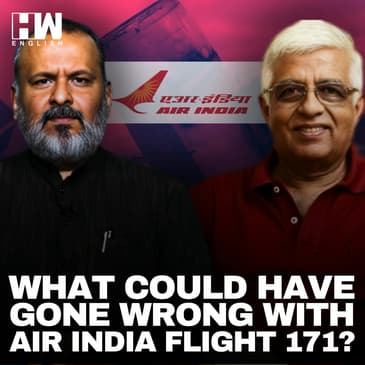
Sujit Nair, in conversation with aviation expert Capt. Mohan Ranganathan, discusses the Air India Flight 171 crash near Ahmedabad airport. The flight was en route to London when, within seconds of take-off, it crashed in a residential area.
Learn more about your ad choices. Visit megaphone.fm/adchoices
[00:00:00] Namaskar! The Boeing 787 Dreamliner 8 series crashed yesterday. This aircraft was taking off from Ahmedabad to Gathwick airport in UK. 241 out of 242 passengers died.
[00:00:22] The number of people who died on ground because this aircraft crashed on ground just outside the airport. The number of people who died on ground, these numbers are yet to be confirmed. Now why did this aircraft crash? Because Dreamliner, that is especially the 8 series,
[00:00:45] this is the first fatality that a Dreamliner, Boeing Dreamliner 8 series has encountered. There has never been an accident. So then what really happened? This aircraft was registered in 2012, so it is not a very old aircraft. 2012 is not an old aircraft in terms of the way you see aircraft and the model. So it has not been a very old aircraft. So then what went wrong?
[00:01:15] Was it a technical fault? Was it an administrative fault? Was it a pilot error? Was it because of a bird hit? Was it because of an engine failure? What really went wrong? Because when we talk about bird hit, people say that, listen, you know, there has to be smoke. There was no smoke. So is that the way you see bird hit? Or when an object enters the aircraft? Is that what happens?
[00:01:41] So all of this, we thought we will talk to an expert because I think that's the person who should be answering all these questions. And we have Captain Mohan Ranganathan. Mohan Ranganathan doesn't need an introduction because he is possibly one of the most well known aviation safety experts in the country.
[00:02:06] Let's talk to him. And what I did is I actually asked a very basic question so that as a layman, I understand what exactly happened. Questions that are not very technical, but questions that will give us a perspective of what could have happened. What could have happened yesterday? Let's go in and talk to him.
[00:02:31] Is aviation safe in India? I would say no. Standards of pilots and the standards of training have diminished worldwide. If heads don't roll now, and this is not a small accident, you know, it's a huge accident and it's a setback. So any obstacle which penetrates that plate is not supposed to be permitted.
[00:02:56] But airport authority due to political pressure will give NOC to some structure or other. They will not touch somebody who's got a lot of connections and wealth. Is there a pilot error in this entire? I wouldn't call it a pilot error. I would call it a human error. What went wrong is, well, everybody will blame the pilot, but I blame the system.
[00:03:46] Because if you go through the track record, almost all the fatal accidents we've had in India, most of the major ones are in India. And the Tata's have taken over. It's three years now. But what is worrying is the same set of people have been manning the top positions except for the expats.
[00:04:15] And there is no accountability. See, when you have a fatal accident, there should be accountability. You have to find out why it is happening. Now, if it's happening once too often, you just can't say that it is, you know, they'll write it off as pilot error.
[00:04:36] The reports are cooked up. And there's a lot of manipulation of facts to achieve. Like I'm sure that in school, you will know what is the answer that you should get. And you work backwards by fudging the figures. And people who have been manning the safety and training in India have been fudging the figures for a long, long time.
[00:05:05] So if heads don't roll now, and this is not a small accident, you know, it's a huge accident. And it's a setback. 241 people died. Yeah. And then so many on ground. Correct. See, so it's not just Air India. Now, yesterday on that NDTV show that correspondent was showing, he was talking about the building in which the aircraft crashed.
[00:05:33] He said it is 1 plus 5, the structure, which means 60 feet, a minimum 70 feet high building, 300 meters from the end of the runway, end of the compound wall. So, how did they allow a tall object? And it's an obstacle who gave the no objection certificate should be held accountable and action should be taken.
[00:06:03] Yeah. So, Sir, I am sorry to interrupt, but according to rules, that particular building was not supposed to be there, isn't it? I think so. You can't have that tall building. Yeah. You see, the Annex 14 standard one, you know, the volume one clearly gives the funnel, the takeoff funnel. Right. And if it, and from the end of the runway, that anger.
[00:06:31] So, any obstacle which penetrates that plate is not supposed to be permitted. But, Airport Authority due to political pressure will give NOC to some structure or other. They will all go around with bulldozer to demolish poor people's apartments and houses. But they will not touch somebody who has got a lot of connections and wealth.
[00:06:55] So, coming back to the aircraft, Sir, 787 8 Series Dreamliner, one of the best that Boeing has. As of now, this is the first ever accident that has been reported for a Dreamliner. What actually went wrong then? See, what I suspect it is not the aircraft.
[00:07:21] I think it is either bird ingestion which caused the compressor stall, the loud bang that some couple of passengers reported. Even though a survivor had said 30 seconds after takeoff, there was a loud bang. If birds are ingested, and Ahmedabad is notorious for birds, you can have the mismatch of airflow which will cause the compressor to stall.
[00:07:51] And that is the sound they would have heard. And the other thing could be like a foreign object damage. Like, you know, birds flying around, they could have picked up something from the side and flying across. They might have dropped it on the runway or the shoulder of the runway. And that would have been sucked in. So, it could be a foreign object damage or bird ingestion which can cause this.
[00:08:18] So, and those engines are very powerful. It will suck in anything which is within the area of the airflow. A bird hit, wouldn't that cause some kind of smoke or some kind of engine issue? Wouldn't it be visible? See, if it is a small bird, there will be not much of smoke. By the time it comes out of that huge engine, it could have been cooked completely.
[00:08:49] And if you look at the video, you don't see that portion where the stall takes place because it could have just been burned. Unless it's a very large flock of birds, you won't get the smoke. Mm-hmm. So, even if it is installed, you can get black smoke. But I didn't see any smoke as such looking at that. Yes, there was no smoke.
[00:09:16] That is precisely no smoke as in when the plane went down, there was no smoke. So, normally I was trying to do a little bit of research in a very layman's kind of way. Most of the bird hits, I found that there was some element of smoke that came out of the engine. And here there was no smoke. So, that was the question I asked you, sir. Sir, another thing is the landing gear was down. Yes.
[00:09:43] So, shouldn't the landing gear be up at that altitude and that speed? It should be up before you reach 35 feet as per the procedures. And this was 40 feet? This was 400 feet. Oh, 400 feet, I am sorry. So, shouldn't that be… Exactly.
[00:10:00] So, what I suspect is they must have had a compressor stall either due to birds or due to some object being sucked in. And that noise could have startled them. What you call a startle effect.
[00:10:21] So, when you suddenly hear a noise as you are rotating and you can be distracted and he is going to copilot. Okay, they say he had 1100 hours. Out of that 200 hours will be on a small Cessna aircraft. So, the other 900, how many hours does he have on the Dreamliner is something that you have to check.
[00:10:47] So, if he doesn't have much experience and if they are not used to… I mean, if they didn't anticipate… When you see a lot of birds, you should be mentally prepared that this can happen. But if you are not prepared for an eventuality, it takes you by surprise. When something like this happens, when you are taken by surprise, what will happen is you may forget a few vital actions.
[00:11:14] And by the time it is not climbing and you see the obstacles ahead of you and you are focused on that and you forget this. That's exactly what happened in the Mangalow crash when the pilot decided to go around. Yes. Because that ILS structure, which was illegal, it was supposed to be frangible, but they had a concrete structure.
[00:11:41] So, when he saw the huge concrete structure, he tried to go because he knew that he can't stop the aircraft. And the same thing, if they had seen that big building ahead, that hospital building, which appears to be a violation, they would have been focused on that and nothing else would have registered. You know, when some kind of a startle effect takes over, you are going to be focused on that. And that is what I think a good investigator will…
[00:12:11] Fortunately, because Boeing is in a controversial position right now, the NTSB will be far more alert than they were in the Mangalow crash because it was not pointing a finger at an American manufactured aircraft. While here, the whole world is looking at the first fatal accident for a Dreamliner. Boeing is already facing a lot of technical problems.
[00:12:40] So, they would want to make sure that nothing is swept under the carpet. So, from that point of view, NTSB will be very alert for this crash, unlike the other crashes they have involved themselves in. So, let's take one particular case like we are just discussing. Let's assume that it was a bird hit. If it was a bird hit, sir, what exactly could the captain do when it was taking off and you have a bird hit within 40 seconds, for instance?
[00:13:07] What exactly, what are the steps that the captain could have done? See, when I was part of the Civil Aviation Safety Advisory Council after the Mangalow crash, I was also appointed into the bird committee. And I had brought out a procedure for bird avoidance by pilots.
[00:13:29] And I had some friends with the bird society and see these kites, they all have self-preservation instinct. So, close to the ground, no bird or a kite is going to dive down because it's ground. It will want to get away to escape. So, close to the ground, any bird, if it feels an aircraft is coming towards it, will only climb.
[00:13:57] Because otherwise it will crash into the ground. So, the way to avoid a bird while flying on takeoff is, you have, okay, you have the normal rotation angle. But if you find the bird coming at you, if you dip your nose down slightly, yes, you may not be theoretically correct for the climb angle.
[00:14:21] But dropping your nose one or two degrees, what will happen is, it's going, and over the wing you have the air flow, the slipstream. Now, the bird will be blown off by the slipstream. So, you will escape the path of the bird.
[00:14:38] But on the other hand, if you don't understand what the bird is going to do, if you try to climb also, your engines are so large and the air flow that it sucks is going to be so wide, almost 20 feet diameter. Anything in the path will be sucked in.
[00:14:58] If you are at an altitude, like what Sullenberg had, you know, there the birds will dive down because they got plenty of ground sky below them. And they are not going to try and climb there. So, climbing when you are at altitude, you can avoid a bird. If you are close to the ground, you must dip down, dip the nose slightly to push the birds off.
[00:15:26] But most of the pilots don't understand that. Again, a layman's question. Sir, within that aircraft, in that huge aircraft, when you are sitting in the cockpit, so do you actually visually see birds from where you sit? Yeah, you can. You have a clear wind shield. So, even if it is a small concord.
[00:15:49] That is why in the concord, they had the nose dipping down for takeoff because once it gets airborne and it is going supersonic, it will lift up. So, if they had that for the approach, they would not be able to see ahead because the cockpit is so far behind. Correct. So, correct, correct, correct, correct. So, they have the nose down. Yeah. Okay.
[00:16:16] Sir, we have developed, I mean our technology has developed, the aircraft, the aeronautical technology has developed. Sir, we still have this basic problem of bird hit. Why is that so, sir? Why are we not able to create a methodology or a technology which can avoid bird hits, which can ensure that the plane doesn't need to worry about birds anymore?
[00:16:43] See, there is one thing I don't know what is the SOP that Air India or other airlines in India follow now. But when I used to fly here, we had a system where I had made the SOP for Sahara when I was flying with them and SpiceJet, where I had insisted that even if it is in clear weather, keep the weather radar on.
[00:17:09] You know, the radar frequency disturbs the birds and they move away. There was a study done about that. So, if you keep your weather radar on throughout for all takeoffs and landing, the chance of avoiding a bird strike is very good. But if you don't, then you have got to depend on your eyes. Assuming it is not a bird hit, what else could it be?
[00:17:37] It could be, you know, like if the birds which are flying around, they pick some object from the side of the runway and they drop it on the runway shoulder or the runway. Then the engine can pick up that object. Like what happened to the Concorde?
[00:17:59] You know, the previous aircraft which took off some part dropped out and these engines picked up and that is how the Concorde crashed. Now, it will be interesting if the investigators ask for details of which flight took off before. Yeah. So, that will be an idea. Or if there are strong winds, it can blow in, you know, objects onto the runway.
[00:18:27] So, I don't think the winds were very strong, but it can happen. Like if there is an aircraft which is turning off with high thrust, it can blow sand and other things across. So, that can happen. So, it could be a foreign object which had been sucked in, which can cause the same kind of damage. Sir, I am sorry, I am asking you a very basic question so that, you know, a normal audience understands what the situation is.
[00:18:55] Sir, how big or small need the object be for it to cause a crash? The object can be even about one inch diameter. This much and that can cause a crash? Yeah. That's the… Is there any technology that has been designed or being invented that can kind of ensure that, you know, the engine doesn't get… I mean, the engine doesn't blow up.
[00:19:24] They do have… No, it doesn't… only the blades will be affected. You know, it may not be the whole engine. You see, they are turning at such a high RPM and you have the fan blades. It's not just the coarse section of the engine. You got the wide fan section. So, it is the fan blades which will be bent or affected, which causes a mismatch in airflow. And that could cause that noise.
[00:19:51] But, it will not be a loss of thrust because of that. Let's take a second scenario. The nose was towards… It was as if it was going to land. The flight… the nose was tipping up. The landing gear was still down. Sir, what else could have gone wrong? Is there any other possibility other than a hit or a… Or a… Or an object going inside the engine or a bird hit or…
[00:20:19] Is there any other possibility that you can envisage? See, one of the features of… All the Boeing design… Right from the first 737… There is a feature that Boeing has… The stabilizer. See, smaller aircrafts have elevators… And large high-speed aircrafts… The elevators are small. So, what happens is the tail plane…
[00:20:47] The whole tail plane will move. The stabilizer is strong and big. And… You change the angle of the stabilizer to compensate for the small elevator. And that elevator… Stabilizer control… Is under control wheel of the pilot… On the Boeing. So, if… If… When you use the stabilizer… You are… You know, when you want to get your nose up… Then…
[00:21:16] You got to get the… Stabilizer up… So that… It lifts up. And… So, using the stab trim… One of the old manuals used to have that… The modern… All the new manuals… Boeing has deleted a number of lines… And one was that… Fly in trim speed. So, the aircraft flies… The speed at which it is trim. So, when he loses an engine… Or loss of thrust…
[00:21:46] And he is trying to climb… If you are trying to use the elevator at slow speed… You will find that the control force is heavy. So, the tendency is to… Use the stabilizer to release the thing. But when you release the pressure… The aircraft will seek its interim speed. Suppose you have trimmed back… The… Stabilizer will lift up the nose… You know… Because of the stab trim setting… Okay. So, that is why the nose is high.
[00:22:15] So, when he… Is trying to gain height… And the speed is dropping… Because the thrust is already gone… And… Looking at the final stages… You know… From the time he started dipping down… It appears to be… The aircraft was stalling. If… If assuming… I just want to… What I am trying to… Kind of figure out is that… Is there any way… We could have saved that 241 lives… If there were no buildings… For instance… In the…
[00:22:44] In the… In the… In the path… Would that save… Would that help? Well… If the area… Beyond the building… Was clear… And if the building… Was also… Not an… Officially… It is an obstacle… If the gliding gear… Was up… He would have had… A better climb gradient… Initially… And also… A… Longer glide distance… Without the… Drag of the gear… So… The reason why… It was shallow… And it was sinking…
[00:23:15] Was the drag… Caused by the gear… So… If they didn't… If the gear… Was not there… There is a possibility… It could have gone… Beyond that building… And if the area… Was clear… They could have even… Crashed on the… Flat ground… That would have saved lives… Yeah… It would have… Saved… The people… Who are on ground… Who died… And also… Many…
[00:23:44] Who are on board… Correct… Absolutely… Sir… Let's… Let's assume that… You said it… Right in the… In the onset… You said… That… There is… There is no way… That… You know… We always tend to blame the pilot… And… It is not the pilot… It is the system… That is at fault… Completely appreciate that point… Sir… But… Is there… Still… Is there a pilot error… In this… In this entire…
[00:24:12] I wouldn't call it a pilot error… I would call it a human error… Schumann… Can you… Can you… Can you… Can you… Can you tell me the distinction between the two, sir? Okay… Uh… You know… If you go through the… Lead investigator of the Air France crash in Toronto in 2005… The… Journalist asked him… Is it a pilot error… And the answer he gave was… He says… I don't…
[00:24:41] Call it a pilot error… He is a human… And… It is a human… Who has not… In a… I look at what… Makes the pilot… Do what he is not trained to do… So… In a situation that was confronted by this crew… Have they done similar exercise on the simulator… Have they been trained for that? See… Uh… When you… Have…
[00:25:10] Dual engine failures… At… A tenth… Uh… 3000 feet… And things like that… Has any airline… Even thought of doing a dual engine failure… On rotation… So… If you have been trained to do something… And then you make an error… You can call it a pilot error… Here is a situation… Where he is not being trained… To do this…
[00:25:32] So, like what that real ambassador, that's chief investigator said, I look at what made the pilot do, what he's not trained to do. So that is a way a good investigator should look at.
[00:25:48] You see, the NX 13 clearly says, if you have an accident investigation, identify what caused the accident and prevent a recurrence in training and safety standards. Here, if you go through most of the accidents in India, it is almost a repetition of the same thing again and again.
[00:26:15] And people who have been heads of safety or operation or training, they continue there. Nobody is blamed. Poor pilot is blamed. When you say dual engine failure, how do we visually kind of figure out whether there is a dual engine failure or whether a single engine has failed? Because obviously if there is a bird hit, then you have one engine failure, isn't it?
[00:26:41] See, if it is a one engine failure, any aircraft is certified all your takeoffs, the weights are based on losing one engine on takeoff. You can climb out safely clearing all the obstacles. The way the takeoff performance is calculated is after takeoff, what they call the takeoff segment, you get your gear up before you reach 35 feet.
[00:27:10] And then 35 feet to 400 feet is called the second segment, which you require a gradient of 2.8%, which is factored by another 0.7 if you are. And this, all these tracks are cleared by 35 feet by the aircraft, even on single engine.
[00:27:38] Only if you can do that, you can takeoff with that weight. Anytime your gradient cannot match there, then you will reduce the takeoff weight. That's why depending on the temperature, sometimes you get into, they tell you the flight is full, but you may find some seats are empty and you think that they are bluffing. It's because at high temperature and high altitude runways, they'll have to go further. Every takeoff is based on losing an engine on takeoff.
[00:28:08] When you have two engines, you can climb out comfortably. But the weight calculation is based on this. Oh, so what you're technically saying, sir, that you never can make out whether there is a one engine flying or two engines in operations. You can never actually make out visually, can you? You can make out visually like in the older aircrafts by the way it is swing to one side.
[00:28:34] You know, and you correct it and bring the, but the modern, like a Dreamliner or a 320 Airbus aircrafts, it has auto compensation like 777, the fly-by-wire aircraft. They automatically correct for an engine failure, the swing. So the pilot, really speaking, will not feel it. While the older aircraft, because you are taking the corrective steps, you know exactly which engine is gone.
[00:29:02] In a modern aircraft, it takes a few minutes to realize that one engine is gone. So other than modern technology being of help, it has, in such cases, it has actually kind of caused this fatality, isn't it, sir? Had the pilot known that there is one engine that has failed, he could have immediately switched on to the next engine, like you rightly said.
[00:29:25] See, that is what FAA had also identified more than 15 years back, that the manual flying skills of pilots have diminished considerably because too much dependence on automation. Let me ask you a broader question now, sir. Are our flights safe? Is aviation safe in our country? Are we doing the right things? Are we ensuring that our planes are safe?
[00:29:54] Are we ensuring that our airports are good? Are we ensuring our runways are fine? Are we ensuring that the surroundings are kept according to the international norms? Is aviation safe in India, sir? The best example is Calicut or Mangalore.
[00:30:17] If you take Calicut, 2020, like after the Mangalore crash, when we did the audit and inspection of Calicut, we wrote that it doesn't meet the standards. It doesn't have a runway and safety area. It doesn't have the side strip, which is supposed to be 140 meters. It's only 75 meters. We don't have the 300 meter runway and safety area on both ends.
[00:30:48] And what did they say? It'll be done. And Sindhya formed a committee, which identified that these safety areas are not there. So reduce the runway length. So airlines go crying to them, saying that they'll have to reduce payload. They have to offload passengers. So he gives time. What happens? Just like the DGCA gave time for the flight and duty time to be, you know, they said you implement it by July.
[00:31:17] What about fatigue? It is not a marketing tool. A human is a human. So just like that, the airports do not meet the standards. Many of the airports do not meet the standards. Like Bombay High Court had given orders for demolition of so many obstacles in Bombay. Have they done that? You're in Bombay. See, more than 100 obstacles, they are still left to chance.
[00:31:44] So if a crash takes place, will the judge take the responsibility? Will the DGCA take the responsibility? So I would say that safety is only a six-letter word in India. It doesn't exist. What has the quality of pilots in the world in general and India in particular? Have the quality of pilots increased?
[00:32:11] Are they better now or are they turning more mechanical driven, electronic driven, auto driven? How would you rate a pilot today, sir? From the standards of pilots and the standards of pilots, of training have diminished worldwide.
[00:32:34] It is not the same quality as the pilots from my generation or even the next generation. Today, they are all dependent on out-of-flight system and they don't think they fly mechanically. And like we used to be trained with the concept, you fly the plane, don't let the plane fly you.
[00:32:58] Today, I can tell you that 30% of the pilots may do it, but 70% are totally slave-stored. They fly on minimum. They want to fill the aircrafts coming in at a large fast pace. You've got pilots who come from the flying club, flying a small aircraft, 200 hours.
[00:33:26] They come with a CPL and they do the minimum training and they are cleared as a co-pilot. So, you may have a captain who is a new captain with a new co-pilot and the total cockpit time will be worldwide for wide body. They don't let you fly as a captain and a wide body unless you have 6000 plus hours and 3000 hours on that type.
[00:33:52] While in India, you will find a captain will be 25 years old with maybe minimum 2500 hours and the co-pilot with 200 hours. So, if you think you are safe with that and who is dependent on autopilot, God help you. Sir, just to conclude our conversation so that I and my viewers have understood it right.
[00:34:16] What you are saying, sir, is the Dreamliner per se, 787, the 8 series, it's a fairly good aircraft. What we are saying is, sir, that the chances are that what we see, the way we see it, at least as of now, is it's possibly a bird hit or any object that must have hit the engines. That's what we are saying. We are saying that the probability of the fact that the landing gear was not pulled up
[00:34:43] is because the pilot must have been stunned at that point in time because he saw buildings right in front of him which shouldn't have been there actually and therefore he hasn't pulled up the landing gear. We shouldn't see anything beyond that is what we are saying. Third, what we are saying is, sir, what you said and I think it was very profound that if at all it is, it's a human error and not a pilot's error per se because somewhere down the line what he didn't do or what he did
[00:35:13] which was not trained, which he was not trained for. So, that's your point number four you made, sir. And point number five we are making is, sir, that there is a possibility if we had a clearer ground in front of him, if we had followed the norms to the T and we had a clearer ground in front of him and no tall buildings, possibly the flight would have landed in some form or another. Maybe there would have been some injuries and stuff but it could have saved some lives.
[00:35:42] That's what we are saying, sir. Yeah, take the crash thing. Only 20 people died even though it went over the cliff and crashed into thing. It broke. Only 20 people died. You know, it was not a disaster like what happened in Mangalore. And the last thing you said and that I thought was very important is that the quality of pilots that we are seeing worldwide, not just India, worldwide, the quality of pilots because of their dependence on technology,
[00:36:10] because of this autopilot kind of generation that has been created, the quality of pilots has deteriorated. So, that's how we would sum up, would we say, or anything that I have missed out, anything that you would like to add more? No, that's fine. And most important, you need a regulator who is a regulator, not a facilitator. The regulator factor, yes. Who could actually ensure that, you know,
[00:36:38] once they identify the problem and then they have the where and means to correct it. Absolutely, sir. Thank you so much for talking to me. Thank you so much for talking to me. As always, it's such a pleasure to talk to you. Thank you, sir. Thank you so much.