

What does it take to champion creativity in the age of AI?
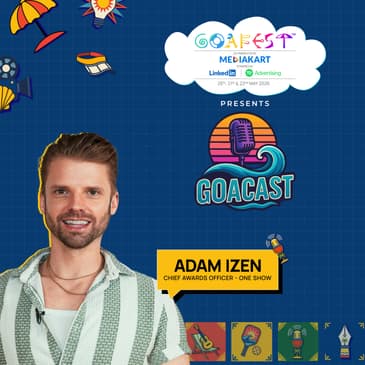
In this episode of GoaCast, the official podcast of GoaFest 2026, host Jenisha Shah sits down with Adam Izen, Chief Awards Officer at The One Club for Creativity, for a conversation that goes far beyond advertising.
From an unconventional career spanning theatre, fashion, sculpture, puppetry, and storytelling to leading one of the world's most prestigious creative awards, Adam shares why there is no single path to success—and why staying curious is the greatest creative advantage.
They explore:
* What "Resetting for Growth" really means
* Human creativity vs. AI-generated creativity
* Why storytelling remains advertising's biggest superpower
* How award-winning work is evaluated
* The future of creative excellence in the AI era
* Why authenticity beats perfection
* Lessons from a career built on curiosity, imagination, and reinvention
* The platforms, trends, and marketing practices shaping the industry's future.
Whether you're a marketer, creative professional, student, founder, or someone passionate about innovation, this episode offers fresh perspectives on where creativity is headed—and why the human touch still matters.
Host: Jenisha Shah
Guest: Adam Izen, Chief Awards Officer, The One Club for Creativity
Subscribe for more exclusive conversations from GoaCast, the official podcast of GoaFest 2026, featuring global leaders shaping the future of advertising, media, creativity, marketing, and technology.
#GoaCast #GoaFest2026 #AdamIzen #JenishaShah #TheOneClubForCreativity #Advertising #Marketing #Creativity #ArtificialIntelligence #Storytelling
[00:00:00] Have you ever felt like, what am I doing with my life? Just looking at people around you? I'm not these people and these people would not understand me. I'm Chief Awards Officer, I was like that's a pretty cool-ass job. Speaking of challenges, one very big one, AI. I mean it is here and it's powerful and it's helpful. As long as there are humans behind it and driving the ideas, I think we're like doing okay. Which platform is the most overrated for marketing right now?
[00:00:27] I mean I just called out Instagram but I have to say I'm getting a little bit, I'm a little over it and like I feel like it's becoming a little more washed out like Facebook got a few years ago. Like it's just like inundated with like just junk. Advertising is actually a pretty young industry when you look at it and in that time we've had the invention of radio, television, internet, now AI. What does Resetting for Growth actually mean to you?
[00:00:54] For me it's always been about listening to myself and the world. Hi, I'm Janisha and I'm hosting GoaCast which is GoaFest official podcast and today we have with us Adam.
[00:01:14] Adam has entered the advertising space very newly through different unconventional routes from sculpture, design, physical movement, art, everything that spans under the name of creativity. It's been an amazing journey and we're so lucky to have you Adam. Thank you for having me, very happy to be here. Amazing. I'm gonna start with the theme of GoaFest which is resetting for growth. Yes. I know with your father in the military there was a very unconventional life you've led even growing up.
[00:01:42] And when you look back now across all of the different things you've done, what does resetting for growth actually mean to you? Hmm. For me it's always been about listening to myself and the world and pursuing what it is that I'm interested in, what speaks to me, leaving behind what doesn't speak to me anymore.
[00:02:03] And I think that we as an industry, as we reset for growth, it's similar. It's about changing with the way that the industry is changing, new formats of creativity. It's not a step backwards, it's just a pivot and moving towards what's next.
[00:02:21] And with everything changing so fast, I think the term creativity has also lost its, it's a completely different thing now, especially it being called human creativity and not just creativity in general. Any thoughts on that? Yeah, I feel that I like to specify human creativity just to be very clear that my values are really in behind what people are making and what people are thinking and feeling and putting out in the world.
[00:02:52] I think that there's definitely a delineation between that and then what's being created online and through computers. But I'm not sure that the rest of the world always feels the same. So I just really like to continue to put that emphasis on people, even though I do feel that intrinsically creativity is human. But some people maybe need some more specificity.
[00:03:16] Yeah, you have to clarify. But it'd be great for you to just give us a brief of your entire journey. I know now you stumbled into advertising early on in your career and to now be chief affords officer. Yes. It's a different journey, not the usual. And there's many out there that are intrigued just by the journey that you've had. Yeah, I grew up as a kid making art and theater. I studied theater in college, directing costume design and dance.
[00:03:45] I ended up in fashion for about 10 years, leading trade shows and business to business solutions for emerging designers to help give them a platform to build their business. And then I joined the one club about four to five years ago as membership director and then shifted over to one show and now overseeing all of their awards. So, yeah, definitely no linear paths there.
[00:04:12] And but for me, my professional career has always been about supporting creative people and their business. And so there's been no change of language or methodology really there. The advertising industry was new to me, but mostly it's just been getting to know the people that are that are in the industry, which is always fun. And and get to shake things up by bringing an outsider's perspective.
[00:04:39] That's very interesting. In fact, I was just going to ask you about the outsider's perspective, because it's again, anyone in advertising typically doesn't come from that sort of varied perspective across different dimensions. You've done everything from theater, dance, physical arts, culture, everything before. How does that change how you look at creativity today? Because someone else's perspective could be limited to just one particular aspect. Sure. Sure.
[00:05:08] I'm not sure it's exactly what my secret sauce is, but I do think that ultimately what's creatively I'm about telling stories. And so I've been able to bring that into the one club and look at our members and look at how do we tell people's stories and their own pursuit of creativity. And then also now that I'm in the awards sector, you know, what what is the story that we're trying to tell?
[00:05:35] What is the narrative? What like how do we make people care about something, especially in a time where people are feeling maybe a bit jaded about awards at times? Yeah. You know, how can I how can I bring some more story and drama into awards? And awards for everyone has always been about the glam that comes with it. You're on the other side, so you obviously see it at a much deeper level.
[00:06:00] What is it that actually makes this an interesting path for you going forward? It goes back to just being able to celebrate creative people and their work to be able to be part of some of the happiest moments of their career, whether it's giving them that award or even asking them to judge and working with them through that judging process.
[00:06:24] Most of what I get to do is very happy. There's a lot of politics and other things there that maybe I would like to deal with a little less. But ultimately, what we do is is be part of a great moment in people's lives. And so that's what I love about it. And then love getting dressed up for an award show. So that's fun, too. No, for sure. That's the best part. Yeah.
[00:06:47] But with people usually coming across to you through the entire journey, right? Like they're on the other side of the table for them. It's difficult to identify what the bar for excellence is. And you've been on the creative side. Yeah. Anyone who's on that side thinks they're the best or they're striving for the best and that they deserve it. But how do you determine because you're at the center of this growing excellence also finding where the bar is and then awarding those who actually deserve it.
[00:07:15] Yeah. I think like the best thing is that I'm not setting the bar. Our judges are setting the bar. Yeah. We're just trying to set the means for them to be able to do that as best as possible. One Show is very proud to put together one of the best juries in the year every year. So we have some of the best creative minds. They're seeing what's out there. They know what's coming down the pipeline. So when they get in the room, that's what they're looking for. And they're helping to set that standard for what comes next.
[00:07:44] So, so yeah, I'm very happy that I don't have to be the one to decide. You're facilitating them with everything they need. Yes, exactly. Yeah. Amazing. But yeah, let's go into a little bit about your entire journey so far. I know you went from, I read an article about one of the first few times that you weren't able to find a Muppet and then you ended up making it handmade at home. Yeah. Obviously you were moving and had to constantly move because of your father. But how was, how did it all start? And when did you realize that you have an ink for creativity?
[00:08:14] Yeah. When I was really even younger than that, I'm the youngest kid. I have two older sisters. And so when my sister, who's a little closer to me in age, started going to school, she had to make a diorama for James and the Giant Peach. So she had to make all the characters in the scene. And I threw a fit because I wanted to make it myself. And so my mom had to go and collect supplies so that I could do one alongside her.
[00:08:40] And so it's just been a part of me making characters, telling stories. It's been something I've been passionate about my whole life. And I just keep getting pulled back to it. That turned into making creatures out of clay and then puppets. And then I kind of left it all behind after college and went into this fashion career, but was looking for a bit of a shift during COVID and had more time on my hands.
[00:09:09] And so I just, as I always did, went back to making. And it wasn't really until I, as an adult, started making again that I started to realize that I have talent in that as well. And I've continued to pursue it on the side because I find that it's really important to me and my sanity and that it's just something I really, that I love to do.
[00:09:34] And that people seem to love to see and be part of when I display it or whatever. Yeah, you've often said that you have two sides to your life. One is in boardroom and meeting rooms as chief of awards officer. But the other side is also creating and having that creative juice flow every night when you have the time or especially in COVID, when you had more time, you got into it again. But how do you manage that? Oh, gosh. I just do it. I just need to do it.
[00:10:04] So, you know, luckily right now, my home office is also my studio. So, you know, once I'm done working for the day, I can turn around and start my artwork, spend weekends working on it. And it's just, it's part of my own therapy and process to be able to have that time. So, I'm pretty diligent about making it. But I also have reset moments of, you know, we just got through our creative week. One show was a couple days ago on Friday.
[00:10:34] So, for the last few months, I haven't been in my studio as much, but it just has me that much more eager to get back in there and be more wildly creative when I get home from maybe here. And then you have another trip planned. Yeah, yeah. Well, in between. But with so much happening, even outside of when you're in the studio, how do you keep yourself motivated to keep going back? I guess you don't need to keep yourself motivated because you want to and you're longing for it. Yeah.
[00:11:05] But how do you always tend to find your way back there? Because there's other things that can attract you, right? There is the corporate ladder sometimes, which maybe didn't attract you before. But now that you're a part of this overall journey with one show at least, I think there's more there. Yeah. I think for me, it was harder a while ago before I had started to build confidence and before I had as many outlets.
[00:11:29] Now, you know, I do look for I look for projects where it has a deadline if it has like a either fabricating for somebody else or I'm part of an art show that helps me to stay disciplined. But also just, you know, people in my life want they want to see what's next and want and so I want to be able to make so that they can see something new. And yeah, so I saw it. It's taking a little less true discipline like it's just kind of part of my process now.
[00:11:58] But but yeah, I think giving yourself a deadline is always a good thing. That's good. Yeah. Have you ever felt like you were like, what am I doing with my life? Just looking at people around you because it's so unconventional, right? Or people have comments. Yeah. When I first read this question, I was like, oh, you just like hit me right here because I don't think people necessarily look at my life and think that. But it is very true.
[00:12:25] I've spent so much time being like, oh, my gosh, I just wish that I was that kid who grew up knowing they wanted to be a doctor or a lawyer and just followed that path through school and then did that and just never worried about it because I've spent so much time looking for the next job, trying to figure out what it is. Like if you if you look at my resume and put yourself in my shoes and think about what going on to LinkedIn is like and seeing all these jobs, I'm like, I I'm not these people. And these people would not understand me.
[00:12:54] So it's very rare that that like magic happens of someone recognizing my skill and me seeing opportunity there. But then like, look at it. I'm chief awards officer. I was like, that's a pretty cool ass job. Like, yeah, I don't know where it came from, but it but it happens. So you just kind of have to have the faith and and keep moving forward. But yes, it's it's been a challenge. And I wish it would have been I had been a simpler person.
[00:13:22] No, you shouldn't have enough talent like yours out there. So definitely stand out. But has there ever been a time where you had to literally convince someone of this being pure art? Because the perspective is very different when it comes to creativity and art. What's good to one eye may not be someone else. This being like the work in advertising being art. Yeah. Yeah. I mean, honestly, I don't know that. I don't know if I see it as like pure art.
[00:13:49] And I don't know that the creative people in this industry see themselves as making art. You know, they're they're they're helping create innovative ideas for business. But I think that it still comes from a very similar place of connecting with humanity. And, you know, my my belief that ties art and creativity as it pertains to advertising is that we're creating things that don't have to be there.
[00:14:16] Right. The brands that we love the most and the campaigns that we love the most, they didn't have to do that. They didn't have to create a beautiful storefront or immersive environment. They didn't have to make a commercial that made you laugh or cry. But in doing so, we connect with them and we remember them and we start to develop a relationship with them.
[00:14:35] And so I think that's the part of it is tapping into that humanity and that human connection that makes creativity so special and such an important part of of advertising and business. I like that you said you don't they don't have to do it. Right. They're doing it to build a deeper connection with not just customers or just people in the space. Yeah. But how do you think storytelling plays an important role here?
[00:14:58] Because I think creativity is driven often by storytelling and the ability to express your thoughts and emotions in different ways. It can be in very different formats, but it looks different to different people. Yeah. I think storytelling is is huge, especially for the brands that are really looking to do more than just push a product.
[00:15:19] People who are brands that are looking to develop a deeper connection with their audience to have a longer term relationship with them and have them coming back time over time. You need that through line. And so you need that story. And so I think that the brands that we hold nearest and dearest are the ones that are telling the richest stories. So. So, yeah, I'm all for it. Any in particular that comes to your mind?
[00:15:48] Yeah, I'm a big fan. I think I mean, I think everything that Apple does is is a really great like they have built just such an awesome through line of just of tech, but also celebration through music, through really stunning visuals and innovation. And look how excited we get for every one of their new drop, you know, keynotes where they talk about all the new features like that. There's some storytelling there that's really beautiful on a more artistic side.
[00:16:17] I'm a big fan of gentle monster and just like these surreal worlds that they build and invite you into. So, you know, it's cool to just see the spectrum that that storytelling can take and and how it's expressed from brand to brand. But that's what makes advertising so cool. And every brand so different. I went to the gentle monster store in Seoul when I was there, which is their flagship store. Yeah. And it blows your mind. Yeah. With how you can think about a store to look that way.
[00:16:46] Yeah. Right. And it's such a it's such a treat and they didn't have to do it. You know, they're selling glasses. But, you know, it's so memorable and it and it's, you know, it's such a treat for for people to be able to get and see that it's it's, you know, like giving your your clients a gift. When you were in advertising, did you work on any particular any particular projects that still stay with you because of the work you did? So I have never actually worked in advertising traditionally.
[00:17:15] I came in here from from fashion and then just now supported from the outside. So I'm an outsider through and through in that perspective. And then as an outsider, is there ever a time that you felt that was an advantage because otherwise it's always considered that the inner ones win, but the outsider has a different perspective? Yeah. I think that it my outside perspective has always been an advantage. I don't know. I've never let it hold me back.
[00:17:44] And I have danced around from industry to industry in the past that I'm very comfortable doing it. And I think it makes me a more creative problem solver because I come from different perspectives and I'm not coming from the jaded history of having been in the same thing for so long. So I'm always looking to find where are the gaps, where are the problems and how can we enter a new space in a way that I think is harder when you've been in the same environment for years and decades.
[00:18:14] And you think having a creative past leads to this sort of perspective? I think it's led to mine for sure. You know, my creativity has all been about exploring new mediums, has been about having to problem solve in those mediums to, again, going back to storytelling. How do we tell these stories? So I think that it's definitely been a big part of my success.
[00:18:43] Overall, I know there was a story also about your dad being in the military. So you had to travel a lot, which meant no permanent home and no permanent place to be, no permanent friends, at least in one space because you kept moving. Did that impact anything? Yeah. You make my childhood sound so bleak. I'm a happy kid. I was a happy kid. No, but I mean, it is true.
[00:19:07] And I don't, I didn't really realize it until I was older, the impact that it had on me. And I don't see it as anything negative. I'm really grateful for the variety of experiences I had growing up that I got to live in different countries. It's wild to me when I meet people as adults who have always lived in the same town their whole life. You know, it's just very foreign to me. I think it made me very adaptable. It's made me very comfortable.
[00:19:35] I mean, this is my first time in India, just like hopped on a plane and came by myself. And my husband back at home is like, I don't know how you're doing this, but it's just like very comfortable. And then with the people, like I've just been very self-reliant and knowing that like I can, like that I have to depend on myself because I, maybe it sounds a bit sad, but I never knew when I was going to have to say goodbye to the people around me and pick up and move.
[00:20:04] So just kind of became very confident that, you know, I'd be okay and that I can, you know, problem solve and take care of things myself. Yeah. When you got to do it, you got to do it. You got to do it. Yeah. Any advice for anyone who is starting out in any of the fields that you've been in? Because there's so many. Yeah. I think just always, you know, to make it as personal as possible, I think always just trust yourself.
[00:20:31] Always listen to like, what is it that you love about what you're doing? What do you not like? And just keep moving forward. Like, just keep doing. If you're, if you like what you're doing, just keep going. Progress happens. You don't have to like worry about it. Like it's going to, it's going to happen. So just keep moving forward and keep just putting pieces of your life together. That's what makes you, you, your unique experiences are going to make you the most. It's valuable. So push ahead. As someone who is also trying to explore creativity, I think that's great.
[00:21:01] Just to have that motivation and confidence. And that should come internally, not from the outside work. Because you don't need to wait for appreciation. Yeah. I mean, I know I'm in the business of giving people awards, but like, don't wait for your award to know that you're great. Like there's, there's all kinds of things that go on behind awards that they're, they're important, but your own self, uh, confidence and assurance is, is the most important.
[00:21:27] And the only way that you're ever going to get to higher level of recognition, if that's even what you're looking for. Nice. And even the chief awards officer title, I know it just came into existence. Yeah. It's almost like a carved out role for you. Yeah. How does that feel? It's pretty neat. It's pretty neat. Um, you know, we, the one club for creativity is so unique in its structure and that we oversee such a rich portfolio of award shows, uh, to be able to take the helm and start to try
[00:21:57] to figure out, you know, what the, what do they mean collectively and how do we better brand them and how do we better move them forward into the future? Uh, it's, it's a really daunting, but a very cool challenge. And I'm, I'm honored to be sitting in this position and to try to be the, the first to tackle it. Speaking of challenges, one very big one, AI. Ah, yes. Elephant in your room, everywhere you go, I'm sure.
[00:22:23] I know you've obviously always specified about human-based creativity and how that is, should be recognized at its own distinct line, but AI is here and there's nothing that can change it. Thoughts? Yeah. I mean, it is here and, and it's powerful and it's helpful. Like it does have its merits. Um, you know, we've been, we even have awards for it in the one show. Um, so we are recognizing that it is an important tool.
[00:22:50] Uh, you know, we love to see it show up where it can make big ideas bigger. Um, it's done some amazing things for campaigns and health, wellness, and pharma, like just being able to help people in ways it's never been able to help before. In terms of like creative output, I have to maybe some more complicated feelings around that. Um, but you know, I think we're seeing for the most part audiences really responding to, to handmade craft and, and, um, I love to see that.
[00:23:19] And, you know, ultimately, as long as there are humans behind it and driving the ideas, I think we're like doing okay. Okay. So I hope we don't lose that for sure. Um, but, but yeah, we just, we, we do have to, to some degree learn to live with it and work with it. As long as there's a balance. As long as there's a balance. Yeah. But with the definition itself of like great work shifting, um, which it used to be obviously very perfect aesthetics that were always rewarded.
[00:23:47] Now it is like you said, the handmade beauty and imperfection that is being awarded. Yeah. Um, how does this change what you do in your day-to-day role? Hmm. You know, again, I, I don't know that it changes much because I'm, I don't sit at the center of choosing who wins what I said. I sit at the center of helping create that ecosystem so that the judges can decide. Um, you know, we have such a wide range in the, in the one show winning.
[00:24:15] If you go and look at like just last Friday's winners, you have, uh, a Vaseline verified, which is, you know, very social first in culture. There's not really much like art and creativity in that aspect, but it's so in culture and it was, you know, fast and smart. Uh, but then we also had beautiful, um, uh, no project without drama from, uh, for Hornbach,
[00:24:40] which was this beautiful, beautifully crafted piece that was theatrical and cinematic. And, um, you know, so there's a place for everything in there and for ideas to rise to the top. We're just, yeah, we're, we're creating that ecosystem and ultimately looking for the best ideas that sit in culture and let the rest of it shake out as it will. And when you're facilitating judges or finding the best ideas, is there something in particular that has always caught your attention? Hmm.
[00:25:10] Like personally? Yeah. Personally. Personally, I'm, I'm always drawn to the craft. I'm always into what is it that, like the time people spend into something that goes by in 30 seconds, you know, but the, the amount of love and detail and talent that goes into it. Um, I'm always obsessed with those behind the scenes videos and, and that aspect. Very interesting. Any in particular that have been, um, great ones for you to go back to every time you watch it. Yeah.
[00:25:40] Um, I really love, uh, this year we had a winner 18 months, which was a stop motion piece about, um, two, two guys who adopted baby that was found in the subway. And it's really beautiful. It was made by click health out of Canada. Um, I, there was a piece a couple of years ago, actually before I technically worked on the one show, um, I'm pretty sure it's for Ikea. And it was about a boy who meets this like monster, like a troll under a bridge.
[00:26:10] And they had actually created this like giant, like puppet person suit. Like a person was inside of this incredible suit, um, for this, again, for a commercial, like they didn't have to do it. Like I can't even imagine the amount of money that went into it. And it was just so beautiful and imaginative and emotional. Um, I mean, I could go on and on about these pieces. On the lines of imagination, actually, I read another article about you just talking about
[00:26:36] how imagination in itself is what drives this advertising industry today, which is not just directly through creativity. It's just imagination in different forms. Yeah. You've had a very peculiar experience also. I know you created, um, some really nice and beautiful in that kids, uh, museum. You'd created those, uh, different sculptures. You know a lot about me.
[00:27:01] No, I mean, and that particularly caught my attention because that is something that not, it's not about creativity either. It's about imagination on what's going to create the right atmosphere for kids to feel the same emotion you felt while creating it. Yeah. Um, is that a question? You just saw me there. Just talk about it. Okay. Um, yeah. I mean, that's, that's always at the center of what I seek to make is I, I live in a bit
[00:27:29] of like a delusional world where like, like magic lives just on the other side of the curtain. And so I try to create pieces that bring people into that space. And so, yeah, I created this installation of, of puppets in, um, it was in a library, um, to, and it, and built the whole like ballroom around them so that when people entered, they felt like they were in that world.
[00:27:55] And, um, I also have, um, uh, an art installation I did just after was this 10 foot tall ostrich that was like set up in her, um, like dressing room and people could go and interact with her and like pull her down and take photos. And when I even still, when I watch video back of people like taking photos with their kids and posing with her, it's, um, it's just really, it's magical for me to see people kind of escape this moment and step into that space.
[00:28:25] I kind of live in on a daily basis. Um, yeah, it's, that's, that's what I'm always, that's what I seek to do. Yeah. That magic is in fact, so peculiar also, cause I know you've called your own art form slightly different from what any other artist today, um, about it being a fairy tale. Yeah. Um, and to live that fairy tale for not just kids, but adults as well. Yeah. How did you come up with that entire thought process around it being a completely different form?
[00:28:56] It's, I don't think there was much of a process for me as much as it was like finding what it is like that. I just always was drawn back to and, um, you know, I'm, I always been really obsessed with, um, like the, like Mary Poppins when they enter into the cartoon world or for me, I actually grew up with bed knobs and broomsticks, which has a similar scene. Um, and they're around these animated animals.
[00:29:23] And so, um, just themes like that kept finding their way back into my work. And so I decided that I was just going to kind of like own it and be in it and, and then seeing people's responses to it as well has, has kind of driven my desire to, to explore it further because I can see that. That desire, especially from adult, from adults to want to reenter their childhood. But I try not to like make it too, too kid.
[00:29:50] Like I want it to feel adult and just real. It definitely does. Yeah. Oh, thanks. With the amount of people who relate to it for sure. And with today's generation, do you think there's anything about the generation that makes you think, okay, the future is in good hands? Mm. Yeah. Uh, I mean, especially going back to advertising, if, if you don't know what kids are coming out of college, being able to do sign up for one of our portfolio reviews and mentor them because their portfolios are insane.
[00:30:19] That the skills that they're learning and, and that they have at their fingertips coming out of school that like, we just couldn't even imagine 10 years ago because technology has changed so much. I mean, they're so capable and wildly creative. Um, yeah, their, their talent is, is mind blowing. That's amazing. It feels good to foster that. Yeah, of course.
[00:30:42] Um, any advice on someone who is not just starting out, but trying to, as you go through the one show, ADC, Young Guns, everything, is there any advice that in particular is really insightful for someone to follow as they go through their career path? Yeah. Yeah. I think, um, maybe as before, just kind of keep going and keep finding what interests you and, uh, seek out the opportunities that seem interesting and that add something always and always keep learning.
[00:31:12] Like, I think that when you decide that, you know, at all and you know, there's nothing like, that's a very scary place to be. Um, always look for ways to improve, earn new skills. Um, it's just like life is more exciting that way. And at the end of the day, you'll just be better for it. Do you keep learning and learning and learning new skills every day? Yes. Yeah, absolutely. I mean, we just, we just had the one show on Friday and I came out being so proud of
[00:31:40] it, but also like, all right, next year we're going to work on these 10 things. Um, so, so yeah, 100%. Experiences drive that. Yes. Amazing. We're going to move into the fun part now. It's a little bit fun. So this is a, it's a small game called flip the card. Okay. Each one has a question. Okay. So you pick out five to seven, we can go one by one. Okay. And then as you can, it's like a rapid fire, but you can answer as you like. Okay.
[00:32:07] Uh, am I, I'm reading it? Yeah. Yeah. What's something small that makes a big difference in campaigns? Um, I think it's, um, just being able to know how this plays out kind of long-term. Like what, how does this have an impact that's bigger than just the moment it's being received? And how are you going to take this idea and plant a seed for something that might come down
[00:32:34] the line later for a brand so that that brand can continue to, um, carry that narrative and that story onwards? Interesting. Moving into the next one. What's something from another industry you think advertising should adopt? Ooh, um, there should be many in your head.
[00:33:03] Um, I mean, I think right now it's about flexibility, you know, like we're, we're at a time where I, I, I feel like the industry got very comfortable with its structure, with the way that it worked, um, that now everybody's panicking because things are changing. But the truth is that it's always been changing. Advertising is actually a pretty young industry when you, when you look at it. And in that time we've had the invention of, um, radio, television, internet, now AI, like,
[00:33:32] I mean, advertising in a hundred years has changed so much. So like, we need to just like chill a little bit and just start to see where, where we're going and where we need to shift and we'll be fine. But things are still going to keep changing. They're going to keep changing. That's how it works. Yeah. It's how every industry is like this. That is true. There you go. Next one. What kind of client brings out your best work? I'll say the best work.
[00:34:00] Um, I'm going to say, I think those who really know who they are and what, what it is that they want to convey to an audience. And then those that are excited to push boundaries, try something new, um, you know, give that gift that they didn't have to, um, and, and, and trust, trust the creatives. Like, that's what they're there for. Like, like if a big idea feels a bit scary, it's probably the right one. That's a nice way to put it.
[00:34:30] Uh, all right. Let's see. I'll go for this one on the end. Oh, what's a weird or random source that sparked an idea? Um, I mean, I can't speak to a campaign specifically, but, um, for me personally, I'm not, I don't know, I feel like my work is maybe as weird as the source ideas themselves. Um, I don't know.
[00:34:59] I love, I, because of the work that I create artistically, I am always looking for like weird, weird animals and like weird animal facts to kind of build stories out of. Um, so I, I was just watching this, uh, video about these fish that have these big red mouths and they walk along the bottom of the sea, um, like with their fins. Wow. Yeah. Google it. Um, and so now I'm very excited to turn that into something. And how do you come across all of this? Just read about it.
[00:35:29] Just like, yeah, just like weird. Like, I mean, my Instagram feed is really weird. And then also like, I also just like love going to like the zoo and stuff. Wow. Interesting. Uh, okay. That's also a good one. Which platform is the most overrated for marketing right now? Um, well, I mean, I just called out Instagram, but I have to say I'm getting a little bit, I'm a little over it.
[00:35:54] And like, I feel like it's becoming a little more washed out, like, like Facebook got a few years ago. Like, it's just like inundated with like just junk, um, and a lot of, and a lot of like bad ads. Like, I don't think it's like being used super innovative, innovatively. But then is it an Instagram problem or a brand problem? Brand creativity problem. I mean, I think that Instagram kind of opened the floodgates maybe, which has made it, made it lessened its impact.
[00:36:24] Um, I think brands are maybe choosing to show up more creatively on other platforms. Like, uh, I think like TikTok right now is, is a huge one. Just the way that it's like more authentic in the way that its users can connect and get content out there. Um, I think that it makes a lot of sense for brands to try to be in that space. Uh, the algorithm and Instagram has maybe made that a little bit tricky. And so that's why we see what we see there.
[00:36:51] Um, so I'm going to go TikTok for the good platform. Last one. Okay. Oh gosh. What's a consumer insight that actually came from my own life? Um, oh gosh. Um, I feel like there are so many campaigns I, I like would see during the show and being like, oh my gosh, I know exactly what that is.
[00:37:21] But now I had the question. Um, um, Um, or it could be any consumer insight in general that you've learned while switching so many careers. Yeah. Um, I don't know why, like, I feel like I've been good this whole session and now I'm just like hit this block.
[00:37:42] Um, maybe I should pick the other card. You can go with that one. You can go with that one. That's the last one. Okay. This is the last card. Uh, what's something brands should stop doing on social media immediately? Um, you have a lot to say. Yeah. I mean, I think I kind of just said a lot of it, right? Um, I think that they just need to go back to seeing it as a creative tool and not like
[00:38:08] just a promotional platform, but, but really connect authentically with, with their audience. Yeah, definitely. A hundred percent. Yeah. Amazing. That ends the fun part as well. Um, but it has been amazing to just hear your perspective on creativity, the AI agent creativity, and then the depth of experience you've had, uh, across all of the different things you've done in life so far, but wish you all the best with everything. Thank you. And I'm excited to see your speech. Oh, thank you so much. Thank you for having me.
[00:38:38] Thank you.