
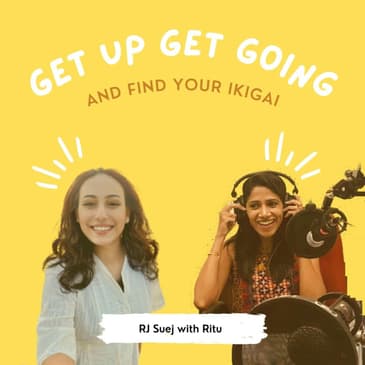

I thoroughly enjoyed recording this episode with Ritu David - the current founder of 3 tech companies who believes in solving real world problems using a mix of data, design, tech and behavioural sciences. Her passion lies in creating tech that reduces inequalities and also in facilitating ethical and inclusive automated decision making. She talks about finding herself and finding a purpose in facilitating tech that actually gets used. I found it refreshing that she did not use a single word of tech jargon, considering how deeply enthused she's about the world of AI!! We seriously need more Ritus in the world of tech and also more folks to listen to this episode to know what I mean :)
[00:00:00] Hello all you lovely people and welcome back to the RJ SueJ Ikigai podcast On Episode 12 today we have another inspiring and interesting guest as usual, her name is Ritu David She's an actuary turn designer turn entrepreneur or yes who's self-professed
[00:00:18] claim is that she is in constant beta and she's looking to grow intellectually and string physically Ritu has been a founder for a while now and right now she's badly running not one, not two but three companies The data duck, alum Bloom and Oasis Helptick
[00:00:38] And if you want to know some fun facts about her she's a very busy dog mom and also a professional swimmer And here she is Ritu how are you doing today? Hi Sajatha I'm really well and thanks for having me here
[00:00:54] Yeah absolutely I've been waiting to do this. I can't tell you how long I've waited and I'm so excited to have fellow entrepreneur and a woman entrepreneur You know and from a feel that I don't understand too much about which is thick
[00:01:09] So can you tell us a bit more about what you do and what got you here? Sure, I sort of stumbled upon where I am I guess like a lot of people
[00:01:19] I think my experience is over time just filtered me into landing into the world of tech so I started off with Using data and helping governments and companies assess their data to solve problems that was
[00:01:42] Relatively technical, but we didn't have big data sets. We were using a lot of You know programming skills, etc. to run it so I was sort of in detect but not in the depth of it I was using tech
[00:01:55] More than I was creating it and and then I realized I love absolutely love design I love designing programs. I love designing interfaces. I love designing Messaging anything that facilitates creative problem solving really
[00:02:13] So when both of those met I realized that tech is the perfect space big data was blowing up about a decade ago I had an actual and data science background so I could you know take advantage of that Tech companies were looking for behavioral scientists who understood data
[00:02:35] And understood people as well to some extent so I was very very lucky To be quite sought after in in consulting I then realized that I really wanted to do things my way and I wanted to have a team. I think it was quite
[00:02:54] Lonely for me. I'm an only child where a nuclear family So it was quite lonely to be working by yourself all the time so yeah, I think I think out of my need for love I
[00:03:09] Created a team and and here we are today. Amazing and how big is your team right now at the data duck We're 63 people spread between Melbourne and Mumbai and what is it that you do?
[00:03:22] You know when we work in wasing just before we started recording we were talking about Ethical and usable data etc etc so I want our listeners to hear about your thoughts on that apart from what you do at the data duck
[00:03:36] Sure, so at the data duck what what we do and what we really try to do is create Tech that gets used So 97% of code does not get used really I find this to be Like a horrifying percentage You know, and maybe that reduced a little bit to
[00:03:58] Over time but I'm pretty sure it's upwards of 80% still today Now imagine all that money all those man hours all those or all those people hours all those Those dreams that people had when they're coding about how this would be eventually used just smashed
[00:04:19] So I just feel that it takes a toll on mental health. It takes a toll on the economy And it really takes a toll on our Allocation of resources. I feel that our resources can be Better optimized if we spend them on things that actually got used right
[00:04:38] At data duck we help firms design and Then develop if they would like the development part tech that will definitely get used So tech that's Designed around user needs and And we use we have behavioral scientists on board
[00:04:57] We have user experience designers on board psychologists people who really work on understanding The human condition and the human mind and and yeah, we use a lot of user research to ensure everything
[00:05:11] We design has a purpose everything we design has a reason and everything we design has value Wow and how do you you know actually get employees to understand or I would say
[00:05:25] Adapt to your culture because this is a very different culture from what most tech you know tech companies would follow Right, so how does it work It's it's been Quite strange in fact Initially we just started with me plus one other person, right and and
[00:05:44] We just we just didn't think about doing it any other way we always put the user in the center and We started designing things that were quite popular and we had I think this was about 10 years ago. We said okay our goal is that we are going to
[00:06:06] Ensure that every phone in the world has an app that we've designed wow and that was the goal of you know Usability right that people are actually using products that we spend our our time effort
[00:06:19] Designing so that was a goal and then more and more people got drawn by that goal. I think that You know you actually get to see the outcome of all your hard work The tech industry is like known to be quite
[00:06:34] Quite exhausting and mentally draining because you never see the outcome of your work sort of like them in some times I guess so it's been it's been Something that's brought people together right and I feel that you know
[00:06:50] There are a lot of creative people who find so much joy when they design an ad and they see it on TV or they design A billboard and they drive past it. There's a real sense of ownership and creation We're just doing the digital version of that right
[00:07:05] Amazing. I think that's simply amazing and I love the parallel that you drew to the government as well Cutie ladies anyway moving on with who are moving back as I would call it You know you grew up in Australia. Am I correct?
[00:07:20] Yeah, I grew up in Kenya in Australia. Okay, how did that influence who you are today? I definitely feel that it's My Australian experience especially has changed the way I view things completely in in the sense that Australia is a very egalitarian society
[00:07:41] We are we try to be as inclusive as we can be we try to be as ethical as we can be because we can afford to There's 22 million people there's a lot of money you know and and I think that that
[00:07:58] Could like people make a lot of effort we stumble sometimes but everyone makes a lot of effort to be ethical and inclusive And that has forced the way and it completely changed the way I think
[00:08:14] Compared to people I think who grew up elsewhere where perhaps in being inclusive being ethical wasn't placed at the top of the list. I point America it's very capitalist and The price of you can't often afford to be ethical and inclusive
[00:08:33] So I just love the fact that Australia Is a bountiful nation that allows for people to be ethical and inclusive and I think that goodness is at the core of us as human beings It's just that sometimes Our incentives aren't aligned
[00:08:48] For us to behave in that sense so in Australia definitely incentives within the community and Corporate's at large in government as well is is about being at ethical and inclusive and I love them
[00:09:00] So that's something I've taken from my Australian experience. I think I learned empathy and teamwork in Kenya There is something beautiful about Kenya when you drive broken ya you see children that have absolutely nothing but are phenomenally happen
[00:09:21] You know you can sit next you can park your BMW sit next to them tell them your problems and they'll have empathy That's so beautiful It's I go I
[00:09:34] Not now because of the pandemic, but we try to go back to Kenya every year just to be in touch with That sense of Humility that sense of beauty that sense of it's okay if you have a different lived experience I can still be
[00:09:48] empathetic towards you your cognitive experience can be different to mine but doesn't mean you don't feel pain And whether that pain is pain from hunger or that pain is pain from not meeting up to your own expectations
[00:10:01] Pain is still pain in its universal and I think that's something that I really learned growing up in Kenya that that their Universal experiences Universal Emotions that bind us together as humanity and and it's when we forget those
[00:10:21] That I think we lose sight of sight of the world. Oh my god. I'm so glad you're here to and you're saying these words because You know as you're saying pain is universal so it's kindness, you know You said that earlier and I think kindness is something that
[00:10:38] People have really Waken to during the pandemic some where I feel right you know each one of us feels that a lot more coming from other people right what would you say Absolutely, I think we're becoming more empathetic
[00:10:53] We're becoming you know less rigid about what it means to be a professional We're seeing people's value for what they bring to the table and not what They project and I love that I love that you know it we laugh at
[00:11:09] Someone walking into rooms. We laugh at topless husbands in the background that like you know Dog like jumping on desk yeah, and all that stuff. I think it's beautiful But that's you know That's a sort of percentage of the world that
[00:11:27] You know are the halves, you know we're lucky enough to have a home office We're lucky enough to be able to work from home I'm not sure how this pandemic has been For for those who are the have not so I'm really keen
[00:11:45] I guess as we learn from this pandemic to see how the world looks at Collective problem solving and looking at the UN sustainable development goals and saying how can each one of us Facilitate those no matter what we do we don't need to be in development to
[00:12:06] You know propel a sustainable development goal whatever goal connects with you be it, you know Livable cities be it sustainable environment be it women and children whatever it is I think we can all find a way to help one goal
[00:12:24] Amazing amazing and I hope each of the listeners who's tuned in connects to this I'm sure I'm sure but as you're saying it's more about not about the halves but more about the have knots You know, it's about connecting to them
[00:12:37] You know and helping them. I think this is really really noble and And it'll through your ethical and usable tech how do you think I know this is not Something that we discussed earlier as a question but just came to mind how do you think
[00:12:53] You can participate in this cause Sure, so I'll just In India the the the largest vaccination scheme I think uh we're all meant to love on to a website Coin and It's challenging for those of us who have access to laptops And it's been challenging to get
[00:13:17] You know a Slite I know it's getting a lot better so I'm not you know complaining in that sense but what I've realized is that Coin is the co-in is the epitome of not being inclusive
[00:13:31] The number of Indians with laptops is solo so the mobile website is actually slower than the desktop or laptop site So if you're accessing Coin from your mobile phone you're much less likely to be able to get Initially it was impossible to get a slot so
[00:13:49] So there's two things one it expects people To have a laptop or access to a smart phone that's very fast access to swift data Access to understanding what needs to be done and be able to be digitally swift, you know
[00:14:06] To be able to complete tasks on a digital platform and then very Swift and Also Very correct manner so if you're if you've punched in your adharka at wrong for whatever reason it's not gonna work
[00:14:20] Out for you so there's a lot of things that I know that people in Mumbai are like oh, you know I've been able to help my house help and my driver get vaccinated now imagine the
[00:14:34] You know billion of people who are not your house helps and your doors and are not necessarily Don't necessarily have access to digitally Native people or digitally adept people What about
[00:14:51] What about them and how do they get this vaccine? How does this vaccine get rolled out in rural areas? How do they even understand how to use this web app you know These are the sorts of things that I
[00:15:06] Know it's very hard to make inclusive tech. It's very challenging and the government's done a great job on rolling this out I just feel that if inclusive tech was As Thought about as you know, okay, what's the WWE do you dot? You know
[00:15:24] URL going to be if in how to make tech inclusive was Talked about as and given as much Thought Then perhaps we would come up with a better way Especially for country like India we need to be inclusive Yeah, I completely agree and
[00:15:46] This was a thought that came to my mind, but you know Didn't think beyond that right? You know you do feel bad like as you said the halves people like us We are like yeah, we wonder what these people are doing
[00:15:58] But what do I do about it right and right now when I heard you speak You know, I was like yeah, and and I do hope people like you can do something about it Tritu more power to you I
[00:16:10] Hope too. I really think that you know to create inclusive tech is a matter of Demandal more than supply I feel that In a free market, you know Entrepreneurs Governments companies everyone just moves towards where the demand is right so we demanded a vaccine
[00:16:33] We got a vaccine we demanded more vaccines. We got more vaccines It's it's the way of the world and every shift that towards a more sustainable world towards more Conscious choices has have actually come from Awareness and demand first right in order for it to be a
[00:16:53] Choice that is not about impact but actually about profit So impact on scale can only happen if it's profitable right and it's only gonna be profitable if they're demand So I think part of Part of the challenges I'm facing now is that how do we generate?
[00:17:14] The first question is how do we generate demand for inclusive and ethical tech? We all know that our data has been used Our brains are being hacked right? Thoughts are being put into our minds because we're consuming so much media Whether we like to admit it or not
[00:17:31] The way we see the world is really colored by the media. We have access to and that's pretty much owned by three or four companies And that's scary
[00:17:42] But we talk about it, but we don't know how to fix it and the only way we fix it is if we Say no to tech that is intrusive note like that's unethical There were times that
[00:17:57] You know we used to pay a lot for a long distance call you and I couldn't do this podcast for example sitting in different cities in our own homes before what by creating you know free technology By
[00:18:14] It's actually us that's the product and I think that penny needs to drop right It doesn't matter at an individual level the liberties that we're giving up because I mean I'm pretty under the radar, you know no one really cares no one's gonna
[00:18:29] Ask Facebook or Google for my data But what are we giving up as society when we choose to use these tools as much as it's for free and as and we're getting connected in a way that's beautiful
[00:18:45] We're also giving up something and I just think that awareness is a collective on what liberties we're giving up needs to be thought about and then Solutions like duct.co and other more ethical solutions can start to become more Viable economically That's you know some serious thought that
[00:19:16] I don't know how to describe it, you know it's really going to be recently Not in very serious but it is it is a serious thing I think I think tech is gonna shape the way we think the shape the way we vote
[00:19:30] The world your kids will live in as completely going to be changed because of social media You know the news that we receive on is all based on algorithms And the way we think is completely changing and I think all of that
[00:19:47] We just need to be aware and we need to create a little bit of demand for something that's more That's more pure I know that sounds very Idealistic but I think we can do it if we are aware
[00:20:01] There was a time when we weren't aware of whole foods we were you know in the 90s We were all drinking soda pop and we were eating chips and I don't know like Package foods really didn't have that much awareness now
[00:20:17] There's a complete shift towards whole foods and I think it was that awareness over time That social pressure as well that availability that let us to making different choices But it all started with the idea completely agree completely agree so you know moving to that part of it
[00:20:35] Ritu You know What background do your clients come from in terms of you know Do you do you focus on clients who have these kind of demands or are you seeing more clients with this kind of demand? So we have clients that don't necessarily have this demand but
[00:20:59] We kind of sneak it in there Definitely I mean there is a economic incentive to making inclusive technology for example making tech That is more female friendly making tech that is more friendly towards people off You know very cognitive experiences people with
[00:21:28] Reading difficulties etc. so and also people this There's a bank that Overcoded they realized That a lot of their seniors had most of their wealth but their seniors weren't able to access digital platforms
[00:21:45] And their seniors used usually in India used to get visited by you know wealth experts But that was all shut down so the bank wanted to create senior friendly technology And that was a you know driven by profit initiative
[00:22:03] They've come to us to create an interface that's based on voice so seniors can say things like Like talk to the to the interface and say portfolio position today You know I want to change XYZ I want to transfer money
[00:22:21] So the whole inter banking interactions will be done on voice and I think that's something beautiful to give seniors access to their own right Something that they've sort of felt that they've lost Over the last 15 months or so
[00:22:40] And I love that we're able to do that and it's a for profit initiative Wow, yeah that makes sense actually that makes a lot of sense and I'm sure white lines would come to you because you're giving them a smart option and a more ethical and inclusive option
[00:22:55] So that's amazing retoo keep going So last but not the least let's talk about the concept of ikigai and I know that you You are aware of this concept for a long long time Right and what it means to you
[00:23:15] I think what it means to me is being in a place where I'm my authentic self And I'm not Trying hard anymore, you know I'm working Hard, but I'm not trying It's coming naturally I Happy I Feel like I'm adding value and
[00:23:41] I have a lot of space in my heart for love Before I found this piece I was angry I would less kind You know when you're stressed there's so much on your mind that You tend to project your grief on to other people
[00:24:04] Hmm and it's very easy to find reasons for why you are not Where you want to be but really the only reason why I feel those of us who come from privileged backgrounds aren't where we want to be is ourselves
[00:24:20] It's the fact that we are not connecting with our inner cells or we are living Like I know I did this when I started off my journey. I was definitely living Trying to live up to expectations that I had created for myself when I was very young exactly
[00:24:40] And those expectations just stopped making sense, you know being an actor is something that Is very looked up to it's you know People are like oh she's an actress must be really smart and I love that validation
[00:24:56] But I hated it you know, I hated the daily work and was that sort of you know Oh your wonderful at parties worth the daily trauma No way So thank you for sharing that very personal aspect of yours and
[00:25:15] Ritu before we close and I would really hate to close this conversation but before we close just wanted to hear from you In terms of the advice that you would like to give people who want to Follow their passion and also
[00:25:34] Make money at the end of the day Yeah, I Think it's It's sort of cliche to say this but it's a lot of trial and error at least it has been for me
[00:25:48] And also the people I know who are at peace and very happy there's been a lot of trial and error and a lot of failure There we're very risk of earth I feel as a society in India and that's what I've noticed
[00:26:05] Just because we don't have the kind of systems to fall back on that you do in the developed world like in Australia You have unemployment pay you have complete your education is completely paid for by the government your health is completely paid for
[00:26:20] So you can survive and live quite well Even if you are unemployed so The fact the fear of failure is not the same in every country Right the fear of failure is a construct of The economic and social conditions of wherever you live
[00:26:45] So it's very easy for me with this sort of super cushy You know if I fall like fall on a cushion versus because of my Australian citizenship versus someone in India
[00:26:57] If they fall they might and they don't have a family backing they might fall on concrete, you know So what risk is is very different to different people but I think one of the things I've noticed is fail Fail a lot and fail fast and
[00:27:14] Start to calibrate and ask yourself why did I I fail and look in words as opposed to externally? I think a lot of us initially Start to blame external circumstances like oh my boss was like this or my
[00:27:29] You know my ex partner was you know mean to me and all my mother was you know Horrible to me while I was growing up you know people always have excuses or reasons as
[00:27:40] Why they think they're unhappy and I think when you start to look inward you can say okay I accept that all of this has happened but it's brought me to where I am today and how can I use those Those scars to really
[00:27:55] move in the next battle with Communists and Serenity and a sense of like surrender to the universe and start to pick up a lot of A lot of signals from the universe. I think when you're on your path
[00:28:14] The universe sends you signals. I am speechless and I just want you to go on I wish this wouldn't end But more power to you Ritu and I know your Iki guys that are being an entrepreneur who facilitates ethical and inclusive tech
[00:28:35] That's used to solve the world's problems. I think I would add with absolute empathy, you know That's what was coming through in your voice empathy, kindness and I think this is what the world needs more of
[00:28:48] So as I said once again more power to you. Thank you so much for being here and sharing your life's experiences with us God bless you Thank you for having me. I've listened to your previous podcasts and they've all been
[00:29:02] Extraordinary people and I think you have a knack of bringing out the extraordinary in the ordinary So thank you for that wow that's that's probably the kind kindest thing I've heard this year
[00:29:14] So thank you for making me feel so good as well take care take care and we'll speak soon. Bye bye So lots of lessons there as usual for each one of us whether related to iki guy or otherwise
[00:29:27] And the best thought that I'm taking home today is to add a sprinkle of empathy and kindness to everything that I do Hope you enjoyed this interaction with a brilliant entrepreneur And I'm waiting to listen to your feedback at my email rdsj and gmail.com
[00:29:44] Till the next inspiring guest comes along here's me saying take care stay safe and keep following your iki guy