
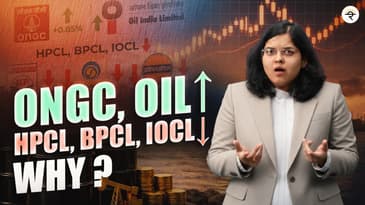
Why are ONGC and Oil India rallying while HPCL, BPCL, IOCL are under pressure? In this video, we break down the complete impact of rising crude oil prices on India’s energy sector, understand why upstream oil companies are benefiting while OMCs are facing margin pressure, and discuss the government’s possible next moves on fuel prices. We also cover the latest royalty cut by the government, its impact on profitability, and technical analysis of upstream oil stocks ONGC and Oil India. If you want to understand how crude oil movements affect Indian energy stocks and the overall market, this video will help you connect the complete picture.
Learn more about your ad choices. Visit megaphone.fm/adchoices
[00:00:00] Jetzt nur du, dein Podcast und eine leckere Auszeit. Ab zu Aldi Nord. Für 2,99 Euro bringst du deine Mittagspause mit Sushi ins Rollen. Mh, lecker! Und für 1,99 Euro gönnst du dir danach noch eine kleine Eiszeit. Bei Aldi Nord findest du immer das passende. Klingt gut? Dann probiere die Snacktime Sushi Box ab 205 Gramm für nur 2,99 Euro. Oder Mucki Sandwich Eis je 8 Stück für nur 1,99 Euro. Das ist Gutes für alle zum Aldi-Preis. Jetzt in deiner Filiale. Aldi. Gutes für alle.
[00:00:30] Hey folks CA Rachana Ranade here and I welcome you all to a very, very interesting video which is based on a topic that is like being discussed extremely across the board. It's about oil companies but wait not all, all the oil companies are the same that I can divide them into two parts. One could be like an upstream company, one could be like a downstream company. If I'm talking about something like ONGC or Oil India they fall into upstream companies and if I'm talking about something like BPCL, HPCL, IOCL these will fall under the
[00:01:00] downstream category. Okay but this is just basics what is upstream what is downstream we are going to discuss that but what else are we going to discuss in the video four key points. Number one we'll talk about why are upstream companies like ONGC and Oil India rallying. Extremely important super interesting part of this video is the technical analysis of both these companies. Third we'll also understand about what's going on with downstream companies like BPCL, HPCL and IOCL
[00:01:26] and very important what actions could government take in these companies. So extremely important video keep on watching the video till the end. Now let's understand what do companies like ONGC, Oil India which are upstream companies what do they exactly do? See they are mainly involved in three activities. Which are the three activities? Number one exploration then drilling and then refining. Okay what do they mean by exploration? They explore. They try to find where can they find reserves for crude oil and natural gas.
[00:01:54] Okay now exploration of course doesn't mean they are going to take a magnifying glass and search. Of course there are there is a lot of technology involved. They can use sound waves and all that we are not going to go into it. But first things first what do they do is they are into exploration of crude oil. Now once they find that okay here we we can have there are possible reserves of crude oil. Then they start the process of drilling obviously post government approvals and all that. Okay second stage drilling is done. They will extract crude oil. But can crude oil directly be used in vehicles? Answer is no. And that is why the third stage comes into picture
[00:02:23] which is refining. Okay crude oil is refined into something like petrol, diesel, ATF that is aviation turbine fuel other products also. Okay so what will they do after that? After they have refined it they are obviously going to sell it. What crude oil natural gas. Okay now logically tell me if crude oil prices rise or if natural gas prices rise is it going to be beneficial for them? Obviously yes their revenue will increase, EBITDA will increase, their profitability will increase. But the big question is that by how much has
[00:02:52] UK oil has increased UK oil or basically crude oil risen and how much can it impact their EBITDA? Can we quantify that? Oil has increased everyone knows that but just to give a quick quantification you can see here this is the monthly candle February ended at somewhere around 72 and you can see March candle itself is a 41% jump. But if I want to check that from Feb end to date this is roughly we are saying that this translates into roughly 46% increase in crude oil prices.
[00:03:22] And this translates to roughly 34% increase in crude oil prices. Let us say $30. Okay now is there a study that if crude oil rises by $30 by how much can the profitability of upstream companies go up? And for that I have found a very interesting news article. Now what does this say? According to an ET report for ONGC every $10 rise in crude oil prices adds adds to around 13,000 crores in EBITDA.
[00:03:51] And for oil India the gain is around 2200 crores. So basic mathematics for $10 rise in crude oil for oil India first let us take example of oil India. Oil India EBITDA will rise by 2200 crores. Currently we are seeing that already crude oil prices have risen by around 30 dollars.
[00:04:12] Ideally in that case their EBITDA can rise by 6600 crores. Okay now we should check how much is their EBITDA. And if I were to check oil India their EBITDA is 2287 crores for a quarter. Okay right now we are saying because of $30 increase it could rise by 6600 roughly. Okay so I hope you are able to understand the quantification of that.
[00:04:38] Now if I am talking about ONGC also they are saying for ONGC it is $10. So for every $10 rise it could lead to 13,000 crores adding up to the EBITDA. Okay add for EBITDA. So $30 will lead to 39,000 crores of EBITDA.
[00:04:54] And currently they are at 25,335 crores of EBITDA for only one quarter. So I hope you have understood the quantification part as well. And if the numbers look so interesting are their charts also looking extremely interesting answer is yes. And that's exactly what we want to check in the next section of the video.
[00:05:12] Now first let's check at the technical analysis of oil India and for that have a look at this. Now if you see here latest candle is 9th of February last three months data everyone knows that. Okay so here if you see the stock price had gone up to roughly what is that 484. Okay it came down look at this downfall this is how much this should be more than 20 30 percent maybe.
[00:05:33] Yes 31 percent okay. So 30 percent downfall again it came up to this similar range and from that it went down by almost 20 percent. So here you can see there is a contraction in the volatility. Here it fell by almost 30 percent here it fell by almost 20 percent. Now what is the next question? In the last three months you have to check whether there could be two three possibilities.
[00:05:57] It goes time pass sideways only possibility number one. Possibility number two it can further go down like this or possibility number three it is again challenging this range and if the volatility is again lesser there is a very clear cut VCP which has been formed here volatility contraction pattern. And then for those who have done my course on price action analysis you already know how the target prices are to be calculated.
[00:06:22] If you have not checked out my course please do check the decoding price action analysis course as well I will give the link in the pinned comment and description box okay. So very interesting chart pattern for oil India let us also check for ONGC. Now for ONGC if you check this is a monthly chart that we are going to go for ONGC and if I were to just do sorry sorry one second yes so if I if I were to check the monthly chart for ONGC here you can see
[00:06:49] that there was an ATH back in 2014 after which the stock moved beyond this again there was a big evening star the stock came back and now what you have to check is again same three possibilities. It could have gone down from here or sideways or it is again challenging this old same level. If there is a breakout with volumes if there is a confirmation candle as well both these charts can look extremely interesting.
[00:07:18] Now let us understand that this crude oil prices going up and all that has been happening since Febend. The technical charts that we discussed are looking very interesting but why is the buzz around these two stocks happening since the last one or two days? Because both these stocks are up around 7 to 11 percent in the last one or two days. What is the new news about this company? The new news is about royalty. Now what is royalty? In simple terms see whenever companies like Oil India or ONGC are drilling crude oil where are they drilling it from? From land or from seabed?
[00:07:48] Land be it land or be it seabed to whom does it belong to? It belongs to India right? Indian government. So if these companies are drilling and are extracting crude oil they have to pay some money to government of India and this money will be nothing but royalty. Simple. Now government of India is saying try and extract crude oil to the best possible level.
[00:08:11] It is not like they can expand their production capacities to a huge extent all of a sudden but government is trying to encourage that. Why? Because when we are importing crude oil everyone has already been knowing this since a long time that we import almost 85 to 90 percent of our crude oil requirement. The moment we import crude oil what happens is that there is a dollar outflow. If there is a dollar outflow our rupees go to weaken further.
[00:08:35] So instead of importing more if we can use maximum of the crude oil that is being drilled by ONGC or Oil India it will be more beneficial for us right? And that is the reason why to encourage they have reduced the royalty. But from what to what? From 20 percent to if it is royalty on crude oil crude oil from where onshore oil production they have dropped it to 12.5 percent. If it is from shallow water offshore it is 7.5 percent for deep water blocks and ultra deep water blocks.
[00:09:03] For first seven years it is zero and then it is later 5 percent and 2 percent respectively. Now please understand when it is about extracting crude oil from deep water blocks ultra deep water blocks. It is very expensive okay and plus it is also pretty much hard to actually extract crude oil from these deep water blocks ultra deep water blocks. And that is the reason why you can see that more incentives have been given to these companies. This is about crude oil.
[00:09:28] Now if you check for natural gas also it has been reduced again all four columns all four pointers are exactly the same. But the new royalty rates are 10 percent 7.5 percent 0 percent for first seven years and then later 5 percent and 2 percent. Okay but this is for what? This is for existing blocks. What about new blocks? Because government also wants to encourage these companies to find new blocks where crude oil can be found again. And for that they have come up with this HELP policy. What is HELP?
[00:09:57] Hydrocarbon Exploration and Licensing Policy. Okay so under this policy they are saying that if you are able to explore new blocks, if you are able to extract new blocks, you will be given further concession for same four pointers onshore, shallow, deep water, ultra water. You can see that the royalties have further dropped. I am not going to read this out. You can pause the screen and check it out. But if you compare it with the previous table also you will understand that all these four percentages are lower than what we discussed for the existing blocks.
[00:10:27] Now because of all these things, brokerage house CLSA, they have given a target price of 405 rupees on ONGC. Are we going to blindly rely? No, we also can do technical analysis. So what I want you all to do is do the technical analysis of ONGC. And as per you, what could be the target price of ONGC? I want you all to let me know that in the comment section below. Now let's move on to the downstream companies, which is HPCL, BPCL, IOCL. What is the overall sentiment behind these stocks?
[00:10:56] Kind of negative. Why? Now for downstream companies, what they do as a business is obviously they'll buy crude oil, they'll refine it and then they'll sell petrol diesel. Okay. Now if the crude oil prices rise, is it going to be bad for them? Obviously, yes. For them, the raw material price is going up. And if that be so, is it going to put pressure on their profits, on their profit margins? Answer is yes. But last one or two days, again, there has been some spark in these stocks,
[00:11:23] some news around these stocks, because of which people are saying that there could be some positive sentiment in this stock as well. But what could be the reasons? There could be three primary reasons. Third one is extremely interesting for these downstream companies. But first, let's start with the very first one. People are saying one solution for these downstream companies who are bearing the brunt of rising crude oil prices, how can they ease that out? Possibility number one by cutting out excise duty. Has the government already done that? Answer is yes.
[00:11:50] This was done on 27th of March, where government of India reduced excise duty by 10 rupees per litre on both petrol and diesel with immediate effect. Let's understand with the help of an example, how can these downstream companies benefit with reduced excise duty? Let's take a simple example. Assume that petrol was sold at 100 rupees by these companies. And let's say excise duty was 13 rupees. So what used to happen? 100 rupees collected from the customer, 13 rupees has to be paid to the government.
[00:12:17] So what is left with these downstream companies is 87 rupees. And from that crude oil price has already increased. So their profit margins are going to squeeze price. Now, instead of that, what have they done is that they have reduced crude oil. They have reduced the excise duty by 10 rupees. Now what would happen now? 100 rupees collected from the customer. But now excise duty to be paid to the government is not 13, but now it would be only 3 rupees. And that is the reason why these oil marketing companies will be left with 97 rupees.
[00:12:46] So can that give them a cushion on the profit margins? Answer is yes. Okay. But this has already been done. So no other action to be taken here. This is already priced into. Okay. What is the second possibility for Achse Din for these stocks? Second possibility could be that upstream companies are asked to share the burden. They are asked to bear the part of the subsidy burden. So what will happen is that whatever is the brunt that these downstream companies are sharing are actually, you know, they are taking it on them.
[00:13:16] This burden can be shared between upstream companies and downstream companies. But right now there are no specific news on how much will be the burden sharing and all that. If such news come up, then please keep a track on these news. And the third one, which is extremely interesting, not good for people like you and me. This could be nothing but rise or price hike in petrol or diesel prices. If this happens, obviously the top line itself for downstream companies is going to improve and it will improve their profitability.
[00:13:45] But the problem is that this will typically lead to higher inflation. And government doesn't want that because that brings a burden on the common man. So government typically tries to delay this as far as possible. But there are certain news in the market right now which are saying that there is a possibility that maybe petrol and diesel prices may rise. If that be so, then the companies like these downstream companies can definitely stand to benefit. What are your thoughts? Will petrol diesel prices increase or not? Let me know in the comment section below.
[00:14:15] If you like today's video, please don't forget to share this with your friends. I'll see you in the next one. Until then, take care. Jayan and bye-bye. You might have come across such advertisements on various social media platforms. Please note, all of these are fraudsters promising unbelievable returns through stock tips. I don't provide any calls or advisory services. I provide only educational content through my social media handles and through my website rachanaranade.com and rachanaranade.in.