
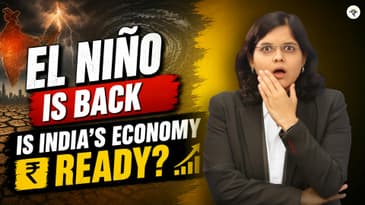

El Niño 2026 forecasts are tracking above 2°C - the threshold for a strong event. Here's what that means for India's economy, inflation, and your investment portfolio. In this video, we break down: What El Niño is and why India gets hit harder than most countries What actually happened to Nifty, food prices and rural demand in 2015–16 What the latest global climate models (June 2026) are forecasting Which sectors face headwinds and which could benefit India's structural buffers - and whether they're enough this time What is covered? 00:00- Introduction 01:11 - What is El Nino? 03:10 - Impact of El Nino in the past 04:52 - How real is Super El Nino 2026? 09:10 - Sector specific impact in 2026-27
Learn more about your ad choices. Visit megaphone.fm/adchoices
[00:00:00] Meditieren, Yoga, Joggen, nichts entspannt mich! Echt? Mich entspannt meine Steuer total! Steuer? Wie Finanzamt? Die Steuererklärung? Ja, ich hab ganz locker über 1000 Euro zurück bekommen. Hast du geheime Connections? Nö, nur die Visu-Steuer-App. Wow! Und das ist einfach? Klar, die macht fast alles automatisch. Plötzlich fühl ich mich so entspannt. Hol dir dein Geld zurück. Tiefenentspannt mit Visu-Steuer.
[00:00:26] El Niño hat die Femines, Markets, Food Inflation und ist wieder zurückgezogen als 2015. Aber wait! India today ist auf einem Buffer, der einfach nicht existiert. Die Frage ist, ist es genug oder nicht? Und das ist genau das Video. So in heutes Video, wir werden uns über 5 Key Dinge zu sprechen. 1. Was ist El Niño und warum es Indien geteckt?
[00:00:54] 2. Was ist auch erst in den letzten Yellows? Und das Weregealia, dass die Markets-Emparat der realen Ahausa ist. Und was die Welt als Gesellschaften verhalten? 3. Was über die Ausnahme testen? 4. Was über die Sектор-Geneingite je? Und die Folge? Und dass diese Beziehungsweise K��를 auf die Sektor-Interview schon weitermachen? In diesem Set ini also in der nächsten Folge, am Ende der Punkt 6? is where the real answer lies.
[00:01:46] in the Pacific Ocean's temperature. Now, the central and eastern Pacific Ocean become abnormally warm. Trade winds, which normally blow from east to west, they weaken. And when that happens, the entire global weather system shifts. Now, here's why India specifically gets hit. So I'm not saying that only India is going to be impacted. The whole world will get impacted, but we are going to focus only from the Indian perspective. What happens in a normal year? Winds push warm water towards Asia,
[00:02:15] towards Indonesia, India, and cold water rises near South America. The result, India gets a good monsoon. But in an end-linear year, those winds weaken or even reverse. Warm water shifts towards South America instead, and cloud formation moves away from India. The result, India gets a weaker and uneven monsoon. And for a country where roughly 42% of the CPI basket is food,
[00:02:42] a weaker monsoon is not just a weather event, it's an economic event. Now, how do scientists actually measure this? There are four monitoring regions in the Pacific called Nino regions. Nino 1 plus 2 region near Peru is the fastest to react, but very volatile. Nino 3 is the eastern central Pacific, which is more stable. Nino 4 is the central Pacific that tells us the type of El Nino,
[00:03:08] but the one that matters most for the market is 3.4. This is the global benchmark. In simple terms, when Nino 3.4 sustains above 0.5 degree Celsius, for five consecutive months, El Nino is officially declared. And when it crosses 2 degree Celsius, that's when we start talking about a super El Nino. Now, keep that 2 degree Celsius number in mind, because we are going to come back to it.
[00:03:39] Now, to understand the El Nino impact, let's look at the historical numbers. The major or the strong El Ninos happened in the years 1877-78, 1982-83, 1997-98, 2009-10, and 2015-16. Now, back in 1877-78, monsoon collapsed in India, which triggered the Great Famine, and it led to millions of deaths. The unfortunate part here was that colonial India had weak safety nets,
[00:04:08] and that's why I feel this one is not directly comparable with the current situation. So, what we should do is, I feel we can focus on the one that is the most recent, which happened in 2015-16. Now, India saw a rainfall deficiency of roughly 14% below normal in 2015, and what followed was important. Pulses prices doubled, food inflation spiked sharply, rural demand weakened, tractor sales slowed, two-wheeler sales slowed,
[00:04:37] and rural FMCG companies started reporting weak numbers. What about Nifty? Nifty fell over 20% during financial year 2015-16. But wait, let's understand an important nuance here. The fall was not only because of El Nino. There were some key global events because of which the major fall actually happened. China's slowdown, the yuan devaluation, and El Nino, all these put together, a lot of things were happening simultaneously
[00:05:06] because of which Nifty was feeling the pressure. But I must say that monsoon stress definitely added to the macro pressure. Now, let's understand what we need to watch out in 2026. Now, I want you all to pay maximum attention because this is the chart which will help you understand what is the 3.4, the Nino 3.4 all about. So look at this chart. This was issued back in June 2025,
[00:05:33] and this one talks about July to December 2025. Okay, see where the lines go. They're flat. They are hovering around zero. Nothing alarming, right? Now, look at the same forecast issued in June 2026, and this is again for the same period which is July to December, but 2026. There are multiple global models that you can see. You can see Melbourne, you can see Montreal, Offenbach, all covering, all converging upwards. And it's not like a flattish upward thing. They're moving up sharply.
[00:06:03] Now, the Nino 3.4 index is tracking towards 2 degrees Celsius, and in fact, beyond that by late 2026. You remember, I had talked about that 2 degrees Celsius number, and I had asked you to keep this number in mind. That's exactly where the models are pointing. This is not a prediction. This is not a panic. This is what the data currently says, and investors, and as investors, we should really understand what that means for us,
[00:06:31] that is for our portfolios. And for that, let's break this down layer by layer. Now, let's start with the first layer, which is food inflation. Now, if you remember, I had already told you that India's CPI, that is the Consumer Price Index, has food at roughly 42% weightage. Now, this means that food prices are not a side story. They are the story. In fact, in a strong El Nino scenario, pulses see the highest spike, and that happened back in 2015. Vegetables typically see short term,
[00:07:02] but sharp shocks. And rice is more policy controlled, but the risk definitely exists. Now, in a worst case scenario, impact on CPI can be upward of 1.5% to 3%. And that takes the headline inflation well above RBI's target of 4%. And it could also possibly take it near or maybe even above 6%. So this could be the inflation impact. Now, let's move on to layer two, which is the RBI policy.
[00:07:30] RBI focuses on inflation, not on monsoon directly, but monsoon drives food prices, which drives the CPI. So it's the same thing, just one step removed, right? Now, what happens is a worst case scenario. If CPI spikes above 6%, the point I mentioned right now, what will happen is that food inflation will stay persistent. And what happens, RBI basically in such scenarios does not go ahead with rate cuts,
[00:07:58] or they at least push the rate cuts. They delay the rate cuts. And in an environment where markets are already pricing in a rate cut cycle, a delay or a reversal of that is a real negative trigger. So the pattern is very much clear. And for the next like 30 seconds, if you pay attention, you will understand what I spoke about these two layers, that is inflation and RBI policy. You will understand this in like next 30 seconds, right? Look at this. Weak monsoon, that will lead to crop stress.
[00:08:26] That can lead to a supply shock. This can lead to food inflation. This is because of which RBI gets cautioned. Rate cuts can get delayed. Consumption can slow. And this is where market feels it. But wait, can the Nifty impact be extremely terrible? Ideally, no, because here's something important to understand. Nifty is not an agriculture heavy index. Financial services alone account for roughly 37% for Nifty 50.
[00:08:55] IT is around 14%. Oil and gas is around 11%. So L-Linio doesn't hit Nifty directly, but it does hit Nifty indirectly through the macro channels that we just discussed. Now, what could be a worst case scenario? Weak monsoon, plus inflation spike, plus rate cut delay. If all these things come together, we may possibly see a correction of around 5 to 10%, but not a crash. I'm saying a correction. And correction, as we all know, can be opportunities
[00:09:26] for buying good quality stocks depending on which stocks you are tracking, which sectors you are looking at, and which brings me to the most important part of the video, which is the next one. Now, we will understand about different sectors and whether it will have a positive impact, negative impact, even if you can see some stock names on screen. Needless to say, these are not stock recommendations. We are just trying to analyze the impact of L-Linio on various sectors and companies. You have to do your own research before you take any investment decision, right?
[00:09:55] First, let's focus on the sectors which may have a negative impact. And here, I feel there could be two, three different types of sectors. One could be about the rural consumption, normal consumption, like FMCG consumption. Second could be like an entry-level consumption, which is about something like two wheelers. And if I'm talking about capex-related consumption in the rural theme, it could be about agri-equipments. All these could have a negative impact. Now, why am I saying that? Logic is very simple. Unfortunately, if we have a weak monsoon, it will lead to
[00:10:24] rural incomes falling. And if rural incomes fall, the demand is going to fall. If demand falls, overall expenditure is going to be lesser, be it normal expenditure related to FMCG consumption, or it could be even about capex, the point that I mentioned. It could be about big farm-related purchases like tractors and all, right? Which could be a mixed bag. It could be something like banking, because even if I talk about NPAs in the rural segment, could they increase? Yes, but I feel
[00:10:53] the overall demand from the urban space, that will remain more or less similar, right? Now, what could be a positive category of sectors? It could be something like agrochemicals. It could be something like irrigation or water-related sectors. It could be about power and utilities. And again, the logic is again very simple to understand. See, with a weaker monsoon, the farmers would definitely want to ensure that the crops are protected. And for that, they can spend more on something like relevant fertilizers
[00:11:22] or similar products, right? Second thing is about water scarcity. This can be a problem and because of which irrigation-related equipments can come into demand and irrigation stocks can benefit because of that. And the third one is about the overall rising temperature because of the heat wave. And if this happens, electricity demand is going to increase because of which power or utility stocks can see a good one. Now, if all these points are clear in the next section and in the final section, basically,
[00:11:52] the most important point comes up is can India cushion itself? Now, here's an important data that we should focus on, right? What you can see on screen right now, these are reservoir levels across India as a percentage of the life capacity. Okay. Look at the 10-year average. It's at 34.4%. But as of early April 2026, how much is that? It's 44.6%. That's not marginally above average. That's significantly above average.
[00:12:21] And historically, agricultural outcomes correlate more with storage levels rather than with rainfall alone. And what this means is that even if monsoon is below normal, the impact on crops may be delayed or partially even cushioned because India enters this season with fuller water storage than usual. Now, let's understand few more pointers as well as to how we can compare India today with India a decade ago. Today, India has higher irrigation coverage
[00:12:51] across the farm districts. We have larger food grain buffer stocks and MSP mechanisms that stabilize the farm incomes. We have a rising share of non-farm income in rural areas. So, rural households are also less dependent solely on crops. And also, we have a better supply chain management and import flexibility. See, these are structural changes I'm talking about. These are not temporary changes and they have steadily weakened the old tight link between rainfall deficiency
[00:13:21] and economic damage. So, to wrap up this whole discussion, if you ask me, Rachana, if you were to track one number, what would that be? It would be the Nino 3.4 model number because if the temperature stays above 2 degrees Celsius, I think the impact on inflation and rural demand could be a shade higher. But if it stays below 2 degrees Celsius, it would definitely be a manageable impact. I hope you found today's video really helpful. It was a different video that we tried to cover today.
[00:13:50] If you did like it, please don't forget to smash this like button. Please don't forget to share this video with your friends. I'll see you in the next one. Until then, take care. Chai and bye-bye. You might have come across such advertisements on various social media platforms. Please note, all of these are fraudsters promising unbelievable returns through stock tips. I don't provide any calls or advisory services. I provide only educational content through my social media handles and through my website rachinaranade.com and rachinaranade.in.