
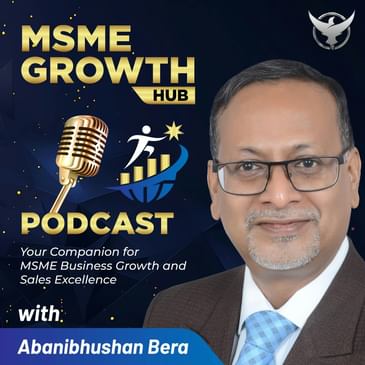

In this episode of the MSME Growth Hub Podcast, we explore the five key parameters you must consider before choosing a growth strategy. Many MSMEs struggle with inconsistent revenue and slow business growth, often because they choose the wrong expansion path.
We break down critical factors like market demand, financial readiness, operational capacity, competition, and risk management to help you make smarter decisions.
If you're considering scaling your business, entering new markets, or launching new products, this episode provides a strategic framework to ensure your growth is profitable and sustainable.
👉 Next Steps: Ready to start your revenue growth journey? Join my L0 Bronze Course today and get Lifetime Membership to the MSME Growth Hub for just ₹999! Here’s what you get:
✅ One-on-One Free Consulting Session with me.
✅ Access to the MSME Growth Hub Community through my LMS.
✅ Learn on the go with iOS & Android App Access.
✅ Upcoming: Join my exclusive weekly Inner Circle Calls (Coming Soon).
💡 Coming Soon: My L1 Silver Course will be launching in 45 days through an exclusive webinar—stay tuned for updates!
🎙️ If you found value in this episode, subscribe, share it with fellow entrepreneurs, and leave a review. Let’s build sustainable growth together! 🚀🔥
Website URL: https://msmegrowthhub.com
#BusinessGrowth #ScalingStrategies #MSME #Entrepreneurship #MarketExpansion #SustainableGrowth #RevenueGrowth #MSMEGrowthHubPodcast
[00:00:00] Welcome to another episode of the MSME Growth Hub Podcast. I am your host Abanibhusan Bera, MSME Growth Strategist and Sales Excellent Coach. And today we are diving into one of the most critical 8 overlooked aspects of business growth and that is choosing the right growth strategy.
[00:00:20] Many entrepreneurs know they need to grow and scale but struggle with which strategy to choose. Should you expand into new markets? Should you launch new product? Should you acquire competitors? Or should you focus on digital transformations?
[00:00:38] The wrong choice can lead to wasted time, resources and financial strain. That's why today we are discussing 5 essential parameters you must consider before deciding on a growth strategy. These key factors will help you align your expansion plans with your business capacity, market conditions and financial stability.
[00:01:05] By the end of this episode, you will have a clear roadmap to choose the best path for sustainable and consistent revenue growth. Let's get started. Business Growth isn't a one-size-fits-all approach. Your ideal strategy should be best on your business's unique strengths, market position and operational capacity. Here are 5 key parameters to evaluate.
[00:01:35] 1. Parameter 1. Market Demand and Customer Needs Before choosing a growth strategy, analyze the demand in your industry. Expanding too fast into a saturated or declining market can lead to losses. 2. Key Questions to Ask Are Is there an actual demand for your product or service in the new market?
[00:02:01] 2. Our customer needs evolving in a way that supports your growth? 3. Can your existing customers be upsold or cross-sold additional services? Here is an example.
[00:02:17] Say, you are an industrial automation MSME considering to expand into tier two cities. After conducting market research, you realized that automation awareness was low and businesses were hesitant to invest in expensive solutions.
[00:02:34] 4. Instead of expansion, you can decide to offer affordable starter kits allowing customers to experience the benefits before commuting to large investment. 5. The Proof of the Fear is Use Market Surveys, Customer Feedback and Computer Analysis before expanding. 5. Parameter 2. Financial Readiness and Scalability
[00:03:03] 5. Growth Requires Capital If your business lacks financial stability, premature scaling can lead to cash flow crisis. 6. Key Areas to Evaluate 6. Do you have the financial resources to support expansion without affecting daily operations? 7. How will the growth strategy impact profitability and cash flow? 8. Can your pricing and cost structure sustain the expansion?
[00:03:31] 8. Here is one example. 9. Say, you are a B2B distributor of electronic components wanting to expand internationally. 9. You must not underestimate shipping costs, import duties and foreign currency fluctuations which may lead to unexpected financial losses. 9. Instead, you can shift your focus to domestic partnerships before taking on international markets.
[00:03:59] 10. Here is a Pro-T. Before expansion, secure a financial buffer of at least 3-6 months operational costs. 10. Parameter 3. Operational Capacity and Infrastructure 10. Many businesses fail at scaling because they don't have the internal processes, supply chain or manpower to handle increased demand. 11. The key considerations are, do you have the operational systems to support growth?
[00:04:28] 12. Can your supply chain handle increased volume without delays or quality issues? 13. Do you need to invest in automation, additional staff or training? 13. Here is an example. 14. Say, you are an MSME offering custom packaging solutions and looking for winning bulk order contract with some major retail brand. 15. In such case, your production capacity must fulfill the demand and if it's overlooked and not addressed,
[00:04:56] 15. It may lead to delays, customer dissatisfaction and financial penalties. 15. So, the take-away is don't expand before optimizing your production process. 16. The proof-tief here is conduct an operational audit before launching a new growth strategy. 16. Perimeter 4. Competitive Landscape and Differentiation How will your business stand out as it scales?
[00:05:21] 17. Entering a new market or segment without competitive positioning can lead to price wars and low margins. 18. Who are your top competitors and what are their weaknesses? 19. Can you offer a unique value proposition that sets you apart? 20. Are there gaps in the market that you can capitalize on? 21. Here is an example. 21. Say, you are a solar panel MSME planning to enter a highly competitive city market,
[00:05:48] 22. But soon you realize that big players dominated the segment. 22. So, instead of direct competition, you can reposition your brand to focus on rural and off-grid solar solutions 23. Where demand is high but competition is low. 23. Here is a pro-tie. Before expansion, define your competitive advantage. 24. Is it price, quality, innovation or customer experience?
[00:06:18] 25. Parameter 5. Long-term market. 25. Long-term sustainability and risk management. 26. Not all growth strategies lead to long-term success. 26. If the strategy isn't sustainable, it can cause overexpansion, stop burnout and financial instability. 27. Key risk factors to assess. 28. Can your business sustain long-term growth or is this strategy a short-term spike?
[00:06:45] 29. What are the potential risks and external threats? 29. Economic downturns, policy changes, etc. 29. How will you measure success and when? 29. When will you adjust if needed? 30. Let me give you an example. 30. Say, you are a construction MSME looking to expand aggressively into commercial real estate projects assuming constant market demand. 31. Now think of the scenario of market slowdown which happens in almost all industries.
[00:07:13] 31. You may stock with high overhead costs forcing you to downsize and restructure. 31. So my pro tip is always have a risk mitigation plan before pursuing aggressive expansion. 32. So the key takeaways and final thoughts. 33. Choosing the right growth strategy is not just about ambition. 34. So the first thing is about alignment.
[00:07:38] 34. Before making big expenses and decisions, evaluate your business using these five parameters. 35. First, market demand and customer needs. Are there real opportunities in the market? 36. Financial readiness and scalability. Can you afford to grow sustainably? 36. Operational capacity and infrastructure. Can your business handle increased demand?
[00:08:04] 36. Number four, competitive landscape and differentiation. Do you have any age where competitors? 36. And number five, long term sustainability and risk management. Is the growth strategy viable in the long run? 36. If you choose the right strategy at the right time, your growth will be profitable, sustainable and impactful. 37. Now here is the next steps.
[00:08:30] 37. Take action today. Review your growth plans and assess them against these five parameters. 37. DM me on LinkedIn or share your biggest challenge in choosing a growth strategy. 38. Thank you for tuning in to the MSME Growth Hub Podcast. 38. If today's episode gave you valuable insights, imagine what structured guidance can do for your business growth.
[00:08:55] 38. I personally invite you to take the next step and join my branch course which is a level zero course and that will give you lifetime membership to the MSME Growth Hub. 39. And that's for just 999 Indian rupees. 39. And you will get number one, a one on one free consulting session with me.
[00:09:22] 39. Number two, access to the MSME Growth Hub community through my learning management system. 39. Number three, learn on the go with iOS and Android app access. 40. And number four, and soon you will have the opportunity to join my exclusive weekly Recycle Calls. 40. Plus, if you are serious about accelerating your growth, stay tuned. 41. My 11 Silver course webinar is launching in just 45 days.
[00:09:52] 41. Visit my website www.msmegrowthhub.com now to join the Level Zero course and take the first step toward transforming your business. 41. And as always, if you enjoyed this episode, don't forget to subscribe, share and leave a review. 42. Use support surely will help more MSME entrepreneurs like you access high-value content. Let's build sustainable growth together.