
Learn more about your ad choices. Visit megaphone.fm/adchoices
[00:00:00] Welcome to the DREAMERS Disruptors Podcast, a combined initiative by Riquint and Bloomberg Quint
[00:00:12] where we speak to new age leaders who are redefining leadership in the digital era.
[00:00:18] Today, we have with us Tarun Katyal, the man responsible for stirring the Z group into
[00:00:24] India's OTT market.
[00:00:27] Thank you so much for joining us Tarun. Tarun, you've been part of the entertainment industry
[00:00:31] for over two decades now.
[00:00:33] If I were to ask you to define your leadership style in three words, what would they be?
[00:00:39] So the three words that I always tell people is I rely on you.
[00:00:45] If you can trust people, if you believe in people and if you can rely on them, then you're
[00:00:50] the safest in a place where you are.
[00:00:52] So for me, the eternal concept of leadership that's worked for me is servant leadership.
[00:00:59] And why do I call it servant leadership?
[00:01:01] It's really the best relationship that you can have with your teams is what your parents
[00:01:06] have with you which is selfless.
[00:01:09] If you're able to drive them to deliver their true potential, if you're able to work
[00:01:15] with them for them to become winners in their own right and come out feeling that they've
[00:01:20] done something meaningful, then your words, the leader that you want to call yourself.
[00:01:26] And who are the people who've played a key role here?
[00:01:29] Who've influenced your leadership style as your role models?
[00:01:32] So they know I've had various role models in my life and I think there are people who
[00:01:38] help you drive your true potential.
[00:01:41] One of my early role models in my career was an ad man and really a strategy guru called
[00:01:49] Anand Halve.
[00:01:50] I worked with him really at the start of my career.
[00:01:54] So he was one of my early mentors and you know, I still hold a lot of what I learned from
[00:02:00] him with me.
[00:02:01] So he was one of my early career mentors then I worked with some very wonderful people
[00:02:07] to my media career.
[00:02:09] Samin Nair is another guy who I learnt a lot from.
[00:02:12] He's allowed me to learn how to take risks and big bets and how do they pay off?
[00:02:19] And the other side of fear is freedom.
[00:02:22] He really empowered and allowed us to take a lot more risk and what we created at start
[00:02:28] TV than we were early on was because of him.
[00:02:32] In my recent career working with Puneet Royce, guys also been really, really rewarding.
[00:02:37] He's a very trusting and empowering leader.
[00:02:40] And he allows you to be able to envision your work as well as the organization collaboratively
[00:02:48] with him and to be able to go out and do that without second guessing you on a daily basis.
[00:02:54] And from your personal life?
[00:02:56] So I think my mother is my role model for my personal life and I've said this in many
[00:03:01] places.
[00:03:02] I think she is a great example of how you could balance work, life and stay committed
[00:03:08] to what you do.
[00:03:10] She's really the role model of being selfless, selfless not only to us but she was like an
[00:03:16] education is selfless to all the children that she taught for so many years.
[00:03:20] Wow.
[00:03:21] Okay, tell us about your journey so far, your professional journey.
[00:03:25] So you know, the last decade has been very, very eventful and I think the amount of change
[00:03:30] that's happened in the last decade hasn't happened for many decades before.
[00:03:34] Even from understanding that the cable and satellite environment was changing, the media
[00:03:39] environment was changing.
[00:03:41] I was running a big FM which was FM radio network.
[00:03:46] We allowed ourselves to understand that you know local going local was the key and localization
[00:03:52] was the key and we established ourselves in 60 cities across the country from there on
[00:03:58] my big learning on a failure was that we launched a set of English channels partnered
[00:04:04] with CBS and RTL and we realized that English was starting to give away to video on demand
[00:04:12] and digital videos see me.
[00:04:14] So after getting into their business a couple of years later, I clearly could see that this
[00:04:20] was not the future linear television or linear broadcast in the English language was going
[00:04:25] to go away, it was going to feel away.
[00:04:28] So there was no point in investing in something that you knew didn't have any long term outcome.
[00:04:33] So we actually shut up those channels and moved the investments towards regional channels
[00:04:39] which was the other big learning that I had, the booming of regional television.
[00:04:44] And we launched Bochpuri as well as an FTA challenge targeted towards UPMPB hard and those
[00:04:53] became really successful which is the one we sold to Z which I came moved to Z through
[00:04:58] an IQ higher.
[00:04:59] Wherein I came into a digital video streaming.
[00:05:03] We started the digital video streaming platform with three very inherent qualities, one was
[00:05:09] making sure that we were in vernacular languages, 12 vernacular languages because we knew
[00:05:13] that the next billion users were coming and the disruption of 4G, the data availability
[00:05:20] and then that being used for digital video in their own language was going to happen and
[00:05:26] that really paid us off well.
[00:05:28] The other big disruption was video on various devices.
[00:05:32] So right from a feature phone, a iOS, a geo feature phone, right on the other end to 4K,
[00:05:40] 8K devices and television devices.
[00:05:42] We made sure that we were present and all and the year of connected devices are today
[00:05:46] very, very real.
[00:05:48] Triangulated that with broadband, triangulated that with the entry level smart TVs that
[00:05:54] are under $100 now, the entire smart TV and the digital video streaming is now moving
[00:06:00] from mobile handsets to connected devices and smart TVs.
[00:06:05] So a lot of disruption, a lot of changes in the ecosystem and I think the consumption
[00:06:11] of video is going to go between short form, long form, UGC, mobile TV into gaming and place
[00:06:20] stations through really becoming immersive over a period of time.
[00:06:24] What was some of the key learnings as you moved from television to OTT?
[00:06:28] I think when we started making premium content at Z, we didn't make a big leap between TV
[00:06:36] content and digital content and in the first few months itself, we realized that that
[00:06:40] content will not work because the kind of premium content that the users wanted was
[00:06:46] visually going to be very, very starkly different.
[00:06:48] And so we pivoted very quickly into making shows like Grand Bars and Final Call which were
[00:06:55] larger than life but were also real, relevant, resonant and not very over dramatic and told
[00:07:03] like the way TV was big too.
[00:07:05] Right.
[00:07:06] So how does a leader like you deal with such failures?
[00:07:09] Awareness, accountability and change.
[00:07:11] First, you've got to build awareness that there is something wrong, except that there's
[00:07:15] something wrong and you've got to fix it.
[00:07:18] Then take accountability and self accountability.
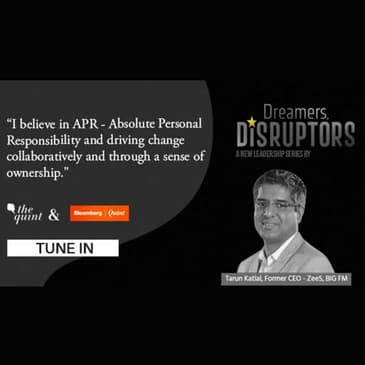
[00:07:20] I believe in APR absolute personal responsibility.
[00:07:24] You take responsibility rather than you're not shoving it all over the place, take accountability,
[00:07:29] take responsibility that we have something broken that we need to fix it and then drive
[00:07:33] change in very important and driving change collaboratively, driving change from the front
[00:07:38] and driving change with a sense of ownership.
[00:07:41] Driving change with a sense of ownership.
[00:07:43] Very well.
[00:07:44] All right, let's talk about the year that's gone by.
[00:07:47] 2020.
[00:07:48] Viewership for most ODD platforms grew massively during the lockdown but most of the work was
[00:07:54] being done remotely from home.
[00:07:56] How did this pan out for you guys?
[00:07:57] I think COVID has been tough for everybody but it has also been opportune for some industry
[00:08:04] and I think we've been fortunate to be in that bucket.
[00:08:07] What we've been able to see is that digital video streaming came off age like I told you
[00:08:12] trying to relate it with broadband and broadband proliferation has become much more than it
[00:08:17] ever was.
[00:08:18] The middle class has moved to adopting broadband like a utility at home.
[00:08:23] You have broadband at home, you have a smart TV or a smart device that can have a Zot 5
[00:08:27] Stake or a smart box or stuff like that.
[00:08:29] Then you have apps which allow you to stream video very easily.
[00:08:34] Triangulate all of this and you will have great outcomes for digital video streaming at home.
[00:08:39] I think productivity is very high because I think we've become far more disciplined about
[00:08:43] meetings, about people, about timing.
[00:08:46] So that really has worked very well for us.
[00:08:50] What has now worked is that I think you end up working more than your plans or work like
[00:08:54] balance is a little skewed but I think people have come together they stay safe but
[00:08:58] they also collaborate to grow.
[00:09:00] Does it impact the work life balance?
[00:09:02] It is tough.
[00:09:03] We've tried to hold now switch off by 8 o'clock at least and make sure that weekends
[00:09:07] are switched off and make sure that we create a balance of life and time and work as much
[00:09:16] and as far as possible.
[00:09:17] Do you think work from home is here to stay?
[00:09:19] I think there will be two parts of this work, one will be where you need to be on the
[00:09:23] ground.
[00:09:24] So production, shooting, making content, that cannot be worked for more than that part
[00:09:29] of the last mile has to be on the ground and that continues to be on the ground.
[00:09:34] We've got to just make sure that it's as they are enough for more of safety and precaution
[00:09:38] and built into it.
[00:09:39] So that's really good.
[00:09:41] Strategic work can be done from home, collaborative work can be done from home and that continues
[00:09:47] to be.
[00:09:48] Okay.
[00:09:49] Moving beyond work.
[00:09:50] Tell us about your hobbies.
[00:09:51] So I think meditation allows you to set yourself stay in the present, be able to focus
[00:09:56] your energies around what is today rather than trying to live with the present or the
[00:10:02] future.
[00:10:03] It allows you to be interested, it allows you to be able to be empathetic.
[00:10:09] So I spend at least an hour everyday making sure that I invest into meditating and centering
[00:10:16] myself.
[00:10:17] So I think I like to read and I read all sorts of things but I think reading gives you lots
[00:10:26] more ideas and liberates you.
[00:10:28] The other thing that I like particularly is to be able to teach.
[00:10:35] So I either teach in colleges or create curriculum with colleges in being able to transform people's
[00:10:44] thinking their lives and I commit myself some amount of time to that all the time.
[00:10:50] Wonderful.
[00:10:51] Before we let you go, let's hear three tips for the next generation of dreamers disrupt
[00:10:56] us.
[00:10:57] I think be able to stay introspective, stay high on integrity and let the water find its
[00:11:08] own cause.
[00:11:09] Very well.
[00:11:10] Thank you so much Tarun for being a part of this series.
[00:11:12] It was a pleasure to have you.