
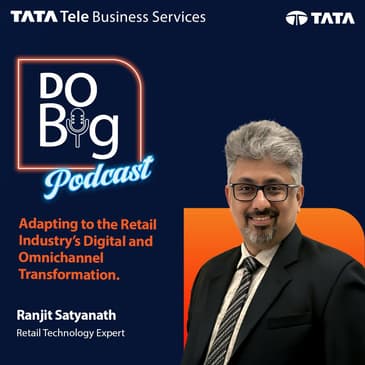
In this insightful episode, we’re joined by Ranjit Satyanath, a seasoned retail expert, to discuss the rapidly evolving retail landscape driven by modern consumer demands. From the rise of e-commerce and mobile shopping to the growing buzz around quick commerce, Ranjit shares strategies for small retail businesses to adapt to rapid technological advancements and stay competitive.
Tune in to the podcast for actionable insights on navigating retail’s tech-driven transformation.
[00:00:09] Today we will delve into something that is of interest to most of us. We all shop retailers are leveraging cutting-edge technologies to enhance our shopping experience.
[00:00:21] Today we will explore how AI, AR, big data are transforming shopping into a seamless and personalized journey for millions of Indians.
[00:00:31] From AI-driven recommendations to AR-powered try-ons, technology is playing a pivotal role in helping us, the consumers, and retailers make the most out of the next couple of months, which is their busiest season.
[00:00:45] Joining us today as we kind of decode retail technology, we have Ranjit Satyanath, retail technology practitioner, and he is going to talk us through what is going on in India's retail landscape when we talk about technological innovations.
[00:01:04] Ranjit, welcome to the Do Big Podcast. It's a pleasure to have you here today.
[00:01:10] Thank you, Shital. Pleasure to be talking AI and retail with you today.
[00:01:14] You know, it's so funny, when we first met and started working, I don't think any of us was really looking at, like, we were in what, the early 2000s?
[00:01:24] 2006 to be precise.
[00:01:26] Correct. And, you know, we were just about talking e-commerce in those days, and today suddenly everything's just revolutionized.
[00:01:34] So, tell me, how has, or tell our listeners, how has the retail industry transformed when you think about this whole response to shifting consumer behaviors?
[00:01:46] You and I were talking about e-commerce and starting an e-commerce platform for the company that we were working for, which is ShopperStop.
[00:01:54] But today, it's all about quick commerce, right? So, where the world has taken, like, I don't know, 30 years to do e-commerce, we have done e-commerce, mobile commerce, and quick commerce in, like, 10, 12 years.
[00:02:08] What do you think? Just walk us through that whole shift.
[00:02:11] When I joined retail in 2006, I had just come in from a very large bank.
[00:02:17] And banks, and the bank that I came from was at the forefront of technology.
[00:02:22] It tried to use technology in all customer interactions, all customer journeys.
[00:02:26] And retail was at a very different place then.
[00:02:28] In retail, technology was sort of just beginning to make its inroads.
[00:02:33] Having a fully functional enterprise resource planning system used to be an exception in those days.
[00:02:40] And retail was about, you know, if you were a forward-looking retailer, ERP and a point-of-sale system, billing system in the store.
[00:02:47] But that's when, you know, in 2007, when the iPhone was first launched, that's really when, you know, it's like a tipping point for technology.
[00:02:56] And all consumer-facing, actually, technology became democratized from that point forward.
[00:03:02] People started having access to very sophisticated technology in the farms of their hands.
[00:03:08] And then they wanted to do things with it.
[00:03:11] And obviously, you know, one of the things that humans have been doing since time immemorial was buy.
[00:03:17] And it's only natural that buying got into the mobile phone.
[00:03:20] So the first wave, actually, in 96, between 98 to 2000 is when the first e-com, you know, bubble made its presence fail.
[00:03:32] That was a bubble because it was a lot of technology that was way ahead of its time and not many, many takers for the functionality that it brought to the table.
[00:03:42] But, you know, from 2008 to 2009 onwards, people, you know, that tipping point, which I mentioned earlier, kicked in.
[00:03:50] And a lot of retailers started making their own websites.
[00:03:54] They started experimenting with how they can sell, expose their in-store inventory online.
[00:04:01] And then as more and more people started getting access to touch phones, the form factor of the website changed.
[00:04:07] It became amplified.
[00:04:08] And then, you know, then came the next phase, which is the social websites started making its presence fail.
[00:04:18] In 2010 or so is when Facebook started really getting a lot of traction in India.
[00:04:24] People started getting exposed to what's happening in other geographies, people sharing things that they purchased.
[00:04:30] And suddenly that the impulse buying people, the impulse started picking in for people and people started going in for going into Google, searching for products.
[00:04:40] Amazon was still not in India.
[00:04:42] And I remember at that time, the Amazon team had come to visit us and they told us the interesting statistic, which actually I found very, very shocking,
[00:04:53] shocking, that the second largest traffic to Amazon.com in the US was from India, which means that a lot of people in India,
[00:05:02] even though they did not have access to Amazon merchandise, were actually going to Amazon.com to check out, you know, what were the things that they could not buy.
[00:05:10] Probably a few people with access were actually, you know, buying online.
[00:05:14] I did it a few times myself.
[00:05:15] Whenever I had to go to the States, I used to order it and have things sent to my hotel.
[00:05:19] I'm sure there were people who would say, people would send stuff to their relatives who were coming down.
[00:05:26] So that's when, you know, Amazon, Amazon started off in India.
[00:05:29] They started a website called jungly.com.
[00:05:31] Correct.
[00:05:33] And jungly.com was a site on which you couldn't buy anything.
[00:05:36] You could just, you could just look at products and jungly would direct you to the retailer's website.
[00:05:43] If the retailer had a website and what Amazon was doing at that time was to, you know,
[00:05:47] gauge what kind of products customers would have bought if they came in.
[00:05:53] So it was sort of their market research in India before they actually formally entered.
[00:05:57] Then Flipkart, Flipkart also, you know, started operations around that time.
[00:06:03] And obviously they became a huge success.
[00:06:06] Amazon followed.
[00:06:07] And by 2014 or so is when we saw e-commerce really come into its own.
[00:06:13] So there was Flipkart, Amazon, Snapdeal.
[00:06:16] These were the three big guys.
[00:06:17] There was eBay also in the three.
[00:06:19] So there was, there was lots of online traction and everybody, everybody was trying to get their act together.
[00:06:27] Then this was the time when people started talking about Omnichannel, about giving customers a unified experience across online,
[00:06:38] online and offline, across online and offline, making sure that the same inventory that you saw in store was also available online.
[00:06:47] And the customer who came and claimed it got access to that inventory first.
[00:06:51] But they were, they were discovering customer behavior that if a customer came in store and found a promotion and they did not find that promotion online, you know, they would, they would feel bad.
[00:07:03] And they would, they would, you know, make a big fuss about it.
[00:07:06] So slowly a lot of tools which allowed customers to get their Omnichannel game organized started coming, started being available in the markets.
[00:07:17] And retailers started, you know, adopting them.
[00:07:21] And then once COVID came, it really accelerated people's acceptance of e-commerce.
[00:07:28] Even people of demographics, much senior to the Gen Zs started going online and buying stuff.
[00:07:39] And today, you know, cut to today, we have quick commerce where you can have an impulse and, you know, get it fulfilled from your favorite retailer within 10 minutes, 15 minutes.
[00:07:50] What we are seeing today is, you know, customer journeys and many, many retailers are reporting it that, you know, there are retailers have multiple channels.
[00:08:00] They have their app, their website, some of them have chatbots, they have stores and people expected customer to have linear journeys.
[00:08:08] But we are actually seeing that the lines between all these different channels are blurring.
[00:08:12] A customer may, you know, search for a product online, research for it online, come to the store, you know, experience it, then go back online, make the purchase and have it delivered to them.
[00:08:25] So retailers need to ensure that, you know, because customers keep hopping on and off different channels, the consistency that the customer gets between all these channels is, you know, up there.
[00:08:38] You don't want suddenly a customer to come online and figure out that inventory is not available for a product for something that he had just seen in the store.
[00:08:48] They want services like, I will buy the product online and if quick commerce is not available, then, you know, I'm okay to go to the store and pick it up.
[00:08:59] So retailers need to get their technology act together and ensure that these kind of journeys are in place.
[00:09:06] And mind you, it's going to be horses for courses because not every category will require a click and collect.
[00:09:14] Grocery will definitely not require click and collect, but maybe fashion and consumer durables may.
[00:09:20] Retailers really need to understand their target customer segment.
[00:09:24] They need to understand their categories before crafting customer journeys that work for that specific section of customer.
[00:09:32] So, you know, Randeev, it's quite funny because I remember when we first heard about e-commerce coming into play and we were, there was a lot of worry about small businesses.
[00:09:45] There was a lot of worry about the small retailer.
[00:09:47] I distinctly remember big fears around e-commerce will come in, the bomb and pop stores will get wiped out, small and medium business enterprises will get, you know, squeezed for margins and things like that.
[00:10:02] I remember all of those conversations were happening in the world of retail where people were protesting saying, should we really have e-commerce, etc.
[00:10:09] From a small and medium business perspective or a small and medium size retail business perspective, what do you think they can do to keep up with the kind of tech changes that are there in the space?
[00:10:26] You're quite right.
[00:10:29] There was a lot of talk at that time, which expressed fears that the small and medium business owners would get wiped out.
[00:10:38] But actually what happened was the reverse.
[00:10:42] Today, thanks to technology, you are able to see a lot more entrepreneurs and B2C brands make their presence felt.
[00:10:51] Technology has enabled, you know, these businesses to actually reach a wider market than what they would have been able to do had they been restricted to just physical spaces.
[00:11:03] Today, take QSR for instance, they work only with warehouses, right?
[00:11:08] They don't even have stores.
[00:11:09] In fact, their stores themselves are called dark stores.
[00:11:13] So actually technology has enabled them.
[00:11:18] And one of the main reasons for this is, you know, in the last 10 years or so, we are seeing a lot of very affordable SaaS platforms being made available.
[00:11:30] You have platforms like Zoho, which actually help you automate the entire backend operations and platforms like Shopify, MyDukan, which helps retailers create their front ends.
[00:11:47] You know, in as short a time as probably a couple of days, these kinds of technologies are really responsible for creating hundreds of new businesses on a daily basis.
[00:12:00] Secondly, there is this social commerce which has made its presence.
[00:12:06] So today it's possible through Instagram, WhatsApp, Facebook for you to create your own catalogs, for you to create your own storefronts and expose your products to people who come, you know, to check out their social feed.
[00:12:21] So they are able to purchase as soon as that impulse for a product is created.
[00:12:26] There are umpteen last mile delivery platforms that are there.
[00:12:31] So all you need to do is integrate Shopify and a lot of these platforms come with ready-made integrations to logistics aggregators.
[00:12:40] So you can, with the flick of a button, you can actually reach 3000 pin cores, for instance, which includes, you can even ship your products to countries other than India.
[00:12:55] Then there are products which help you, you know, up your omnichannel games.
[00:12:58] If you have your store, you want to leverage your inventory across channels.
[00:13:03] You want to have common promotions across channels.
[00:13:05] There are platforms that are available on a SaaS model that enable you to do that.
[00:13:12] And then there are, you know, platforms which take all your data, the shopping history, your inventory, which customer has come and express demand for what product.
[00:13:23] So, you know, take all that and create targeted campaigns reaching, Sheetal, if you are a consumer and if you have, if you have expressed in a particular, a particular dress, it can, it can give you very targeted messaging regarding the dress till the time you actually make that purchase.
[00:13:42] So technology has actually really allowed these small businesses to thrive.
[00:13:48] So, you know, the government is also doing a lot of work in this space, right?
[00:13:51] So down south, they're experimenting largely with ONDC as a platform, which allows for even smaller retailers, right?
[00:14:02] To be able to access the market.
[00:14:04] I'm just trying to understand how does, you know, how does initiatives like an ONDC, for example, how can, you know, medium and small businesses leverage those kind of initiatives to make a better offering for themselves or a better business offering for themselves?
[00:14:21] So right now, ONDC is promising small and medium businesses to, you know, giving them the capability to come on the platform and, you know, make their products available to anybody, to anybody who's willing to onboard them.
[00:14:41] So that today there is a gating process by, you know, the likes of Flipkart and Amazon.
[00:14:46] So ONDC is trying to remove that and, and, and democratize the onboarding of, of products.
[00:14:53] But the challenge really is that just because you have a product listed on a website doesn't mean that the customer will actually buy it.
[00:15:04] You have to do a lot of work in terms of creating great content around your product.
[00:15:11] And if you're able to create great content around your product, then, you know, then you might as well go on platforms like Amazon.
[00:15:20] Today, ONDC, actually the jury is still out whether ONDC is a success.
[00:15:25] It is being marketed as something that is, you know, come from the same, from the same stables as UPI and therefore will be as big a success.
[00:15:34] But the jury is still out whether ONDC can make as big an impact as, as UPI.
[00:15:41] But I think, you know, these kinds of, these kinds of initiatives are always welcome.
[00:15:46] Let retailers experiment with it.
[00:15:48] Maybe there are some rough edges which will get smoothened with, you know, a lot of these retailers coming on platforms like ONDC.
[00:15:55] And, you know, the, the, the, the, the small retailer will benefit and the buyer will benefit.
[00:16:04] So I know you spoke about seamless journeys across, you know, the omni channel presence, et cetera.
[00:16:11] But are you seeing a shift in consumer behavior where consumers are now navigating towards any one particular channel?
[00:16:20] Right. So for example, somebody like me has almost stopped going into stores.
[00:16:27] My, most of my shopping is online.
[00:16:30] Right. And more I speak, at least in urban India, when I speak to people, more and more people seem to be doing e-commerce, m-commerce and quick commerce.
[00:16:40] Right. And therefore, if I got a great deal online, I don't really go and worry about whether the same deal is running in the store or not.
[00:16:49] Are you finding that thanks to technology, there has also been a shift in consumer behavior in terms of how they are shopping in terms of, do they access all channels?
[00:17:04] Do they now navigate on smaller channels?
[00:17:07] Do you find that, you know, because when you have to think of a unified journey across, that seems like a fairly complicated process.
[00:17:16] But if you now start saying, hey, I can segregate my consumers.
[00:17:20] And I know that there is the e-commerce consumer and there is the e-commerce consumer and there is the store consumer.
[00:17:27] Would you be able to do differential consumer experiences and journeys?
[00:17:33] You know, like I said in the beginning, depending upon category, the consumer moves across channels.
[00:17:40] Now for something like grocery, you know that, you know, any grocery product, there is no need to go to the store.
[00:17:49] So you're very happy to buy it online.
[00:17:53] So I, so like me, I'm sure many people experiment with the latest grocery service provider out there.
[00:18:01] And, you know, obviously when the latest, the latest online retailer always gives you the best prices.
[00:18:09] So one is tempted to go and check out how their shopping experiences and whether it is big basket or Reliance's mini basket or the Swiggy Instamarts of the world.
[00:18:20] You know, you can, you can, you know that the product quality is going to be largely the same.
[00:18:24] But if it's, if it is say of, if it is a consumer durable, for example, even if you are a online customer, you don't want to go to the store.
[00:18:33] You, it will not stop you from checking out prices in different, on different sites or on different apps and, and get the best deal.
[00:18:41] You know, whoever is ready to provide it to you.
[00:18:44] But then there are products like say cars, a car buying journey invariably today starts online.
[00:18:52] Correct.
[00:18:53] You will look at team BHP, you look at videos, you will look at, you, you, you look at reviews online.
[00:19:02] And once you have shortlisted, you will go to a showroom, you will take a test drive and then, you know, consummate that journey at the store.
[00:19:12] So it is actually highly product specific and fashion is somewhere in between fashion.
[00:19:17] You know, like I'm talking about my specific example.
[00:19:21] So for example, if I find that I get the product that I like in terms of design, in terms of quality and in terms of fit with a particular website, I'm pretty happy to go online and buy it.
[00:19:33] So for fashion, I'm a, I'm a, I'm a, I'm an online customer, but there are certain categories within fashion, like say shoes where fit is fit is very important.
[00:19:41] I mean, for everyone, but for that, I would probably go to a store and buy maybe, maybe research online, find the design that I like, then go to the store, make sure that it fits properly and buy from there.
[00:19:52] But one thing that is very stark is that today, even, even with multiple channels, one sees that 92% of all searches, 92, between 92 to 95% of all searches happen on the mobile rather than on a, on a desktop browser.
[00:20:11] Any retailer who wants to go online has to get their mobile game, you know, in top gear.
[00:20:19] So, you know, there are also challenges which come with technology, right?
[00:20:22] Very often when I go to stores nowadays, if I do land up going to stores, you will find that the post machine is not working.
[00:20:29] It's not linked to, you know, the central server.
[00:20:33] If you ask them, is this available in my size?
[00:20:35] They will say, I will call you back and let you know, stop like that, right?
[00:20:39] Because some server downtime has happened.
[00:20:42] Somewhere connectivity is lost.
[00:20:44] Electricity is not happening.
[00:20:45] All India, I mean, we have all of these various challenges, which we don't really see in the metros.
[00:20:51] But as you go into tier two and tier three, all, how should I say, all the loopholes kind of start to emerge in, in the space.
[00:21:01] And I'm just trying to understand that if there are small and medium retailers who have to connect multiple stores, you know,
[00:21:09] the role of connectivity and communication starts to become extremely important.
[00:21:14] What's the solve there?
[00:21:15] What are the challenges and what's the solve?
[00:21:17] I am telling you challenges from a consumer point of view, but I'm sure that from a business point of view, also there are challenges.
[00:21:22] And what do you think are the solves there?
[00:21:24] I think one has to start from, I mean, putting myself into a retailer shoe.
[00:21:29] What I would do is I would first start with connectivity because today all applications are online.
[00:21:37] Gone are the days when you have, you know, a server in the store with your power fast loaded on it.
[00:21:44] In an omni-channel world, your inventory needs to be in real time.
[00:21:49] Your promotions need to get applied in real time across different channels.
[00:21:55] So network connectivity is the biggest thing that you need to invest in.
[00:22:00] But the good news there is that today network costs are becoming much, much cheaper than what it was earlier.
[00:22:07] So, therefore, retailers need to ensure that their network connectivity is addressed.
[00:22:14] Today, it is very easily possible to have two links of 10 Mbps in the store because that is what you are going to need.
[00:22:23] I mean, assuming you have a reasonable customer walk-in, you are running a store of 10,000 to 15,000 square feet.
[00:22:33] You have so many in-store applications that you are right from your customer walk-in application to your POS, to your ERP, inventory check-in, your promotions engine.
[00:22:47] All of it requires connectivity.
[00:22:50] And, you know, if you are starting a store today, you need to ensure that your connectivity is taken care of.
[00:22:59] Then you have to ensure that all your data is synchronized.
[00:23:04] So you can't have a different inventory for online and a different for your store.
[00:23:09] Because then you will never be, you know, leveraging your working capital in an efficient manner.
[00:23:13] So every time, every time a product is sold in the store, your inventory has to deplete so that your online customer gets an accurate view of what is available for him to buy.
[00:23:23] Now, with network comes challenges of cybersecurity.
[00:23:28] Every day we hear about problems regarding somebody being hacked, somebody's data being made available online.
[00:23:35] So retailers need to ensure that they invest reasonable amounts to safeguard their data and safeguard their systems from somebody maliciously putting it down.
[00:23:47] If retailers have been around for a few years, they would have some legacy systems, which are probably built on, say, client-server architecture.
[00:23:59] And you need to integrate it with your omnichannel systems, which are API-based.
[00:24:04] So balancing new technologies with, you know, legacy systems, that is something that they have to take care of.
[00:24:10] So you have to make sure that all your systems are modern and they are able to speak to each other to leverage, you know, the power of digital.
[00:24:19] And then you have to do, you know, all this at a reasonable cost that don't impact your bottom line to an extent that you can't afford.
[00:24:32] So I think these are some three, four challenges that retailers need to take care of.
[00:24:37] And if they are able to do this in a consistent manner and in a scalable manner, I think they are going to be very successful.
[00:24:44] So that brings me to another question, which is not a question that typically people are talking about, especially in the retail space, right?
[00:24:52] The first thing you walk into the store and you buy something or even online and the details are your mobile numbers and, you know, your email IDs and, oh, we'll send you a bill online.
[00:25:04] And, you know, all of that.
[00:25:05] What happens with consumers' data privacy and consumers' data security?
[00:25:11] Today, that is something which all retailers, wow, that, you know, they protect like it's their crown jewels.
[00:25:20] But we know for a fact that, you know, at least from the news and anecdotal evidence that we see around us that data security is something which comes as an afterthought.
[00:25:33] So retailers really need to ensure that this, it is actually their crown jewels because if they really harvest this data in an efficient way, then the customer is going to reward you with more and more business.
[00:25:47] There are laws which have been in the making for some time, which promise consumers that they will have full control of how retailers use that data, how not only retailers, how any business use that data.
[00:26:04] But sorry to say today, you know, we are far from an ideal state.
[00:26:08] And that is something that we need to work towards happening very, very quickly.
[00:26:14] So while large retailers who've been in the business, et cetera, need to go back and work on it, let's say a small and medium retailer, the MSME business, how can he ensure that that happens from day one?
[00:26:27] Or at least because they're currently small, how can they kind of look at data privacy and security and make that a big differentiating point for themselves?
[00:26:37] Because they're small and can it be managed?
[00:26:40] So if you set it up now, will it reap benefits in the future?
[00:26:43] See, today it is largely available on some Excel sheet.
[00:26:48] So if a retailer really is interested in protecting that, then they should go for some kind of certification like PCI DSS.
[00:26:57] These are audits that happen by certifying agencies who come and audit your processes end-to-end and make sure that any personally identifiable information or any credit card information
[00:27:12] that is lying around in systems or in an unencrypted fashion are highlighted and you get your certification only if you address it.
[00:27:26] And retailers have to do it every year to ensure that it's not like a one-time exercise and you're certified and then you can do what you want.
[00:27:36] You have to do that certification process every year.
[00:27:40] And if retailers are really serious about safeguarding their customer data, then they should go for such certification mechanisms and ensure that global standards for protecting their customer data is brought on the table from day one.
[00:27:55] Okay.
[00:27:56] You know, we've talked a lot about the issues, etc.
[00:27:59] Tech has been changing really quickly, right?
[00:28:02] And like you and I have seen, I mean, from 2007 to 2024 and in 17 years, we've seen a lot of changes which have come in, right?
[00:28:14] What are the three big future trends that you're anticipating in retail technology which you think is going to be in change?
[00:28:23] So one thing that we are already in the midst of is AI.
[00:28:27] So, you know, I am seeing like it has happened with SaaS platforms, AI, machine learning and technologies of their ilk is going to become more and more cheaper.
[00:28:40] And it will be possible for, it's actually already pretty cheap.
[00:28:45] And retailers who want to use it will be able to do that.
[00:28:50] And this will really drive this very hyper-personalized marketing and product recommendations.
[00:28:57] We are already seeing live stream commerce, you know, from the time COVID started, a lot of retailers started taking interest in live stream commerce where somebody like an influencer is trying to sell you things on the website.
[00:29:13] Augmented reality is going to be the next big thing.
[00:29:16] So, you know, we are seeing large companies like Meta are putting in a lot of their dollars and making this a reality, making the headsets lighter, making more content available.
[00:29:27] We are seeing some early, I'm seeing this more in the healthcare sector, some experiments around autonomous deliveries.
[00:29:36] So today, hospitals use drone deliveries between hospitals to send blood samples between each other.
[00:29:44] I'm sure, you know, we'll see this in some categories of retailers, retail very soon.
[00:29:50] And then there is this whole metaverse thing where retailers will be able to establish virtual stores and, you know, that will become one more channel.
[00:30:02] And retailers will have one more channel for the retailer to actually give a consistent experience on.
[00:30:08] That will offer a lot of immersive shopping experiences to the customer who's sitting at home.
[00:30:14] And if you see online shopping, the look and feel hasn't changed from the time it got introduced.
[00:30:21] But metaverse is going to change that, make it more immersive and give a better experience.
[00:30:27] And do you see the metaverse coming in in the next five, seven years?
[00:30:32] Or do you see the longer term play?
[00:30:34] In certain categories, for sure.
[00:30:36] Like already certain high-end cars have started experimenting with it.
[00:30:43] I mean, I would hazard a guess that in the next five years, it will become more mainstream.
[00:30:50] Especially say building and construction material.
[00:30:53] They are showing a lot of interest in metaverse integration.
[00:30:58] Vehicles I already talked about.
[00:31:00] But a lot of lifestyle retail will want to do metaverse integrations.
[00:31:07] Okay.
[00:31:07] One last question because this is something that I personally think is very interesting.
[00:31:11] What do you think is going to be the role of voice when you think about retail in the future?
[00:31:18] Yeah.
[00:31:18] Something like, hey, Alexa, my tide has run out and can you ensure that it gets shipped tomorrow?
[00:31:25] Yeah.
[00:31:26] I think that is voice-activated shopping, especially with the influx of the smart speakers that are out there.
[00:31:34] It's only going to be a matter of time before voice commerce becomes a thing.
[00:31:39] We expected this to happen a few years earlier.
[00:31:42] But I think thanks to COVID, that hit a speed bump.
[00:31:48] But again, experiments are happening on voice commerce.
[00:31:54] In India, it's going to be a challenge because we have so many different ways of speaking.
[00:32:00] But with AI, I think that challenge is going to get surmounted.
[00:32:08] And in certain categories, which are like in top-up categories like groceries and vegetables,
[00:32:17] I think there could be use cases for voice commerce.
[00:32:21] Okay.
[00:32:22] Great, Ranji.
[00:32:23] Thank you for answering all of my questions patiently.
[00:32:26] And absolutely wonderful to have you here today and have this conversation with you.
[00:32:32] I'm sure that, you know, retailers have a lot to think about and definitely the small and medium-sized retail businesses.
[00:32:39] Given that technology is going to both bring in the competition but also aid them to grow.
[00:32:47] So it's quite important as to how they utilize this technology, right?
[00:32:53] Because it will definitely give them a competitive edge.
[00:32:57] And I think the chances are that it also helps, you know, help them grow,
[00:33:02] especially if you think about it as regional players who will now have access to, you know,
[00:33:07] the country at large to be able to deliver products and services.
[00:33:12] So thank you so much.
[00:33:13] It was a pleasure having this conversation with you and look forward to chatting with you some more at some point.
[00:33:20] Likewise.
[00:33:20] Thanks, Shital.
[00:33:21] Thank you for tuning in to the Do Big Podcast.
[00:33:24] A podcast that is dedicated to providing insights, strategies, and success stories of smart digital solutions for SMEs.
[00:33:32] We believe that behind every successful business, there's a strong foundation of reliable and secure technology via digital connectivity,
[00:33:41] cloud infra, cloud apps, collaboration tools, or cybersecurity solutions.
[00:33:45] In a rapidly evolving digital world where technology is key to progress,
[00:33:50] Tata Tele Business Services stands at the forefront of digital transformation of SMEs.
[00:33:55] Tata Tele Business Services, with their extensive experience and commitment to empowering businesses,
[00:34:01] understands the unique needs of SMEs.
[00:34:04] Whether it's scalable connectivity, robust communication tools, or tailored ICT solutions,
[00:34:10] Tata Tele Business Services is here to propel your business forward.
[00:34:14] Tata Tele Business Services is synonymous with innovation, reliability, and transformative solutions.
[00:34:20] So, if you're ready to take your organization to new heights of success,
[00:34:25] we encourage you to explore the transformative possibilities that Tata Tele Business Services has to offer.
[00:34:32] Our contact details are in the description below.
[00:34:35] Remember, we're available on major podcast platforms.
[00:34:38] So, if you enjoyed today's conversation, subscribe to our podcast for future episodes,
[00:34:43] which we promise will be packed with equally valuable insights on questions entrepreneurs face
[00:34:48] as they digitize and scale businesses with the help of technology.
[00:34:53] Don't forget to rate and review our podcast as well as share it with peers,
[00:34:57] colleagues, and other entrepreneurs like yourself who will benefit from listening to it.
[00:35:02] Thank you for listening to us.
[00:35:03] And until the next time, keep embracing technology and may your business thrive in the digital era.
[00:35:09] Thank you.